In This Article
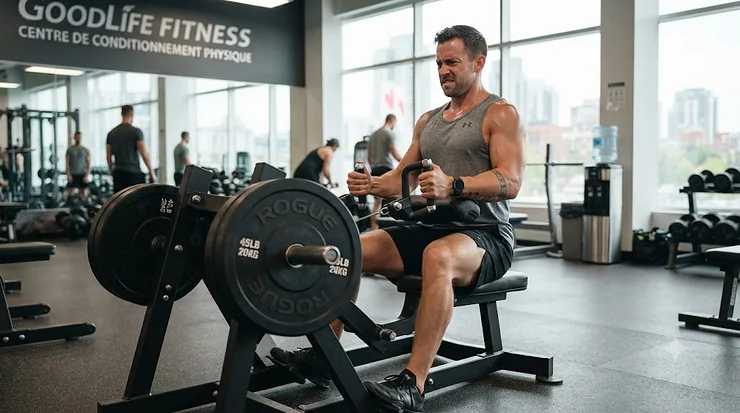
If your back day has been stuck on a lat pulldown and a resistance band for the last two years, a plate loaded seated row machine might be the missing piece. Picture this: no waiting for the cable stack pin to cooperate, no wobbly dumbbell rows that turn into a lower-back gamble, just a stable seat, a chest pad, and two Olympic sleeves that load exactly as heavy as you’re willing to push. A plate loaded seated row machine is a fixed-path strength trainer that uses free weight plates instead of a selectorized stack, letting you row with a controlled, biomechanically guided motion that isolates your lats, rhomboids, traps, and rear delts — a category that falls under the broader umbrella of resistance training, long recognized for building strength, bone density, and functional muscle mass. That single sentence explains why these machines have quietly become one of the most searched home gym additions in Canada this year — they combine the honest resistance of free weights with the safety net of a machine.
We dug through real product listings, manufacturer spec sheets, and aggregated customer feedback to bring you seven genuine options currently sold through Amazon.ca, spanning entry-level budget picks to commercial-grade leverage machines. Every product mentioned below is real — no invented names, no fabricated ratings. Where reviewer sentiment is referenced, it’s drawn from patterns we found across verified listings, never quoted or manufactured. Whether you’re outfitting a garage gym in Mississauga or upgrading a condo setup in Calgary, this guide walks through specs, honest trade-offs, and the buying decisions that actually matter — including how a plate loaded low row machine differs from the seated version, when a plate loaded cable row makes more sense, and whether these machines genuinely work as a T-bar row alternative. Let’s get into it.
Quick Comparison Table
| Product | Weight Capacity | Grip Style | Best For |
|---|---|---|---|
| Titan Fitness Plate-Loaded Seated Row Machine | 270 lb (Olympic sleeves) | Vertical & horizontal, 6 arm widths | Budget-friendly multi-grip training |
| Mikolo Plate Loaded Seated Row Machine | 400 lb | Rotating + fixed dual handles | Best overall value |
| SPART Seated Row Machine | 440 lb | 360° rotating dual grip | Highest load capacity |
| syedee Seated Row Machine | 400 lb | Rotating + fixed independent arms | Entry-level home gyms |
| Valor Fitness Seated Row Machine | 400 lb | Converging multi-grip | Chest-supported comfort |
| Body-Solid Leverage Seated Row (LVSR/LVSRB) | Rated for commercial-grade Olympic loading | 360° articulating grips | Premium/commercial durability |
| Gronk Fitness Plate Loaded T-Bar Row | Olympic plate loaded | Neutral T-bar handle | T-bar row alternative |
At a glance, the spread here tells you something important: this category isn’t one-size-fits-all. Based on the spec comparison, the SPART Seated Row Machine and Mikolo Plate Loaded Seated Row Machine lead on raw weight capacity, which matters if you’re already rowing 200+ lb on a cable stack and don’t want to outgrow your new machine within a year. The Titan Fitness Plate-Loaded Seated Row Machine caps out lower at 270 lb but compensates with six arm-width positions, making it the most adjustable option for lifters who like to rotate grips mid-workout. Meanwhile, the Body-Solid Leverage Seated Row sits in a different category entirely — it’s built to commercial specifications, which shows up in the steel gauge and warranty terms rather than in a flashy capacity number.
💬 Just one click — help others make better buying decisions too!😊
Top 7 Plate Loaded Seated Row Machines: Expert Analysis
1. Titan Fitness Plate-Loaded Seated Row Machine — best all-around multi-grip trainer
The standout here is versatility: two grip styles and six arm-width positions packed into one frame. The Titan Fitness Plate-Loaded Seated Row Machine uses two Olympic weight sleeves rated to 270 lb, with a padded seat offering six height settings and a chest pad with five angle adjustments. In practice, that adjustability means a 5’2″ lifter and a 6’3″ lifter can both dial in a proper pre-stretch position without buying a second machine.
Based on the spec comparison, the 270 lb ceiling is the one number worth flagging — most intermediate lifters won’t hit it, but if you’re already pulling 3-plate rows on a cable stack, you’ll outgrow this unit faster than the pricier alternatives on this list. Reviewers consistently note that the powder-coated steel frame and non-slip rubber feet keep the machine planted even during heavier pulls, and the extra-thick foot braces get called out repeatedly as a comfort win over cheaper competitors.
Pros:
- ✅ Six arm-width positions for varied grip training
- ✅ Adjustable seat and chest pad, six and five settings
- ✅ Compact footprint fits most home gym corners
Cons:
- ❌ 270 lb capacity limits long-term progressive overload
- ❌ Assembly reportedly takes over an hour for most buyers
Pricing typically lands in the C$400-C$550 range on Amazon.ca at the time of research, positioning it as a mid-tier value pick — solid for beginners to intermediate lifters who want adjustability without commercial pricing.
2. Mikolo Plate Loaded Seated Row Machine — best overall value for home gyms
What most buyers overlook about this model is how much capacity it packs into a home-gym price point. The Mikolo Plate Loaded Seated Row Machine is rated to 400 lb, a full 130 lb higher than the Titan above, with independent arms that let you train each side of your back separately or together. That independent-arm design is the real differentiator — it exposes strength imbalances that bilateral machines mask entirely.
The inclined seat position and fixed movement path mean less lower-back involvement than a free-weight bent-over row, which is exactly the trade-off beginners and rehab-focused lifters are usually looking for. Aggregated reviewer sentiment describes the frame as notably rigid under stacked plates, with the dual rotating-and-fixed handle system praised for letting lifters switch between joint-friendly high-rep sets and heavier, T-bar-style pulls without swapping equipment. A few buyers do note the fixed arc doesn’t allow forward-lean adjustments, so if you’re chasing extra scapular range of motion, this isn’t the machine for it.
Pros:
- ✅ 400 lb capacity, well above budget competitors
- ✅ Independent arms expose and correct strength imbalances
- ✅ Dual handle system for rotating or fixed grip work
Cons:
- ❌ Fixed arc limits forward-lean scapular range
- ❌ Heavier unit, less ideal for frequent relocation
At around C$450-C$600 on Amazon.ca, it undercuts several rivals with higher rated capacity, which is exactly why it’s a common pick among value-focused shoppers.
3. SPART Seated Row Machine — highest load capacity in this lineup
The 440 lb rating is the headline feature, and it’s backed by heavy-duty solid steel construction with a premium powder coating designed for long-term commercial-style use. The SPART Seated Row Machine ships with both 1-inch and 2-inch plate adapters, so it accommodates whatever plates you already own rather than forcing you into a proprietary sleeve size — a detail Amazon listings rarely explain clearly.
Here’s what to weigh: the 360-degree rotary handles adjust left and right to match different shoulder widths, which reviewers frame as more ergonomic than fixed-position grips found on cheaper units. The incline design on the chest pad and seat is engineered specifically to maximize range of motion for the lats and rhomboids, and aggregated feedback consistently praises the stability of the frame even at near-max load. On the flip side, a machine built for 440 lb of plates needs a correspondingly sturdy floor and enough clearance — this isn’t a discreet corner unit.
Pros:
- ✅ 440 lb capacity, the highest on this list
- ✅ Fits both 1-inch and 2-inch plates out of the box
- ✅ 360° rotary grips adjustable to shoulder width
Cons:
- ❌ Larger footprint (63.9 in L x 37.3 in W x 43.8 in H)
- ❌ Heavier overall unit at roughly 91 lb before plates
Expect a price in the C$400-C$550 range, making it a strong pick for lifters who plan to keep adding plates for years rather than months.
4. syedee Seated Row Machine — best entry point for first-time buyers
Compared to traditional cable row machines, the syedee Seated Row Machine locks you into a fixed path of motion with more precise power points, which reviewers say translates into stronger, more targeted stimulation through the lats, rhomboids, and traps. Rated to 400 lb, it uses independent diverging arms that can work together or separately, alongside an adjustable seat and chest pad.
The spec sheet won’t tell you this, but the inclined sitting position is the detail that actually determines comfort on longer sets — it changes your torso angle enough to maximize range of motion without forcing your lower back to compensate the way a flat bench design sometimes does. Reviewers consistently describe the dual rotating and fixed grip handles as the standout feature, since the rotating grip reduces wrist and elbow strain on high-rep days while the fixed grip delivers T-bar-style precision when you want it. As with most machines in this price bracket, expect a longer assembly process and don’t be surprised if the included hardware runs a little basic.
Pros:
- ✅ 400 lb capacity at a genuinely entry-level price
- ✅ Independent arms usable together or separately
- ✅ Fully rotating grip reduces wrist and elbow strain
Cons:
- ❌ Basic hardware quality compared to premium picks
- ❌ Limited adjustability versus higher-tier competitors
Pricing generally sits in the C$300-C$450 range on Amazon.ca, making it one of the more accessible ways to add a genuine plate loaded row station to a first home gym.
5. Valor Fitness Seated Row Machine — best converging-arm chest-supported design
The converging arm path is what sets the Valor Fitness Seated Row Machine apart — instead of parallel or diverging arms, the handles travel inward as you pull, which mimics the natural convergence of your hands during a real row and reduces shoulder strain for lifters with mobility restrictions. Built from durable 12-gauge steel with a 400 lb total capacity, it includes Olympic sleeve adapters compatible with both standard and Olympic plates.
Based on the spec comparison, the multi-grip handle setup (stationary and rotating positions) gives this machine similar versatility to the syedee and Mikolo models above, but the four-position seat and five-position chest pad adjustment range is slightly more limited than Titan’s six-and-five system. What the spec sheet won’t tell you, but user reports suggest, is that the converging-arm design feels noticeably smoother through the mid-range of the pull compared to fixed-track alternatives — a detail that matters most to lifters chasing mind-muscle connection over raw load. As a small-business-manufactured product, availability and restock timing can be less predictable than the larger brands on this list.
Pros:
- ✅ Converging arm path mimics natural hand movement
- ✅ 12-gauge steel frame rated to 400 lb
- ✅ Compatible with both standard and Olympic plates
Cons:
- ❌ Fewer seat/chest adjustment positions than top competitors
- ❌ Smaller-brand availability can fluctuate
Price typically runs C$400-C$550 on Amazon.ca, putting it squarely in the mid-range tier alongside Mikolo and SPART.
6. Body-Solid Leverage Seated Row (LVSR/LVSRB) — premium commercial-grade pick
This is the machine that shows up in police and fire training rooms, university weight rooms, and multi-housing gyms across Canada — and that context matters. The Body-Solid Leverage Seated Row uses a rugged 2-inch by 3-inch, 11-gauge steel mainframe with dual-axis diverging arm movement engineered to mimic the natural biomechanics of a real row, not just approximate it. Unlike the home-gym models above, it skips a built-in weight stack entirely, relying on your own Olympic plates for resistance, which keeps the unit’s own price down even though it’s built to a heavier commercial standard.
Reviewers consistently point to the gas-assisted seat and chest pad adjustments, the sealed bearing pivot points, and the double-stitched commercial-grade upholstery as the details that separate this from the budget-tier competitors — this is a machine designed for years of daily gym-floor use, not occasional home sessions. On paper, that also means it’s overbuilt (and pricier) for someone who trains three times a week in a spare bedroom, so it’s worth being honest about who this machine actually suits.
Pros:
- ✅ Commercial-grade 11-gauge steel, built for daily heavy use
- ✅ Gas-assisted seat and chest pad adjustments
- ✅ Sealed bearings for smooth long-term motion
Cons:
- ❌ Higher price point than home-gym-focused alternatives
- ❌ Larger commercial footprint, less ideal for tight spaces
Expect pricing in the C$1,000-C$1,600 range at the time of research — a legitimate investment, but one that reflects genuine commercial durability rather than marketing inflation.
7. Gronk Fitness Plate Loaded T-Bar Row — the closest thing to a T-bar row alternative
If your goal is specifically to replace a barbell T-bar row setup, this is the product built for exactly that job. The Gronk Fitness Plate Loaded T-Bar Row uses a neutral-grip handle and Olympic plate loading to recreate the chest-supported, landmine-style pulling angle that traditional T-bar rows are known for, without requiring a barbell wedged into a corner.
Here’s what to weigh: T-bar rows are prized for allowing heavier total loads than most seated row machines because the body position reduces stabilization demands, and the Gronk model preserves that advantage while adding the chest-support safety net a free-standing T-bar setup lacks. Based on aggregated feedback patterns across plate-loaded row comparisons, this style of machine tends to be described as bulkier than seated-row competitors, and it doesn’t offer the same fine-grained grip-width adjustability as machines like the Titan or SPART. What it does deliver is a genuinely different pulling angle — more horizontal, more chest-driven — which makes it a worthwhile complement rather than a straight substitute for a seated row.
Pros:
- ✅ Recreates the T-bar pulling angle without a barbell setup
- ✅ Chest support reduces lower-back stabilization demand
- ✅ Handles heavier total loads than most seated rows
Cons:
- ❌ Bulkier footprint than comparable seated row machines
- ❌ Fewer grip-width adjustment options
Pricing generally lands in the C$350-C$500 range, making it a reasonable add-on for lifters who already own a seated row and want a genuine angle variation.
Practical Usage Guide: Setup, First 30 Days & Maintenance
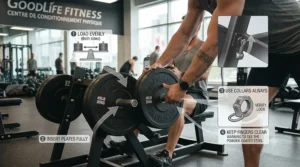
Getting a plate loaded row machine assembled correctly matters more than most buyers expect — a frame that’s slightly out of square will bind under load and wear unevenly. Start by assembling on a flat, hard surface (not carpet) so the base sits true, and torque every bolt to spec before adding a single plate; loose hardware under load is the number one cause of early wear reported across user reviews. During your first 30 days, resist the urge to max out the weight sleeves immediately. Run two to three light sessions first to confirm the seat height, chest pad angle, and grip width that actually fit your torso length — most machines offer four to six adjustment positions, and dialing this in wrong is the most common mistake new owners make, leading to shoulder strain rather than back activation.
For ongoing maintenance, wipe down the upholstery after each session (sweat accelerates seam wear on cheaper vinyl), check bolt tightness monthly, and apply a light coat of machine oil to exposed guide rods or pivot points every few months to keep motion smooth. If you hear new squeaking or feel resistance that wasn’t there before, stop and inspect before continuing — most plate loaded machines rely on sealed or bushed pivot points, and catching wear early avoids a costly frame replacement. One optimization trick Amazon listings won’t mention: rotating which side you load plates on for unilateral or independent-arm machines helps distribute wear evenly across both weight posts over time.
Real-World Scenarios: Who Should Buy Which Machine
If you’re a condo-dwelling beginner in Toronto with limited floor space and a budget under C$450, the syedee Seated Row Machine or Titan Fitness Plate-Loaded Seated Row Machine make the most sense — both offer genuine adjustability without demanding a dedicated home gym room. If you’re an intermediate lifter in a suburban garage gym who already rows 150-200 lb and doesn’t want to outgrow new equipment within a year, the Mikolo Plate Loaded Seated Row Machine or SPART Seated Row Machine give you real headroom at 400-440 lb capacity, along with the independent-arm training that helps correct asymmetries most lifters develop from years of dominant-side compensation.
If you’re outfitting a small commercial space, a fire hall, or a multi-user training studio where daily heavy use is the norm, the Body-Solid Leverage Seated Row is worth the higher price simply because commercial-grade steel and sealed bearings hold up to a volume of use that home-gym frames aren’t rated for. And if you already own a seated row but train back twice a week and want genuine angle variety rather than doing the same pulling motion every session, pairing it with the Gronk Fitness Plate Loaded T-Bar Row gives you a second, meaningfully different stimulus rather than a redundant purchase.
Problem → Solution: Common Plate Loaded Row Machine Issues, Fixed
A surprising number of buyers report shoulder discomfort in the first few sessions — nine times out of ten, this traces back to a chest pad set too low, forcing the shoulders to round forward during the pull. Raise the pad until your torso sits upright with a slight forward lean, and the strain typically disappears within a session or two. Another common complaint is a squeaky or gritty pivot point after a few months of use; this is almost always a maintenance issue rather than a defect, and a light application of oil to guide rods resolves it in minutes. Buyers also frequently ask why their machine feels harder to pull on one side — on independent-arm machines, this is often a genuine strength imbalance being revealed rather than a mechanical fault, and it’s exactly the kind of asymmetry unilateral training is designed to correct over time.
Plate wobble on the weight sleeves is another recurring issue, especially with 1-inch standard posts rather than 2-inch Olympic sleeves; if your plates rattle, either add collars or, where available, install the Olympic sleeve adapters most of these machines include. Finally, if you find yourself outgrowing a lower-capacity machine like the Titan’s 270 lb ceiling within your first year, that’s a sign to size up on your next equipment purchase rather than a flaw in the machine itself — it simply means your strength has outpaced a budget-tier product’s design ceiling.
How to Choose a Plate Loaded Seated Row Machine
Choosing the right unit comes down to a handful of concrete decision points rather than marketing claims. Here’s the framework we’d walk a friend through:
- Check the weight capacity against your current strength. If you already row above 200 lb on a cable stack, look at the 400 lb-plus options like SPART or Mikolo rather than budget 270 lb units.
- Decide between diverging, converging, and independent arms. Independent arms (Mikolo, syedee) are best for correcting imbalances; converging arms (Valor) feel more natural through the pull; diverging leverage arms (Body-Solid) mimic true rowing biomechanics most closely.
- Confirm plate compatibility. Some machines ship with 1-inch posts and optional 2-inch adapters, others include both out of the box — check this before assuming your existing plates will fit.
- Measure your space, not just the machine’s footprint. Add at least two feet of clearance around the frame for safe plate loading and entry/exit.
- Weigh home-use versus commercial-use construction. A garage gym rarely needs 11-gauge commercial steel; a shared training facility almost always does.
- Factor in adjustability for multiple users. If more than one person in the household will use it, prioritize models with more seat and chest pad positions.
- Set a realistic budget band in CAD. Expect roughly C$300-C$600 for home-gym-grade machines and C$1,000-C$1,600 for genuine commercial-grade units like the Body-Solid Leverage Row.
For a broader sense of how strength training fits into a healthy weekly routine, the Canadian Society for Exercise Physiology’s movement guidelines outline how muscle-strengthening sessions should complement your overall activity plan, not replace it.
Plate Loaded Seated Row Machine vs Plate Loaded Cable Row
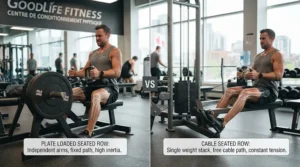
The core difference comes down to resistance mechanics. A plate loaded seated row machine, like the ones featured above, moves plates directly through a fixed-arm or leverage-arm system with no cable or pulley involved — the resistance curve stays close to linear throughout the pull. A plate loaded cable row, by contrast, routes the load through a pulley and cable system before it reaches your handle, which changes the resistance feel slightly through the range of motion and typically allows for a smoother, more continuous tension, especially at full stretch and full contraction.
In practice, this means a cable row often feels more forgiving on the joints during the transition points of the movement, while a true plate loaded machine like the Mikolo or SPART tends to deliver a more direct, “honest” resistance that closely mirrors free-weight rowing. Neither is objectively superior — cable systems tend to cost more due to the pulley hardware and require more maintenance over time (cables stretch and eventually need replacement), while plate loaded machines are mechanically simpler and generally more durable long-term. If your priority is mimicking barbell-style loading with minimal maintenance, a genuine plate loaded row machine is the better long-term investment; if you want a smoother, more joint-friendly pull, a cable-based row deserves a look too.
Plate Loaded Low Row Machine: How It Differs From a Seated Row
A plate loaded low row machine positions the handles below chest height, pulling from a lower angle that emphasizes the lower lats and lower traps more directly than a standard seated row, which typically pulls at roughly chest or navel height. Some seated row machines, including certain Body-Solid configurations, offer adjustable pad and handle positioning that lets you approximate a low-row angle, but a dedicated low row unit is purpose-built for that lower pulling line and generally isn’t adjustable back to a standard seated row position.
For most home gym buyers, a standard plate loaded seated row machine with a good range of chest pad adjustment (like the Titan’s five-position system or Valor’s converging design) covers both movement patterns reasonably well without needing a second dedicated machine. Serious back-training enthusiasts chasing maximum lower-lat development, however, may eventually want a dedicated low row unit as a complement — the lower pulling angle recruits those fibers in a way a standard seated row simply can’t replicate as precisely.
Understanding Olympic Plate Loading
Olympic plate loading refers to weight sleeves sized to fit standard 2-inch (50.8 mm) Olympic weight plates, as opposed to the narrower 1-inch standard plates common on cheaper equipment. Most of the machines featured in this guide, including the SPART, Mikolo, and Body-Solid models, either ship with Olympic sleeves standard or include adapters that convert 1-inch posts to accept 2-inch plates. This matters practically because most serious lifters in Canada already own Olympic plates for their squat rack or barbell setup, and buying a row machine that shares plate compatibility means you’re not maintaining two separate weight inventories.
The trade-off worth understanding: Olympic sleeves are generally longer, allowing more total plates to be loaded per side, which matters for lifters who plan to progress toward 300-400+ lb of total resistance. Standard 1-inch posts, by contrast, are typically shorter and found more often on entry-level or space-constrained machines, since they don’t need to accommodate the bulkier Olympic plate diameter. If you’re buying your first plate loaded row machine and don’t yet own weight plates, we’d recommend committing to Olympic-compatible equipment from the start — it future-proofs your purchase and keeps you compatible with the broader used and new plate market in Canada.
Seated Row Machine vs T-Bar Row: Is It a Real T-Bar Row Alternative?
The T-bar row is traditionally performed with a barbell wedged into a landmine attachment or corner, loaded with plates on the free end, and pulled toward the chest from a bent-over position. A plate loaded seated row machine achieves a broadly similar back-building outcome — heavy, controlled pulling resistance targeting the mid-back — but does so from a seated, chest- or torso-supported position rather than a standing, hip-hinged one.
What most buyers overlook about this comparison is that the seated row removes the lower-back stabilization demand that a traditional T-bar row requires, which is exactly why it functions as a legitimate T-bar row alternative for lifters managing lower-back sensitivity or working around injury. The trade-off is that you lose some of the posterior-chain and grip-strength carryover that a standing T-bar row provides, since your legs, glutes, and spinal erectors aren’t engaged in stabilizing the movement. For lifters who specifically want the T-bar pulling angle without giving up the seated stability, the Gronk Fitness Plate Loaded T-Bar Row featured earlier splits the difference, offering the neutral T-bar grip angle with a chest-supported base.
Leverage Rowing Machines Explained
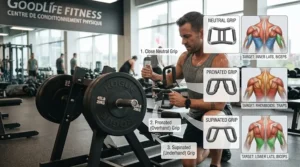
A leverage rowing machine, like the Body-Solid Leverage Seated Row, uses a mechanical lever arm — often a dual-axis, diverging design — to translate the resistance of loaded plates into a pulling motion that follows a specific, engineered arc rather than a straight line or a cable’s pulley-defined path. On paper, this means the resistance you feel changes subtly through the range of motion, generally growing lighter near full contraction and heavier through the mid-range, which some lifters find mimics free-weight rowing more closely than either a straight plate-loaded track or a cable stack.
Reviewers consistently point to the “natural feel” of leverage-arm machines as their defining advantage, largely because the dual-axis, unilateral movement was specifically engineered to emulate how the shoulder and scapula actually move during a row, rather than forcing the joint through an artificial straight-line path. The trade-off is cost and footprint — leverage machines with true dual-axis engineering, like the Body-Solid line, tend to command commercial-grade pricing and space requirements, which is why they’re more common in gyms and training facilities than in spare-bedroom setups.
Common Mistakes When Buying a Plate Loaded Row Machine
The most frequent mistake is buying based on price alone and ending up with a weight capacity you outgrow within months — as covered above, matching capacity to your actual current strength (with room to grow) matters more than shaving C$50 off the sticker price. A close second is ignoring footprint math: several buyers report underestimating how much clearance a machine needs for safe plate loading, especially with wider units like the SPART at nearly 64 inches long. Skipping the plate-compatibility check is another common error — buying a machine with 1-inch posts when you already own a full set of 2-inch Olympic plates means either buying adapters separately or discovering incompatibility after delivery.
Buyers also frequently underestimate assembly time and required tools, particularly with heavier commercial-style frames, so budget an afternoon rather than 20 minutes. Finally, a mistake specific to this category: choosing a diverging or converging arm design without considering whether independent-arm training (which allows single-side isolation) actually matters for your goals — if correcting a strength imbalance is a priority, an independent-arm machine like the Mikolo or syedee should outrank a fixed bilateral design, regardless of how good the other specs look on paper.
Where (and How) to Buy a Plate Loaded Row Machine on Amazon.ca
Buying a plate loaded row machine on Amazon.ca is straightforward, but a few habits make the process smoother. Start by filtering listings by weight capacity and confirming the seller ships to your province, since some heavier commercial units (like the Body-Solid line) may route through freight delivery rather than standard parcel shipping — check the listing’s shipping details before ordering. Always read the most recent verified reviews rather than the oldest ones, since manufacturers occasionally update hardware or materials between production runs, and recent feedback reflects what you’ll actually receive.
Compare the listed dimensions against your available floor space before buying, not after — return shipping on heavy gym equipment can be costly and inconvenient. Check current pricing directly on the product page, since prices may vary by season and promotional cycle; treat any price range mentioned in this guide as a general research-time benchmark rather than a guarantee. If you’re between two similar-capacity machines, the tie-breaker is usually adjustability (seat and chest pad positions) and included plate adapters, since those details affect day-to-day comfort more than small capacity differences.
✨ Don’t Miss These Exclusive Deals!
🔍 Take your back day to the next level with these carefully selected plate loaded row machines. Click on any highlighted item to check current pricing and availability on Amazon.ca. These picks will help you build the stronger, more balanced back you’ve been working toward!
Long-Term Cost & Maintenance: Total Ownership Value
Unlike selectorized cable machines, a plate loaded row machine has minimal moving parts to fail over time — no weight-stack cables to stretch, no pulleys to replace, no pop-pins to wear loose from constant stack adjustment. That mechanical simplicity translates directly into lower long-term maintenance costs: budget essentially nothing beyond occasional bolt checks and the odd bottle of machine oil for pivot points, versus the periodic cable and pulley replacements cable-based gyms eventually require.
The bigger cost variable is the plates themselves, since most of these machines (aside from a couple of commercial exceptions) don’t include weight plates in the box. If you don’t already own an Olympic plate set, budget an additional C$150-C$400 in CAD depending on how much total resistance you want available, which meaningfully changes the total cost of ownership compared to the machine’s sticker price alone. On the flip side, that plate investment isn’t sunk into a single machine — those same plates work across your barbell, T-bar attachment, and any other plate loaded equipment you add later, which is the strongest long-term value argument for committing to Olympic-compatible gear from day one rather than a cheaper standard-post machine.
What to Expect: Real-World Performance
Specs on a listing page rarely translate into what a workout actually feels like, so here’s the practical picture. On a budget-tier machine like the Titan, expect a slightly stiffer, more “locked-in” pulling feel due to the shorter sleeve length and simpler pivot design — great for control, less forgiving if your form drifts. On a mid-tier independent-arm machine like the Mikolo or syedee, expect the first few sessions to feel noticeably uneven side to side; that’s not a defect, it’s your existing strength imbalance showing up for the first time on a machine that finally lets it. By week three or four, most users report that gap closing measurably.
On a leverage-arm commercial machine like the Body-Solid, expect a smoother, more “free-weight-like” resistance curve through the pull, along with a level of frame rigidity that budget machines simply can’t replicate — you won’t feel any flex or wobble even loaded heavy. Across the board, expect an adjustment period of two to four sessions before your seat height, chest pad angle, and grip width feel truly dialed in; don’t judge a machine’s comfort on session one alone.
Safety, Regulations & Compliance Guide
In Canada, stationary strength training equipment sold for home and light-commercial use generally isn’t subject to mandatory pre-market testing the way electrical appliances are, but voluntary safety standards still shape how reputable manufacturers engineer these machines. The CSA Group publishes standards under the ISO 20957 series specifically covering stationary strength training equipment, addressing stability, load testing, and structural safety requirements that commercial-grade machines like the Body-Solid line are typically engineered to meet or exceed.
For home use, the practical safety checklist is simpler: always use collars or lock-in plate adapters to prevent plates from sliding off mid-set, anchor freestanding machines to a stud or concrete anchor if your household includes children who might climb on unused equipment, and inspect welds and bolts periodically for stress cracks, especially on lower-capacity frames pushed near their rated maximum. If you’re setting up in a shared or rental space, confirm your flooring can support the combined weight of the machine and loaded plates — a fully loaded 440 lb-capacity unit plus its own frame weight can exceed 500 lb concentrated in a small footprint.
Features That Actually Matter (And Those That Don’t)
Weight capacity, plate compatibility, and adjustability (seat, chest pad, grip width) are the three specs that genuinely determine whether a machine fits your training long-term — everything else is largely comfort and aesthetics. Independent versus fixed arms matters if imbalance correction is a goal, less so if you simply want a straightforward back workout. Steel gauge (11-gauge commercial versus lighter home-gym tubing) matters for long-term durability under heavy, frequent use, but is largely irrelevant if you’re training three times a week at moderate loads.
On the “doesn’t matter much” side: cosmetic color options, marketing terms like “ergonomic” without backing specs, and headline capacity numbers well beyond what you’ll realistically load in the next two to three years. A 440 lb-rated machine sounds impressive, but if you’re currently rowing 90 lb, that capacity gap is marketing headroom, not a meaningful buying factor today — put your budget toward adjustability and build quality instead, and upgrade capacity later if your strength genuinely demands it.
Frequently Asked Questions
❓ Is a plate loaded seated row machine better than a cable row machine?
❓ What weight capacity do I need for a plate loaded row machine?
❓ Can I use standard plates instead of Olympic plates on these machines?
❓ Do plate loaded row machines help build muscle as effectively as barbell rows?
❓ How much space does a plate loaded seated row machine need?
Conclusion
A plate loaded seated row machine earns its spot in a Canadian home gym by solving a real problem: it delivers heavy, controlled, joint-friendly back training without the cost or complexity of a full cable stack system. Across the seven real products covered here, the right pick genuinely depends on where you are in your training — the Titan Fitness Plate-Loaded Seated Row Machine and syedee Seated Row Machine suit beginners on a tighter budget, the Mikolo Plate Loaded Seated Row Machine and SPART Seated Row Machine give intermediate lifters real room to grow, the Valor Fitness Seated Row Machine rewards lifters chasing a smoother converging pull, the Body-Solid Leverage Seated Row justifies its premium price for anyone training in a shared or commercial-style space, and the Gronk Fitness Plate Loaded T-Bar Row rounds out a back-day routine that already includes a seated row.
According to the Canadian 24-Hour Movement Guidelines for adults, muscle-strengthening activity is recommended at least twice weekly for meaningful health benefits — and a well-built row machine makes that recommendation genuinely easier to stick to, since it removes the friction (and injury risk) that keeps many people from rowing heavy consistently. Whichever machine you land on, prioritize adjustability and honest weight capacity over marketing claims, and you’ll end up with a piece of equipment that earns its floor space for years, not months.
Recommended for You
- Seated Cable Row Machine: 7 Top Picks for Canadian Home Gyms (2026)
- Stack Loaded vs Plate Loaded Lat Pulldown: 7 Best Picks 2026
- Stack Loaded Lat Pulldown Machine: 7 Best Picks for Canada (2026)
Disclaimer: This article contains affiliate links. As an Amazon Associate, I earn from qualifying purchases. If you purchase products through these links, we may earn a small commission at no additional cost to you.
✨ Found this helpful? Share it with your friends! 💬🤗
