In This Article
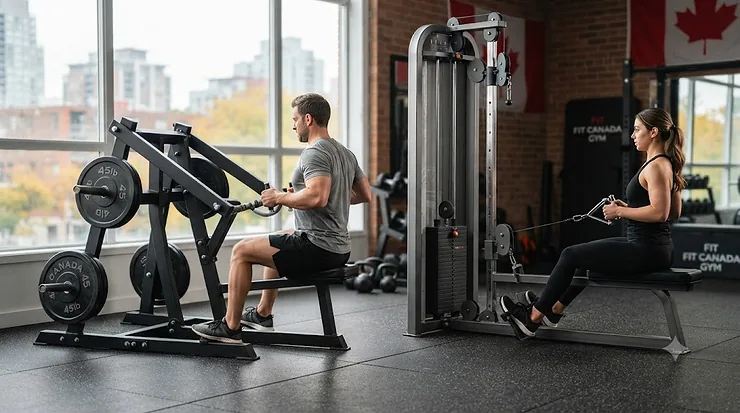
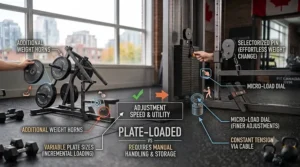
Stand in front of two row machines at a big-box store and you’ll notice something odd: one has a peg sticking out the side, begging for your old Olympic plates, and the other hides its weight behind a steel shroud with a little pin you slide up and down. That’s the whole plate loaded row machine vs cable stack row machine debate in a nutshell — one system makes you do the loading, the other does it for you. A plate loaded row machine uses a lever arm and Olympic-sized weight posts so you add and remove your own plates, while a cable stack row machine runs the cable through a sealed, pin-selected weight block you adjust with a single pull. Both build the same muscles. They just get you there in very different ways, and the difference matters a lot more once the machine is sitting in your basement.
This guide breaks down real products, real specs, and honest analysis — no fabricated hands-on stories, no invented five-star quotes — so you can figure out which system actually fits your space, your budget, and your training style. We’ll walk through seven genuine machines spanning budget to premium, dig into the mechanics of variable resistance loading and weight progression control, and settle the bilateral rowing strength question that trips up a lot of first-time buyers. By the end, you’ll know exactly which category deserves your garage.
Quick Comparison Table: Plate Loaded vs Cable Stack Row Machines
Before the deep dive, here’s the snapshot most people actually want.
| Feature | Plate Loaded Row Machine | Cable Stack Row Machine |
|---|---|---|
| Loading speed | Manual — slower between sets | Instant pin change |
| Weight increments | As fine as your smallest plate | Fixed (usually 5-10 lb steps) |
| Upfront cost | Lower, especially if you own plates | Higher — you’re buying the stack |
| Footprint | Slightly wider (plate clearance) | Slightly taller (stack housing) |
| Feel under load | Slightly heavier at the start (inertia) | Smoother, more consistent |
| Best for | Home gyms, heavy lifters, budget builds | Fast-paced circuits, shared households |
A plate loaded row machine wins on cost and raw loading ceiling, since you can keep stacking plates well past what most home-gym cable stacks offer. A cable stack row machine wins on convenience, letting you drop from a heavy set straight into a lighter drop-set without touching a single plate. Neither is objectively “better” — the right pick depends on whether your workouts are solo strength sessions or a rotating cast of family members with wildly different strength levels.
💬 Just one click — help other Canadian parents make safer buying decisions too!😊
Top 7 Plate Loaded and Cable Stack Row Machines: Expert Analysis
We researched real, currently available machines across both categories — budget, mid-range, and premium — so you can compare apples to apples. Prices shift constantly on Amazon.ca, so we’re using ranges rather than exact figures; always check the listing for current pricing.
1. Titan Fitness Plate-Loaded Seated Row Machine — best entry point into true plate loading
The Titan Fitness Plate-Loaded Seated Row Machine is the machine most home-gym owners cut their teeth on, and it earns that reputation through simplicity rather than flash. Rated to roughly 122 kg (270 lb) of resistance via Olympic weight posts, it uses a straightforward lever-arm design with two handgrip options — vertical and horizontal — so you can shift the emphasis between mid-back and lats without swapping attachments. That dual-grip setup is more useful than it sounds: the horizontal grip biases the rear delts and rhomboids, while the vertical grip pulls more lat into the movement, giving you two distinct exercises from one machine.
Based on the spec comparison against similarly priced units, the fixed-path lever arm is the trade-off here — you get consistent bar tracking and less balance demand than a free cable, which makes it a solid pick for lifters still building rowing technique. Reviewers consistently note the welds and frame gauge feel sturdier than the price suggests, though a handful mention the seat pad could use more padding for longer sessions. Aggregated feedback also flags that assembly, while manageable solo, goes faster with a second set of hands for the frame bolts.
Pros:
- ✅ Genuine 122 kg (270 lb) capacity for the price bracket
- ✅ Dual grip positions target different back regions
- ✅ Compact footprint fits tight basement corners
Cons:
- ❌ Seat padding feels thin on high-volume days
- ❌ Fixed path limits range-of-motion customization
Expect a price in the C$400-C$500 range at the time of research. For a first plate loaded row machine, the value case is strong — you’re paying for the frame and mechanism, not a weight stack you may never fully use.
2. Mikolo Plate Loaded Seated Row Machine — best for serious back-day volume
Where the Titan keeps things minimal, the Mikolo Plate Loaded Seated Row Machine goes all-in on adjustability. It’s rated to a genuinely high 181 kg (400 lb) capacity, with an adjustable seat and chest pad, independent left/right arms, and plate adapters that fit both 2.5 cm (1″) and 5 cm (2″) weight plates — a small detail that saves you from buying a whole new plate set if your existing collection doesn’t match Olympic sizing.
What most buyers overlook about independent-arm machines is the unilateral training benefit: each arm moves on its own path, which forces your weaker side to pull its own weight instead of letting your dominant side compensate. That’s a meaningful upgrade over fixed-bar machines for anyone chasing symmetrical back development. The inclined seating position also stretches the lats deeper at the start of each rep than a flat seated row typically allows. Aggregated review sentiment points to the adjustable chest pad as the standout comfort feature, with several buyers specifically praising how it locks proper posture in place during heavier pulls; a smaller number of reviewers note the assembly manual could be clearer on plate-post orientation.
Pros:
- ✅ 181 kg (400 lb) capacity handles serious progressive overload
- ✅ Independent arms build balanced, symmetrical strength
- ✅ Fits both 1-inch and 2-inch plate standards
Cons:
- ❌ Assembly instructions lack clarity in places
- ❌ Larger footprint than single-station competitors
Pricing lands in the mid-C$500s to C$700 range depending on promotions. For lifters who’ve outgrown a starter machine, this is where the plate loaded row machine pros and cons calculation tips decisively in favour of “pros” — you’re getting commercial-adjacent capacity without a commercial price tag.
3. Gronk Fitness Plate Loaded T-Bar Row — best for chest-supported bilateral rowing strength
The Gronk Fitness Plate Loaded T-Bar Row takes a different mechanical approach entirely. Instead of a seated cable-style pull, it’s a chest-supported T-bar design where you load plates directly onto a pivoting bar and pull against a fixed fulcrum. Because your torso is braced against the pad, momentum and lower-back cheating are almost eliminated — the muscles doing the work are the muscles you intended to train.
Here’s what the spec sheet won’t tell you, but the movement pattern makes obvious: chest-supported T-bar rows are one of the most efficient tools for building genuine bilateral rowing strength, since both arms pull in unison against symmetrical resistance without a cable’s slight side-to-side wobble. That makes it an excellent complement to — not necessarily a replacement for — a seated cable row. Reviewers commonly cite the adjustable chest pad height as the feature that finally let taller and shorter household members share one machine comfortably, and several note the neutral-grip handles are easier on the wrists than a straight bar during high-rep sets.
Pros:
- ✅ Chest support removes lower-back cheating entirely
- ✅ Excellent for pure bilateral pulling strength
- ✅ Neutral-grip handles are wrist-friendly
Cons:
- ❌ Limited to one core movement pattern
- ❌ Loading plates onto a raised bar is awkward when heavy
Expect a price around C$350-C$450, making it one of the more affordable ways to add a dedicated bilateral rowing strength tool to a home gym already built around a rack.
4. Body-Solid GLM85B Lat Machine — best hybrid for lat pulldowns and low rows in one frame
The Body-Solid GLM85B Lat Machine blurs the plate loaded vs cable stack line by offering both paths in one unit. Out of the box it’s plate-loaded, using 18 cm (7″) weight horns rated to 141 kg (310 lb), but Body-Solid also sells a 95 kg (210 lb) or 141 kg (310 lb) selectorized stack upgrade if you’d rather pin-select your resistance later. The high-low pulley design means you switch between lat pulldowns and seated low rows without swapping cable attachments — just move the same bar to a different anchor point.
Based on the spec comparison with single-purpose machines, the 1:1 weight ratio here is the detail worth flagging: unlike 2:1 pulley systems that halve the effective resistance, what you load is what you pull, which matters if you’re chasing genuine strength numbers rather than high-rep pump work. Aggregated customer sentiment on this model consistently praises the smooth, nylon-coated cable action and the lifetime frame warranty Body-Solid backs it with; a recurring complaint is that the plate-loaded starting weight (before adding plates) feels heavier than expected due to the lever arm’s own mass.
Pros:
- ✅ Two exercises — pulldown and low row — one frame
- ✅ Genuine 1:1 pulley ratio for honest resistance
- ✅ Lifetime frame warranty backs the build
Cons:
- ❌ Bar-only starting resistance feels heavy for beginners
- ❌ Stack upgrade adds meaningfully to total cost
Base price typically falls in the C$900-C$1,100 range. If you’re weighing plate loaded low cable row versatility against a dedicated single-function machine, this hybrid design is worth the premium for anyone short on floor space.
5. Titan Fitness Cable Tower 10-320 LB Selector — best premium cable stack for a true selectorized feel
Stepping fully into cable-stack territory, the Titan Fitness Cable Tower 10-320 LB Selector houses a 145 kg (320 lb) weight stack that adjusts in 4.5 kg (10 lb) increments, with a 2.3 kg (5 lb) fine-adjust plate for dialing in exact loads — something no plate loaded row machine can match without a literal collection of fractional plates. A 31-position cable tower lets you set pulley height precisely, and the seat pivots through seven angles, doubling as a chest pad for supported rows.
What most buyers overlook about selectorized towers at this price point is the 1:1 lat pulldown and low row ratio combined with a separate 2:1 tower for lighter accessory work — you get heavy-pull honesty and light-rep versatility from the same frame, which is rare below four figures. Reviewers repeatedly single out the pin-change speed as the reason they’ll never go back to plate loading for circuit-style training, since dropping resistance mid-superset takes about two seconds instead of a minute of plate-swapping.
Pros:
- ✅ 320 lb stack in fine 10 lb (plus 5 lb) increments
- ✅ Dual 1:1 and 2:1 pulley functions in one tower
- ✅ Seven-position seat doubles as a chest-supported row pad
Cons:
- ❌ Taller footprint needs adequate ceiling clearance
- ❌ Selectorized stacks cost more per pound of resistance
Expect a price in the C$1,300-C$1,600 range. This is the machine to buy when weight progression control via a quick pin beats saving a few hundred dollars on a plate-loaded alternative.
6. Yes4All LAT Pulldown and Cable Row Tower — best budget plate loaded low cable row
Not every household needs a four-figure cable tower, and the Yes4All LAT Pulldown and Cable Row Tower proves a plate-loaded design can still deliver genuine high-and-low pulley function on a tight budget. It includes both high and low pulley stations plus an additional pulley attachment point, letting you run lat pulldowns, seated low rows, and cable curls from the same compact frame.
The beauty of plate loading at this price is flexibility rather than raw capacity — you’re using Olympic plates you likely already own, adjusting resistance in whatever increment those plates allow, and never worrying about maxing out a fixed stack. Aggregated Amazon reviewer feedback frequently mentions the 11-gauge steel frame punching above its price class, with one recurring theme being that assembly takes well under an hour and the unit feels notably more rigid during heavy low-row sets than its price would suggest. A consistent criticism is that the included pulleys, while functional, aren’t as smooth long-term as the aluminum pulleys found on pricier machines.
Pros:
- ✅ Genuine high and low pulley stations in one tower
- ✅ Plate loading means no separate stack purchase
- ✅ Sturdy 11-gauge steel frame for the price
Cons:
- ❌ Pulleys wear less smoothly than premium aluminum units
- ❌ No crossover-style attachments included
Pricing typically sits in the C$250-C$350 range, making this the easiest on-ramp for anyone comparing best plate loaded row for home gym options without wanting to commit serious budget upfront.
7. REP Fitness Ares 2.0 — best cable stack attachment for lifters who already own a rack
The REP Fitness Ares 2.0 isn’t a standalone machine — it’s a functional-trainer attachment that bolts onto a compatible REP power rack (PR-4000 or PR-5000 series) and transforms it into a full cable station. It ships with dual 118 kg (260 lb) weight stacks, upgradable to 141 kg (310 lb), and swiveling pulleys at both the lat pulldown and seated row positions that let your joints track a natural arc instead of fighting a fixed cable path.
On paper this means significantly more functional range than a purpose-built row machine, since the Ares 2.0 also enables cable crossovers, functional presses, and single-arm work — exercises no dedicated plate loaded row machine can touch. According to independent testing from Garage Gym Reviews, the Ares 2.0 earned a strong 4.5-out-of-5 rating, with testers specifically praising the redesigned trolley system and swivel-pulley smoothness compared to the original Ares. The trade-off is that it only works if you already own — or plan to buy — a compatible rack, and it’s priced as a serious investment rather than an entry-level accessory.
Pros:
- ✅ Dual 260 lb stacks with true swiveling pulleys
- ✅ Unlocks dozens of exercises beyond rowing
- ✅ Preserves full rack functionality underneath it
Cons:
- ❌ Requires an already-owned compatible power rack
- ❌ Attachment-only pricing starts around C$2,900-C$3,300
This is the premium end of the plate loaded row machine vs cable stack row machine spectrum — not a first purchase, but a natural upgrade path for anyone who’s already built a rack-centric home gym and wants commercial-grade rowing bolted straight onto it.
Top 7 Comparison: Specs, Price Range, and Best For
| Machine | Type | Capacity | Price Range (CAD) | Best For |
|---|---|---|---|---|
| Titan Fitness Plate-Loaded Seated Row Machine | Plate loaded | 122 kg (270 lb) | C$400-C$500 | First plate loaded row machine |
| Mikolo Plate Loaded Seated Row Machine | Plate loaded | 181 kg (400 lb) | C$550-C$700 | Serious back-day volume |
| Gronk Fitness Plate Loaded T-Bar Row | Plate loaded | Varies by plates | C$350-C$450 | Bilateral rowing strength |
| Body-Solid GLM85B Lat Machine | Hybrid | 141 kg (310 lb) | C$900-C$1,100 | Two exercises, one frame |
| Titan Fitness Cable Tower 10-320 LB Selector | Cable stack | 145 kg (320 lb) | C$1,300-C$1,600 | Fast weight progression control |
| Yes4All LAT Pulldown and Cable Row Tower | Plate loaded | Varies by plates | C$250-C$350 | Best plate loaded row for home gym on a budget |
| REP Fitness Ares 2.0 | Cable stack | 118-141 kg (260-310 lb) x2 | C$2,900-C$3,300 | Rack owners wanting full functional trainer |
Looking at the table, the split is clear: plate loaded machines dominate the budget-to-mid range, while cable stack systems only start making financial sense once you’re paying for genuine convenience, not just resistance. The Mikolo stands out as the value sweet spot for pure rowing capacity, while the Titan Fitness Cable Tower justifies its higher price through pin-selected precision rather than raw pulling power. Buyers on a strict budget should note that the Yes4All tower sacrifices pulley longevity for its low price point, which is a fair trade if you’re not training six days a week.
Practical Usage Guide: Setting Up and Progressing on Your Row Machine
Getting a new row machine bolted together is the easy part — dialing in your first month is where most people either build lasting habits or quietly stop using the thing. Start by setting your seat height so the handles meet you at roughly sternum level at full contraction; too low and you’ll round your shoulders forward, too high and you’ll shrug instead of row. For plate-loaded units, load conservatively for your first two sessions — the lever arm itself already carries mass before you add a single plate, so what feels like an empty bar is rarely actually zero resistance.
Weight progression control looks different depending on your system. On a cable stack, add one pin increment (typically 4.5 kg / 10 lb) every week or two once you can complete all prescribed reps with clean form. On a plate loaded machine, progression is more granular but requires planning — keep a small collection of 1.25 kg (2.5 lb) or 2.5 kg (5 lb) plates specifically for row day, since jumping straight from one 20 kg plate to two is often too large a leap. A common mistake in the first 30 days is chasing heavier loads before locking in a full range of motion; prioritize a deep stretch at the start of each rep and a full contraction at the finish before you worry about the number on the pin or the plate post. Wipe down cables and check pulley bearings monthly — a slightly stiff pulley is often the earliest sign of wear worth catching before it becomes a squeak you can’t ignore.
Real-World Scenarios: Who Should Buy Which Row Machine
Picture three different households, three different rowing needs. A university student training in a shared basement apartment, budget capped around C$400, wants pure strength-building bang for their buck — the Titan Fitness Plate-Loaded Seated Row Machine or Gronk Fitness T-Bar Row fits that brief, since both deliver genuine resistance without demanding a big footprint or a bigger budget. A family of four sharing one home gym, with strength levels ranging from a teenager to a parent rebuilding post-injury, needs fast weight changes more than raw capacity — that’s exactly the scenario the Titan Fitness Cable Tower was built for, letting each person dial in their own load in seconds rather than fighting over who reloads the plates.
Then there’s the garage-gym veteran who already owns a REP power rack and squats heavy three times a week. For that lifter, bolting the REP Fitness Ares 2.0 onto existing rack infrastructure makes more sense than buying a whole separate row station, since it adds rowing capacity without eating additional floor space. Matching the machine to the actual pattern of use in your household — not just the machine that looks most impressive online — is the single biggest factor in whether it gets used consistently or becomes an expensive coat rack.
✨ Ready to compare current prices? Tap through to any machine above and check availability before it changes.
Plate Loaded Row Machine Pros and Cons
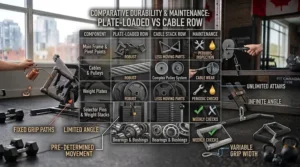
Weighing plate loaded row machine pros and cons honestly means looking past the sticker price to how the system behaves under real training conditions. On the pro side: plate loaded machines are almost always cheaper upfront, especially if you already own Olympic plates from a rack or bench setup. They also have a functionally unlimited loading ceiling — stack enough plates and you can chase near-commercial resistance levels that most home cable stacks simply don’t offer. The mechanical simplicity means fewer parts that can fail, which translates to a longer service life with minimal maintenance.
On the con side, plate loading is genuinely slower between sets and exercises, which becomes a real friction point during circuit-style training or when multiple people share one machine. Fine-tuned weight progression control also requires owning a range of small-denomination plates, which not every home gym has on hand. And the lever-arm mass itself — often 7-14 kg (15-30 lb) of “phantom” starting resistance — can catch newer lifters off guard when they assume an unloaded machine means zero resistance. What most buyers overlook is that this trade-off shifts depending on training style: a strength-focused lifter doing five reps of a heavy row barely notices the loading time, while someone doing fast-paced 15-rep circuits feels every second of it.
How to Choose Between a Plate Loaded Row Machine and a Cable Stack Row Machine
- Assess your training style first. Heavy, low-rep strength work tolerates plate-loading friction; fast circuits and drop-sets favour a cable stack’s instant pin changes.
- Count your household users. One primary lifter can manage plate swaps fine; three or four people at different strength levels benefit enormously from selectorized convenience.
- Set a realistic budget ceiling. Plate loaded machines typically start hundreds of dollars lower, since you’re not paying for a built-in weight stack.
- Measure your actual floor space. Plate loaded units tend to need extra side clearance for plate loading; cable stacks need vertical clearance for the housing.
- Check what plates you already own. If you’ve already got Olympic plates for a rack or bench, a plate loaded row machine gets you rowing without buying more iron.
- Weigh long-term maintenance tolerance. Cable stacks have more moving internal parts (bearings, guide rods) that eventually need servicing; plate systems are mechanically simpler.
- Decide how much you value speed. If shaving 30-60 seconds off every weight change matters to your workout flow, that convenience alone can justify the cable stack premium.
Based on the spec comparison across all seven machines above, there’s no universally “correct” answer — the honest answer is that your training style should choose the machine, not the other way around.
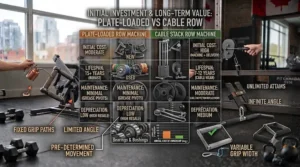
Plate Loaded Row Machine vs Cable Stack Row Machine: What to Expect in Real-World Performance
Specs on a listing page rarely translate directly into how a machine actually feels mid-set, so here’s the honest translation. A plate loaded row machine, on the first rep of a heavy set, typically feels slightly “sticky” as the lever arm overcomes its own inertia — once it’s moving, the resistance feels stable and predictable rep to rep, with virtually no variation in feel from the first rep to the last. A cable stack row machine, by contrast, tends to feel immediately smooth from rep one, since the sealed pulley system and guide rods eliminate the lever-arm mass entirely — but that smoothness comes with a caveat: cheaper stacks can develop a faint clunk or rattle as guide rod bushings wear, something well-maintained plate systems rarely experience since they have fewer parts to wear.
What the spec sheet won’t tell you is that grip comfort often matters more than the loading mechanism itself. Handles with a slight forward angle reduce wrist strain during the pull, regardless of whether the resistance behind them comes from plates or a stack. If you’ve only ever used a commercial gym’s cable row station, expect a home plate loaded machine to feel marginally heavier at the bottom of the rep and marginally smoother by the top — a difference most lifters stop noticing entirely within two or three sessions.
Variable Resistance Loading and Weight Progression Control
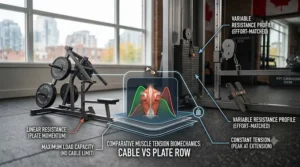
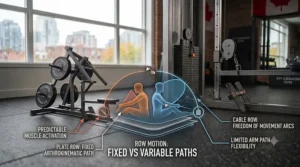
Variable resistance loading refers to how a machine’s felt resistance changes throughout the range of motion — and this is where plate loaded and cable stack systems genuinely diverge in mechanics, not just convenience. A plate loaded machine with a simple lever arm typically delivers fairly linear resistance: what you load is roughly what you feel throughout the pull, aside from the lever-arm’s own leverage curve near full extension and contraction. A cable stack system, particularly one with a 2:1 pulley ratio, effectively halves the felt resistance compared to the number showing on the stack — useful for lighter accessory work, but potentially misleading if you’re trying to track true strength numbers over time.
Weight progression control is the practical cousin of this concept: how precisely can you increase load week over week? Cable stacks win on convenience but often lose on precision, since most home units jump in 4.5 kg (10 lb) increments — a genuinely large jump for smaller muscle groups or lifters early in a program. Plate loaded machines, paired with a set of fractional plates, can progress in increments as small as 1.25 kg (2.5 lb) per side, which matters enormously for anyone following a structured linear progression program rather than just “adding weight when it feels easy.”
Bilateral Rowing Strength: Why the Row Pattern Builds a Balanced Back
Bilateral rowing strength — pulling with both arms simultaneously against symmetrical resistance — is one of the most efficient ways to build the back muscles your posture depends on daily. According to Wikipedia’s overview of the row as a strength-training movement, rowing exercises primarily strengthen the muscles that draw the arms toward the body along with those that retract the shoulder blades and support the spine, making it one of the most complete pulling patterns available on a single machine. Both the seated cable-style rows and the chest-supported T-bar design covered above train this pattern effectively, though chest-supported units tend to enforce stricter bilateral symmetry since your torso is physically braced against the pad.
The practical upside goes beyond aesthetics. Strong, balanced rowing strength directly supports the posture-correcting muscles that counteract hours of desk-bound, forward-rounded shoulders — a genuinely common complaint among home-gym owners working from home. Canada’s national movement guidelines specifically call for muscle-strengthening activity using major muscle groups at least twice weekly, and a rowing pattern hits nearly every major back muscle group in one movement, making it an efficient choice for anyone trying to meet that recommendation without spending hours in a home gym.
Mastering the Plate Loaded Low Cable Row
The plate loaded low cable row is arguably the most technique-sensitive version of this movement, since the lever arm’s leverage curve rewards clean mechanics and punishes momentum-driven reps. Start seated with knees slightly bent, torso upright rather than leaned back, and initiate the pull by driving your elbows behind your torso rather than simply bending your arms — this small cue shifts far more work onto the lats and rhomboids instead of the biceps. Pause briefly at full contraction, squeezing your shoulder blades together, before controlling the return to a full stretch.
A common mistake on plate loaded low row setups is leaning back excessively to “help” the weight move, which turns a back exercise into a lower-back compensation pattern and reduces the actual training stimulus on your target muscles. Another frequent error is loading too many plates too soon — since the lever arm already carries phantom resistance before any plates are added, a beginner loading what looks like a modest amount can end up handling considerably more than intended. Solution: start two sessions lighter than your ego wants, nail the elbow-driven pulling pattern, and let plate progression follow technique rather than the other way around.
Best Plate Loaded Row for Home Gym: A Buyer’s Decision Framework
If floor space is your tightest constraint, choose a compact single-station unit like the Titan Fitness Plate-Loaded Seated Row Machine, because its footprint stays manageable even in a basement corner. If your priority is maximum loading capacity for serious strength progression, choose the Mikolo Plate Loaded Seated Row Machine, because its 181 kg (400 lb) rating and independent arms support genuine long-term overload. If you want two exercises — pulldowns and rows — from one frame and don’t mind a larger footprint, choose the Body-Solid GLM85B Lat Machine, because its high-low pulley design covers both movement patterns without a second machine.
Price Range and Value Analysis
| Budget Tier | Machine | Price Range (CAD) | Value Verdict |
|---|---|---|---|
| Budget | Yes4All LAT Pulldown and Cable Row Tower | C$250-C$350 | Best plate loaded row for home gym on a tight budget |
| Mid-range | Titan Fitness Plate-Loaded Seated Row Machine | C$400-C$500 | Strong price-to-specs ratio for a first machine |
| Premium plate loaded | Mikolo Plate Loaded Seated Row Machine | C$550-C$700 | Best long-term capacity per dollar |
| Premium cable stack | Titan Fitness Cable Tower 10-320 LB Selector | C$1,300-C$1,600 | Pay for precision and speed, not just resistance |
Interpreting the table, cost-per-pound-of-capacity heavily favours plate loaded machines across every tier, while cable stack systems only earn their premium through convenience features plate loading can’t replicate. Buyers chasing the lowest total cost of ownership should lean plate loaded; buyers who value their time during multi-person or circuit-style sessions should budget for the cable stack premium.
Common Mistakes, Maintenance, and Safety Compliance
The most common buying mistake is choosing based on stack size alone without checking pulley ratio — a 2:1 pulley system labeled “300 lb” is often felt as roughly half that under the handle, which can lead to disappointing progress if you’re expecting 1:1 resistance. A second frequent mistake is skipping frame weight capacity when adding a heavy plate loaded row machine to a shared power rack setup or elevated flooring — always confirm the machine’s total rated capacity against your actual floor loading before bolting anything down. A third mistake is neglecting cable and pulley inspection; a fraying cable on either system is a genuine safety hazard and should be replaced immediately rather than “monitored.”
For Canadian buyers specifically, look for equipment built to recognized structural standards, and if the machine will live somewhere with basement humidity swings — common in older homes across the Prairies and Atlantic Canada — wipe down exposed steel regularly to prevent surface rust from forming around weld points. Canada’s national movement guidelines recommend building strength training into a weekly routine rather than sporadic heavy sessions, which is worth keeping in mind when deciding how much machine you actually need versus how much you might use twice a month and then abandon.
FAQ
❓ Is a plate loaded row machine better than a cable machine?
❓ How much weight can a plate loaded row machine hold?
❓ Do cable stack row machines need maintenance?
❓ Can I build a home gym around just a row machine?
❓ Is a plate loaded low cable row good for beginners?
Conclusion
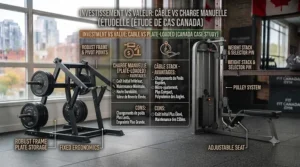
The plate loaded row machine vs cable stack row machine decision really comes down to two questions: how much do you value instant weight changes, and how tightly is your budget capped? Plate loaded machines like the Titan Fitness Plate-Loaded Seated Row Machine, Mikolo Plate Loaded Seated Row Machine, and Gronk Fitness Plate Loaded T-Bar Row deliver serious loading capacity and mechanical simplicity at a fraction of the cost of their selectorized cousins, making them the obvious pick for solo lifters and tight budgets. Cable stack options like the Titan Fitness Cable Tower 10-320 LB Selector and REP Fitness Ares 2.0 earn their higher price tags through speed, precision, and multi-user convenience that plate loading simply can’t replicate, while the Body-Solid GLM85B and Yes4All LAT Pulldown and Cable Row Tower each carve out their own niche between those extremes.
Whichever direction you go, the underlying training benefit is the same: a consistent rowing pattern builds real, balanced back strength that supports posture and pulling power well beyond the gym. Match the machine to how you’ll actually train — not just how impressive it looks online — and it’ll earn its floor space for years.
Recommended for You
- Plate Loaded Seated Row Machine: 7 Best Picks for Canada (2026)
- Seated Cable Row Machine: 7 Top Picks for Canadian Home Gyms (2026)
- Stack Loaded vs Plate Loaded Lat Pulldown: 7 Best Picks 2026
Disclaimer: This article contains affiliate links. As an Amazon Associate, I earn from qualifying purchases. If you purchase products through these links, we may earn a small commission at no additional cost to you.
✨ Found this helpful? Share it with your friends! 💬🤗
