In This Article
The best dumbbell set for beginners covers roughly 2 to 11 kg (5 to 25 lb) per hand. It steps up in small, manageable jumps, feels secure in your grip, and fits the space you actually have. For most Canadians, that means either a compact fixed hex set with a rack or a well-built adjustable pair.
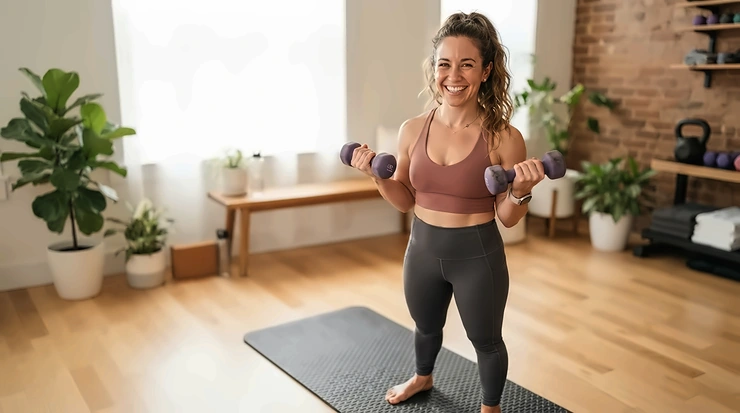
Here’s the uncomfortable truth about home training. Most of us don’t fail because the weights were wrong. We fail because the weights were in the way, or too heavy, or too light, or rolled under the couch and cost us the motivation to bend down. Dumbbells are among the oldest pieces of strength equipment around, and that simplicity is exactly why choosing the best dumbbell set for beginners feels deceptively easy. It isn’t.
The stakes are real, too. ParticipACTION’s 2025 Report Card found that only about 35% of Canadian adults meet the muscle-strengthening guideline. Add a January cold snap that turns the commute to a gym into an expedition, and a decent set at home starts looking less like a luxury and more like a smart habit.
This guide does the homework for you. I’ve compared seven real products across budget, mid-range and premium tiers. I’ve mapped out starter weight ranges, how to approach learning proper form, what professional dumbbell sets for home gym use actually offer, and how to plan for upgrading to heavier sets later. Everything is framed in metric first, with imperial in brackets, and prices in Canadian dollars.
A quick note on honesty. Where I summarize customer feedback, it’s the aggregated sentiment from real third-party and retailer reviews, and I’ll say so when I couldn’t verify a product’s review pool. Nothing here is a made-up anecdote or an invented testimonial.
Quick Comparison Table: Seven Sets at a Glance
Before the deep dive, here’s the cheat sheet. Price ranges are approximate, converted to CAD at the time of research, and they shift constantly, so check current price on the listing before you buy.
| Product | Type | Weight Range (per hand) | Approx. Price Range (CAD) | Best For |
|---|---|---|---|---|
| Amazon Basics Neoprene Dumbbell Hand Weights | Fixed, light | 1.4-3.6 kg (3-8 lb) in common bundles | C$30-C$60 | Absolute first-timers testing the habit |
| BalanceFrom Rubber Coated Hex Dumbbell Set | Fixed hex | Up to 23 kg (50 lb) in the larger configurations | C$70-C$250 (varies by set) | Budget buyers who want room to grow |
| CAP Barbell 150 lb Coated Hex Dumbbell Set with Rack | Fixed hex + rack | 2.3-11.3 kg (5-25 lb) pairs | C$300-C$450 | Beginners who want storage solved |
| Yes4All Adjustable Dumbbell Set | Spin-lock adjustable | 40 lb total up to 200 lb total sets | C$60-C$120 (smaller sets) | Lowest cost per kilogram |
| Flybird Adjustable Dumbbell | Adjustable | Tops out at 11.3 kg (25 lb) | C$100-C$200 | Light-load beginners, tight spaces |
| NÜOBELL Adjustable Dumbbells | Premium adjustable | 2.3-22.7 kg (5-50 lb) or up to 36.3 kg (80 lb) | C$650-C$900 | Quick swaps, long-term use |
| PowerBlock Elite EXP Stage 1 | Expandable adjustable | 2.3-22.7 kg (5-50 lb), expandable to 40.8 kg (90 lb) | C$550-C$800 | Those planning to progress for years |
Read that table as a ladder of commitment. The Amazon Basics Neoprene Dumbbell Hand Weights cost less than a decent pizza night, while the PowerBlock Elite EXP Stage 1 costs more than some used bikes. The sweet spot for most beginners sits in the middle: a CAP Barbell 150 lb Coated Hex Dumbbell Set with Rack if you want fixed weights, or a Yes4All Adjustable Dumbbell Set if you want the best price per kilogram. If you want a long-term, space-efficient solution and can stomach the cost, the PowerBlock Elite EXP Stage 1 is the one that scales.
💬 Just one click — help others make better buying decisions too!😊
Top 7 Picks for the Best Dumbbell Set for Beginners: Expert Analysis
1. Amazon Basics Neoprene Dumbbell Hand Weights — cheapest way to test the habit
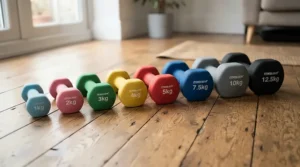
The standout here is price and simplicity. These come in light bundles (common listings include 3, 5 and 8 lb pairs, plus variants with a stand), and a metal core sits fully wrapped in neoprene with hex-shaped ends.
In practice, the hex heads stop the weights rolling between sets, and the neoprene grip means sweaty palms won’t turn a curl into a skid. Those light loads suit warm-ups, rehab-style movements, Pilates and high-rep shoulder work. They won’t carry you through a real squat or press progression for long, which is the honest limitation.
Based on the spec comparison, this is a starter-of-the-starters pick. Reviewers on retailer listings consistently praise the grip, the no-roll shape and the colour-coded markings, and one trainer’s long-term review reports good durability after about a year and a half of regular use. I couldn’t verify the Amazon.ca review count, so treat those as general themes rather than a guarantee.
Pros:
- ✅ Neoprene grip stays comfortable when hands get sweaty
- ✅ Hex ends stop dumbbells rolling away
- ✅ Very low cost of entry
Cons:
- ❌ Light weights get outgrown within weeks
- ❌ Little value for lower-body or heavy pressing work
Price range: roughly C$30-C$60 depending on the bundle. Verdict: ideal if you’re not sure you’ll stick with it, but plan to graduate.
2. BalanceFrom Rubber Coated Hex Dumbbell Set — more reach for a low price
The standout is headroom. This family of fixed hex sets stretches into the 5 to 50 lb (2.3 to 22.7 kg) territory, with neoprene-coated cast iron heads. Check the exact listing for which pairs are included, because configurations vary.
That extra reach matters. A beginner pressing 5 kg overhead in week one may be pressing 10 kg by month three, and a set that tops out at 3.6 kg simply stops being useful. Fixed hex dumbbells also have an advantage over adjustables: nothing to loosen, nothing to twist, nothing to mis-set when you’re tired.
Where it gets interesting is the value logic. Because individual pairs are separate, you can use a lighter pair for lateral raises and a heavier one for rows in the same session, with no fiddling in between. Third-party roundups list the BalanceFrom line as a budget-friendly mainstay, but I couldn’t verify a robust Amazon.ca review pool, so I’m not going to invent sentiment for it.
Pros:
- ✅ Greater weight reach than basic light sets
- ✅ Hex heads prevent rolling
- ✅ No adjustment mechanism to fail
Cons:
- ❌ Takes up more floor space as pairs multiply
- ❌ Storage rack often sold separately
Price range: roughly C$70-C$250 depending on the set size. Verdict: strong value if you’re willing to buy a rack or use a corner shelf.
3. CAP Barbell 150 lb Coated Hex Dumbbell Set with Rack — storage solved from day one
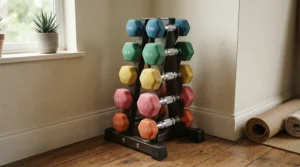
The standout is the included A-frame rack. You get five pairs (5, 10, 15, 20 and 25 lb, or 2.3 to 11.3 kg), coated hex heads on grey iron, and a steel rack, all for roughly a dollar per pound in US pricing according to one reviewer’s breakdown.
Why does that matter? Clutter kills consistency. A rack with a vertical footprint of about 36 cm by 33 cm (14 by 13 inches) means your dumbbells live somewhere specific, and the weights are one arm-reach away. The 2.3 to 11.3 kg range also lines up neatly with what most beginners press, curl and row for the first six months.
The spec sheet won’t tell you this, but reviewers note a few practical annoyances. Some mention a strong chemical smell out of the box, shipments arriving in several boxes, and a tight finger gap when lifting weights from the rack. Garage Gym Reviews scored it 3.8 overall and called it an ideal beginner weight set, with a small weight range and frame tightening over time as the main downsides.
Pros:
- ✅ Five pairs and a rack in one purchase
- ✅ Weights cover most beginner exercises
- ✅ Cast iron heads feel solid and dependable
Cons:
- ❌ Tops out at 11.3 kg (25 lb) per hand
- ❌ Rack hardware may need periodic tightening
Price range: roughly C$300-C$450. Verdict: the best dumbbell set for beginners who value an organized space and want to start lifting the day it arrives.
4. Yes4All Adjustable Dumbbell Set — lowest cost per kilogram
The standout is brute simplicity. This is an old-school spin-lock design: handles, cast iron plates and star-lock collars. Sets range from about 40 lb up to 200 lb total, and the larger sets give up to roughly 45 kg (100 lb) per dumbbell.
For a beginner, that translates into serious value. One reviewer’s cost breakdown put the pricing near a dollar a pound, which is a fraction of what proprietary selector systems cost. The plates are standard-style, so you can add compatible 1-inch plates on the smaller sets later.
Here’s the catch, and it’s a real one. The handles are long (about 40 cm, or 16 inches), which makes them bulkier than an equivalent fixed dumbbell at lighter weights, and changing plates takes longer than turning a dial. Reviewers generally like the secure feel of the collars, though some note the lock screw doesn’t hold the collar indefinitely, and a few feel that a 40 lb set is too low once they progress.
Pros:
- ✅ Cheapest cost per kilogram on this list
- ✅ Familiar spin-lock collars feel secure
- ✅ Larger sets scale up for years
Cons:
- ❌ Plate changes take a minute or two
- ❌ Long handles feel bulky at light loads
Price range: roughly C$60-C$120 for smaller sets. Verdict: unbeatable for budget buyers who don’t mind a little hands-on loading.
5. Flybird Adjustable Dumbbell — gentle ceiling for true beginners
The standout is its modest ceiling. Consumer Reports noted that the Flybird Adjustable Dumbbell topped out at about 11.3 kg (25 lb), the lowest max of the sets they tested, and that’s precisely why it suits the lightest-load newcomers.
Why would a low ceiling be a feature? Because most beginners don’t need 36 kg dumbbells in week one, and small jumps matter more than big maximums. A set that progresses in small steps lets you get from “this feels too light” to “this is just right” without paying for weight you won’t touch for a year. Consumer Reports’ reviewers warned that sets progressing in 10-pound jumps may be clumsy for beginners, which is where a gentler design shines.
On the review side, thereview.ca described it as an affordable, beginner-friendly option with a small weight range and a somewhat unusual selection system. I couldn’t verify a deep Amazon.ca review pool, so this is a reasoned fit rather than a crowd-sourced verdict.
Pros:
- ✅ Small weight range suits true beginners
- ✅ Compact footprint for tight apartments
- ✅ Affordable versus premium adjustables
Cons:
- ❌ Outgrown once you pass about 11.3 kg per hand
- ❌ Less suited to heavy lower-body work
Price range: roughly C$100-C$200. Verdict: a smart pick for small spaces and lighter goals.
6. NÜOBELL Adjustable Dumbbells — premium swaps that save time
The standout is the pace. The NÜOBELL line comes in a 5 to 50 lb version (2.3 to 22.7 kg) and a 5 to 80 lb version (up to 36.3 kg), with weight increments in the same small-step class as the Bowflex-style designs.
Based on the spec comparison, the real draw is workout flow. Garage Gym Reviews noted that NÜOBELL uses less plastic than Bowflex-style designs, and its length changes with the weight loaded rather than staying fixed. That means lighter settings feel more like a compact dumbbell, which is a meaningful difference for exercises like goblet squats and presses where length affects balance.
The trade-off is cost. The same comparison noted that the 50 lb NÜOBELL came in over US$150 more than the Bowflex 552, and the 80 lb version was priced below the Bowflex 1090. I couldn’t verify a robust Amazon.ca review pool, so no invented praise here.
Pros:
- ✅ Quick weight changes keep workouts moving
- ✅ Length shrinks at lighter loads
- ✅ Two weight ranges (50 or 80 lb) available
Cons:
- ❌ High upfront cost for a beginner
- ❌ Overkill if you only need light weights
Price range: roughly C$650-C$900. Verdict: worth it only if you’re sure you’ll train for years and value speed.
7. PowerBlock Elite EXP Stage 1 — grows from 23 kg to 41 kg
The standout is expandability. The PowerBlock Elite EXP Stage 1 covers 5 to 50 lb (2.3 to 22.7 kg) per hand in 2.5 lb steps, using welded steel plates and a magnetic pin. Two expansion kits, sold separately, extend it to 70 lb (31.8 kg) and then 90 lb (40.8 kg) per hand, and it carries a five-year limited warranty.
That upgrade path is the whole story. Picture a beginner who starts at 5 kg curls and, eighteen months later, is pressing 20 kg dumbbells. Rather than buying a second set, they add a kit. The unit replaces 16 pairs of fixed dumbbells in a footprint of roughly 30 by 17 cm (12 by 6.5 inches), which is wonderfully space-friendly.
Reviewers do flag trade-offs. Some find it a little clunky to dial in 2.5 or 5 lb steps because you remove internal weights, and others note that mass concentrates around the handle, so it can feel heavier than a traditional dumbbell. A major US retailer lists a high rating from about 50 reviews, but I couldn’t verify Amazon.ca counts.
Pros:
- ✅ Expansion kits push capacity to 90 lb
- ✅ Five-year limited warranty adds confidence
- ✅ Welded steel construction feels robust
Cons:
- ❌ Fine increments require removing internal weights
- ❌ Weight sits close to the handle, which feels different
Price range: roughly C$550-C$800. Verdict: the best long-term investment on this list, if your budget allows.
How to Choose the Best Dumbbell Set for Beginners
Choosing the best dumbbell set for beginners isn’t about finding the fanciest gear. It’s about matching a handful of practical criteria to your life.
- Set your realistic budget first. Fixed sets and spin-lock adjustables start low, while premium selector designs cost several times as much. Decide what you’d happily spend if you were certain you’d stick with it, then subtract a bit.
- Measure your space. A rack-based fixed set needs a corner; an adjustable needs a shelf. If you live in an apartment, adjustables can reclaim a lot of floor.
- Choose your starter weight ranges. Aim for coverage from roughly 2 to 11 kg (5 to 25 lb) per hand at a minimum. Anything lighter gets outgrown fast, while anything much heavier is wasted money.
- Prioritize small increments. Jumps of 2.5 lb to 5 lb (about 1 to 2 kg) are more beginner-friendly than 10 lb jumps.
- Check the grip and handle. Neoprene or rubber coatings are comfortable, while rough knurling can chew up palms.
- Plan for upgrading to heavier sets later. An expandable system or a platform with compatible plates saves repurchasing.
- Verify safety and warranty. Look for a clear warranty, and check Health Canada’s recall database before you buy (more on that below).
Do those seven things, and the choice usually narrows to two or three candidates quickly.

Starter Weight Ranges: What You Actually Need
Starter weight ranges are where most buyers go wrong, either by buying a set that’s too light to be useful or too heavy to be safe. Most beginners do best starting with loads they can lift for 10 to 12 controlled repetitions, then progressing slowly. Fitness Avenue’s Canadian guide similarly suggests a 5 to 30 lb range suits most beginners, while intermediate lifters often push toward 50 lb.
| Exercise Group | Typical Starting Range (per hand) | Best Set Type | Best For |
|---|---|---|---|
| Lateral raises, rear delts | 1-4 kg (2-8 lb) | Light fixed set (Amazon Basics Neoprene Dumbbell Hand Weights) | Shoulder isolation |
| Curls, triceps extensions | 3-7 kg (5-15 lb) | Fixed or adjustable (CAP Barbell 150 lb Coated Hex Dumbbell Set with Rack) | Arm work |
| Overhead and bench presses | 5-11 kg (10-25 lb) | Adjustable or mid-range fixed (Flybird Adjustable Dumbbell) | Upper-body strength |
| Rows, goblet squats, deadlifts | 7-18 kg (15-40 lb) | Wider range (Yes4All Adjustable Dumbbell Set) | Lower body and back |
These are general starting points, not prescriptions, and your own capacity will vary with age, training history and any injuries. The table shows why a 5 to 25 lb collection feels sufficient for upper-body work, while squats and rows quickly demand more. If lower-body training is a priority, either go with a wider range from the start, as with the PowerBlock Elite EXP Stage 1, or plan on extra pairs.
Learning Proper Form: Your First 30 Days
Learning proper form beats chasing heavier weights, every time. The Canadian 24-Hour Movement Guidelines recommend muscle-strengthening activities using major muscle groups at least twice a week for adults aged 18 to 64. Twice a week doesn’t ask for heroics, and that’s good news for newcomers.
Here’s a simple 30-day approach to learning proper form with any set on this list.
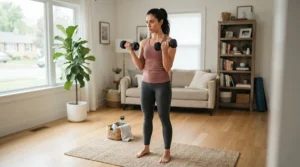
- Week 1: Light and slow. Use weights you could lift 15 times. Do goblet squats, dumbbell rows, floor presses and shoulder presses, two sets of 10 each. Count three seconds down on every rep.
- Week 2: Add a mirror or a phone. Record yourself from the side. Check that your back stays neutral on rows and your ribs stay down on overhead presses.
- Week 3: Increase reps before weight. Move from 10 to 12 reps per set, then add a third set.
- Week 4: Make the first small jump. When 12 clean reps feel manageable, add about 1 to 2 kg (2.5 to 5 lb).
Common mistakes in the first month include swinging the weight, flaring the elbows on presses, and holding your breath. If you want extra reassurance, a session with a certified trainer or kinesiologist can catch problems early. Check with a health professional first if you have a medical condition, are pregnant or are recovering from injury.
Professional Dumbbell Sets for Home Gym: When Pro-Level Gear Makes Sense
Professional dumbbell sets for home gym use come in two flavours: heavy-duty fixed sets and premium adjustable systems. The question for a beginner is whether that quality is worth paying for upfront.
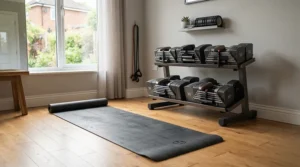
On the adjustable side, the PowerBlock Elite EXP Stage 1 and NÜOBELL Adjustable Dumbbells are the closest to gym-grade. Welded steel construction, secure locking and years of warranty support are the draws. On the fixed side, rubber hex designs like the Rogue Rubber Hex Dumbbells are popular benchmarks for serious home gym owners, with a range that, according to Garage Gym Reviews’ comparison, extends from 2.5 to 125 lb (1.1 to 56.7 kg).
So who should buy professional dumbbell sets for home gym use as a beginner? Realistically, those who are certain they’ll train long-term, who have a dedicated corner, and who prefer buying once. Everyone else is better off starting with a CAP Barbell 150 lb Coated Hex Dumbbell Set with Rack or a Yes4All Adjustable Dumbbell Set, then upgrading once habits are locked in. It’s the training equivalent of renting before you buy.
One more consideration is resale. Branded, widely recognized sets tend to hold their value better than no-name alternatives, which softens the cost of upgrading later.
Adjustable vs Fixed Dumbbells: Which Is Better for Beginners?
Fixed dumbbells are the classic: grab and go. Adjustables are the clever space-savers: one pair, many weights. Both can be the best dumbbell set for beginners, depending on your situation.
| Factor | Fixed Sets (e.g., CAP Barbell 150 lb Coated Hex Dumbbell Set with Rack) | Adjustable Sets (e.g., PowerBlock Elite EXP Stage 1) |
|---|---|---|
| Space | Needs a rack or floor space | Compact, one pair |
| Speed of change | Instant | Seconds to a minute |
| Cost per kg | Moderate | Low (spin-lock) to high (premium) |
| Reliability | Nothing to break | Mechanism can wear |
| Best For | Quick circuits, shared homes | Apartments, long-term progression |
Looking at the table, fixed sets win on speed and simplicity, while adjustables win on footprint and long-term flexibility. Fitness Avenue’s Canadian guide suggests adjustables can save up to 90% of the storage space of traditional dumbbells, which matters in a small condo. If you do lots of supersets and circuits, fixed sets keep the flow moving. If you lift in a bedroom corner, adjustables are hard to beat.
Safety, Recalls and Canadian Compliance: What to Check Before You Buy
Dumbbell safety is rarely discussed until something goes wrong. Check recalls before every purchase, especially for adjustables that rely on moving parts. Health Canada’s recalls and safety alerts database is the official place to look in Canada.
This isn’t hypothetical. In June 2025, Johnson Health Tech Trading, which took over the brand, recalled the Bowflex SelectTech 552 and 1090 adjustable dumbbells in cooperation with US regulators, after weight plates could dislodge during use. Roughly 3.8 million units were involved, with injuries reported. Health Canada had also posted an earlier, separate recall of certain Bowflex SelectTech 1090 units back in 2012, so the family has a history worth knowing. I haven’t included the Bowflex SelectTech models in the picks above for that reason. If you already own one, search the recall notice and your serial number, and contact the manufacturer about a remedy.
Practical safety habits matter just as much:
- Tighten spin-lock collars before every set.
- Inspect plates and handles for cracks or loose hardware.
- Keep hex or rubber-coated dumbbells off glass-topped tables and hardwood edges.
- Clear a metre of space around you.
- Look for a clear warranty and a seller with real returns support.
Upgrading to Heavier Sets Later: Plan the Path Now
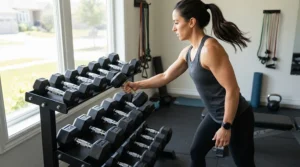
Upgrading to heavier sets later is inevitable if you train consistently. The principle behind it is progressive overload: gradually increasing the demand on your muscles so they keep adapting. Your first set should be chosen with that day in mind.
There are three practical paths:
- Expandable systems. The PowerBlock Elite EXP Stage 1 accepts kits that extend it to 31.8 kg and then 40.8 kg per hand. You buy once and add.
- Plate-loading adjustables. The Yes4All Adjustable Dumbbell Set lets you add compatible plates on certain models, though check the hole size, since larger sets use a slightly different diameter than the smaller ones.
- Mix-and-match fixed pairs. Start with a CAP Barbell 150 lb Coated Hex Dumbbell Set with Rack, then add a pair of 15 kg dumbbells when your 11 kg pair gets easy.
A useful rule of thumb: when you can complete all your sets and reps with clean form for two consecutive sessions, add the smallest available increment. Don’t skip steps. If you do outgrow a light set, keep it. Those lighter pairs remain useful for warm-ups and accessory work, so they never really go to waste.
Real-World Scenarios: Which Beginner Are You?
Here are three buyer profiles, with matching picks and reasoning.
The condo dweller (budget C$100-C$250, three sessions a week). Space is the enemy, so go adjustable. The Flybird Adjustable Dumbbell suits lighter goals, while the Yes4All Adjustable Dumbbell Set gives more room to grow. Store them under a bench or in a closet.
The family starter (budget C$300-C$450, two adults and a teenager). Shared use means varied loads and quick swaps. The CAP Barbell 150 lb Coated Hex Dumbbell Set with Rack keeps everyone in the same corner, and nobody has to adjust a thing mid-workout.
The committed long-term lifter (budget C$550-C$900, four sessions a week). Buy once, buy well. The PowerBlock Elite EXP Stage 1 provides an upgrade path, while the NÜOBELL Adjustable Dumbbells emphasize fast changes. Either way, you’re set for years.
The choice often comes down to space, shared use and how soon you’ll outgrow the entry weights. If you’re torn, start modest and revisit in six months.
Common Mistakes When Buying Your First Dumbbell Set
Mistakes are cheaper to avoid than to correct. Watch for these.
- Buying too light. A set maxing out at 3.6 kg feels cute for a week.
- Buying too heavy. A 36 kg adjustable looks impressive, but if you only use 40% of the range, you’ve overpaid.
- Ignoring increments. Big jumps make steady progress awkward, so look for small steps.
- Skipping storage. A pile of dumbbells in a corner is a trip hazard, and a rack or shelf solves it.
- Forgetting the recall check. One search on Health Canada’s database costs nothing.
- Chasing every gimmick. Fancy dials don’t improve your technique; practice does.
Long-Term Cost and Maintenance: Total Cost of Ownership
The sticker price is only the opening bid. Total cost depends on how long you’ll use the set and how often you’ll upgrade.
| Product | Approx. Price Range (CAD) | Max Weight Per Hand | Warranty Notes | Best For |
|---|---|---|---|---|
| Amazon Basics Neoprene Dumbbell Hand Weights | C$30-C$60 | About 3.6 kg (8 lb) | Check listing | Testing the habit |
| CAP Barbell 150 lb Coated Hex Dumbbell Set with Rack | C$300-C$450 | 11.3 kg (25 lb) | Check listing | Organized beginners |
| Yes4All Adjustable Dumbbell Set | C$60-C$120+ | Varies by set | Check listing | Budget progression |
| PowerBlock Elite EXP Stage 1 | C$550-C$800 | 22.7 kg (50 lb), expandable | 5-year limited | Lifetime use |
Notice how a cheap set that you outgrow in three months can end up costing more than a pricier set you keep for five years. The PowerBlock Elite EXP Stage 1 carries a five-year limited warranty and an expansion path, which spreads its cost over a long runway. For maintenance, wipe sweat from handles after sessions, keep cast iron dry to prevent rust, and re-tighten rack hardware and collars every few weeks. Five minutes of care per month is plenty.
FAQ
❓ How much should a beginner spend on a dumbbell set in Canada?
❓ What weight dumbbells should a beginner start with?
❓ Are adjustable dumbbells worth it for beginners?
❓ Is the Bowflex SelectTech 552 still safe to buy?
❓ Can I build muscle with dumbbells at home?
Conclusion: Start Light, Think Long
Choosing the best dumbbell set for beginners comes down to three questions: how much space do you have, how fast will you progress, and how much do you want to spend now versus later. For the tightest budgets and the shortest commitment, the Amazon Basics Neoprene Dumbbell Hand Weights offer a low-risk start. For an organized, ready-to-lift corner, the CAP Barbell 150 lb Coated Hex Dumbbell Set with Rack is the most beginner-friendly all-in-one. For cost per kilogram, the Yes4All Adjustable Dumbbell Set is hard to beat. And if you’re sure you’ll stick with it for years, the PowerBlock Elite EXP Stage 1 and NÜOBELL Adjustable Dumbbells are the investment picks.
Whatever you pick, the weights are only the beginning. Learning proper form, respecting starter weight ranges and planning for upgrading to heavier sets later will do more for your results than any brand logo ever could. Start light, move well, and make your first month boringly consistent.
✨ Ready to build your home gym?
🔍 Click on any highlighted product to check current pricing and availability, and pick the set that fits your space, your budget and your goals. Your future stronger self will thank you! 💪
Recommended for You
- Dumbbell Sets Vs Adjustable Dumbbells For Home Gym: 7 Best Picks 2026
- Compact Dumbbell Sets: 7 Proven Picks For Canada (2026)
- Professional Dumbbell Set: 7 Proven Picks For Canada 2026
Disclaimer: This article contains affiliate links. As an Amazon Associate, I earn from qualifying purchases. If you purchase products through these links, we may earn a small commission at no additional cost to you.
✨ Found this helpful? Share it with your friends! 💬🤗
