In This Article
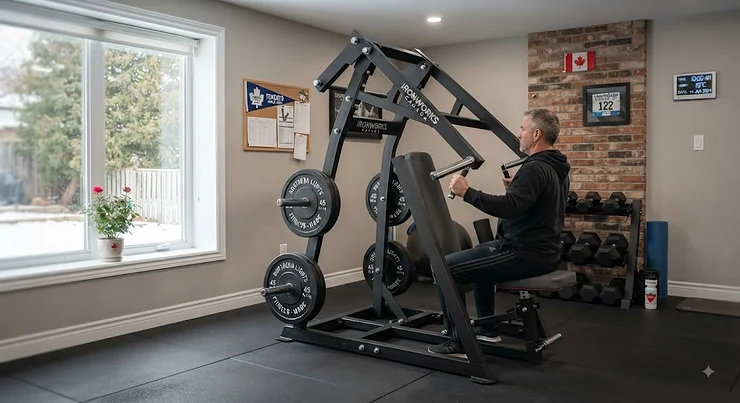
Here’s a confession most fitness articles won’t make: nobody actually needs a leverage chest press machine for home gym use. You could build a respectable chest with a barbell, a bench, and a spotter who occasionally shows up. But take away the spotter — which, let’s be honest, is most of us most of the time — and suddenly a machine that lets you press to true failure without anyone standing over you starts to look less like a luxury and more like common sense. That’s the entire pitch behind converging-arm, plate-loaded pressing machines, and it’s why they’ve quietly become one of the fastest-growing categories in Canadian garage and basement gyms.
A leverage chest press machine for home gym use is a plate-loaded strength machine with independently pivoting arms that follow a fixed, converging arc — mimicking the path of a barbell or dumbbell press while adding a mechanical safety net so you can train alone. Unlike a cable stack, resistance comes directly from Olympic plates you already own, and unlike a barbell, the arms catch you if a rep goes sideways.
This guide walks through seven real, currently available machines spanning roughly C$300 to well over C$2,000, explains what the specs actually mean for your training, and digs into the plate-loaded vs Smith machine and plate-loaded vs cable resistance debates that trip up most first-time buyers. It’s worth grounding this in the bigger picture too: Canada’s public health guidance on physical activity recommends adults get muscle-strengthening exercise at least twice weekly, and a dedicated pressing station makes that far easier to sustain at home. Whether you’re outfitting a Toronto condo gym or a Prairie garage, by the end you’ll know exactly which pressing station fits your space, budget, and goals — and how to avoid the mistakes that turn a promising home gym pressing station into a very expensive coat rack.
Quick Comparison Table
| Machine | Type | Weight Capacity | Price Range (CAD) | Best For |
|---|---|---|---|---|
| Body-Solid ProClubLine LVBP | Plate-loaded leverage | High commercial-rated | C$1,900–C$2,400 | Serious home gyms wanting commercial durability |
| Steelflex PLBP | Plate-loaded leverage | Rated to 264 lb user | C$1,600–C$1,900 | Buyers who want commercial feel at a lower cost |
| Titan Fitness Plate-Loaded Chest Press | Plate-loaded leverage + FID bench | 1,000 lb rated | C$900–C$1,150 | Garage gym builders wanting flat/incline/decline range |
| Valor Fitness BF-48 | Plate-loaded leverage | 250 lb per side | C$600–C$800 | Mid-range buyers upgrading from a basic bench |
| Marcy MD-9010G Smith Cage | Smith machine + cage system | 600 lb rack capacity | C$700–C$950 | Multi-exercise home gyms, not chest-only |
| VEVOR Chest Press Machine | Plate-loaded leverage | 450 lb rated | C$300–C$420 | Budget buyers and apartment gyms |
| Cap Barbell Leverage Gym | Plate-loaded leverage gym | Standard Olympic plate compatible | C$550–C$750 | Entry-level all-in-one pressing and pulling station |
The spread here tells its own story: you’re paying almost entirely for steel gauge, bearing quality, and welded joint count, not for “more features” in any flashy sense. Looking at the table, the Body-Solid ProClubLine LVBP sits at the top for a reason — commercial-grade construction that’s meant to survive years of heavy use without the pivot points developing play. Budget buyers shouldn’t dismiss the VEVOR Chest Press Machine, though; for someone testing whether machine pressing suits their training style before committing serious money, it’s a reasonable entry point. The Marcy MD-9010G stands apart from the rest of this table because it isn’t a dedicated chest press at all — it’s a Smith machine and cage system that happens to include pressing, which matters a lot if you’re choosing between a single-purpose leverage machine and a do-everything station.
💬 Just one click — help other Canadian golfers make a smarter bag choice too!😊
Top 7 Leverage Chest Press Machines for Home Gyms: Expert Analysis
1. Body-Solid ProClubLine LVBP — commercial-grade build for serious home lifters
The standout here is the frame: Body-Solid builds the LVBP around a 2-inch by 3-inch, 11-gauge steel mainframe, which is genuinely heavier gauge than most machines marketed for home use. In practice, that thickness matters more than most buyers assume — thinner tubing flexes under heavy load over years of use, and flex at the pivot points is exactly what turns a smooth press into a wobbly one.
Key specs worth understanding: the machine uses converging, independently moving press arms with sealed bearings at every pivot point, and both the seat and starting arm position are gas-assisted for quicker adjustment between users. Sealed bearings specifically mean you’re not dealing with exposed bushings that need periodic lubrication — a genuinely practical advantage if this machine lives in a humid basement gym, which is common across Canadian homes.
Based on the spec comparison against lighter home-market machines, this is squarely built for buyers who train seriously and expect the machine to still feel tight in five years, not just on day one. It’s arguably overbuilt for someone doing three light chest sessions a month, and that’s fine — that buyer should look further down this list. Reviewers consistently describe the converging arm path as closely mimicking a free-weight press, with the independent arm movement specifically praised for exposing and correcting left-right strength imbalances that a fixed barbell can hide.
Pros:
- ✅ Heavy 11-gauge steel frame built for long-term durability
- ✅ Sealed bearings reduce maintenance in humid basements
- ✅ Independent arms correct left-right strength imbalances
Cons:
- ❌ Premium price puts it out of reach for casual lifters
- ❌ Large footprint needs a dedicated home gym space
Expect this machine in the C$1,900–C$2,400 range depending on retailer and shipping to your province — a serious investment, but one that reflects genuinely commercial-spec components rather than marketing language stretched over a home-grade frame.
2. Steelflex PLBP — commercial feel without the full commercial price tag
Steelflex builds the PLBP around a 25-degree converging arm pattern, and that number is worth pausing on: a wider convergence angle generally means a deeper stretch at the bottom of the press and a more complete contraction at lockout, closer to what a dumbbell press allows than a fixed-bar machine typically achieves.
The frame itself uses 11-gauge, 2-inch by 4-inch oval steel tubing with continuous welds at every pivot point rather than bolted connections — continuous welding is a detail that matters more in a plate-loaded machine than in a stack machine, because every rep transmits direct mechanical stress straight through those joints. Steelflex also rates the machine’s bearings for three years and manufactures in an ISO 9000:2000-certified facility, which is a genuine quality signal in an industry where a lot of “commercial-grade” claims are unverifiable.
What most buyers overlook about this model is that the arms can be used together or independently, giving you both a standard bilateral press and a single-arm unilateral option in the same machine — useful if you’re rehabbing a shoulder or correcting an imbalance without buying a second piece of equipment. Aggregated reviewer sentiment on this model is thinner than for the more widely distributed Body-Solid line, but the consistent theme across available feedback is that the pressing motion feels notably smoother than lower-priced plate-loaded alternatives.
Pros:
- ✅ 25-degree converging arms allow a deeper natural stretch
- ✅ Continuous-weld frame construction at all pivot points
- ✅ Arms work together or independently for unilateral training
Cons:
- ❌ Bench position is fixed, not multi-angle adjustable
- ❌ Smaller dealer network makes Canadian shipping less predictable
Price typically lands around C$1,600–C$1,900, positioning it as a genuine mid-to-premium alternative to Body-Solid for buyers who want commercial-grade engineering without stretching to the top of the market.
3. Titan Fitness Plate-Loaded Chest Press Machine — flat/incline/decline versatility in one frame
The standout feature is right in the name: this is one of the few plate-loaded leverage machines in this price bracket built around a genuinely adjustable Flat/Incline/Decline (FID) bench rather than a single fixed pressing angle, which means upper, mid, and lower chest work from one station.
Titan rates the frame to 1,000 pounds combined capacity and includes two 9.5-inch loadable weight posts compatible with standard Olympic plates, along with 13 distinct bench depth positions to accommodate different torso lengths and arm reach. The independent press arms follow a converging arc designed to replicate free-weight range of motion, and built-in safety catches let you bail out of a failed rep without a spotter — arguably the single most important feature for anyone training alone.
Here’s what the spec sheet won’t tell you, but garage gym reviewers note: the press feel at this price point is good but not flawless, with some reviewers describing mild inconsistency in resistance smoothness compared to the pricier Body-Solid and Steelflex machines above. That’s a reasonable trade-off given the price gap, and for buyers prioritizing angle versatility over ultimate smoothness, it’s still a strong pick. Reviewers who’ve owned both dumbbells-and-bench setups and this machine consistently note the space savings, since the foldable bench frees up floor space for other movements when not in use.
Pros:
- ✅ True flat/incline/decline adjustability for full chest coverage
- ✅ Built-in safety catches for solo failure-point training
- ✅ Compact folding bench saves floor space between sessions
Cons:
- ❌ Press feel less refined than premium commercial machines
- ❌ Assembly is reported as lengthy by several buyers
Check current price, but expect this machine to sit around C$900–C$1,150 — a reasonable middle ground between entry-level plate-loaded units and full commercial-spec machines.
4. Valor Fitness BF-48 — the practical step-up from a basic adjustable bench
Valor’s BF-48 stands out as their flagship chest press specifically because it pairs converging, iso-lateral arms with a bench that still functions as a genuine flat-to-incline adjustable bench on its own — you’re not sacrificing bench versatility to get pressing arms bolted on.
The iso-lateral arm design allows fully independent movement per side, which functions effectively as both a flat and incline pressing station depending on how you set the seat and back pad angle. Frame construction uses 11-gauge steel at the high-stress upright points, stepping down to 12-gauge in the lower frame — a sensible engineering choice that puts material where the stress actually concentrates rather than uniformly overbuilding (and overpricing) the whole unit.
Based on the spec comparison with the entry-level BF-47 bench-only model in Valor’s lineup, the BF-48 clearly targets buyers who’ve already tried a basic adjustable bench with dumbbells and want the added safety and consistency of guided arms without jumping straight to a C$1,500+ commercial machine. A common theme in aggregated feedback on Valor’s home-gym line is praise for the plate storage pegs keeping the surrounding floor space usable — a small detail, but one that matters a lot in a Canadian basement gym where square footage is often the real constraint, not budget.
Pros:
- ✅ Iso-lateral arms double as flat and incline pressing
- ✅ Smart steel gauge allocation keeps weight and cost reasonable
- ✅ Built-in plate storage pegs keep the training area tidy
Cons:
- ❌ 250-lb-per-arm rating limits headroom for advanced lifters
- ❌ Some assembly reports mention inconsistent bearing fitment
Typical pricing runs C$600–C$800, making the BF-48 one of the more sensible mid-range picks for someone who has outgrown a bare adjustable bench.
5. Marcy MD-9010G Smith Cage System — the multi-station alternative worth comparing
This entry earns its spot specifically as the comparison point for the plate-loaded chest press vs Smith machine question, because the MD-9010G bundles a full Smith machine, squat rack, cable pulley system, and adjustable bench into one footprint rather than isolating chest pressing the way the other six machines here do.
The Smith bar rides on sealed linear bearings along a fixed vertical track, with adjustable safety catches that let you bail a rep by simply rotating the bar into the nearest catch — a different safety mechanism than the converging-arm machines above, but one that serves the same core purpose of solo training. Cable-routed high and low pulleys add pec-deck-style flye work and functional pressing variations that a dedicated leverage machine can’t replicate, and the rack itself supports up to 600 pounds of loaded weight.
What most buyers overlook about this category is that a Smith machine’s fixed vertical bar path is mechanically very different from a leverage machine’s converging arc — the vertical track forces your shoulders through the same plane on every rep, while converging arms let each arm find its own natural pressing angle. Reviewers consistently note the value proposition of getting a squat rack, cable station, and press bar in one purchase, but some also flag that the bench that ships with it is noticeably less padded than dedicated pressing benches from Body-Solid or Titan.
Pros:
- ✅ Combines Smith machine, cable station, and rack in one unit
- ✅ Sealed linear bearings keep the bar path smooth
- ✅ Genuinely full-body, not chest-press-only, capability
Cons:
- ❌ Fixed vertical bar path lacks a leverage machine’s natural arc
- ❌ Included bench padding is thinner than dedicated press machines
Price typically runs C$700–C$950 in the Canadian market — competitive with mid-range leverage machines, but you’re buying a completely different category of equipment, not a direct substitute.
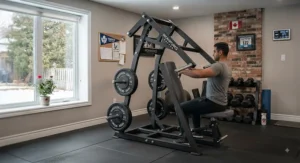
6. VEVOR Chest Press Machine (450 LBS) — the budget entry point worth taking seriously
The standout feature at this price is straightforward: a sub-C$450 plate-loaded leverage machine with independent converging arms, which puts machine pressing within reach of buyers who’d otherwise be priced out of the category entirely.
VEVOR rates the unit to 450 pounds combined and builds the bench around removable adapter sleeves compatible with both 1-inch standard and 2-inch Olympic plates — a practical touch for anyone with a mixed plate collection, which describes a lot of first-time home gym builders. The frame folds flat for storage, addressing one of the biggest objections apartment and condo dwellers have to machine-based training: permanent floor footprint.
Honest analytical take: at this price, you are trading long-term durability and press-feel refinement for accessibility, and that’s a legitimate trade-off rather than a flaw to be embarrassed about. Reviewers consistently describe the press motion as smooth for the price point, while also noting assembly instructions that could be clearer — a common theme across budget fitness equipment generally, not unique to this brand. For someone who wants to test whether they’ll actually use a leverage press machine before investing in a premium unit, this is a genuinely reasonable way to find out.
Pros:
- ✅ Lowest entry price among genuine leverage machines here
- ✅ Folds flat, ideal for apartment and condo storage
- ✅ Accepts both 1-inch and 2-inch weight plates
Cons:
- ❌ 450-lb capacity limits long-term progression for strong lifters
- ❌ Assembly instructions reported as unclear by several buyers
Expect a price in the C$300–C$420 range, making this the clear budget champion of the group — with the appropriate caveats about longevity.
7. Cap Barbell Leverage Gym — an accessible all-in-one pressing and pulling station
The standout feature is scope: the Cap Barbell Leverage Gym extends beyond chest pressing into a genuine multi-station leverage gym, adding pulling and lower-body movement patterns to the pressing arc that anchors this whole category, at a price closer to the budget end than the commercial end.
Built around a plate-loaded design compatible with standard Olympic plates, the unit combines converging press arms with additional stations for movements like rows or pulldowns depending on configuration, letting one machine cover more of a full-body routine than a single-purpose chest press. This matters most for buyers with genuinely limited square footage — a common Canadian reality in condos and smaller starter homes — where a single multi-function frame beats assembling several standalone machines.
On paper, this means less specialization than the dedicated chest machines above; you’re not getting the same converging-arc refinement as the Body-Solid or Steelflex units because the frame has to serve multiple movement patterns rather than being optimized purely for pressing. Reviewers consistently frame this as a reasonable trade-off for the price and footprint, with the most common praise centering on value relative to buying separate single-purpose machines, and the most common complaint centering on tighter clearance around the frame during heavier pressing sessions.
Pros:
- ✅ Multiple movement patterns in one plate-loaded frame
- ✅ Strong value versus buying several single-purpose machines
- ✅ Compatible with standard Olympic weight plates
Cons:
- ❌ Less specialized press feel than dedicated chest machines
- ❌ Tighter working clearance around the frame when loaded heavy
Pricing generally sits in the C$550–C$750 range, positioning it as a genuine multi-station alternative for anyone weighing “one do-everything machine” against “one dedicated press.”
Practical Setup & First 30 Days Guide
Getting a plate-loaded machine into position is only step one — how you set it up in your space determines whether you actually use it. Most Canadian basements aren’t purpose-built gym rooms, and moisture is the detail people skip. CMHC and Health Canada guidance generally points to keeping indoor relative humidity between 30% and 50%, with a lower target during very cold weather to help prevent condensation, which matters directly for a leverage machine’s sealed bearings and steel frame — a damp slab under rubber flooring traps moisture against the base plates and accelerates corrosion at exactly the pivot points you’re relying on for smooth motion.
Before your first session, bolt or anchor the machine’s base if the manual specifies it, particularly for taller leverage frames that see real lateral force during heavy pressing. In the first 30 days, resist the urge to max out the weight posts immediately; use lighter loads to learn where each arm’s natural stopping point sits, since converging arms differ machine to machine even within the same brand’s lineup. A common early mistake is skipping the safety catch adjustment specific to your torso length — most machines ship with catches set for an average-height user, and five minutes of adjustment before your first working set prevents a genuinely awkward failed-rep situation later. For more detail on managing basement humidity around any home gym equipment, CMHC’s guidance on basement moisture control is a useful starting point before you finalize your setup.
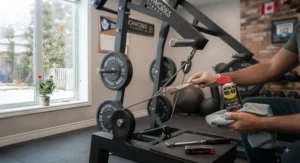
Maintenance is refreshingly low for sealed-bearing models: a monthly wipe-down of the plate posts and a visual check of weld points and bolts covers most of what’s needed. Unsealed bearing budget models benefit from occasional light lubrication at the pivot points, especially in humid basement environments, to prevent the gritty resistance that develops when moisture and dust combine at exposed joints.
Real-World Scenarios: Who Actually Needs This Machine
The solo lifter without a spotter. If you’re training alone — which describes most home gym owners — a leverage machine’s core value proposition is training to genuine failure safely. Someone in this position pressing 3-4 times weekly should prioritize a machine like the Body-Solid ProClubLine LVBP or Steelflex PLBP, where sealed bearings and heavier steel justify the price through years of consistent, safe heavy pressing.
The condo or apartment dweller with 40 square feet to spare. Here, footprint dictates the decision more than budget does. A folding option like the VEVOR Chest Press Machine, or the more compact Cap Barbell Leverage Gym if pulling movements matter too, fits this scenario far better than a fixed commercial frame that permanently claims floor space you might need for other uses.
The budget-conscious beginner building a first home gym. If you’re not certain machine pressing will become a permanent part of your routine, starting with a lower-cost entry point like the VEVOR unit or the Valor Fitness BF-48 lets you validate the habit before committing C$1,500+ to a commercial-grade frame you might use inconsistently.
Plate-Loaded Chest Press vs Smith Machine
This comparison comes up constantly, and the honest answer is that these solve overlapping but genuinely different problems. A plate-loaded chest press machine uses converging, independently pivoting arms that let each side of your body find its own natural pressing angle — closer to a dumbbell press than a barbell press in feel. A Smith machine, like the rack built into the Marcy MD-9010G, constrains the bar to a single fixed vertical (or near-vertical) track.
The practical difference shows up under fatigue. On a leverage machine, if your left side is slightly stronger, that arm naturally travels its own path without forcing the weaker side to compensate awkwardly — the imbalance becomes visible and correctable over time. On a Smith machine, the fixed bar path means your stronger side can subtly take over the rep without you fully noticing, since the bar itself stays perfectly level regardless of which side is doing more work.
Where the Smith machine wins is versatility per dollar: the MD-9010G doubles as a squat rack, cable station, and pressing rig, while a dedicated leverage press does one thing extremely well. If chest pressing is your primary goal and you have the budget and space for a dedicated unit, a leverage machine like the Body-Solid LVBP or Titan Fitness FID press generally delivers a more natural pressing feel. If you need one machine to cover squats, presses, and cable work in a genuinely tight footprint, the Smith machine’s versatility becomes the deciding factor regardless of its less natural bar path.
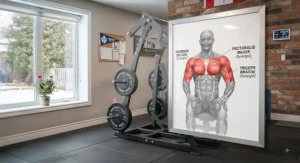
Plate-Loaded Machine for Home Strength Training: What the Category Actually Offers
Plate-loaded machines occupy a specific middle ground in home strength training that’s worth understanding before you buy. Unlike selectorized weight-stack machines, resistance comes from Olympic plates you load and unload manually — which means the resistance curve feels closer to genuine free weight than a cam-and-cable system typically achieves, since you’re moving real mass rather than a pulley-multiplied stack.
For home strength training specifically, this matters for two practical reasons. First, cost: if you already own a set of Olympic plates for a barbell or another machine, a plate-loaded chest press adds capability without adding a second full weight stack purchase — every machine in this article’s top seven, aside from the Marcy Smith cage’s rack function, draws from the same plate collection. Second, portability of resistance: plates can be reallocated across multiple plate-loaded stations (a press, a row, a leg press) as your home gym grows, whereas a weight-stack machine’s resistance is permanently locked to that single unit.
The trade-off is loading time and noise — swapping plates between exercises takes longer than pinning a stack, and Olympic plates clanging onto steel posts isn’t subtle in a shared living space. For a dedicated home gym with reasonable soundproofing, this is a minor inconvenience. For a shared condo wall, it’s worth testing before committing to a heavier machine.
Pressing Movement Training: What Actually Changes Week to Week
Pressing movement training on a leverage machine follows a different progression curve than free-weight pressing, and understanding this prevents frustration in the first few months. Because the arms provide a fixed arc with built-in stability, you’ll often find your working weight on a machine exceeds what you can press with a barbell — the machine removes the stabilization demand that normally limits how much load your smaller supporting muscles allow through.
This isn’t cheating; it’s a genuinely different training stimulus. Machine pressing lets you isolate the pressing muscles — chest, front delts, triceps — more directly, which is valuable for hypertrophy-focused training where mechanical tension on the target muscle matters more than total-body stabilization skill. What most buyers overlook about this shift is that pressing strength gained on a machine doesn’t always transfer one-to-one back to barbell pressing, since the stabilizer muscles that a free barbell demands simply aren’t being trained the same way.
A sensible weekly structure for pressing movement training on a leverage machine looks like two to three sessions, spaced with at least 48 hours of recovery between chest-focused days, working in the 6-12 rep range for most sets with occasional lower-rep, higher-load sessions once your form is consistent. This aligns with the broader Canadian 24-Hour Movement Guidelines for adults, which recommend muscle-strengthening activity using major muscle groups at least twice a week — a leverage chest press machine comfortably satisfies that upper-body component on its own.
Plate-Loaded vs Cable Resistance: Which Suits Your Goals
Cable-based chest training — think a functional trainer or the pulley stations built into the Marcy MD-9010G — uses a weight stack routed through pulleys, delivering smooth, continuous tension throughout the entire range of motion, including at the very top and bottom of a rep where free weight or plate-loaded resistance often goes slack.
Plate-loaded leverage machines, by contrast, follow gravity more directly: resistance peaks and eases through the arc similarly to how a barbell or dumbbell press feels, with more challenge in certain portions of the range than others. Here’s what the spec sheet won’t tell you: this isn’t a flaw in plate-loaded design, it’s simply a different resistance profile, and which one suits you depends on your training goal. Cable resistance tends to favor constant-tension work useful for muscle definition and controlled tempo training, while plate-loaded leverage resistance tends to favor raw strength development because it mimics the loading pattern of the free-weight lifts most strength standards are actually measured against.
For a home gym buyer choosing between the two, the honest framework is this: if your goal is strength that transfers toward eventual barbell benching, a plate-loaded leverage machine like the Titan Fitness or Body-Solid units trains a more analogous movement pattern. If your goal is muscle definition, joint-friendly training, or you’re managing an existing shoulder issue where constant, controllable tension reduces strain, a cable station or a hybrid unit like the Marcy MD-9010G’s pulley system deserves serious consideration alongside or instead of a dedicated leverage press.
How to Choose a Leverage Chest Press Machine
- Confirm your available floor space first, not last. Measure the fully extended length of the machine, including press-arm range of motion, not just its folded footprint — a common and costly measuring mistake.
- Match weight capacity to your realistic long-term strength, with margin. A beginner pressing 135 lb today may be pressing 225 lb in two years; buying a 250-lb-capacity machine now can mean re-buying later.
- Prioritize sealed bearings if your gym space has any humidity concerns. Basements across most of Canada see seasonal humidity swings that accelerate wear on exposed bearing surfaces.
- Decide between single-purpose and multi-station before comparing prices. A dedicated press and a Smith cage system solve different problems; comparing their prices directly without this context leads to disappointment either way.
- Check plate compatibility against what you already own. Some machines require adapter sleeves for standard 1-inch plates versus 2-inch Olympic plates — a detail easy to miss until delivery day.
- Read the fine print on adjustability. A fixed-angle bench like the Steelflex PLBP works only for flat pressing, while an FID bench like Titan’s opens up incline and decline training from the same frame.
- Weigh assembly complexity realistically. Heavier commercial-grade machines often require two people and several hours; budget models are quicker but sometimes ship with less forgiving tolerances at the joints.
Common Mistakes When Buying a Leverage Chest Press Machine
The single most common mistake is buying based on weight capacity alone without considering arm convergence angle and bearing quality — two specs that affect how the machine actually feels far more than the maximum number stamped on the frame. A 1,000-lb-rated budget machine with unsealed bushings can feel worse under a 200-lb load than a 250-lb-rated machine with premium sealed bearings, because smoothness and capacity are separate engineering questions entirely.
A second frequent error is underestimating footprint in the fully extended pressing position, not just the machine’s resting dimensions — buyers regularly discover their new press extends further into the room mid-rep than the folded or resting measurements suggested. A third mistake is ignoring plate compatibility until after purchase, only to discover an existing plate collection needs adapter sleeves that weren’t included. Finally, many first-time buyers skip researching aggregated review sentiment specifically around assembly quality, which varies more between otherwise similar-spec machines than most buyers expect — a machine with excellent core engineering can still earn frustrated reviews over a genuinely confusing instruction manual.
Long-Term Cost & Maintenance: What Ownership Actually Costs
The purchase price is only part of the total cost of ownership for a plate-loaded leverage machine. Because these units use Olympic plates rather than a built-in stack, your plate collection is effectively a shared, reusable asset across every plate-loaded piece of equipment you own — a cost-per-use advantage that compounds as your home gym grows, since a single set of plates can serve a press, a row, and eventually a leg press without additional resistance purchases.
Maintenance costs skew low for sealed-bearing commercial machines like the Body-Solid LVBP and Steelflex PLBP, where the three-year bearing warranties common in this tier reflect genuinely low expected failure rates under normal use. Budget machines carry a different long-term cost profile: lower upfront price, but a higher likelihood of needing bearing replacement, bolt tightening, or upholstery repair within a few years of regular use. Framed as return on investment, a C$2,000 commercial machine used consistently for a decade costs roughly C$200 per year of service, while a C$350 budget machine that needs replacement after three years of heavy use costs a comparable annual figure — meaning the “cheaper” option isn’t automatically the better value once you account for realistic lifespan against your actual training frequency.
Home Gym Pressing Station for Different Audiences
Beginners benefit most from machines with generous safety catch adjustability and clear starting-position guides, since learning proper shoulder positioning matters more early on than raw weight capacity — the Valor Fitness BF-48 or VEVOR unit’s lower entry cost also reduces the financial risk of discovering machine pressing isn’t your preferred training style.
Intermediate and advanced lifters chasing continued strength gains should prioritize higher weight capacity and sealed-bearing smoothness, since inconsistent resistance becomes more noticeable — and more limiting — as working loads increase. The Body-Solid and Steelflex machines earn their premium pricing specifically for this audience.
Multi-goal home gym builders, who want pressing alongside squatting, rowing, and pulling in one footprint, are better served by the Marcy MD-9010G or Cap Barbell Leverage Gym than by a dedicated single-purpose press, even if the pressing feel is slightly less refined — the versatility trade-off makes sense when floor space, not press quality alone, is the binding constraint.
Older adults and anyone managing joint sensitivity often do well with the guided, converging arm path specifically because it removes the balance and stabilization demand of free weights while still allowing a full pressing range of motion — worth discussing with a healthcare provider if you have an existing shoulder or rotator cuff concern before starting a new pressing program.
Safety Considerations for Home Gym Pressing Equipment
Machine pressing carries genuinely lower injury risk than unsupervised barbell pressing precisely because the guided arc and safety catches replace the role a spotter would normally play — this is the core safety argument for the entire category. That said, proper setup matters: anchor freestanding frames per the manufacturer’s instructions if your machine’s footprint or your training intensity calls for it, and always test the safety catch mechanism at a light weight before your first heavy working set.
Canadian home gym owners should also factor basic electrical and structural safety into a garage or basement gym build more broadly — a heavy plate-loaded machine concentrates significant weight on a small footprint, so confirming your subfloor and, where relevant, joist span can handle the loaded weight is a reasonable step for older homes. For general physical activity safety context, ParticipACTION’s guidance on strength training notes that a targeted strength-training program can help reduce the risk of muscle overuse injuries by about half, reinforcing that structured machine-based training, done consistently and with proper form, is a genuinely protective habit rather than simply a performance one.
Frequently Asked Questions
❓ Is a leverage chest press machine as effective as a barbell bench press?
❓ Can I use a leverage chest press machine without a spotter?
❓ What weight plates fit a plate-loaded chest press machine?
❓ How much space does a home gym pressing station actually need?
❓ Is a Smith machine or a dedicated leverage press better for a first home gym?
Conclusion
There’s no single “best” leverage chest press machine for home gym use — there’s only the best one for your space, budget, and training goals, and this guide’s seven picks span that range deliberately. If you want commercial durability and plan to train hard for years, the Body-Solid ProClubLine LVBP and Steelflex PLBP justify their higher price through sealed bearings and heavy steel that simply won’t loosen up the way budget frames eventually do. If versatility across pressing angles matters more than ultimate smoothness, the Titan Fitness Plate-Loaded Chest Press earns its spot with genuine flat/incline/decline adjustability. Buyers managing tighter budgets or footprints have real options too — the Valor Fitness BF-48, VEVOR Chest Press Machine, and Cap Barbell Leverage Gym all deliver legitimate value at their respective price points, while the Marcy MD-9010G remains the strongest pick for anyone who needs pressing alongside squatting and pulling in one frame.
Whichever direction fits your situation, the underlying case for this whole category holds: training chest press to genuine failure, safely, without waiting around for a spotter who might not show up, is worth the investment for anyone serious about progressing at home.
✨ Ready to Build Your Home Pressing Station?
🔍 Compare the seven machines above against your available space and budget, then click through to check current pricing and availability on Amazon.ca. A well-matched leverage chest press machine can be the centerpiece of years of safe, consistent chest training right in your own home.
Recommended for You
- Heavy-Duty Multi-Gym for Serious Lifters: 7 Top Picks (2026)
- Multi-Stack Home Gym Machine: 7 Best Picks for 2026
- Commercial Multi-Gym for Small Gym Business: 7 Picks (2026)
Disclaimer: This article contains affiliate links. As an Amazon Associate, I earn from qualifying purchases. If you purchase products through these links, we may earn a small commission at no additional cost to you.
✨ Found this helpful? Share it with your friends! 💬🤗
