In This Article
Your back is basically the muscle group you never see and always regret neglecting. You can curl in the mirror for a decade and still walk around with the posture of a question mark, because nobody’s watching their lats do the work. That’s the quiet argument for a seated row machine for home gym use: it’s the one piece of equipment that forces horizontal pulling — the exact movement pattern most home setups completely ignore in favour of pressing everything in sight.
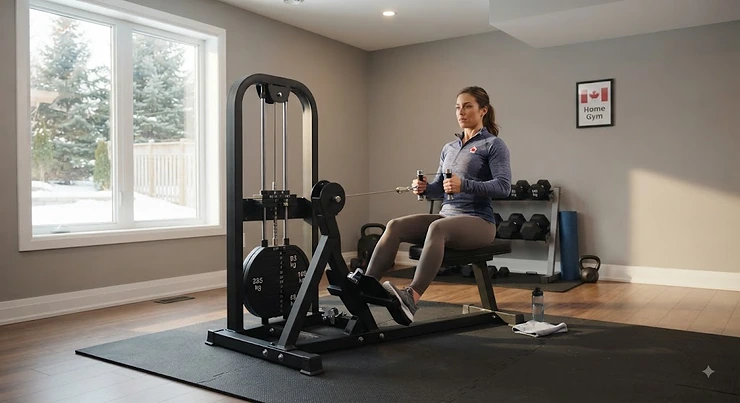
A seated row machine for home gym training is a fixed-path resistance machine that lets you sit, brace your chest or torso against a pad, and pull a handle (or independent handles) toward your body to work the lats, rhomboids, traps, and rear delts. Some are plate-loaded, some run on a leverage arm with gas-assisted resistance, and some hide inside a multi-station cable gym.
This guide breaks down seven real, currently available machines — from a sub-C$450 plate-loaded unit to a leverage row machine that lands just under C$1,500 CAD — with honest analysis pulled from spec sheets and aggregated reviewer sentiment, not fabricated hands-on claims. Whether you’re chasing bigger lats, better posture, or just tired of doing bent-over rows with a wobbly lower back, there’s a machine here that fits your space, budget, and training goals. According to Canada’s physical activity guidance for adults, muscle-strengthening activities using major muscle groups are recommended on a regular basis, and a dedicated pulling machine is one of the more joint-friendly ways to check that box consistently.
Quick Comparison Table
| Machine | Type | Price Range (CAD) | Weight Capacity | Best For |
|---|---|---|---|---|
| Mikolo Plate Loaded Seated Row Machine | Plate-loaded | C$350–C$450 | 400 lb | Tightest budget |
| Marcy MWM-990 Multifunctional Home Gym | Cable stack | C$750–C$900 | 150 lb stack | All-in-one beginners |
| Titan Fitness Plate-Loaded Seated Row Machine | Plate-loaded | C$500–C$650 | 270 lb | Best value dedicated row |
| Valor Fitness CB-14 Plate Loaded Seated Row Machine | Plate-loaded | C$650–C$800 | 400 lb | Adjustability on a budget |
| Body-Solid GSRM40B Plate Loaded Seated Row Machine | Plate-loaded | C$1,050–C$1,250 | Commercial-rated | Durability-focused lifters |
| Body-Solid Pro Clubline Leverage Seated Row | Leverage | C$1,350–C$1,499 | Commercial-rated | Leverage machine under $1,500 CAD |
| PRIME Fitness USA Plate Loaded Seated Row | Plate-loaded, made-to-order | C$2,200–C$2,800 | Commercial-rated | Buy-it-once premium |
Look at the spread here and a pattern jumps out fast: price climbs almost in lockstep with adjustability and steel gauge, not with brand hype. The Mikolo Plate Loaded Seated Row Machine and Titan Fitness Plate-Loaded Seated Row Machine both get you into a dedicated pulling motion for under C$650, but you’re trading away the multi-position chest pads and heavier-gauge frames that the Body-Solid GSRM40B Plate Loaded Seated Row Machine and Body-Solid Pro Clubline Leverage Seated Row bring to the table. If your ceiling is around C$1,500 and you specifically want a leverage row machine (gas-assisted, dual-axis arms instead of a straight cable pull), the Body-Solid leverage unit is the only one on this list built that way.
💬 Just one click — help others make better buying decisions too!😊
Top 7 Seated Row Machines for Home Gym: Expert Analysis
1. Mikolo Plate Loaded Seated Row Machine — cheapest true plate-loaded row on the market
The standout here is the price-to-capacity ratio: a 400 lb plate capacity for a machine that regularly sells in the low-budget bracket is genuinely unusual. The frame is heavy-gauge steel with a corrosion-resistant coating, the seat sits at an inclined angle designed to deepen the stretch at the bottom of the pull, and it ships with dual sleeve adapters so it accepts both 1-inch and 2-inch Olympic plates out of the box. Independent arms are the other headline feature — each side moves on its own path, which forces your weaker side to actually contribute instead of coasting off the stronger one.
Based on the spec comparison, this is the machine for someone furnishing a garage gym from scratch who needs a row station without blowing the whole equipment budget on one piece. The inclined seated position is a smart engineering choice for reaching a fuller range of motion than flat-seat competitors in the same price bracket, though the trade-off is a compact footprint that may feel snug for taller lifters. Reviewers consistently note that assembly takes real time and a second set of hands helps, and a handful mention the unilateral arms squeak faintly under heavy load until broken in — a cosmetic annoyance more than a functional flaw. On specs alone, this holds up well against machines costing two or three times as much.
Pros:
- ✅ 400 lb plate capacity at a genuinely budget price
- ✅ Independent arms build side-to-side strength balance
- ✅ Compact footprint fits small home gym corners
Cons:
- ❌ Assembly reportedly takes longer than expected
- ❌ Limited long-term durability data since it’s newer to market
Price sits around C$350–C$450 CAD at the time of research, and for that range it’s hard to find a plate-loaded row with comparable capacity — a genuinely strong value verdict for first-time buyers.
2. Marcy MWM-990 Multifunctional Home Gym — cheapest way to add a low-pulley row to a full station
This one is not a dedicated row machine, and that’s actually the standout feature: it’s a compact, weight-stack multi-gym with a low pulley station that lets you perform seated rows alongside more than 30 other exercises — lat pulldowns, chest presses, leg extensions, curls — from one footprint. If you’ve only got room for a single machine and want to cover your whole upper body, not just pulling, this is the play.
The 150 lb weight stack uses a traditional cable-and-pulley system rather than power rods, which reviewers and independent testers flag as the more durable choice for long-term daily use, especially in shared households. What most buyers overlook is that the machine’s physical footprint doesn’t match its operational footprint — the lat bar sweeps outward during use, so you need roughly three feet of clearance in front of the unit even though the frame itself measures about 68 by 36 inches. Aggregated reviewer sentiment is broadly positive on value for money, with recurring praise for the steel frame surviving years of home use, but a genuine limitation flagged repeatedly is that the seat and backrest padding isn’t height-adjustable, which can pinch the range of motion for users over six feet.
Pros:
- ✅ Covers back, chest, arms, and legs in one machine
- ✅ Traditional cable system outlasts power-rod competitors
- ✅ Compact enough for apartments and small basements
Cons:
- ❌ Fixed seat height limits taller users
- ❌ 150 lb stack ceiling caps long-term progression
Expect a price in the C$750–C$900 range, and the value case is strongest for someone building a first home gym from zero rather than someone who already owns a bench and rack and just wants a row station.
3. Titan Fitness Plate-Loaded Seated Row Machine — best dedicated row under six hundred dollars
The standout feature is adjustability at a price point that usually skips it entirely: six seat height settings and five chest pad angle settings, which is more granular positioning than most machines twice its price offer. Extra-thick padded foot braces keep your base locked in during heavier pulls, and the plate posts are rated to handle a meaningful load for serious progressive overload over time.
Here’s what to weigh: the six-position seat genuinely matters if more than one person in the household uses the machine, since it means a 5’4″ and a 6’2″ lifter can both find a proper starting position without kneeling on a milk crate. Reviewers consistently point to the machine maximizing range of motion during the row compared to flat, non-adjustable competitors, which translates to a deeper stretch on the lats at the bottom of each rep. On the downside, some aggregated feedback notes the included handles feel narrower than ideal for lifters with bigger hands, and a few users mention the powder coat shows wear faster than the Body-Solid options further down this list.
Pros:
- ✅ Six seat heights and five chest pad angles
- ✅ Extra-thick foot braces improve stability under load
- ✅ Strong range-of-motion design for the price tier
Cons:
- ❌ Stock handles feel narrow for larger grips
- ❌ Finish shows wear faster than commercial-tier options
At roughly C$500–C$650 CAD, this is arguably the sweet spot for anyone who wants a dedicated row (not a multi-gym) without stepping into four-figure territory.
4. Valor Fitness CB-14 Plate Loaded Seated Row Machine — most adjustable pick in the mid-range
What sets this one apart is dual adjustability paired with genuine compactness: a four-position seat pad and a five-position chest pad, built into a frame that’s reportedly about ten inches shorter than comparable competitors — a real advantage if your gym space is tight. The 12-gauge steel construction is rated to handle 200 lb per arm, for a combined 400 lb total load capacity, and it ships with Olympic sleeve adapters so it works with both standard 1-inch and 2-inch plates.
Based on the spec sheet, the tapered seat design is a small but smart touch — it reduces thigh pressure during longer sets, which matters more than it sounds like once you’re twenty minutes into a back-and-pull session. Aggregated reviews are notably consistent on two points: buyers repeatedly mention appreciating the shorter footprint for space-constrained rooms, and several note the assembly instructions are clear even though the build itself takes a while. On the critical side, a recurring theme is that the handles, while functional, don’t offer the 360-degree rotation found on the pricier Body-Solid and PRIME Fitness machines further down this list — so grip variety is more limited.
Pros:
- ✅ Shorter frame saves real floor space
- ✅ 400 lb combined capacity across both arms
- ✅ Dual sleeve adapters fit standard and Olympic plates
Cons:
- ❌ Handles don’t rotate 360 degrees like premium models
- ❌ Assembly time is longer than budget competitors
Expect to pay in the C$650–C$800 CAD range, and the value verdict is strong specifically for anyone training in a tight spare room where every inch of clearance counts.
5. Body-Solid GSRM40B Plate Loaded Seated Row Machine — commercial-grade durability for serious lifters
The standout here is build quality: this machine is rated for residential, light commercial, and full commercial use on the same frame, which tells you something about the bushings, welds, and steel gauge involved. Four-way multi-grip handles let you switch between wide, narrow, and neutral rowing angles to shift emphasis across the upper and mid-back, and the fully adjustable DuraFirm seat and chest pads accommodate a wide range of body types and arm lengths.
What most buyers overlook about this model is that the pre-stretch position matters as much as the pulling motion itself — the adjustable chest pad lets you dial in a deeper starting stretch on the lats than fixed-pad machines allow, which is where a lot of the real hypertrophy stimulus comes from in a rowing movement. Reviewers and commercial gym operators consistently cite this line as durable enough for high-throughput settings, which is a strong signal for home use where the machine will see years of repeated loading. On the downside, the commercial rating comes with commercial size and weight — at roughly 88 lb and a 54-by-44-inch footprint, this isn’t a machine you casually shuffle into a closet between sessions.
Pros:
- ✅ Four-way grips for wide, narrow, and neutral rows
- ✅ Commercial-use rating signals long-term durability
- ✅ Fully adjustable seat and chest pad for varied body types
Cons:
- ❌ Larger footprint than budget-tier alternatives
- ❌ Heavier machine makes repositioning difficult
Pricing lands around C$1,050–C$1,250 CAD, which is a meaningful step up from the budget tier, but the value case is straightforward if you want a machine that won’t need replacing when your strength numbers climb.
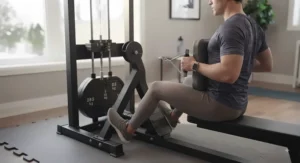
6. Body-Solid Pro Clubline Leverage Seated Row — best leverage row machine under $1,500 CAD
This is the leverage machine on the list, and the standout feature is right there in the mechanism: instead of a straight cable pull, it uses dual-axis, unilateral, diverging-arm movement designed to follow a more biomechanically natural pulling path. Gas-assisted chest support automatically adjusts to different arm lengths, and 360-degree articulating hand grips let your wrists follow their natural rotation through the pull instead of locking into one fixed angle.
Here’s what a leverage row machine review should actually tell you: the diverging arms mean each side of your back works somewhat independently even though you’re pulling both handles at once, which is a middle ground between a barbell row (fully independent, harder to control) and a fixed-bar cable row (fully linked, easier but less unilateral demand). Based on the spec comparison, the 2-by-3-inch 11-gauge steel mainframe is built to the same commercial standard as Body-Solid’s other Pro Clubline equipment, and the gas-assisted seat adjustment removes the fiddly pin-and-hole seat sizing that slows you down on machines further up this list. The honest trade-off is that leverage machines generally cost more per pound of resistance capacity than plate-loaded row machines, since you’re paying for the linkage engineering, not just steel and pads.
Pros:
- ✅ Gas-assisted seat adjusts instantly to different users
- ✅ Diverging arms mimic a more natural pulling path
- ✅ Commercial 11-gauge steel mainframe built to last
Cons:
- ❌ Premium leverage design costs more than plate-loaded rivals
- ❌ Heavier and bulkier than most home-gym row machines
Real-world pricing tends to land right around C$1,350–C$1,499 CAD depending on retailer and shipping — squarely inside the “leverage machine under $1,500 CAD” bracket, and arguably the best value leverage row machine in that price ceiling.
7. PRIME Fitness USA Plate Loaded Seated Row — the buy-it-once premium pick
The standout feature is customization depth: eight chest pad adjustments and eight seat height adjustments, paired with what the manufacturer calls Smart Strength Technology — a system that lets you shift where in the pulling motion the resistance feels heaviest (start, middle, end, or combinations of each). This machine is made to order, which is unusual in a category dominated by mass-produced imports.
What the spec sheet won’t tell you outright, but the adjustable resistance-profile feature strongly implies, is that this machine is built for lifters who’ve outgrown the “just add plates and pull” stage and want to manipulate exactly where a rowing movement feels hardest — useful for breaking through sticking points or working around old shoulder issues by avoiding a painful range. At roughly 350 lb for the machine itself and a 59-by-56-inch footprint, this is a serious commitment of both floor space and budget, squarely aimed at home gym owners who train like it’s their job, not a casual back-day accessory. Based on the spec comparison against every other machine on this list, nothing here offers comparable adjustability of the actual resistance curve, not just the seat and pad positions.
Pros:
- ✅ Adjustable resistance profile across the pulling motion
- ✅ Eight-position seat and chest pad for precise fit
- ✅ Made-to-order build quality, not mass-produced
Cons:
- ❌ Highest price and largest footprint on this list
- ❌ Overkill for casual or beginner home gym users
Expect a premium price tag in the C$2,200–C$2,800 CAD range at the time of research — the clear top-tier pick if your budget and space both have room to stretch.
Practical Usage Guide: Setting Up Your Row Machine Right
Getting a seated row machine for home gym use into your routine correctly matters more than which model you bought — a mediocre machine used with good form beats a premium one used sloppily. Start with seat height: your chest pad or torso should sit level enough that the handles line up roughly with your sternum when your arms are extended, not your chin or your belly button. Too high and you’ll shrug the weight up with your traps; too low and you’ll round your lower back reaching for it.
For your first 30 days, resist the urge to load the machine like you’re auditioning for a strongman show. Most plate-loaded seated row machines reward controlled tempo over raw weight — a two-second pull, a one-second squeeze at your chest, and a three-second release does more for lat development than yanking plates around at max load. Maintenance is refreshingly low: wipe down vinyl padding after sweaty sessions so it doesn’t crack prematurely, check and re-tighten bolts monthly (vibration loosens hardware faster than you’d think), and lubricate any exposed pivot points or bushings every few months if your machine has them, which leverage machines like the Body-Solid Pro Clubline Leverage Seated Row typically do. The single most common first-month mistake is skipping the pre-stretch — letting the chest pad sit too close so you never get a full stretch at the bottom, which quietly caps your lat development before it starts.
Real-World Scenarios: Who Should Buy Which Machine
Picture a university student in a shared basement apartment with maybe 40 square feet to spare and a strict budget. That person is looking at the Mikolo Plate Loaded Seated Row Machine or the Marcy MWM-990 Multifunctional Home Gym — the Marcy especially, since one machine covering the whole upper body beats three separate pieces crammed into a hallway.
Now picture a home gym owner in their late 30s who already has a rack, a bench, and dumbbells, and just wants dedicated back volume without another multi-gym eating floor space. That’s the Titan Fitness Plate-Loaded Seated Row Machine or Valor Fitness CB-14 Plate Loaded Seated Row Machine territory — both dedicated, both reasonably compact, both under C$800.
Finally, picture someone training five days a week, chasing real strength progression, who’s already felt a cheap machine flex or wobble under load. That person should be looking at the Body-Solid GSRM40B Plate Loaded Seated Row Machine, the Body-Solid Pro Clubline Leverage Seated Row, or the PRIME Fitness USA Plate Loaded Seated Row, depending on whether budget tops out near C$1,200, C$1,500, or stretches toward C$2,800.
✨ Don’t Miss These Exclusive Deals!
🔍 Take your home gym to the next level with a row machine that actually matches your training goals. Click on any highlighted pick above to check current pricing and availability on amazon.ca. A stronger back and better posture are one purchase away!
Buyer’s Decision Framework
If space is your biggest constraint, choose a compact plate-loaded unit like the Valor Fitness CB-14 Plate Loaded Seated Row Machine because its shorter frame was specifically engineered around tight footprints. If budget is your hard ceiling and you need more than just a row station, choose the Marcy MWM-990 Multifunctional Home Gym because it consolidates several movement patterns into one weight stack. If you want the most natural pulling biomechanics and have up to C$1,500 CAD to spend, choose the Body-Solid Pro Clubline Leverage Seated Row because its diverging-arm design tracks closer to how your shoulder blades actually move. If you’re training at a genuinely advanced level and want to manipulate resistance curves, choose the PRIME Fitness USA Plate Loaded Seated Row because nothing else on this list offers that level of control.
How to Choose a Seated Row Machine for Home Gym
- Measure your space first, not last. Account for the sweep of the pulling motion and the arc of any lat bar attachment, not just the machine’s resting footprint — a mistake that trips up more buyers than any spec on the page.
- Match capacity to where you’re headed, not where you are. A 200 lb plate capacity feels generous as a beginner and frustratingly limiting eighteen months later.
- Prioritize seat and pad adjustability over raw capacity if multiple people will use it. A machine with six seat positions is more useful to a shared household than one with 50 extra pounds of headroom. This lines up with the Canadian Society for Exercise Physiology’s movement guidelines, which recommend muscle-strengthening work for all major muscle groups at least twice a week — a target that’s easier to hit consistently on a machine that actually fits everyone using it.
- Decide between plate-loaded and leverage mechanics deliberately. Plate-loaded machines cost less per pound of capacity; leverage machines like the Body-Solid Pro Clubline Leverage Seated Row offer a more natural diverging-arm path but at a real price premium.
- Check the steel gauge and frame rating, not just the marketing copy. Commercial-rated frames such as the Body-Solid GSRM40B Plate Loaded Seated Row Machine are built to a materially higher durability standard than budget imports.
- Factor in handle variety. Four-way or 360-degree rotating grips let you change hand position mid-program to keep stimulating the back from slightly different angles.
- Budget for plates separately if buying a plate-loaded machine. The machine price rarely includes weight plates, and that’s an easy line item to forget until checkout.
Leverage Row Machine vs Plate-Loaded Row Machine
This is the comparison most buyers skip, and it’s the one that actually changes which category you should shop in. A plate-loaded seated row — like the Titan Fitness Plate-Loaded Seated Row Machine or Body-Solid GSRM40B Plate Loaded Seated Row Machine — pulls along a fixed cable or pulley path. It’s simple, cheaper to manufacture, and easy to maintain since there’s less mechanical linkage to wear out.
A leverage row machine, like the Body-Solid Pro Clubline Leverage Seated Row, replaces that fixed cable with a pivoting arm system. The resistance you feel changes slightly through the range of motion because of the leverage ratio, which many lifters find feels more like a natural row and less like fighting a straight-line cable. The diverging-arm design also allows more genuine unilateral movement — your left and right sides can travel slightly different paths — which a fixed-bar cable row can’t replicate. The trade-off, as covered in the product section above, is cost: leverage engineering adds meaningfully to the price tag, which is why the Body-Solid Pro Clubline Leverage Seated Row sits at nearly triple the price of the Titan Fitness Plate-Loaded Seated Row Machine despite similar overall footprint. Neither approach is objectively better — plate-loaded machines win on value and simplicity, leverage machines win on movement feel and unilateral demand.
Common Mistakes When Buying a Seated Row Machine
The most common and costly mistake is buying based on plate capacity alone. A 500 lb-rated frame sounds impressive, but if the seat only has two height positions, you may never train in a properly aligned position regardless of how much weight you can technically load. A close second is ignoring floor clearance for the pulling arc — several reviewers across multiple machines on this list specifically flag underestimating the forward sweep of the handles or lat bar, only to discover it clips a nearby wall or rack mid-rep.
Buyers also frequently skip checking whether a machine accepts both standard 1-inch and Olympic 2-inch plates — a real problem if you already own a specific plate diameter and the new machine only takes the other kind. Finally, a subtler mistake: chasing a leverage machine purely for the “premium” label without confirming it actually fits your training style. If you mostly train alone at moderate weights, the extra cost of a leverage system like the Body-Solid Pro Clubline Leverage Seated Row may not pay for itself compared to putting that money toward a well-built plate-loaded option and better plates.
Rowing Machine Form: What to Expect from Real-World Performance
Specs tell you what a machine can do; form determines what it actually does for your back. On a seated row machine, the movement starts with your shoulder blades — pull them together and down before your arms even bend, then let your elbows drive back past your ribs while keeping your torso still against the pad. The most common form breakdown reviewers and trainers describe is using momentum — rocking the torso forward and back to sling the weight — which shifts load off the back muscles and onto the lower spine.
What most buyers overlook about rowing machine form specifically is grip width’s effect on which muscles do the most work: a wider grip biases the rear delts and upper back, while a closer, more supinated grip shifts emphasis toward the lats and lower traps. This is exactly where four-way handles on machines like the Body-Solid GSRM40B Plate Loaded Seated Row Machine, or the 360-degree rotating grips on the Body-Solid Pro Clubline Leverage Seated Row, earn their keep — they let you cycle through grip angles across a training block instead of hammering the same pattern every session. On a well-adjusted machine, expect a full stretch at the front of the rep, a hard squeeze at the back, and controlled negatives — that’s the real-world signal that both your form and your machine setup are dialed in correctly.
Plate-Loaded Pulling Exercises for Back and Pull Training
A seated row is one exercise, not a whole back day, and pairing it with other plate-loaded pulling exercises rounds out a proper back and pull training session. A sensible structure looks like this: start with a heavier compound pull — barbell rows or a plate-loaded row machine set at your working weight for 3 to 4 sets of 6 to 10 reps — then move to a wider-grip variation on the same machine (using four-way or rotating handles) for 3 sets of 10 to 12 to hit the rear delts and upper traps from a different angle.
From there, plate-loaded pulling exercises like single-arm rows on a leverage machine such as the Body-Solid Pro Clubline Leverage Seated Row add unilateral volume, which is genuinely useful for correcting side-to-side strength imbalances that bilateral rowing tends to mask. Close out with a higher-rep, lighter-load finisher — 2 sets of 15 to 20 on whichever seated row machine you own, focusing purely on the squeeze at the top of the pull rather than chasing weight. This kind of back and pull training structure — heavy compound, moderate variation, unilateral accessory, high-rep finisher — is a template that scales down for the Mikolo Plate Loaded Seated Row Machine‘s more modest capacity just as easily as it scales up for the PRIME Fitness USA Plate Loaded Seated Row‘s adjustable resistance curve.
Long-Term Cost & Maintenance
Sticker price is only part of the real cost of a seated row machine for home gym use. Plate-loaded machines require you to already own or separately buy weight plates, which can add several hundred dollars depending on how heavy you plan to train — a cost that applies equally to the Titan Fitness Plate-Loaded Seated Row Machine and the PRIME Fitness USA Plate Loaded Seated Row alike, regardless of the machine’s own price tag. Leverage machines like the Body-Solid Pro Clubline Leverage Seated Row also take plates, so that cost isn’t avoided by going the leverage route — you’re paying extra for the linkage mechanism, not saving on plates.
Ongoing maintenance costs are genuinely low across this whole category compared to cable-stack multi-gyms like the Marcy MWM-990 Multifunctional Home Gym, which eventually needs replacement cables — a wear item that plate-loaded and leverage machines simply don’t have. Upholstery is the most common replacement item across the board; expect vinyl seat and chest pads to need reupholstering or replacing somewhere in the 5 to 10 year range depending on use frequency, with commercial-rated frames like the Body-Solid GSRM40B Plate Loaded Seated Row Machine generally outlasting budget imports on pad durability alone. Total cost of ownership over five years tends to favour dedicated plate-loaded machines: lower upfront cost than leverage or premium options, minimal wear parts, and resale value that holds up reasonably well if the frame and welds are solid.
Safety, Regulations & Compliance for Home Gym Equipment in Canada
Home gym equipment in Canada falls under the Canada Consumer Product Safety Act, which gives Health Canada authority to test products for mechanical, chemical, and other hazards and to enforce safety standards on items sold here, exercise machines included. In practice, keeping an eye on Health Canada’s published consumer safety guidelines and recall notices before and after you buy is a genuinely useful habit — mechanical fitness equipment recalls do happen, and checking is free.
For a seated row machine specifically, the practical safety checklist is short: confirm plate posts have working locking clips or collars before every heavy session, inspect cables or gas-assist mechanisms on leverage machines periodically for fraying or leaks, and make sure the machine is on a level, non-slip surface so it can’t shift mid-pull. If you’re training with any pre-existing back or shoulder condition, it’s worth checking in with a healthcare provider before starting a new pulling program, since general physical activity guidance for Canadian adults notes that some circumstances warrant a conversation with a health professional about what’s appropriate for you.
Leverage Machines Under $1,500 CAD: Is It Worth the Upgrade?
The C$1,500 CAD mark is a meaningful psychological line for home gym buyers, and the Body-Solid Pro Clubline Leverage Seated Row sits right under it — which makes it worth asking directly whether the leverage upgrade is worth the jump from a C$650–C$800 plate-loaded machine like the Valor Fitness CB-14 Plate Loaded Seated Row Machine.
The honest answer depends on training age. A newer lifter still building base strength and consistency gets relatively little extra benefit from diverging-arm biomechanics — a well-built plate-loaded machine delivers nearly identical muscle stimulus for a fraction of the price. An intermediate or advanced lifter who’s logged real time under a barbell and cable machines, and who notices asymmetries or wants a more natural pulling arc to manage shoulder comfort, is the buyer who actually benefits from what a leverage machine under $1,500 CAD offers. On paper, the extra cost buys gas-assisted adjustment speed, a more natural unilateral path, and commercial-grade steel — real upgrades, but ones that matter more the more experienced and specific your training gets.
Frequently Asked Questions
❓ What muscles does a seated row machine work?
❓ Is a leverage row machine better than a plate-loaded row machine?
❓ How much weight capacity do I need on a seated row machine?
❓ Can a seated row machine replace pull-ups or barbell rows?
❓ How often should I train back and pull exercises each week?
Conclusion
There’s no single best seated row machine for home gym use — there’s only the best one for your space, your budget, and how seriously you’re training. The Mikolo Plate Loaded Seated Row Machine and Marcy MWM-990 Multifunctional Home Gym get you pulling for well under C$900. The Titan Fitness Plate-Loaded Seated Row Machine and Valor Fitness CB-14 Plate Loaded Seated Row Machine cover the dedicated mid-range sweet spot. The Body-Solid GSRM40B Plate Loaded Seated Row Machine and Body-Solid Pro Clubline Leverage Seated Row step up into commercial-grade territory, with the latter delivering genuine leverage-machine biomechanics right at the C$1,500 CAD ceiling. And the PRIME Fitness USA Plate Loaded Seated Row sits at the top for lifters who want total control over their resistance curve and don’t mind paying for it.
Whichever you choose, the real win isn’t the machine — it’s finally giving your back the same attention your chest and arms have gotten for years. Check current pricing on amazon.ca before you commit, since plate-loaded and leverage equipment pricing shifts more than people expect.
Recommended for You
- Plate-Loaded Leg Press Machines: 7 Best Picks for Canadian Home Gyms (2026)
- 7 Best Plate-Loaded Shoulder Press Machines in Canada (2026)
- Leverage Chest Press Machine for Home Gym: 7 Picks for 2026 (Pros; Cons)
Disclaimer: This article contains affiliate links. As an Amazon Associate, I earn from qualifying purchases. If you purchase products through these links, we may earn a small commission at no additional cost to you.
✨ Found this helpful? Share it with your friends! 💬🤗
