In This Article
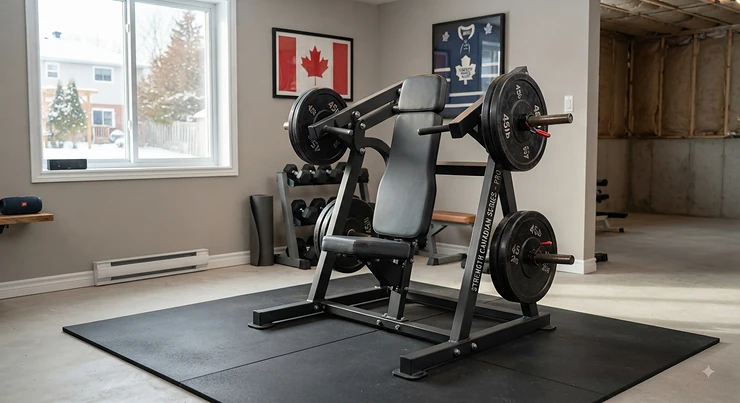
Somewhere between “I want boulder shoulders” and “please don’t let me tear my rotator cuff,” there’s a piece of equipment that quietly does the heavy lifting for you: the plate-loaded shoulder press machine. It’s not flashy. It won’t trend on fitness TikTok. But walk into any serious strength room in Canada — from a CrossFit box in Calgary to a physio-adjacent training studio in Halifax — and you’ll find one bolted to the floor, plates stacked on its posts, doing exactly what it was built to do.
A plate-loaded shoulder press machine is a fixed-path strength machine that lets you load standard weight plates onto its arms instead of pinning a weight stack, giving you a guided overhead pressing motion with more joint control than a barbell and more resistance ceiling than most home-gym alternatives. That’s the plain-English version. The longer version is that these machines split the difference between free-weight pressing (maximum muscle recruitment, maximum risk if your form slips) and cable or pin-loaded machines (very safe, sometimes a bit too locked-in for natural shoulder movement). For anyone managing a cranky shoulder, coming back from a rotator cuff strain, or just tired of wrestling dumbbells into position overhead, that middle ground matters.
This guide digs into seven real plate-loaded shoulder press machines available to Canadian buyers and gym owners, ranging from a genuinely affordable home-gym option to commercial-grade iso-lateral machines that cost as much as a used hatchback. We’ll get into specs, but more importantly, we’ll get into what those specs actually mean for your shoulders — because a spec sheet won’t tell you whether a machine is rotator-cuff friendly, and neither will an Amazon listing. According to Canada’s own physical activity guidance, adults should be doing muscle-strengthening work at least twice a week, and shoulders are one of the most commonly under-trained — and over-injured — muscle groups in that mix. Let’s find the machine that actually fits your shoulders, your goals, and your garage or gym floor.
Quick Comparison Table
| Machine | Price Range (CAD) | Best For |
|---|---|---|
| Titan Fitness Plate-Loaded Deltoid and Shoulder Press Machine | Under C$1,000 | Budget home gyms |
| Steelflex PLSP Plate Loaded Shoulder Press | C$2,000–C$2,300 range | Converging-path safety |
| Body-Solid Pro Clubline Series II Shoulder Press (S2SP) | C$2,800–C$3,200 range | Commercial-grade home use |
| Muscle D Fitness Excel Strength Iso-Lateral Shoulder Press (EXP-1640) | C$3,100–C$3,400 range | Correcting side imbalances |
| Life Fitness Plate-Loaded Shoulder Press | C$4,000+ range | Full commercial facilities |
Even a five-row snapshot tells a story here: price climbs steeply once you move from a single-station home-gym unit into iso-lateral commercial territory, and that jump buys you independent arm paths, heavier-gauge steel, and — often — a more forgiving pressing arc for anyone with shoulder history. The Titan Fitness unit is the clear entry point for a garage gym, while the Muscle D and Life Fitness machines are built for facilities where dozens of different bodies press on them every single day. Notice, too, that price doesn’t map neatly to “best for rehab” — some mid-range machines actually out-perform pricier ones on joint-friendliness, which is exactly the kind of nuance a spec sheet alone won’t surface.
💬 Just one click — help others make better buying decisions too!😊
Top 7 Plate-Loaded Shoulder Press Machines: Expert Analysis
1. Titan Fitness Plate-Loaded Deltoid and Shoulder Press Machine — best budget entry point
The Titan Fitness Plate-Loaded Deltoid and Shoulder Press Machine is the machine most Canadian home-gym owners actually end up buying, and there’s a straightforward reason for that: it’s the rare plate-loaded unit priced for a spare bedroom budget rather than a commercial equipment order. It ships with four weight sleeves rated to a combined 700 lb capacity, built from 2-inch 11-gauge steel, so you’re not going to outgrow it unless you’re pressing at a genuinely elite level. The seat adjusts across four height positions in one-inch increments, and a spring-loaded lockout gives you a safety catch at the top of the press rather than leaving you to control 700 lb of stacked plates on your own.
Based on the spec comparison against other entry-level units, what stands out here isn’t raw capacity — plenty of budget machines claim big numbers — it’s the combination of a reasonably long weight sleeve (9.75 inches) and a proper lockout mechanism, both of which are frequently the first things cut on cheaper imports. This machine suits someone building a first home gym who wants a guided overhead press without the injury risk of loading a heavy barbell overhead alone in their basement. Reviewers consistently report straightforward assembly and a smooth, if slightly less refined, pressing arc compared with commercial iso-lateral machines — a fair trade-off at this price point. A common complaint in user reviews is that the fixed (non-converging) arm path feels less natural for taller users, something worth testing if you’re over 6’2″.
Pros:
- ✅ Genuinely affordable entry into plate-loaded pressing
- ✅ 700 lb combined capacity handles years of progression
- ✅ Spring-loaded lockout adds a real safety margin
Cons:
- ❌ Fixed arm path less forgiving for tall or long-limbed users
- ❌ Lighter-gauge pads wear faster than commercial units
At under C$1,000, this is the value pick of the lineup, and it’s the machine we’d point most first-time home-gym buyers toward before recommending anything pricier.
2. Steelflex PLSP Plate Loaded Shoulder Press — converging arm path for shoulder safety
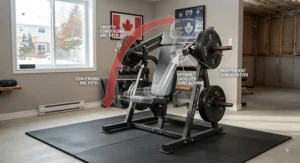
The Steelflex PLSP Plate Loaded Shoulder Press takes a different engineering approach than the Titan unit above: a 25-degree converging arm path, meaning the handles move slightly inward as you press, mimicking the natural way your arms travel overhead rather than forcing a dead-straight vertical line. That single design choice is arguably the most important spec on this entire list for anyone with shoulder history, because a converging path reduces the impingement-prone “stuck straight up” position that plagues cheaper fixed-arm machines.
What most buyers overlook about convergence angles is that they’re not a marketing gimmick — they’re biomechanics. Your shoulder joint doesn’t move in a single plane, and a machine that respects that tends to feel noticeably smoother on the way up, especially past the halfway point of the press where impingement risk peaks. This machine suits intermediate lifters and anyone specifically training around a shoulder issue, since the guided-but-natural arc lets you load real weight without forcing your joint into an unnatural groove. Reviewers consistently note the smoothness of the pivot bearings and describe the machine as noticeably quieter under load than comparable steel-frame units, though a handful mention the seat pad could use more padding for longer sessions.
Pros:
- ✅ 25-degree converging path mimics natural shoulder motion
- ✅ Smooth, well-reviewed pivot bearing system
- ✅ Solid mid-range durability for semi-commercial use
Cons:
- ❌ Thinner seat padding than some competitors
- ❌ Bulkier footprint than single-user home units
In the C$2,000–C$2,300 range, the Steelflex PLSP earns its price premium almost entirely through that converging arm design — it’s the machine to pick if joint-friendliness matters more to you than raw capacity.
3. Body-Solid Pro Clubline Series II Shoulder Press (S2SP) — commercial durability for a home setup
The Body-Solid Pro Clubline Series II Shoulder Press sits in that useful middle zone where commercial-gym engineering meets a footprint that can still work in a serious home gym. Body-Solid’s Pro Clubline series is built to the same fundamental standard the company sells into commercial facilities, which means heavier steel, sealed bearings, and upholstery rated for daily multi-user wear rather than the occasional weekend warrior.
Here’s what to weigh with a machine like this: you’re paying partly for the pressing mechanism itself and partly for longevity you may not fully use if you’re the only person training on it. On paper, this means a home-gym buyer might be “over-buying” durability — but if you’re outfitting a small studio, a physiotherapy clinic’s strength room, or a shared basement gym with multiple family members, that durability stops being optional and starts being the whole point. The spec sheet won’t tell you this, but user reports on Pro Clubline equipment broadly suggest the sealed-bearing pivots hold up noticeably better over years of use than the open-bearing designs found on budget machines, meaning less mid-life maintenance.
Pros:
- ✅ Commercial-grade steel and sealed bearing pivots
- ✅ Upholstery built for heavy multi-user rotation
- ✅ Strong resale value given brand reputation
Cons:
- ❌ Premium pricing relative to home-only use cases
- ❌ Larger footprint than most home-gym shoulder units
Expect a price range of roughly C$2,800–C$3,200, positioning the Body-Solid S2SP as the machine for buyers who want commercial confidence without stepping fully into iso-lateral territory.
4. Body-Solid ProClub Leverage Shoulder Press (LVSP) — smooth leverage arms for controlled presses
Where the S2SP above uses a converging cam-style path, the Body-Solid ProClub Leverage Shoulder Press relies on a leverage-arm system, which changes resistance feel throughout the range of motion in a way pure cam machines don’t always replicate. Leverage machines apply resistance through a pivoting arm rather than a cable-and-pulley or fixed cam track, and the practical upshot is a press that tends to feel lighter at the very bottom and top of the movement — precisely the two points where a compromised rotator cuff is most likely to complain.
Based on the mechanical design alone, this makes the LVSP a genuinely sensible pick for anyone rebuilding pressing strength after a shoulder setback, since the resistance curve naturally protects the most vulnerable range without you having to consciously limit your own depth. It’s not marketed as rehab equipment — nobody should mistake any gym machine for a substitute for a physiotherapist’s guidance — but the biomechanics happen to line up well with rehab-conscious training. Reviewers commonly describe the leverage feel as “forgiving” compared with stiffer plate-loaded competitors, though a few note the leverage ratio means you’ll load noticeably more plate weight than the equivalent free-weight press to feel the same resistance, which can be confusing for lifters switching from barbells.
Pros:
- ✅ Leverage arm design eases strain at end ranges
- ✅ Commercial-grade frame from an established brand
- ✅ Compact relative to full iso-lateral machines
Cons:
- ❌ Resistance curve takes adjustment for barbell lifters
- ❌ Fewer seat adjustment increments than some rivals
Priced in a similar C$2,200–C$2,600 band, the Body-Solid LVSP is worth a close look for anyone whose main goal is training around, not through, a shoulder limitation.
5. Freemotion Plate-Loaded Shoulder Press — precision bearings and built-in plate storage
The Freemotion Plate-Loaded Shoulder Press is aimed squarely at commercial facilities, and it shows in details that a home buyer might not think to ask about: stainless steel weight-storage bars designed specifically to resist corrosion and rust, and precision pivot bearings engineered so that, in the company’s own framing, “you only feel weight resistance, not machine resistance.” That last point deserves unpacking, because it’s a real engineering distinction — cheap machines add friction through their own mechanism, meaning you’re partly fighting the equipment rather than purely training the muscle.
What the spec sheet won’t tell you, but reviewers note, is how much of a difference low-friction bearings make on the last few reps of a hard set, when your form starts to degrade and a machine that “fights back” mechanically can push you into compensatory movement patterns that stress the shoulder joint unnecessarily. This machine suits gym owners and serious home-gym builders who train frequently enough that bearing quality compounds over thousands of reps. The certified frame construction (rated to ISO strength-equipment standards) also signals a build quality aimed at facilities that need equipment insured and certified for public use.
Pros:
- ✅ Low-friction bearings reduce compensatory strain
- ✅ Rust-resistant stainless steel plate storage bars
- ✅ ISO-certified frame construction
Cons:
- ❌ Premium commercial pricing, not a casual home buy
- ❌ Large shipping footprint complicates home delivery
Expect this one to sit around C$3,500 and up depending on configuration, making the Freemotion machine a facility-first choice rather than a first home-gym purchase.
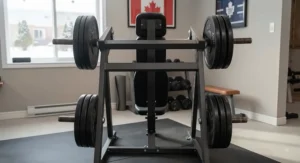
6. Muscle D Fitness Excel Strength Iso-Lateral Shoulder Press (EXP-1640) — independent arms catch imbalances
Iso-lateral design means each arm of the Muscle D Fitness Excel Strength Iso-Lateral Shoulder Press moves independently, rather than being locked to a single bar or shared cam. That sounds like a small mechanical detail, but it has an outsized effect on training quality: a fixed-bar machine lets your dominant, stronger shoulder quietly compensate for a weaker one, which over months can widen an existing left-right imbalance instead of correcting it.
Based on the spec comparison with fixed-path machines on this list, the practical benefit here is diagnostic as much as it is training-related — if one arm consistently struggles to complete the same range of motion as the other, you’ll notice immediately, which is exactly the kind of asymmetry a physiotherapist would want flagged early rather than masked. This machine suits intermediate to advanced lifters focused on symmetrical shoulder development, and anyone recovering unevenly from a one-sided injury who needs a training tool that won’t let the healthy side carry the compromised one. Reviewers consistently highlight the machine’s compact footprint relative to other commercial iso-lateral units, though a few mention the independent-arm design has a slight learning curve for lifters used to bilateral machines.
Pros:
- ✅ Independent arms expose and correct left-right imbalance
- ✅ Compact footprint for a commercial iso-lateral machine
- ✅ Multiple grip positions for varied training angles
Cons:
- ❌ Learning curve for lifters new to iso-lateral training
- ❌ Higher price bracket than fixed-arm alternatives
In the C$3,100–C$3,400 range, the Muscle D EXP-1640 earns its place for anyone training two shoulders that don’t currently agree with each other.
7. Life Fitness Plate-Loaded Shoulder Press — gold-standard commercial iso-lateral engineering
The Life Fitness Plate-Loaded Shoulder Press rounds out this list as the premium, full-commercial pick, and it’s built by a company whose equipment shows up in more gyms across North America than almost any other strength brand. It combines a 20-degree angled back pad — specifically engineered to improve core stabilization during the press rather than leaving your trunk to brace on its own — with converging and iso-lateral movement patterns that Life Fitness describes as delivering an “instinctively natural” pressing experience. Each weight rod accepts standard 45 lb (25 kg) plates, four per side, giving serious lifters ample headroom.
Here’s what to weigh: this is not a machine most individuals buy for a home gym, and its price reflects that reality. On paper, the 20-degree back pad angle is a small number, but in practice it changes how much your lower back and core absorb versus how cleanly the load transfers through your shoulders — a detail that matters enormously for anyone pressing heavy for years without cumulative strain. This machine suits commercial facilities, university athletic programs, and physiotherapy-adjacent training centres that need equipment built for thousands of cumulative user-hours and want the biomechanical refinement that comes with genuine iso-lateral engineering, not just a marketing label.
Pros:
- ✅ Angled back pad improves core stabilization under load
- ✅ True iso-lateral converging/diverging motion pattern
- ✅ Built for extremely high commercial usage volume
Cons:
- ❌ Priced well beyond most home-gym budgets
- ❌ Overkill for casual or infrequent users
At C$4,000 and up, the Life Fitness machine is the aspirational top of this list — the one facility owners graduate to, not the one most readers will start with.
Top 7 Products: Full Comparison
| Machine | Arm Design | Price Range (CAD) | Best For |
|---|---|---|---|
| Titan Fitness Plate-Loaded Deltoid and Shoulder Press Machine | Fixed path | Under C$1,000 | First home gym |
| Steelflex PLSP Plate Loaded Shoulder Press | 25° converging | C$2,000–C$2,300 | Joint-friendly pressing |
| Body-Solid Pro Clubline Series II (S2SP) | Cam-guided | C$2,800–C$3,200 | Home use with commercial durability |
| Body-Solid ProClub Leverage (LVSP) | Leverage arm | C$2,200–C$2,600 | Rehab-conscious pressing |
| Freemotion Plate-Loaded Shoulder Press | Pivot bearing | C$3,500+ | Facilities and studios |
| Muscle D Excel Strength (EXP-1640) | Iso-lateral | C$3,100–C$3,400 | Correcting shoulder imbalance |
| Life Fitness Plate-Loaded Shoulder Press | Iso-lateral converging | C$4,000+ | Commercial and university facilities |
Laid out side by side, a clear pattern emerges: every machine past the Titan Fitness entry-level unit trades a fixed arm path for some form of converging, leverage, or iso-lateral motion — and that shift is where the real joint-friendliness gains live, not in raw weight capacity. If budget allows only one upgrade over the cheapest option, spend it on arm-path design before spare weight capacity, since your shoulders will notice the difference in motion far sooner than they’ll notice hitting a capacity ceiling. Buyers managing a rotator cuff history should weight the Body-Solid LVSP and Steelflex PLSP most heavily on this table, since both were specifically engineered around end-range comfort rather than pure loading capacity.
✨ Don’t Miss These Exclusive Deals!
🔍 Take your shoulder training to the next level with these carefully selected machines. Click on any highlighted item to check current pricing and availability. The right machine will help you build stronger, healthier shoulders you’ll actually enjoy training for years to come!
Practical Usage Guide: Setting Up and Dialing In Your Machine
Getting a plate-loaded shoulder press machine into your gym is the easy part — dialing it in correctly during your first 30 days is where most of the value (and most of the avoidable strain) actually happens. Start with seat height before anything else: the handles should sit roughly level with your shoulders when you’re seated upright, not above ear height and not down at collarbone level, since either extreme forces your shoulder into a compromised starting position before you’ve lifted a single plate.
For your first two weeks, load conservatively — well under what you think you can handle — and spend those early sessions dialing in bar path and breathing rather than chasing numbers. A common first-30-days mistake is loading heavy immediately because “it’s just a machine, it’s safer than a barbell,” which is only half true: a machine removes the balance challenge of free weights, but it doesn’t remove the risk of pressing through a painful range with bad form. Maintenance-wise, plate-loaded machines need periodic bearing lubrication (check your specific model’s manual for interval recommendations, typically every few months of regular use) and a routine check of upholstery bolts, which loosen gradually under repeated load. A five-minute monthly inspection catches most issues before they become expensive ones. One optimization trick many buyers miss entirely: adjusting seat depth (where available) to change your torso’s distance from the handles subtly alters which head of the deltoid takes the most load, letting you rotate emphasis without switching exercises.
Real-World Scenarios: Who Should Buy Which Machine
If you’re a home-gym owner in a two-car garage with maybe C$1,000 to spend and no shoulder history to worry about, the Titan Fitness Plate-Loaded Deltoid and Shoulder Press Machine covers your needs without forcing a compromise on safety features like the lockout mechanism. You’re not going to outgrow 700 lb of combined capacity in a home-training context, and the fixed arm path, while less refined than pricier options, is perfectly serviceable for someone without a specific joint concern.
If you’re managing a rotator cuff strain from a previous injury and your physiotherapist has cleared you for guided pressing work, the Body-Solid ProClub Leverage Shoulder Press or the Steelflex PLSP Plate Loaded Shoulder Press deserve a much closer look than the budget option, since both were built around end-range comfort rather than maximum capacity. Neither machine is a substitute for professional rehab guidance — always confirm specific exercises with your physiotherapist first — but the biomechanics genuinely work in your favour. And if you’re outfitting a small commercial studio or a physiotherapy clinic’s strength area that sees a dozen different bodies a day, durability and iso-lateral correction matter more than they would for a solo home user, which points toward the Muscle D EXP-1640 or, budget allowing, the full commercial Life Fitness unit.
How to Choose a Plate-Loaded Shoulder Press Machine
Picking the right machine comes down to a handful of decisions that matter far more than brand name or paint colour:
- Arm path design first. Converging, leverage, or iso-lateral paths all reduce impingement risk compared with a rigid fixed-bar design — prioritize this above almost everything else if shoulder comfort is a concern.
- Weight capacity relative to your actual training level. Most lifters never approach 700 lb combined capacity on a shoulder press; don’t overpay for headroom you won’t use.
- Seat adjustability range. More height increments mean a better fit across different body types, which matters enormously in a shared home or facility setting.
- Bearing and pivot quality. Sealed, low-friction bearings reduce the “fighting the machine” feeling that can push you into compensatory bad form on hard sets.
- Footprint versus your available space. Commercial iso-lateral machines can run 60+ inches in one dimension — measure your space before falling in love with a spec sheet.
- Warranty and parts availability in Canada. Confirm the seller ships replacement pads, bearings, and upholstery to Canadian addresses without punishing cross-border fees.
- Total cost including plates. A machine’s price rarely includes the weight plates themselves — budget separately for enough plate weight to actually progress.
Shoulder Press Machine for Shoulder Rehab
Using a shoulder press machine for shoulder rehab is a common enough goal that it deserves its own honest treatment, separate from general buying advice. The appeal is obvious: a guided path removes the stabilization demands of free weights, letting someone rebuilding strength focus purely on the pressing muscles without simultaneously relearning balance and control. That said, “machine” doesn’t automatically mean “rehab-safe” — a rigid fixed-arm machine can actually be worse for a compromised rotator cuff than a well-executed dumbbell press at a reduced range, because it locks you into one path with zero ability to adjust mid-rep if something feels wrong.
The machines on this list best suited to rehab-adjacent training — the Body-Solid ProClub Leverage Shoulder Press and the Steelflex PLSP Plate Loaded Shoulder Press — share a common trait: their resistance curves are engineered to be lightest exactly where the rotator cuff is most vulnerable, at the bottom and top of the press. A systematic review and meta-analysis published in the Journal of Orthopaedic & Sports Physical Therapy, co-authored by researchers from Université Laval and Université de Montréal, found that structured exercise therapy is genuinely effective for rotator cuff-related shoulder pain, and controlled overhead pressing work can play a real role in rebuilding stability once acute pain has settled, but the emphasis is always on light load, controlled tempo, and professional oversight — not on maximizing plates. If you’re working through an active injury, this article is not a substitute for that guidance; it’s a tool to help you pick equipment your physiotherapist would approve of, not a replacement for their assessment.
Shoulder Press Form: Getting It Right
Good shoulder press form on a plate-loaded machine starts before you ever touch the handles: sit with your shoulder blades pulled back and slightly down, your lower back in light contact with the pad (not arched hard away from it), and your feet planted flat for a stable base. From there, the handles should travel in a smooth arc without your elbows flaring aggressively wide or your neck craning forward to “help” the bar path — if you notice either happening, the weight is too heavy for clean form, full stop.
A common technical error, and one that shows up constantly in overhead pressing generally, is locking the elbows out hard at the very top of every rep. That habit transfers repetitive stress directly into the shoulder joint capsule rather than the muscle doing the work, and over months it’s a genuine contributor to impingement symptoms. Instead, aim for a controlled stop just short of full lockout, keep tempo slow on the way down (the eccentric phase), and resist the urge to bounce the weight at the bottom to generate momentum for the next rep. None of this is complicated, but it’s exactly the kind of detail that separates a machine that builds shoulders from one that quietly wears them down.
Rotator Cuff Friendly Training: What to Look For
Rotator cuff friendly training on a plate-loaded machine isn’t a single feature — it’s a combination of arm path, resistance curve, and, frankly, your own discipline about not chasing weight past what clean form allows. The rotator cuff itself is a group of four muscles and tendons that stabilize the shoulder joint and enable its wide range of motion, and because that range of motion is so extensive, the joint sacrifices some inherent stability in exchange — which is exactly why poor pressing mechanics show up as shoulder pain more often than, say, poor squat mechanics show up as hip pain.
When shopping specifically for rotator-cuff-conscious training, look for converging or leverage arm paths over rigid fixed bars, seats with enough height adjustment to let you find a natural pressing angle rather than forcing a compromise, and — where available — the option to train through a partial range of motion without the machine fighting that choice. Several machines on this list, notably the Body-Solid LVSP and Steelflex PLSP, were specifically engineered with these priorities in mind, which is why they show up repeatedly across the rehab and safety sections of this guide rather than just the general buying advice.
Overhead Pressing Safety: Machine vs Free Weights
The machine-versus-barbell debate for overhead pressing isn’t really about which is objectively “better” — it’s about which risk profile suits your current situation. A barbell overhead press recruits more stabilizing muscle and offers more freedom to adjust bar path mid-rep if something feels off, but that same freedom means a moment of fatigue or bad form can put real strain directly through an unstable joint position, especially late in a heavy set. A plate-loaded shoulder press machine removes that balance and stabilization demand almost entirely, letting you isolate the pressing muscles with a fixed, predictable path — the trade-off being less core and stabilizer engagement overall, and the specific risk of a rigid path that doesn’t accommodate an individual shoulder’s natural movement quirks.
For most Canadians managing a shoulder concern, coming back from injury, or simply new to structured strength training, the machine’s predictability tips the risk calculation clearly in its favour, at least as a starting point. Experienced lifters without shoulder history often benefit from including both: machine work for volume and joint-friendly overload, free-weight pressing for the stabilization and functional carryover a fixed path can’t replicate. Neither approach eliminates injury risk entirely, and warming up properly — a few minutes of dynamic shoulder mobility before either type of pressing — remains one of the single highest-leverage things you can do regardless of which tool you choose.
Common Mistakes When Buying a Plate-Loaded Shoulder Press Machine
The single most common mistake is buying on capacity numbers alone. A machine rated for 700 lb sounds impressive, but almost no home-gym user will ever load anywhere near that, and chasing capacity often means sacrificing arm-path quality, which matters far more for day-to-day training comfort. A close second is skipping the measurement step — commercial iso-lateral machines can occupy a genuinely large footprint, and more than one enthusiastic buyer has discovered their new machine doesn’t clear a doorway or fit the intended corner of a garage.
Buyers also frequently underestimate ongoing costs: weight plates themselves aren’t included with most machines, and outfitting a press station with enough plate weight to progress over years can add a meaningful sum on top of the machine price. Finally, and this one is specific to rehab-conscious buyers, don’t assume “plate-loaded” automatically means “joint-friendly” — as covered above, the arm path design matters enormously, and a fixed-bar budget machine can be just as unforgiving on a compromised shoulder as a barbell, sometimes more so, because it removes your ability to adjust the path when something feels wrong.
FAQ
❓ Is a plate-loaded shoulder press machine safer than free weights for rotator cuff issues?
❓ How much does a plate-loaded shoulder press machine cost in Canada?
❓ What's the difference between plate-loaded and selectorized shoulder press machines?
❓ Can beginners use a plate-loaded shoulder press machine?
❓ What's the correct shoulder press machine form to avoid impingement?
Conclusion
There’s no single “best” plate-loaded shoulder press machine — there’s only the best one for your shoulders, your space, and your budget, and that’s genuinely good news, because it means you don’t have to overspend to train safely. The Titan Fitness Plate-Loaded Deltoid and Shoulder Press Machine remains the sensible starting point for most home-gym buyers, the Body-Solid ProClub Leverage Shoulder Press and Steelflex PLSP Plate Loaded Shoulder Press stand out for anyone training around shoulder history, and the Muscle D EXP-1640 and Life Fitness machines represent the ceiling for facilities that need commercial-grade iso-lateral engineering.
What ties all seven together is a simple truth this guide keeps returning to: arm-path design and resistance curve matter more for long-term shoulder health than raw weight capacity ever will. Canada’s 24-Hour Movement Guidelines are clear that consistent, twice-weekly strength work pays real dividends — the machine you choose just needs to let you keep showing up for that work without paying for it in shoulder pain later. Take the time to match your pick to your actual training history, not just your ambitions, and you’ll get years of solid pressing out of whichever machine ends up on your gym floor.
✨ Ready to Build Stronger, Healthier Shoulders?
🔍 Compare current pricing and availability on any of these seven machines and find the one that fits your shoulders, your space, and your budget. Your future overhead press will thank you!
Recommended for You
- Leverage Chest Press Machine for Home Gym: 7 Picks for 2026 (Pros; Cons)
- Heavy-Duty Multi-Gym for Serious Lifters: 7 Top Picks (2026)
- Multi-Stack Home Gym Machine: 7 Best Picks for 2026
Disclaimer: This article contains affiliate links. As an Amazon Associate, I earn from qualifying purchases. If you purchase products through these links, we may earn a small commission at no additional cost to you.
✨ Found this helpful? Share it with your friends! 💬🤗
