In This Article
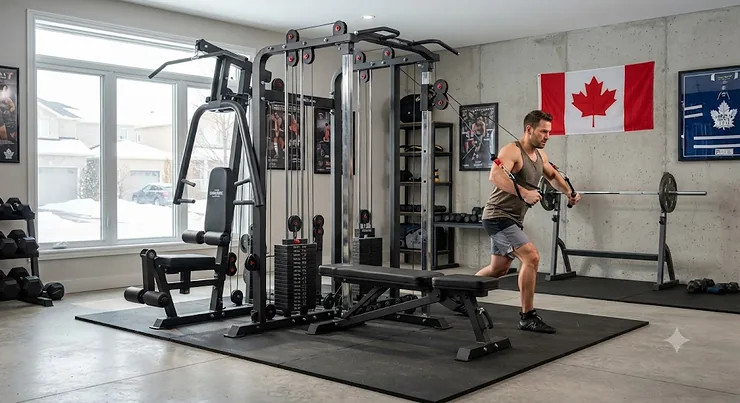
A heavy-duty multi-gym for serious lifters is a strength-training machine built around a reinforced steel frame, heavier weight stacks or plate-loaded resistance, and multiple stations, designed to withstand daily, high-load use rather than the occasional light workout. In plain terms: it’s the difference between a machine that flexes and rattles under a hard set of rows, and one that just sits there, solid, while you work. If you’ve been circling the idea of building a real home gym instead of renewing another membership, you already know the hard part isn’t motivation — it’s figuring out which machine can actually take a beating for the next decade.
This guide breaks down seven real, currently available machines spanning budget modular racks to commercial-grade multi-stack systems, all sourced from actual manufacturer specs and aggregated owner feedback rather than marketing copy. We’ll walk through what “heavy-duty” really means on a spec sheet 🔩, how a heavy-duty multi-gym for serious lifters stacks up against a traditional free-weight setup, and which of the seven fits your space, your budget, and how hard you actually train. Along the way, you’ll notice we lean on the well-documented training principle of progressive overload as a lens for judging whether a machine can grow with you, because a multi-gym that maxes out your strength in eighteen months isn’t really a long-term investment — it’s an expensive placeholder.
One quick note before we dive in: none of the products below list exact live prices, because Amazon and retailer pricing shifts constantly. Instead, you’ll see CAD price ranges based on research at the time of writing — always check the current listing before you buy.
Quick Comparison Table
| Multi-Gym | Best For | Price Range (CAD, approx.) |
|---|---|---|
| Force USA MyRack Modular Power Rack | Budget-conscious lifters starting from scratch | Around C$700–C$900 base; C$1,200–C$1,800 built out |
| Marcy MD-9010G Diamond Smith Cage System | Plate-loaded value without a fixed stack ceiling | C$1,300–C$1,700 |
| Major Fitness Drone2 | All-in-one rack plus cable crossover in one footprint | C$1,800–C$2,600 |
| RitFit M1 Pro Smith Machine | Smoothest guided-bar solo training | C$2,800–C$3,600 |
| Body-Solid GPR378 Power Rack | A rack that expands into a full multi-station gym | C$1,400–C$2,800 depending on attachments |
| Body-Solid DPLS-SF Pro Clubline | Light-commercial upper-body durability | C$4,200–C$5,200 |
| Body-Solid EXM3000LPS | Flagship dual-stack, seven-station household gym | C$6,000–C$7,600 |
✅ Looking at the spread above, there’s a genuine budget-to-flagship ladder here rather than seven versions of the same machine. Lifters upgrading from a basic bench-and-rack setup will likely land in the Major Fitness Drone2 or RitFit M1 Pro middle tier, while multi-person households or anyone who has already outgrown a single weight stack should be looking at the Body-Solid DPLS-SF Pro Clubline or Body-Solid EXM3000LPS. Budget shoppers shouldn’t dismiss the Force USA MyRack Modular Power Rack either — it’s genuinely rated for serious loads, it just asks you to build the system piece by piece.
💬 Just one click — help others make better buying decisions too!😊
Top 7 Heavy-Duty Multi-Gyms: Expert Analysis
Before jumping into full write-ups, here’s how the seven machines stack up on the specs that actually matter for a heavy-duty multi-gym for serious lifters: frame steel gauge (lower numbers mean thicker steel), maximum rated capacity, and how resistance is generated.
| Multi-Gym | Frame Steel | Rated Capacity | Resistance Type | Best For |
|---|---|---|---|---|
| Force USA MyRack Modular Power Rack | 12-gauge, 2.4″ uprights | 2,000 lb static | Free weight / add-on cable | First-time buyers on a budget |
| Marcy MD-9010G Diamond Smith Cage System | Heavy tubular steel | 2,000 lb-rated cable | Plate-loaded, no fixed ceiling | Growing lifters who own plates |
| Major Fitness Drone2 | 2″ x 2″ commercial-grade | 2,000 lb static | Cable crossover + rack | All-in-one convenience |
| RitFit M1 Pro Smith Machine | Reinforced linear-bearing frame | 1,500 lb combined | Weight stack + cable | Solo Smith-bar training |
| Body-Solid GPR378 Power Rack | 11-gauge, 3″ x 3″ | 2,000 lb rated | Free weight, stack optional | DIY multi-gym builders |
| Body-Solid DPLS-SF Pro Clubline | 11-gauge oval tube | Commercial duty | 200–210 lb selectorized stack | Upper-body isolation work |
| Body-Solid EXM3000LPS | Commercial-grade steel | Commercial duty | Dual 210 lb stacks | Multi-user households |
✅ The pattern worth noticing here is that “heavy-duty” doesn’t map cleanly to price — the Force USA MyRack Modular Power Rack carries the same 2,000 lb static rating as the far pricier Major Fitness Drone2, because raw frame strength is largely a function of steel gauge and welds, not stations or stack count. What you’re actually paying for as prices climb is resistance sophistication (fixed stacks versus plate-loading), station variety, and finish quality — not necessarily a sturdier skeleton. Reviewers who assume a bigger price tag automatically means a stronger rack are missing what the spec sheet is really telling them.
1. Force USA MyRack Modular Power Rack — cheapest true entry into serious lifting
The standout here is honesty: this is a genuinely heavy-duty frame sold at a genuinely low starting price, with no stations bundled in to inflate the number. Built from 12-gauge steel on 2.4-inch uprights with 54 laser-cut, Westside-spaced holes, the rack is static-tested to 2,000 lbs — a number that holds up whether you’re racking a heavy squat or hanging off the frame for pull-ups. What most first-time buyers overlook is that the base unit ships without J-hooks, safeties, or even a pull-up bar, so the advertised entry price isn’t the real cost of a usable rack. Based on the spec comparison, this is best suited to lifters who want to build out a multi-gym module by module over a year or two rather than buy a finished system on day one. Reviewers consistently note the laser-cut holes feel smooth rather than burred, and several mention the compact footprint working well in small garages and spare rooms — though more than a few flag the surprise of needing to immediately order attachments to make the rack functional.
Pros:
- ✅ Static-tested to 2,000 lbs on a genuinely compact footprint
- ✅ 54 Westside-spaced holes for precise height adjustments
- ✅ Modular — buy only the attachments you actually need
Cons:
- ❌ Ships without J-hooks, safeties, or a pull-up bar
- ❌ Not really a multi-gym until cable or lat modules are added
Expect to pay around C$700–C$900 CAD for the base rack alone, with a fully built-out setup (hooks, safeties, bar, bench) landing closer to C$1,200–C$1,800. For the price, it’s tough to beat as a foundation — just budget for the extras from day one rather than being caught off guard.
2. Marcy MD-9010G Diamond Smith Cage System — plate-loaded value with no stack ceiling
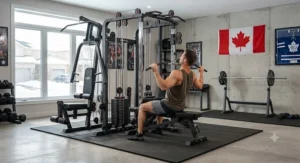
What stands out about this machine is that it sidesteps the fixed-stack ceiling entirely by using your own standard or Olympic plates for resistance. The cage measures roughly 70 inches long by 79 inches wide by 85 inches tall, and the aircraft cable running through the crossover pulleys is rated to 2,000 lbs of tensile strength — solid numbers for a machine in this price bracket. Here’s what to weigh: because resistance is plate-loaded rather than stack-selected, there’s technically no upper limit the way there is with a 150 or 200-lb fixed stack, which matters once you’re benching or rowing serious weight. The included bench adds a dual-function leg developer and preacher curl pad, effectively bundling three pieces of equipment into one frame. Reviewers on budget-focused comparison sites consistently flag this as the best value pick in the plate-loaded category, praising the combination of Smith bar, squat cage, and cable stations in one footprint; the recurring complaint is that assembly takes longer than expected and the linear bearings benefit from occasional lubrication to stay smooth.
Pros:
- ✅ Uses standard or Olympic plates, so there’s no fixed ceiling
- ✅ Combines Smith bar, squat rack, and cable stations in one frame
- ✅ Bundled bench adds leg developer and preacher curl functions
Cons:
- ❌ You’ll need to buy weight plates separately
- ❌ Linear bearings need occasional maintenance to stay smooth
Pricing typically falls in the C$1,300–C$1,700 range at the time of research, making the Marcy MD-9010G Diamond Smith Cage System a strong pick for lifters who already own a plate set and want one machine that replaces three.
3. Major Fitness Drone2 — best all-in-one for cable and rack work
The advantage this machine leans on is sheer station density: a power cage, dual lat pulldown, cable crossover, and pull-up station all live inside one 2,000-lb-rated frame built from commercial-grade 2-inch by 2-inch steel uprights. That combination means you’re not choosing between a rack for barbell work and a functional trainer for cables — you get both without doubling your floor space. On paper, this reads as the most convenient option for someone who wants variety without assembling a Frankenstein setup of separate machines; based on the spec comparison, the accessory bundle (dip handles, T-bar, tricep rope, ankle straps, lifting belt) further reduces what you need to buy separately. What the spec sheet won’t tell you, but owner reports suggest, is that the frame holds up well under heavy squats and doesn’t develop the wobble some lighter all-in-ones show after a few months of daily use — and the brand’s lifetime after-sales support gets mentioned repeatedly as a differentiator. The trade-off reviewers flag most is logistics: because it ships in multiple boxes via freight, full assembly commonly stretches across a weekend rather than an afternoon.
Pros:
- ✅ 2,000 lb capacity with commercial-grade 2″x2″ steel uprights
- ✅ Combines rack, cable crossover, and pull-up station in one unit
- ✅ Ships with a full accessory bundle included
Cons:
- ❌ Multi-box freight delivery stretches assembly across a weekend
- ❌ Cable resistance depends on which plate or stack configuration you choose
At around C$1,800–C$2,600 CAD depending on trim, the Major Fitness Drone2 sits squarely in the mid-range and earns its price through sheer functional density rather than premium materials.
4. RitFit M1 Pro Smith Machine — smoothest guided bar path in its class
This machine’s calling card is movement quality: a linear-bearing Smith attachment with spring-assisted counterbalance, rated for up to 1,500 lbs of combined training capacity across 11 adjustable height settings. Linear bearings track more consistently than the basic bushings found on entry-level Smith machines, which matters in practice because a barbell that binds sideways mid-rep is both annoying and genuinely unsafe under heavy load. The cable crossover system runs a 2:1 pulley ratio across 15 adjustable positions, adding low-to-high crossover, chest press, and triceps extension variations to the core squat-and-press movements. Based on the spec comparison, this suits solo lifters who want to train heavy without a spotter and who value smoothness enough to pay a premium for it — it’s a weaker pick for anyone chasing the absolute highest fixed-stack ceiling, since the factory stack tops out lower than a true commercial system. RitFit reviewers consistently describe the counterbalance system as making unracking feel noticeably lighter than the actual bar weight suggests, and several note that stepping up from the base model to the Pro or 3D trim is worth the price difference specifically for how much smoother the bar path feels.
Pros:
- ✅ Linear-bearing Smith path feels noticeably smoother than budget rivals
- ✅ Spring-assisted counterbalance makes unracking heavy bars easier
- ✅ 2:1 pulley ratio cable crossover adds real isolation variety
Cons:
- ❌ Factory weight stack tops out lower than true commercial units
- ❌ Premium trims add meaningfully to the base price
Expect a price range of roughly C$2,800–C$3,600 CAD for the Pro trim — a fair ask if smooth, spotter-free heavy lifting is your priority over raw resistance ceiling.
5. Body-Solid GPR378 Power Rack — 2,000 lb frame that grows into a full gym
The defining feature of this rack is its expandability: start with a bare-bones 11-gauge, 3-inch by 3-inch steel power rack rated to 2,000 lbs, then bolt on the GLA378 lat attachment and SP200 weight stack later to turn it into a genuine multi-station machine. The four-side-welded joints (rather than bolted corners) are what let it hold that rating without flexing during a heavy re-rack — a detail that matters more than most spec sheets make it sound, since a rack that shifts under load is a safety issue, not a cosmetic one. With 20 adjustment levels spaced every three inches and a 7-foot overall height, it’s also one of the few options here built specifically to fit basements with lower ceiling clearance. What most buyers overlook is that the base unit alone isn’t technically a “multi-gym” — it’s a serious rack that becomes one once you add the optional modules, which is precisely the appeal for anyone building a setup gradually. Owners across retailer review sections consistently describe rock-solid stability during heavy squats and straightforward assembly, with the main criticism being that first-time buyers sometimes expect a full multi-station machine out of the box and are surprised the lat and stack pieces are sold separately.
Pros:
- ✅ 11-gauge, 4-side-welded steel holds a genuine 2,000 lb rating
- ✅ 7-ft profile fits basements with lower ceilings
- ✅ Expands into a true multi-station gym with add-on modules
Cons:
- ❌ Base rack alone isn’t a multi-gym without the GLA378 and SP200 add-ons
- ❌ Bench and barbell are sold separately
Pricing runs from roughly C$1,400 CAD for the bare rack up to about C$2,800 CAD once the lat attachment and weight stack are added — a genuinely flexible way to spread a premium home gym investment across more than one purchase.
6. Body-Solid DPLS-SF Pro Clubline — commercial-grade upper-body workhorse
This machine’s standout trait is its light-commercial pedigree: an 11-gauge, 2.375-inch by 4.625-inch oval-tube mainframe paired with 5.5mm aircraft-grade cable rated to over 2,500 lbs, and fiberglass-reinforced nylon pulleys running on sealed bearings. That combination is what separates equipment built for daily, multi-user duty from consumer stacks that start developing play in the pulleys after a year of regular use. The no-cable-change design lets you move directly from a press to a lat pulldown to a seated row without resetting anything, which sounds like a small convenience until you’re mid-workout and don’t want to fuss with cable attachments between sets. Here’s what to weigh: this is a single-station upper-body unit with a 200–210 lb stack standard, so it’s aimed at lifters who’ve already outgrown a basic home-gym stack and want light-commercial durability without committing to a full multi-station system immediately — and it’s designed to modularize into a 3-stack or 4-stack Pro Dual system down the line. Buyers on commercial-equipment forums consistently praise the smooth exercise transitions and the lifetime frame warranty; the main critique is logistical, since the roughly 550-lb shipped weight means freight delivery is mandatory.
Pros:
- ✅ 11-gauge oval-tube mainframe built to light-commercial standards
- ✅ No-cable-change design speeds up multi-exercise sessions
- ✅ Modular into 3-stack and 4-stack commercial systems later
Cons:
- ❌ Roughly 550 lb shipped weight means freight delivery only
- ❌ Still needs a dedicated leg station added separately
At around C$4,200–C$5,200 CAD, the Body-Solid DPLS-SF Pro Clubline sits at the premium end, but for lifters who’ve genuinely outgrown consumer-grade stacks, the durability difference tends to justify it.
7. Body-Solid EXM3000LPS — the flagship for households that never wait in line
The headline feature is dual independence: two separate 210-lb weight stacks feed seven built-in stations, which means two people can genuinely train at full intensity at the same time without one waiting on the other. The leg press station runs a 2:1 ratio, converting the 210-lb stack into 420 lbs of effective resistance — a meaningful number for anyone whose legs have outgrown a standard single-stack leg press. Full steel shrouds enclose both stacks for safety and a cleaner look, and the DuraFirm pads are built not to bottom out over years of use, which matters more than it sounds since cheap padding compresses and loses support within a season or two of daily training. Based on the spec comparison, this is genuinely the ceiling for a selectorized (stack-based) home multi-gym before you’re into plate-loaded commercial pricing territory — best suited to households with more than one serious lifter, or anyone who has decided a dedicated home gym room is a permanent fixture rather than a phase. Reviewers across multiple retailer sites report consistently high satisfaction, specifically calling out the dual-stack setup and leg press station; the recurring critique is practical rather than performance-related — at roughly 900+ lbs shipped, it demands freight delivery and a floor that can handle the load.
Pros:
- ✅ Dual 210 lb stacks let two people train at once
- ✅ Seven stations cover the entire body in one machine
- ✅ Lifetime in-home warranty plus commercial-grade coverage
Cons:
- ❌ Roughly 900+ lb shipped weight demands freight delivery and a solid floor
- ❌ Among the priciest single-unit options in this roundup
Expect a price range of roughly C$6,000–C$7,600 CAD, positioning the Body-Solid EXM3000LPS as the clear flagship of this list — a premium home gym investment for households that have decided strength training is a permanent part of daily life, not a New Year’s resolution.
Practical Usage Guide: Setup, Break-In, and Maintenance
Getting a heavy-duty multi-gym for serious lifters running safely starts before the first rep. Measure your ceiling height first — anything with a pull-up bar or lat pulldown generally needs 84 to 90 inches of clearance, and machines like the Body-Solid EXM3000LPS or Body-Solid DPLS-SF Pro Clubline will want a dedicated floor area rather than a shared corner. During the first 30 days, resist the urge to load the machine to its rated maximum right away; cables, bushings, and welds benefit from a short break-in period where lighter loads let moving parts seat properly. A common first-month mistake is skipping the recommended flooring — dropping plates or racking a barbell hard on bare concrete transmits shock straight into the frame’s welds over time, so a layer of 3/4-inch rubber flooring under any of these machines is cheap insurance for an expensive purchase.
Maintenance itself is low-effort but non-negotiable for anything cable- or pulley-based, like the Marcy MD-9010G Diamond Smith Cage System or RitFit M1 Pro Smith Machine: check cable tension monthly, wipe down guide rods to keep debris from grinding into the linear bearings, and re-torque connecting bolts every few months since vibration from heavy lifting gradually works hardware loose. For plate-loaded and rack-style units like the Force USA MyRack Modular Power Rack and Body-Solid GPR378 Power Rack, the main upkeep is inspecting weld points and safety pin holes for wear, since these are the components taking direct impact when a bar gets dropped into the safeties.
Real-World Scenarios: Multi-Gym for Home Gym Enthusiasts
Picture three different households, all shopping the same category for different reasons. First, there’s the recent-grad renter with a one-car garage and roughly C$1,500 to spend — for them, the Marcy MD-9010G Diamond Smith Cage System or a built-out Force USA MyRack Modular Power Rack makes the most sense, since both deliver genuine heavy-duty capacity without demanding freight delivery logistics or a finished basement. Second, consider the intermediate lifter three years into training who has outgrown a basic bench-and-rack combo and trains five days a week — this is where the Major Fitness Drone2 or RitFit M1 Pro Smith Machine earns its higher price tag, offering enough station variety and resistance ceiling to support real progressive overload without a second upgrade in two years.
Third, picture a household with two serious lifters — say, a couple who both train hard, or a parent training alongside a teenager who’s taken up powerlifting — where waiting for the weight stack becomes a genuine daily friction point. That’s precisely the scenario the Body-Solid EXM3000LPS solves with its dual independent stacks, and it’s also where the incremental Body-Solid GPR378 Power Rack build-out path (rack now, lat and stack module later) can make sense financially, spreading a premium home gym investment across a year instead of one large purchase.
Problem → Solution: Fixing the Most Common Multi-Gym Headaches
Even a genuinely heavy-duty machine runs into predictable snags. Here’s how to handle the ones that come up most often. 🛠️
Problem: The frame feels like it flexes slightly during heavy squats or presses. This is almost always a steel-gauge issue rather than something you can fix after purchase — it’s why we’ve emphasized 11-gauge or better steel throughout this guide, as seen on the Body-Solid GPR378 Power Rack and Body-Solid DPLS-SF Pro Clubline. If you’re already locked into a lighter-gauge machine, bolting it to the floor or a wall stud reduces perceived flex meaningfully.
Problem: Cables feel gritty or catch mid-rep. This is typically debris or dried lubricant in the pulley housing, common on cable-based units like the Marcy MD-9010G Diamond Smith Cage System. A monthly wipe-down of guide rods and a light application of silicone-based lubricant (never oil-based, which attracts dust) usually resolves it.
Problem: You’ve hit the resistance ceiling on a fixed weight stack. Machines like the RitFit M1 Pro Smith Machine cap out at a set stack weight, and once your strength exceeds it, options include adding chains or bands for accommodating resistance, or planning your next upgrade toward a plate-loaded system like the Body-Solid DPLS-SF Pro Clubline, which has no fixed ceiling.
Problem: Freight delivery got delayed or the machine arrived with a floor-load concern. Heavier units — the Body-Solid EXM3000LPS in particular, at over 900 lbs — genuinely warrant a quick check with a structural engineer if you’re placing it anywhere other than a ground-floor slab or a well-supported basement.

How to Choose a Heavy-Duty Multi-Gym for Serious Lifters
Picking the right machine comes down to matching a handful of specs to how you actually train, not to marketing language on a listing page. Here’s the process we’d walk a serious lifter through:
- Confirm the steel gauge first. Look for 11-gauge or thicker uprights on anything you plan to load heavily — as covered above, this single spec predicts stability under load better than price does.
- Match resistance type to your training style. Fixed weight stacks (like the dual stacks on the Body-Solid EXM3000LPS) are faster to adjust between sets; plate-loaded systems (like the Marcy MD-9010G Diamond Smith Cage System) have no ceiling but require more setup time per change.
- Measure your ceiling and floor space before comparing models. Pull-up bars and lat pulldowns typically need 84–90 inches of clearance; write this number down before you start browsing.
- Check the rated weight capacity against your realistic 5-year strength trajectory, not just where you are today — this is the essence of treating the purchase as a long-term strength training setup rather than a stopgap.
- Factor in whether you’re training solo or with others. Multiple simultaneous users is the single biggest argument for dual-stack systems over single-station units.
- Read aggregated review sentiment for assembly and shipping realities, since heavier machines ship via freight and that logistics detail affects real-world satisfaction as much as the equipment itself.
- Budget for flooring, a bench, and a barbell separately if the machine doesn’t include them — the sticker price is rarely the full cost of a usable setup.
Canadian guidance from the Canadian Society for Exercise Physiology’s 24-Hour Movement Guidelines recommends muscle-strengthening activity at least twice weekly for meaningful health benefits, which is a useful baseline for sizing your machine choice — someone training twice a week has very different durability needs than someone training five or six days weekly on the same frame.
Common Mistakes When Buying Multi-Gym Equipment
The single most common mistake is buying based on station count instead of frame quality — a machine advertising “12-in-1” functionality is meaningless if the steel flexes under a heavy set. A second frequent misstep is skipping the ceiling and floor-space measurement step entirely, then discovering the pull-up bar clears by two inches or the footprint doesn’t leave room to load plates comfortably. Buyers also regularly underestimate shipping logistics: anything over roughly 300 lbs, which includes five of the seven machines here, ships via freight to the curb rather than standard parcel delivery, and skipping that research leads to unpleasant delivery-day surprises.
Another recurring error is treating the listed price as the final cost. As we’ve flagged throughout, machines like the Force USA MyRack Modular Power Rack and Body-Solid GPR378 Power Rack are sold without essential attachments, and even fully bundled units like the Major Fitness Drone2 typically still need flooring and, in some configurations, a barbell and plates. Finally, many first-time buyers assume a higher weight-stack number always means a better machine, without checking whether that number reflects actual usable resistance (accounting for pulley ratios) or just the raw stack weight — the Body-Solid EXM3000LPS leg press effectively doubles its stated stack through a 2:1 ratio, a detail easy to miss on a spec sheet skim.
Heavy-Duty Gym Equipment: What “Heavy-Duty” Actually Means
“Heavy-duty gym equipment” gets used loosely across the fitness industry, but on a genuine multi-gym it refers to three measurable things: steel gauge (thickness — lower numbers mean thicker, stronger steel, with 11-gauge being the widely cited benchmark for stability under heavy loads), weld type (four-side-welded joints resist flex far better than bolted connections), and rated static capacity (the maximum combined load the frame is tested to hold without deforming). A machine can look imposing and still fall short on all three; conversely, a compact unit like the Force USA MyRack Modular Power Rack can carry a genuinely heavy-duty 2,000-lb rating despite its smaller footprint. When you’re comparing heavy-duty gym equipment across brands, treat these three specs as your filter before you even look at price or station count — everything else is secondary to whether the frame can actually take the load you intend to put on it, set after set, for years.
Multi-Gym vs Traditional Free-Weight Setup
It’s a fair question: why buy an all-in-one machine when a barbell, a rack, and a bench cover most of what serious lifters need? The honest answer is that it depends on your priorities.
| Factor | Multi-Gym (e.g. Body-Solid EXM3000LPS) | Traditional Free Weights + Rack |
|---|---|---|
| Training safety solo | High — guided paths and safeties reduce spotter dependence | Lower — heavy free-weight lifts benefit from a spotter |
| Exercise variety per footprint | High — multiple stations in one frame | Lower — needs additional equipment for isolation work |
| Strength ceiling over time | Capped by stack weight or plate ceiling | Effectively unlimited with enough plates |
| Upfront cost | Higher for full-featured units | Lower to start, scales with plates purchased |
| Best For | Solo training, multi-user households, guided movement | Powerlifters, athletes prioritizing free-range motion |
✅ The comparison above isn’t really “which is better” so much as “which matches your training age and goals.” A beginner or intermediate lifter, or anyone training without a regular spotter, genuinely benefits from the guided safety of a multi-gym like the RitFit M1 Pro Smith Machine or Major Fitness Drone2. Advanced powerlifters chasing a true one-rep max, on the other hand, will eventually want the unrestricted movement of free weights and a simple rack like the Body-Solid GPR378 Power Rack — which is exactly why several machines on this list are designed to bridge both worlds rather than forcing a choice.
✨ Don’t Miss These Exclusive Deals!
🔍 Take your home gym to the next level with one of these seven carefully researched picks. Click through to check current pricing and availability before stock or promotions change. The right heavy-duty multi-gym for serious lifters is the one that matches your space, your goals, and your budget — not just the biggest name on the label.
What to Expect: Real-World Performance From a Heavy-Duty Multi-Gym
Spec sheets tell you what a machine is rated for; they don’t tell you what a Tuesday-evening leg session actually feels like. In practice, dual-stack systems like the Body-Solid EXM3000LPS feel noticeably quieter and smoother in daily use than their spec sheet numbers suggest, largely thanks to sealed bearings and full steel shrouds that muffle the plate-clacking sound cheaper stacks produce. Plate-loaded systems like the Marcy MD-9010G Diamond Smith Cage System take longer to change resistance between exercises — expect an extra 20–30 seconds per switch compared to a pin-select stack — which matters if you’re training in supersets or on a tight schedule.
Linear-bearing Smith machines, such as the RitFit M1 Pro Smith Machine, genuinely do feel different under the bar than budget bushings-based alternatives; the difference is most obvious on heavier singles and doubles, where side-to-side play becomes a real safety concern rather than a minor annoyance. Real progress on any of these machines still comes down to consistency more than the machine itself — ParticipACTION’s guidance on muscle-strengthening activity notes that only about a third of Canadian adults currently meet the twice-weekly strength benchmark, which says more about habit-building than equipment quality. The machine’s job is simply to get out of your way and let gradual, consistent overload happen safely, week after week, without the frame, cables, or pulleys becoming the limiting factor.
Long-Term Cost & Maintenance: The Premium Home Gym Investment Math
A heavy-duty multi-gym isn’t a cheap impulse buy, so it’s worth running the actual numbers before treating it as a premium home gym investment. The table below compares rough five-year costs assuming a standard Canadian gym membership runs somewhere around C$50–C$70 per month.
| Scenario | Approx. 5-Year Cost (CAD) | Notes |
|---|---|---|
| Gym membership only | C$3,000–C$4,200 | No equipment ownership, ongoing monthly cost |
| Budget multi-gym (Force USA MyRack Modular Power Rack, built out) | C$1,200–C$1,800 one-time | Plus flooring and plates |
| Mid-range multi-gym (Major Fitness Drone2) | C$1,800–C$2,600 one-time | Plus flooring |
| Flagship multi-gym (Body-Solid EXM3000LPS) | C$6,000–C$7,600 one-time | Plus flooring and delivery/assembly |
✅ Even the flagship Body-Solid EXM3000LPS breaks roughly even against five years of gym membership fees, and every option cheaper than it comes out well ahead over the same period — assuming, of course, that you actually use it consistently. The math shifts further in favour of ownership once you factor in the intangible cost of driving to and from a commercial gym, or the very real friction of skipping a session because the weather’s bad. Maintenance costs stay modest across all seven machines — expect to spend perhaps C$50–C$150 CAD a year on lubricant, replacement pins, or the occasional cable if you’re training hard and often.
Long-Term Strength Training Setup: Building for the Next Decade
Treating a multi-gym purchase as a long-term strength training setup rather than a one-off transaction changes how you should shop. Start by being honest about your trajectory: a beginner benching an empty bar today could realistically be pressing 200+ lbs within a few years of consistent training, so a machine that tops out just above your current numbers is a short-term fix, not a real investment. This is where the expandable options on this list earn their keep — the Body-Solid GPR378 Power Rack in particular is built specifically for this philosophy, letting you start with a bare rack and bench, then bolt on the lat attachment and weight stack once your training (and budget) has grown into it.
Warranty coverage is another long-term signal worth weighing heavily: both the Body-Solid DPLS-SF Pro Clubline and Body-Solid EXM3000LPS carry lifetime in-home frame warranties, which is the manufacturer effectively betting on their own steel holding up for decades of home use — a meaningfully different promise than a one- or two-year warranty on a budget unit. If you’re building this out as a genuine decade-plus setup, also plan for the “soft” infrastructure around the machine itself: proper flooring to protect both your subfloor and the equipment, adequate lighting, and, in a Canadian garage specifically, some thought given to humidity and temperature swings that can accelerate rust on exposed steel and cables over a cold, damp winter.
Safety, Assembly & Floor-Load Guide for Canadian Homes
Safety on a heavy-duty multi-gym starts with the floor it sits on, not the machine itself. Canada doesn’t currently mandate a single national safety certification specific to strength-training equipment the way it does for some consumer electronics, so the responsibility largely falls on the buyer to verify frame ratings and follow manufacturer assembly instructions closely — always torque connecting bolts to spec, and re-check them after the first few weeks of use as components settle. For anything approaching or exceeding 500 lbs of machine weight, like the Body-Solid DPLS-SF Pro Clubline or Body-Solid EXM3000LPS, a quick conversation with a structural engineer or contractor is worthwhile if you’re placing it anywhere other than a ground-floor slab, since concentrated point loads from steel frames and weight stacks behave differently than evenly distributed furniture weight.
Interest in home gym equipment has genuinely surged across Canada in recent years, with CBC News reporting on the sustained demand for home fitness gear as more Canadians build dedicated training spaces rather than relying solely on commercial gyms — which also means supply and delivery timelines can vary seasonally, so ordering ahead of when you actually need the equipment is a reasonable precaution. Beyond structural concerns, basic safety habits matter regardless of which machine you choose: always use collars on loaded barbells, set safety pins slightly below your working depth on rack-based systems, and never bypass a machine’s built-in safety stops even when you’re confident in a lift.
FAQ
❓ What is the best heavy-duty multi-gym for serious lifters in Canada?
❓ How much does a heavy-duty multi-gym cost in Canada?
❓ What weight capacity should a multi-gym have for serious lifting?
❓ Is a multi-gym or a power rack better for serious lifters?
❓ How much space do I need for a heavy-duty multi-gym?
Conclusion
A heavy-duty multi-gym for serious lifters isn’t really one product category — it’s a spectrum running from the budget-friendly, build-it-yourself flexibility of the Force USA MyRack Modular Power Rack all the way to the dual-stack, multi-user capability of the Body-Solid EXM3000LPS, with genuinely different machines suited to genuinely different training situations in between. The Marcy MD-9010G Diamond Smith Cage System and Body-Solid GPR378 Power Rack reward lifters who don’t mind assembling a system in stages, while the Major Fitness Drone2 and RitFit M1 Pro Smith Machine suit anyone who wants strong all-around capability without a multi-year build-out. For households that have decided strength training is a permanent fixture rather than a phase, the Body-Solid DPLS-SF Pro Clubline and Body-Solid EXM3000LPS represent the premium home gym investment tier — commercial-grade durability built to outlast a decade of hard training.
Whichever you land on, the specs that matter most stay consistent across every price point: steel gauge, weld quality, rated capacity, and how honestly the resistance type matches how you actually train. Get those right, and the rest — colour, brand name, bonus attachments — is genuinely secondary. Measure your space, set your budget tier, and pick the machine built to handle where your training is headed, not just where it is today.
✨ Don’t Miss These Exclusive Deals!
🔍 Take your strength training to the next level with these seven carefully researched heavy-duty multi-gyms. Click on any highlighted pick to check current pricing and availability before you commit. The right machine today is the one that still fits your training five years from now!
Recommended for You
- Multi-Stack Home Gym Machine: 7 Best Picks for 2026
- Commercial Multi-Gym for Small Gym Business: 7 Picks (2026)
- Single Stack Home Gyms: 7 Best Picks for Canadian Homes (2026)
Disclaimer: This article contains affiliate links. As an Amazon Associate, I earn from qualifying purchases. If you purchase products through these links, we may earn a small commission at no additional cost to you.
✨ Found this helpful? Share it with your friends! 💬🤗
