In This Article
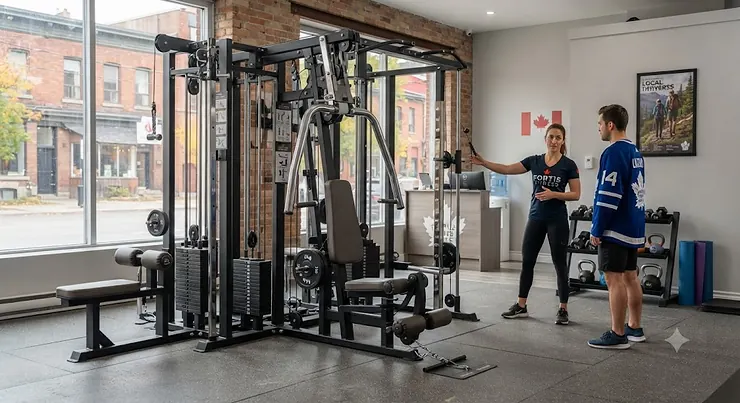
Buying strength equipment for a studio is nothing like buying a treadmill for your basement. The floor space is smaller, the budget is tighter, and every square foot has to earn its keep in member satisfaction and retention. A commercial multi-gym for small gym business use is essentially a compact, multi-station strength machine — usually built around one or two weight stacks — engineered to let two or three clients train at once on a heavier-duty frame than anything sold for residential use. It exists to solve a specific problem: how do you offer chest press, lat pulldown, leg curl, cable crossover, and rowing in the footprint most independent studios actually have, without buying seven separate machines you can’t afford or fit.
Here’s the tension every new studio owner feels: home-gym multi-stations look tempting because they’re cheaper, but they weren’t engineered for eight-hour daily use by rotating clients of different sizes and strength levels. Commercial-rated units cost more upfront, sit on thicker-gauge steel, and typically carry a lighter labour warranty than the frame warranty — which tells you something about what the manufacturer actually expects from real-world wear. This guide walks through seven real, currently available multi-station gyms spanning budget to premium, breaks down what each spec actually means for a working studio, and gives you a practical framework for buying gym business equipment that won’t need replacing in eighteen months. Prices are shown as ranges in Canadian dollars because Amazon.ca and equipment dealer pricing fluctuates — always check current pricing before you commit.
Quick Comparison Table
| Model | Tier | Weight Stack | Simultaneous Users | Price Range (CAD) | Best For |
|---|---|---|---|---|---|
| PowerTec Workbench Multisystem | Budget | ~160 lb | 1 | in the mid-C$2,000s | Solo-trainer studios starting lean |
| Body-Solid G5S | Budget-Mid | 210 lb | 1-2 | C$3,300-C$4,100 range | Boutique studios wanting one workhorse station |
| Inspire Fitness M3 | Mid | 210-215 lb | 1 | C$4,000-C$4,600 range | Personal training studios needing a compact footprint |
| Body-Solid EXM3000LPS | Mid-Premium | 210 lb dual stack | up to 3 | C$4,700-C$5,900 range | Small gyms wanting group-friendly stations |
| Body-Solid Pro Clubline S1000 | Premium | 4 independent stacks | up to 4 | C$6,500-C$8,000 range | Growing studios anticipating peak-hour traffic |
| Hoist H-2200 | Premium | dual stack | up to 2-3 | C$7,100-C$7,900 range | Established gyms prioritizing club-grade durability |
| Batca Omega 4 | High-End | quad stack | up to 4 | around C$9,500-C$10,000 | Multi-trainer facilities running back-to-back sessions |
Looking at the table above, the Body-Solid EXM3000LPS sits in a sweet spot for most independent studios — it gives you dual-stack, three-person capacity without crossing into the four-stack territory that only makes sense once you’re running simultaneous group sessions. Budget-conscious owners should pay attention to the PowerTec Workbench Multisystem and Body-Solid G5S: both are genuinely commercial-rated despite lower price points, they just trade user capacity for cost. If your studio model depends on back-to-back personal training blocks rather than open-floor group hours, the jump to a Batca Omega 4 or Body-Solid Pro Clubline S1000 is harder to justify financially in year one.
💬 Just one click — help others make better buying decisions too!😊
Top 7 Commercial Multi-Gyms: Expert Analysis
1. PowerTec Workbench Multisystem — most affordable true commercial build
The Multisystem earns its “commercial” label honestly, even at its price point — a claim a lot of budget equipment can’t back up. It runs on a functional trainer-style frame with a lever arm press station, adjustable pulleys, and a roughly 160-pound weight stack that’s expandable with add-on plates as your clientele gets stronger. Built from heavy-gauge steel tubing with a standard powder coat finish, it’s designed to handle daily commercial cycling rather than the occasional home session, though the single stack means only one person trains on it at a time.
Based on the spec comparison, this is the machine for a solo trainer or a two-person studio still validating the business before committing five figures to equipment. What most buyers overlook about this model is that its modular attachment system — leg press, dip station, squat rack add-ons — lets you build out capability gradually instead of buying everything on day one. Reviewers consistently note that the lever-arm design feels smoother than pin-loaded stacks for pressing movements, though a handful mention the assembly instructions could be clearer for a first-time buyer without mechanical experience.
Pros:
- ✅ Lowest true commercial-rated entry point in this list
- ✅ Modular attachments let you expand capability over time
- ✅ Lever-arm press feels smoother than basic pin-loaded stacks
Cons:
- ❌ Single-user capacity limits it for busier studio hours
- ❌ Assembly can be fiddly without mechanical experience
At in the mid-C$2,000s, the PowerTec Workbench Multisystem delivers legitimate commercial durability for the price of some home-gym units — a smart entry point if capital is tight in year one.
2. Body-Solid G5S Multi-Station Gym — best single-stack workhorse for boutique studios
The G5S is the machine most small studios quietly rely on because it does the fundamentals extremely well without demanding a warehouse-sized floor plan. A 210-pound weight stack drives a lat pulldown, seated row, chest press, and leg station, all built on Body-Solid’s commercial 11-gauge steel frame — the same gauge steel found on their pricier dual-stack systems. That steel thickness matters more than most spec sheets let on: it’s the difference between a frame that stays true after two years of daily loading and one that develops play in the joints.
On paper, this means one client can move through a full upper-and-lower routine on a single machine, which is exactly what a boutique studio running 30-45 minute personal training slots needs. Aggregated buyer feedback across resale and retail listings consistently describes the G5S as reliable and low-maintenance, with the most common critique being that cable replacement, when eventually needed, requires a technician rather than a DIY fix. For a studio prioritizing floor efficiency over simultaneous-user capacity, it’s hard to beat.
Pros:
- ✅ Commercial 11-gauge steel frame at a mid-range price
- ✅ Compact footprint suits tight studio floor plans
- ✅ Covers upper and lower body on one station
Cons:
- ❌ Single stack means one client at a time
- ❌ Cable service typically needs a technician
Priced in the C$3,300-C$4,100 range, the Body-Solid G5S is a genuinely strong value pick for studios prioritizing quality per square foot over raw user capacity.
3. Inspire Fitness M3 Multi Gym — best for personal training studios needing versatility
The M3 punches above its footprint — it fits on a 4-by-6-foot mat yet manages independent press arms, four pulley stations, a built-in seated ab crunch, and a leg curl/extension unit, all off a single 210-to-215-pound stack depending on configuration. The independent press arm design is the standout feature here: it lets a trainer program unilateral work — correcting a strength imbalance between a client’s dominant and non-dominant side — something fixed-bar multi-gyms simply can’t do.
What most buyers overlook about this model is how much programming flexibility that single independent-arm feature unlocks; it effectively turns one machine into a functional trainer and a traditional multi-gym in one unit. Reviewers who’ve run it in home and light-commercial settings consistently highlight the smooth pulley action and describe the resistance ratios (roughly 1:2 on the high, mid, and low pulleys) as feeling heavier than the number on the stack suggests, which trainers should factor in when programming for beginners. The commercial warranty tier — a 10-year light-commercial coverage versus lifetime residential — signals Inspire designed it with studio use in mind, not just home buyers.
Pros:
- ✅ Independent press arms enable true unilateral training
- ✅ Compact 4×6-foot footprint fits tight studios
- ✅ 10-year light-commercial warranty backs studio use
Cons:
- ❌ Single-user station limits simultaneous client capacity
- ❌ Optional leg press add-on increases footprint and cost
In the C$4,000-C$4,600 range, the Inspire Fitness M3 Multi Gym is arguably the sharpest pick for a multi-gym for personal training studio setups where programming variety matters more than raw throughput.
4. Body-Solid EXM3000LPS Gym System — best dual-stack for growing gyms
This is where a studio starts feeling like a real commercial facility. The EXM3000LPS runs two independent 210-pound weight stacks off one frame, supporting up to three simultaneous users when paired with the optional vertical knee raise attachment. Twenty-eight distinct exercises are possible across its lat pulldown, seated row, leg developer, and ab crunch stations, all riding on pillow-block sealed ball bearings that keep the pulleys running smoothly under heavy daily use.
Here’s what the spec sheet won’t tell you outright: the “two people at once” capability isn’t just a convenience feature, it’s a throughput multiplier for a studio charging per session. If your peak hour currently bottlenecks at one strength station, this single machine effectively doubles capacity without doubling floor space. Reviewers across commercial equipment dealers consistently flag the leg press station’s self-aligning two-bar linkage as a standout — it adjusts the plate angle to the user’s body automatically, reducing the knee strain complaints common on cheaper fixed-angle leg press attachments. The trade-off is size: at roughly 91 by 73 by 83 inches assembled and 947 pounds, this isn’t a machine you reposition on a whim.
Pros:
- ✅ Dual stacks support up to three users simultaneously
- ✅ Self-aligning leg press reduces knee strain complaints
- ✅ 28 documented exercise variations across four stations
Cons:
- ❌ Large footprint demands real floor-planning commitment
- ❌ Heavy at 947 lb, so repositioning later is difficult
At C$4,700-C$5,900, the Body-Solid EXM3000LPS delivers commercial throughput that justifies the jump from single-stack machines once your booking calendar starts showing overlap.
5. Body-Solid Pro Clubline S1000 Four-Stack Gym — best for peak-hour group capacity
The S1000 is built for the moment a small gym stops being small. Four independent weight stacks and four unique stations — adjustable cable column, bench press/mid row/leg extension/leg curl combo, lat and mid row, and leg press/calf raise — let four clients train at once on one footprint, which is the entire value proposition of a four-stack system. Body-Solid built it on the same 11-gauge steel as its lighter units but with a matte black finish and fully shrouded stacks designed to look intentional in a member-facing space, not like leftover warehouse equipment.
Based on the spec comparison against the dual-stack EXM3000LPS, the S1000 essentially doubles simultaneous capacity for roughly 35-40% more cost — a reasonable trade if your studio regularly books overlapping strength sessions. Dealer listings and commercial equipment resellers describe it as popular with hotels, police and fire stations, and training facilities that need heavy-use durability without a full free-weight room, which tells you something about the duty cycle it’s engineered to survive. The shrouded weight stacks are a genuinely practical safety feature for a studio with rotating clients unfamiliar with exposed-plate machines.
Pros:
- ✅ Four independent stations for true four-person capacity
- ✅ Fully shrouded stacks improve client-facing safety
- ✅ 11-gauge steel built for heavy commercial duty cycles
Cons:
- ❌ Meaningful cost jump over dual-stack alternatives
- ❌ Needs a genuinely large dedicated floor zone
Priced C$6,500-C$8,000, the Body-Solid Pro Clubline S1000 makes sense once peak-hour bottlenecks, not budget, become your studio’s limiting factor.
6. Hoist H-2200 2 Stack Multi Gym — best club-grade durability for established studios
Hoist built its reputation supplying big-box health clubs, and the H-2200 carries that DNA into a smaller footprint. It’s a dual-stack system engineered around the same commercial-duty components — precision bearings, heavy-gauge frame tubing, and cable routing designed for continuous daily loading — that Hoist uses on its full club-line equipment. That heritage matters for a studio owner comparing warranty claims data over five-plus years, since Hoist’s parts have a long track record in facilities running far more daily reps than any boutique studio will generate.
What most buyers overlook is that club-grade brands like Hoist price in the engineering margin for abuse tolerance most studios will never actually reach — which is either overkill or genuine long-term insurance, depending on how aggressively you expect to run the equipment. Aggregated commercial dealer feedback consistently describes the H-2200 as smoother under load than comparably priced Body-Solid dual-stack units, though a common theme in service reviews is that replacement parts, while available, cost more than Body-Solid’s aftermarket ecosystem. For a studio planning to keep equipment for a decade rather than replace it every five years, that long-term parts reliability can offset the higher sticker price.
Pros:
- ✅ Club-grade components with a long commercial track record
- ✅ Smooth cable feel reported across dealer reviews
- ✅ Strong resale value within commercial equipment markets
Cons:
- ❌ Replacement parts cost more than Body-Solid’s ecosystem
- ❌ Premium pricing versus comparable dual-stack alternatives
At C$7,100-C$7,900, the Hoist H-2200 suits an established studio owner who values long-term reliability data over saving a few hundred dollars upfront.
7. Batca Omega 4 Multi-Station Gym — best high-capacity option for multi-trainer facilities
The Omega 4 is the ceiling of this list — a quad-stack system built for facilities running multiple trainers and overlapping client sessions simultaneously. Batca specializes almost exclusively in commercial and light-commercial gym equipment, which shows in the modular station design: operators can typically configure combinations of press, pulldown, row, and leg stations to match their specific floor plan rather than accepting a fixed layout.
Here’s what the spec sheet won’t spell out plainly: at this tier, you’re not really comparing weight stacks anymore, you’re comparing throughput per square foot against staffing capacity. A quad-stack system only pays for itself if you actually have four trainers or four simultaneous clients to put on it — otherwise it’s expensive real estate sitting half-used during off-peak hours. Commercial dealer listings position the Omega line alongside Nautilus and True Fitness in the higher end of the multi-station category, and buyers researching Batca consistently cite the brand’s reputation for durability in high-volume facilities like university recreation centres and multi-location fitness chains, environments that mirror the load a busy multi-trainer studio would put on it.
Pros:
- ✅ Quad-stack design supports four simultaneous users
- ✅ Modular station configuration adapts to floor plan
- ✅ Reputation built on high-volume institutional use
Cons:
- ❌ Highest price point in this roundup
- ❌ Only cost-effective with genuine multi-trainer demand
Around C$9,500-C$10,000, the Batca Omega 4 is the right call only if your studio’s staffing model can actually keep all four stations working during peak hours.
Commercial-Grade Multi-Gym vs Home Gym Multi-Gym
The line between a commercial-grade multi-gym and a home gym multi-gym isn’t marketing fluff — it’s engineered into the steel gauge, the bearing quality, and the warranty structure, and it directly affects whether your equipment survives a studio’s duty cycle. Home-rated multi-stations are typically built for a handful of sessions per week from one household. A studio machine gets loaded, on average, dozens of times a day by clients with wildly different body weights, form quality, and respect for the equipment. Manufacturers know this, which is why commercial-grade multi-gym vs home gym multi-gym warranty terms tell the real story: residential machines often carry a longer “lifetime” frame warranty specifically because the manufacturer expects light use, while commercial warranties are shorter on parts and labour precisely because they’re rated for heavier daily wear.
Steel gauge is the other giveaway. Commercial frames commonly run 11-gauge tubing versus the thinner tubing found on budget residential units, and that thickness resists the flex and joint fatigue that develops under constant, varied loading. Bearing quality follows the same pattern — sealed, precision ball bearings versus basic bushings — and it’s the difference between smooth cable action after two years versus a machine that starts grinding within six months. Here’s the honest trade-off: a home-rated unit will save you real money upfront, and for a two-person startup studio testing demand before committing capital, that might be the smarter call short-term. But if you’re already committed to running a studio for years, the total cost of ownership almost always favours starting commercial, since replacing a failed home-grade machine mid-lease costs more than the price difference would have.
Multi-Gym for Personal Training Studio Use
A multi-gym for personal training studio needs looks different than one built for open-floor group classes, and it’s worth being deliberate about which category you’re actually buying for. Personal training studios run tight, structured sessions — usually one client, sometimes two, working through a programmed circuit with a trainer cueing form the entire time. That changes the equipment priority list: independent, adjustable stations that support unilateral work (like the Inspire Fitness M3‘s press arms) matter more here than raw simultaneous-user capacity, because most of the session is one-on-one coaching, not parallel training.
Floor footprint is the second major factor. Personal training studios are frequently built into smaller commercial leases — sometimes converted retail units under 1,500 square feet — where every machine needs to justify its square footage against the revenue it generates per hour. A compact single-stack unit like the Body-Solid G5S or Inspire Fitness M3 typically makes more financial sense here than a four-stack system that sits partially idle between one-on-one sessions. The third consideration, often underestimated by new owners, is noise and visual footprint: personal training clients are paying for a curated, boutique experience, and a hulking commercial rig with exposed cabling can undercut that atmosphere compared to a compact unit with a shrouded, powder-coated finish.
How to Choose a Commercial Multi-Gym for Your Small Gym Business
Picking the right unit comes down to matching machine capacity to your actual booking model, not to the biggest spec sheet you can afford. Work through these criteria in order:
- Count your realistic simultaneous users. Look at your actual peak-hour bookings, not your aspirational ones — a single-stack machine handling one client at a time is often plenty for a studio running staggered personal training slots.
- Measure your floor plan before you shop. Get exact dimensions, including clearance for full range of motion, since undersized floor plans are the most common regret in equipment reviews.
- Check the steel gauge and bearing type. These two specs, more than any marketing copy, predict how the machine holds up after two years of daily commercial use.
- Compare warranty structure, not just length. A shorter commercial warranty on a heavier-duty frame usually beats a longer residential warranty on a lighter one.
- Factor in delivery, assembly, and service access. Commercial units weigh hundreds of pounds and often need professional installation — budget for it upfront, not as a surprise.
- Match the finish to your brand experience. Shrouded stacks and powder-coated frames matter more in a client-facing boutique studio than in a back-room training area.
- Confirm current pricing and financing options directly with the retailer, since displayed prices shift and studios often qualify for equipment financing that changes the real monthly cost.
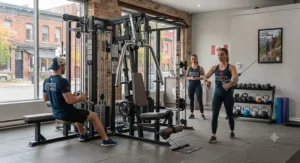
Commercial Fitness Facility Setup: Practical Usage Guide
Getting a commercial multi-gym delivered is the easy part — setting it up correctly is where studios either save themselves years of headaches or create them. Start with floor prep: most commercial units in this weight class (500-950 pounds assembled) need a level, reinforced floor section, and rubber flooring tiles under the footprint reduce both vibration transfer to neighbouring units and long-term wear on the base plates. Professional assembly is worth the extra line item on your invoice — misaligned pulley cables from a rushed DIY build are one of the most common early-failure causes reported across commercial equipment dealer reviews.
In the first 30 days, the biggest mistake new studio owners make is skipping a documented maintenance schedule because everything feels new and smooth. Cable tension should be checked within the first month as components settle, and bearing lubrication points need attention on a quarterly basis at minimum for machines seeing daily commercial use — waiting for a problem to appear means you’re already behind on wear. Optimization tricks worth knowing early: label pin-adjustment ranges for common client body types to speed up transitions between sessions, and photograph your initial cable routing so a technician has a reference point if something needs adjustment later. A commercial fitness facility setup that gets these fundamentals right in month one avoids the compounding equipment issues that show up by year two.
Small Studio Equipment Planning: Real-World Scenarios
Picture three different studio owners, each with a different answer to the same equipment question. First, there’s the solo trainer launching out of a 900-square-foot unit with two clients booked per hour, no staff, and a tight startup budget under C$15,000 for all equipment combined. For her, a PowerTec Workbench Multisystem or Body-Solid G5S makes sense — commercial durability at a price that leaves room for cardio equipment and free weights too.
Second, consider a personal training studio with two trainers running overlapping sessions in a 1,800-square-foot space, generating steady revenue and planning to scale within eighteen months. This owner benefits from the Inspire Fitness M3‘s independent arm design paired with a Body-Solid EXM3000LPS for group-friendly capacity, giving both one-on-one programming flexibility and simultaneous-user throughput without overcommitting floor space prematurely.
Third, picture an established boutique gym in a 3,000-square-foot commercial lease, three trainers on staff, and consistent peak-hour overlap between 5 and 7 p.m. on weeknights. Small studio equipment planning at this scale points toward the Body-Solid Pro Clubline S1000 or Hoist H-2200 — the four-person and club-grade durability respectively justify their higher price tags because the studio’s booking volume actually uses that capacity daily, rather than leaving it idle.
Gym Business Equipment: Problem → Solution Guide
Every studio owner runs into predictable equipment headaches — here’s how the right gym business equipment choices solve them before they start.
Problem: Peak-hour bottlenecks turn away paying clients. Solution: a dual or quad-stack machine like the Body-Solid EXM3000LPS or Body-Solid Pro Clubline S1000 lets multiple clients train simultaneously instead of queuing for one station.
Problem: Floor space is too tight for a full free-weight setup. Solution: a compact single-stack unit like the Inspire Fitness M3, with its 4×6-foot footprint, consolidates dozens of exercises into a fraction of the space a full rack-and-bench setup would need.
Problem: Budget doesn’t stretch to premium commercial brands. Solution: the PowerTec Workbench Multisystem and Body-Solid G5S deliver genuine commercial-rated steel without the club-brand price premium.
Problem: Clients with strength imbalances need unilateral training options. Solution: independent press-arm designs, like the one on the Inspire Fitness M3, let trainers program single-side work that fixed-bar machines can’t replicate.
Problem: Equipment wear accelerates faster than expected. Solution: prioritize sealed bearings and 11-gauge steel — features present across every model in this roundup — and commit to the quarterly maintenance schedule outlined earlier.
Common Mistakes When Buying a Commercial Multi-Gym
The most expensive mistake new owners make is buying capacity they don’t need yet. A quad-stack Batca Omega 4 sitting half-used during off-peak hours ties up capital that could have funded cardio equipment, flooring, or a second trainer’s salary. The opposite mistake happens too — buying a single-stack budget unit and outgrowing it within a year because bookings grew faster than expected, forcing a costly early replacement.
Skipping floor measurements before ordering is another recurring theme in dealer and reseller reviews: several models in this roundup exceed 90 inches in length once assembled, and a studio that measures only the advertised footprint without accounting for full range-of-motion clearance ends up with equipment clients can’t safely use at the edges of the room. Finally, treating warranty length as a simple “longer is better” metric misses the point — a shorter commercial warranty on a heavier-duty frame usually outperforms a longer residential warranty in actual studio conditions, since the underlying components were never rated for daily commercial loading in the first place.
Long-Term Cost & Maintenance
Total cost of ownership rarely matches the sticker price, and that gap widens the cheaper the initial machine is. A budget single-stack unit might cost half of a dual-stack commercial system upfront, but if it needs cable or bearing replacement within two years of daily studio use — a documented risk with residential-rated equipment pushed into commercial duty — the “savings” evaporate fast once you factor in technician callouts and studio downtime during repairs.
Cost-per-use is the more useful lens for a studio owner. A Body-Solid EXM3000LPS at roughly C$5,000 that serves three simultaneous clients across ten years of daily bookings works out to a fraction of a cent per client session once amortized. Compare that to a cheaper machine needing full replacement every three years, and the higher upfront commercial investment usually wins on a ten-year horizon. Budget realistically for ongoing maintenance too: cable replacement, bearing lubrication, and periodic bolt torque checks are routine costs across every model in this roundup, not a sign something’s gone wrong — treat them as a predictable annual line item rather than an emergency expense.
Safety, Regulations & Compliance Guide
Canadian studios have real regulatory obligations here, not just best-practice suggestions. Newly purchased fitness equipment is generally expected to meet Canadian Standards Association safety requirements, and installation should be handled by qualified personnel rather than DIY assembly, particularly for heavier commercial multi-stacks in the 500-950 pound range covered in this guide. Provincial occupational health and safety frameworks also apply to any facility with staff on-site, and the Canadian Centre for Occupational Health and Safety provides practical guidance on structuring routine equipment inspections that most studios can adapt into a simple weekly checklist.
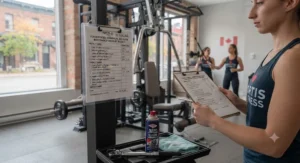
A documented inspection routine matters more than most new owners realize until an insurance claim forces the question. At minimum, a commercial studio should log cable and pulley condition, bolt tightness, and weight stack alignment on a recurring schedule, with photos and dated records kept on file. Beyond satisfying insurers, this habit catches the kind of gradual component wear — a fraying cable, a loosening pin mechanism — that causes the injuries liability claims are actually built around, long before it becomes a client-facing hazard.
Commercial Multi-Gym Review Roundup: What Real Buyers Say
Pulling together aggregated review sentiment across commercial equipment dealers and retail listings, a few consistent themes emerge in commercial multi-gym review feedback. Body-Solid’s line consistently earns praise for reliability and value-per-dollar across its G5S, EXM3000LPS, and S1000 models, with the most repeated critique being that cable and bearing service requires a technician rather than a DIY fix — a reasonable trade-off given the steel quality at these price points. The Inspire Fitness M3 draws particularly strong sentiment around its independent press-arm design and compact footprint, with buyers in home and light-commercial settings both flagging the resistance ratios as feeling heavier than the stack number suggests.
Higher-end brands like Hoist and Batca get consistently strong marks for build quality and long-term durability from commercial dealers who service institutional accounts, though buyers researching these tiers should expect fewer independent consumer reviews simply because these machines sell primarily through commercial channels rather than direct-to-consumer retail. That’s worth noting honestly: verified aggregated review volume thins out significantly above the C$6,000 mark, so buyers at that tier are leaning more on dealer track record and warranty terms than on a large body of public reviews — which is exactly why the spec and warranty comparisons throughout this guide matter more at the premium end.
Features That Actually Matter (And Those That Don’t)
Marketing copy loves to lead with exercise count — “100+ exercises!” — but that number matters far less than most buyers assume, since the practical exercise variety a client actually uses in a session rarely exceeds a dozen movements regardless of the machine’s theoretical maximum. What actually matters: steel gauge, bearing type, and cable tensile strength, because those three specs determine whether the machine still feels smooth after 5,000 reps or starts grinding after 500.
Weight stack poundage is another number that gets more attention than it deserves in isolation — a 210-pound stack with a 2:1 leg press ratio effectively delivers 420 pounds of resistance, so comparing raw stack numbers across machines without checking the resistance ratio is comparing incomplete information. Finish quality — powder coating, shrouded stacks — genuinely matters for client-facing studios but is cosmetic rather than functional, so it shouldn’t override a decision between two machines with meaningfully different steel gauges. Prioritize the boring, structural specs first; let the flashy marketing numbers break ties between otherwise-equal options.
Frequently Asked Questions
❓ What is a commercial multi-gym for small gym business use?
❓ How much does a commercial multi-gym cost in Canada?
❓ Is a commercial-grade multi-gym worth it over a home gym multi-gym?
❓ How many clients can use a multi-gym at once?
❓ What maintenance does commercial gym equipment need?
Conclusion
Choosing the right commercial multi-gym for small gym business needs really comes down to being honest about your booking model before you fall for the biggest spec sheet on the showroom floor. A solo trainer running staggered one-on-one sessions doesn’t need quad-stack capacity any more than a busy three-trainer studio can survive on a single-user machine during its 6 p.m. rush. Match the stack configuration to your actual peak-hour traffic, prioritize steel gauge and bearing quality over flashy exercise counts, and budget honestly for the ongoing maintenance every commercial machine — even the well-built ones in this roundup — genuinely requires.
Whether you land on the budget-friendly PowerTec Workbench Multisystem, the versatile Inspire Fitness M3, or the high-capacity Batca Omega 4, the underlying principle stays the same: commercial equipment is an investment in reduced downtime and client trust, not just a bigger number on an invoice. Check current pricing directly with retailers before you commit, since figures shift, and consider how your studio’s floor plan and staffing model will look in two years, not just on opening day.
✨ Don’t Miss These Exclusive Deals!
🔍 Take your studio’s strength training setup to the next level with these carefully selected commercial multi-gyms. Click on any highlighted item to check current pricing and availability. These machines will help you build the reliable, client-ready training floor your small gym business deserves!
Recommended for You
- Single Stack Home Gyms: 7 Best Picks for Canadian Homes (2026)
- Cable Row Handles 2026: 7 Picks That Won’t Wreck Your Wrists
- Home Multi-Gym vs Adjustable Dumbbells: 7 Smart 2026 Picks
Disclaimer: This article contains affiliate links. As an Amazon Associate, I earn from qualifying purchases. If you purchase products through these links, we may earn a small commission at no additional cost to you.
✨ Found this helpful? Share it with your friends! 💬🤗
