In This Article
If you’ve been staring at functional trainer listings on Amazon.ca for longer than you’d care to admit, wondering whether a single stack vs dual stack functional trainer actually makes a difference for your training — you’re not alone. It’s one of the most debated topics in the Canadian home gym community, and for good reason. The price gap between the two can run anywhere from $400 to well over $1,500 CAD, and choosing the wrong type means either overspending on features you’ll never use, or spending a Canadian winter frustrated by equipment that can’t keep up with your workouts.
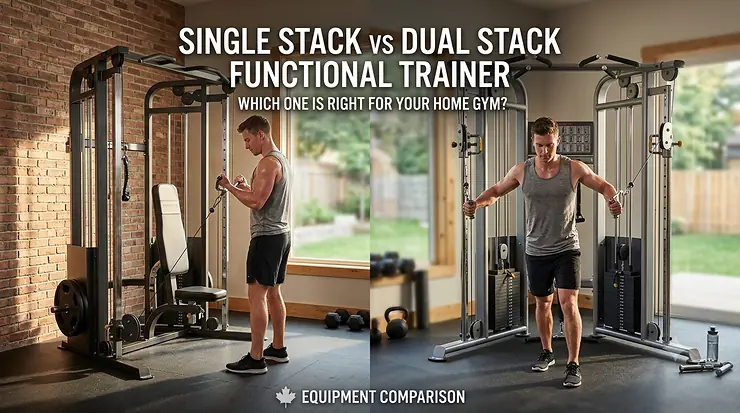
Here’s the short answer for those in a hurry: a single stack functional trainer uses one shared weight stack to power both cable arms, making it simpler and more affordable. A dual stack trainer gives each arm its own independent weight stack, unlocking true unilateral training and more exercise variety. The right choice depends entirely on how you train, your available space, and honestly — your budget in a market where Canadian prices run noticeably higher than their American equivalents.
In this guide, I’ve done the legwork — researching real products available on Amazon.ca, digging into actual user feedback from Canadian buyers, and running the numbers on long-term value in CAD. Whether you’re a beginner setting up your first basement gym in Winnipeg or an intermediate lifter in a Toronto condo looking to replace three machines with one, this breakdown will make your decision straightforward.
Quick Comparison: Single Stack vs Dual Stack Functional Trainer
| Feature | Single Stack | Dual Stack |
|---|---|---|
| Weight stacks | 1 shared stack | 2 independent stacks |
| Unilateral training | Limited | ✅ Full independent arms |
| Cable crossover (true) | ❌ Not possible | ✅ Yes |
| Price range (CAD) | $500–$1,200 | $1,200–$3,500+ |
| Footprint | Compact (~1 m × 1 m) | Wider (~1.5 m × 1.2 m) |
| Weight increments | Shared (halved if both arms used) | Independent per side |
| Best for | Beginners, rehab, small spaces | Intermediate–advanced, full programming |
| Maintenance complexity | Lower (fewer moving parts) | Higher (2× cables, pulleys) |
The table above tells part of the story, but here’s what it doesn’t tell you: the experiential gap between the two machines is larger than the specs suggest. A single stack trainer feels limiting the moment you want to do a cable fly — because splitting resistance between both arms means you’re working with half the weight you selected. For a beginner doing lat pulldowns or tricep pushdowns, that’s never a problem. For someone three months in who suddenly wants to do face pulls and rotational core work at the same time? You’ll be reaching for a dual stack almost immediately.
💬 Just one click — help others make better buying decisions too! 😊
✨ Don’t Miss These Exclusive Deals!
🔍 Take your home gym to the next level with these carefully selected functional trainers. Click on any highlighted item to check current pricing and availability on Amazon.ca. These machines will transform your training — year-round, even through a Canadian winter.
Top 7 Functional Trainers for Canadian Home Gyms: Expert Analysis
1. GF Single Stack Functional Trainer — Best True Single Stack on Amazon.ca
The GF Single Stack Functional Trainer is exactly what its name promises: a freestanding, standalone single stack cable machine with dual swivel pulleys — a genuinely rare category on Amazon.ca where most listings lean dual stack.
The 176 lb (approximately 80 kg) weight stack powers two adjustable cable arms through a shared pulley system. The dual-carriage design is what makes this particularly useful — it supports both bilateral and unilateral movements from a single stack, so you can do single-arm rows, cable curls, or tricep pushdowns without fighting the machine. The all-aluminium pulleys deliver smooth, commercial-grade cable travel, and the freestanding design (no wall anchoring required) makes it genuinely flexible for renters or anyone who occasionally reconfigures their basement gym.
The compact footprint — approximately 215 cm tall × 109 cm wide × 104 cm deep — makes it legitimately suitable for a standard Canadian basement with 8-foot ceilings and no wasted floor space. It ships as a standalone unit with minor assembly required, which Canadian reviewers consistently praise given the typical freight logistics challenges outside major urban centres.
In my assessment, this is the ideal entry-level cable machine for beginners who want cable-based training without the dual-stack premium. It’s not the machine for cable crossovers or simultaneous bilateral movements, but for a solo lifter working through foundational movements — lat pulldowns, face pulls, cable rows, curls — it covers the essentials competently. One limitation worth noting: the shared stack means you cannot set different weights per arm.
✅ All-aluminium pulleys for smooth, durable cable travel
✅ Freestanding — no wall anchoring needed (great for renters)
✅ Compact footprint fits standard Canadian basements
❌ Cannot perform true cable crossovers
❌ No independent weight selection per arm
Price range: Around $600–$900 CAD. Represents solid value for a single stack cable machine for beginners dipping into structured cable training for the first time.
2. Bells of Steel Plate Loaded Functional Trainer — Best Canadian Brand Pick
If you’re a Canadian buyer who values supporting a Canadian company and wants a cable machine that punches well above its price point, the Bells of Steel Plate Loaded Functional Trainer deserves serious attention. Bells of Steel is a Canadian fitness equipment brand based in Toronto, and their Amazon.ca presence means you’re getting factory-direct pricing without cross-border import fees or customs complications — a genuinely meaningful advantage when you’re comparing CAD to USD pricing.
The plate-loaded design skips the selectorized weight stack entirely — instead, you load your own Olympic plates onto 8.25-inch loadable sleeves. In practical terms: if you already own a set of bumper plates or standard Olympic plates, you can start training the day it arrives. The 16 handle height positions provide the exercise variety you’d expect from a functional trainer, and the all-aluminium pulleys — an upgrade over cheaper nylon versions common at this price range — deliver impressively smooth cable feel.
At 206 cm tall (81 inches), it fits comfortably in a room with standard 9-foot ceilings, and even manages a room with 7-foot ceilings if you forgo the chin-up position. The 250 lb cable capacity means serious lifters won’t hit a ceiling anytime soon. Canadian buyer feedback on Amazon.ca consistently highlights the build quality and the smooth pulley action as standout features for the price.
The honest caveat: dropping sets mid-workout requires physically removing plates, which is slower than moving a selector pin. If you do a lot of supersets or circuit-style training, this will occasionally frustrate you. For solo strength training sessions where you’re methodically working through a programme? It’s a non-issue.
✅ Canadian brand — no cross-border headaches, warranty honoured in Canada
✅ Plate-loaded = lower base price; use weights you already own
✅ All-aluminium pulleys; 250 lb cable capacity
❌ Slower weight changes between sets vs. selectorized models
❌ No independent dual-stack capability
Price range: In the $500–$800 CAD range — one of the strongest value propositions for a Canadian-bought cable machine at this tier.
3. Titan Fitness Functional Trainer Cable Crossover Machine — Best Dual Stack Under $2,000 CAD
The Titan Fitness Functional Trainer is the dual stack machine that appears most consistently in Canadian fitness forums for good reason: it delivers the dual 200 lb (approximately 91 kg) independent stacks and 20 height adjustment positions that define a proper functional trainer, at a price point that doesn’t require a second mortgage.
The 2:1 pulley ratio is something worth understanding before you buy: the listed 200 lb stack delivers 100 lb of felt resistance per arm, with 10 lb increments on the stack translating to 5 lb increments of felt weight change. This is actually beneficial for unilateral training and progressive overload — finer adjustments mean you can increase load more gradually, which is especially valuable if you’re rehabbing a shoulder or training a weaker arm to catch up. The 20 vertical height positions allow a genuinely wide range of pulling angles, from ankle-level glute kickbacks to overhead pulldowns.
At 208 cm tall (82 inches) with a 163 cm × 112 cm (64″ × 44″) footprint, this is a machine that needs dedicated space. For a Canadian suburban home gym with a proper dedicated room or two-car garage, that’s manageable. For a Toronto or Vancouver condo, measure twice before clicking purchase.
Canadian reviewers on Amazon.ca frequently mention two things: the assembly is a two-person job (the listing explicitly states this), and the weight of 305 kg (672 lbs) means you’ll want it on concrete or a reinforced floor — a relevant consideration for Canadian basements with older construction.
✅ True dual 200 lb independent stacks per side
✅ 20 height positions; true cable crossover capable
✅ Fine 5 lb effective increments via 2:1 ratio — great for progressive overload
❌ Assembly genuinely requires two people
❌ Footprint demands dedicated space
Price range: Mid-$1,500s to low-$2,000s CAD. For a dual stack with this spec sheet, it represents strong value in the Canadian market.
4. XMark Functional Trainer XM-7626 — Best Dual Stack for Feature-Rich Training
The XMark XM-7626 is a well-established name in functional trainers, and its Amazon.ca availability makes it a legitimate option for Canadian buyers who want commercial-style versatility without a commercial price tag.
Dual 200 lb independent weight stacks, 19 adjustment positions spaced at approximately 9 cm (3.5 inches) apart, and forged steel swivel carabiners engineered for high-traffic, repetitive use — these are specs that would be at home in a light commercial facility. The upgraded accessory package available on Amazon.ca adds a triple chrome-plated chinning triangle, single grip handles, and a triceps rope, which means you’re ready to train across dozens of exercises immediately out of the box.
What most buyers overlook about this model is the quality of the swivel system. In my experience reviewing functional trainers, the swivel carabiner is often the first component to degrade — cheap ones develop friction and lag that ruins cable feel within 12–18 months of regular use. The forged steel swivels on the XM-7626 are a meaningful engineering choice, not a marketing footnote. This matters especially in Canadian home gyms where humidity fluctuations between seasons (humid summers, dry heated winters) can accelerate wear on lower-quality hardware.
The knurled rubber grip handles provide solid non-slip contact even with sweaty hands — a small detail that becomes noticeable the moment you’re doing high-rep cable work in a warm summer garage gym.
Canadian feedback notes that shipping is freight delivery and requires a signature, which means planning around delivery windows — something Canadians in more remote areas know all too well.
✅ Forged steel swivel carabiners — built for longevity
✅ 19 height positions; dual 200 lb independent stacks
✅ Comprehensive accessory package included
❌ Freight delivery requires signature and planning
❌ Heavier footprint needs proper floor reinforcement
Price range: Around $1,400–$1,900 CAD. Competitively positioned for the feature set.
5. Body-Solid GDCC210 — Best Compact Dual Stack for Home Gyms
Body-Solid has been a trusted name in home gym equipment for decades, and the GDCC210 is their answer to the question: “What if I want a dual stack functional trainer, but I don’t have a professional gym’s square footage?”
The key selling point is the space-saving design: at 109 cm × 185 cm × 213 cm (43″ × 73″ × 84″), the GDCC210 fits against a wall without dominating the room. Dual 160 lb independent weight stacks with a 2:1 ratio deliver 80 lb of effective resistance per arm — which, with 2.5 lb effective increments via the 2:1 system, gives you one of the finest progressions available at this price point. This is precisely why the GDCC210 consistently appears in recommendations for rehab settings and for beginners who want to dial in proper progressive overload from day one.
The 19 independent height adjustments and 180-degree cable positioning unlock the full range of functional movements: cable crossovers, rotational core work, high-to-low wood chops, single-arm presses, and everything in between. The integrated chinning bar adds bodyweight pull-up and leg raise capacity without requiring a separate piece of equipment — relevant for Canadian home gym builders trying to maximise a limited footprint budget.
The commercial-rated lifetime warranty on frames and welds is exceptional, though the 3-year warranty on pulleys and 1-year on cables reflects a realistic acknowledgement that consumable components do wear.
✅ Compact footprint — fits against a wall in smaller gym spaces
✅ Fine effective weight increments via 2:1 ratio — excellent for beginners
✅ 180-degree cable positioning; integrated chin-up bar
❌ 80 lb per arm effective maximum — may feel limiting for stronger lifters
❌ Cables and pulleys have shorter warranty coverage
Price range: Around $1,200–$1,600 CAD. Among the most accessible dual stack options on Amazon.ca.
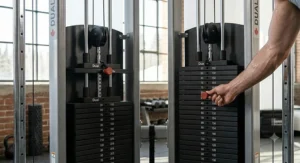
6. Powerline by Body-Solid PFT100 — Best for Beginners Who Want to Grow
The Powerline PFT100 is Body-Solid’s budget-oriented line applied to the functional trainer category, and what it lacks in premium finish, it compensates for with a no-nonsense, genuinely capable feature set that suits beginners perfectly.
Dual 160 lb weight stacks (upgradable to 210 lb) and 20 starting positions with 8 cm (3.2-inch) hole spacing give enough range for nearly any exercise a beginner or intermediate lifter would programme. The 180-degree swivel pulleys are smooth and consistent — the no-cable-change design means you transition between exercises by repositioning the pulley rather than re-threading cables, which genuinely improves training flow for circuit-style workouts.
What I appreciate about the PFT100 specifically for Canadian buyers building their first serious home gym: the upgradeability of the weight stacks is real and reasonably priced. If you buy at the base 160 lb configuration and find yourself progressing faster than expected — as beginners often do in the first 6 months — you’re not stuck buying a new machine. You upgrade the stacks. That’s meaningful long-term value in a market where replacement machines carry a CAD price premium.
The integrated accessory bar storage keeps your training space organised, which might seem trivial until you’ve tripped over a cable handle in a dark basement at 6 a.m. for the third time.
✅ Upgradeable weight stacks — grow your resistance as you progress
✅ No-cable-change pulley design — smoother exercise transitions
✅ Strong value for beginners at this price point
❌ Nylon cable handles are less premium than aluminium alternatives
❌ Base 80 lb effective resistance per arm may feel limiting for advanced lifters early
Price range: In the $1,000–$1,400 CAD range. A solid entry dual stack that grows with you.
7. ALTAS Strength AL-3073 Functional Trainer — Best Light Commercial Option
The ALTAS Strength AL-3073 sits at the premium end of what you’ll find available on Amazon.ca for home gym use, and it earns that position through a combination of build quality and cable capacity that straddles the line between residential and light commercial use.
With 2,000 lb cable capacity included and a heavy-gauge steel frame engineered to commercial-facility standards, this machine is built for lifters who train seriously and frequently. For a Canadian home gym owner who trains five or six days a week and considers themselves a dedicated intermediate-to-advanced lifter, the AL-3073 removes any doubt about the machine holding up under sustained use over years — not just months. The included comprehensive attachment set means you’re equipped immediately, without the extra Amazon.ca orders for handles and ropes that can add $80–$150 CAD to the total cost of cheaper alternatives.
What most buyers in Canada overlook about premium machines like this: the warranty support and parts availability from Canadian-market sellers matters more than it seems when a cable needs replacing three years from now. ALTAS has a growing Canadian dealer network, which means service is more realistic than it is for off-brand machines shipped directly from overseas without established Canadian support.
✅ Commercial-grade build for sustained, high-frequency training
✅ 2,000 lb cable capacity; comprehensive attachment set
✅ Light commercial warranty — appropriate for dedicated home lifters
❌ Significantly higher price point — requires a committed budget
❌ Requires substantial dedicated floor space
Price range: In the $1,800–$2,800 CAD range depending on configuration. A long-term investment for lifters who are serious about cable training.
How to Choose: Practical Framework for Canadian Buyers
Choosing between a single stack vs dual stack functional trainer ultimately comes down to four questions. Answer these honestly and the decision makes itself.
1. What exercises do you actually programme — or plan to programme? If your training consists primarily of lat pulldowns, seated rows, cable curls, tricep pushdowns, and face pulls, a single stack entry-level cable machine covers all of it comfortably. These are symmetrical movements where both arms work together or sequentially — the shared stack is not a limitation. If you want cable crossovers (where both arms move simultaneously against independent resistance), rotational core movements, or alternating-arm exercises with different loads per side, you need dual stacks. There’s no workaround.
2. Are you training alone, or do you share your gym? A dual stack allows two people to train simultaneously on opposite sides with different loads — genuinely useful if you’re building a shared home gym with a partner or family member of significantly different strength levels. A single stack is a single-user machine by design.
3. What is your realistic budget in CAD — total cost of ownership? Canadian pricing on functional trainers typically runs 15–25% higher than US equivalents due to exchange rates, import costs, and freight logistics. Factor in that entry-level single stack machines on Amazon.ca run roughly $600–$900 CAD, while capable dual stacks start around $1,200 CAD and run well past $2,000 CAD. Be honest about whether the features of the dual stack align with your actual current training needs, not hypothetical future programming.
4. How much space do you realistically have? A single stack trainer typically needs about 120 cm × 120 cm (roughly 4′ × 4′) of clear training space around it. A dual stack, particularly the cable crossover-style machines, needs 150–180 cm of width to allow comfortable movement between the cable columns. In a standard Canadian basement or garage gym, this distinction matters.
The Unilateral Training Case: Why Dual Stacks Win for Muscle Balance
This is where the conversation gets genuinely interesting, and it’s the most common reason intermediate lifters upgrade from a single stack to a dual stack machine.
Research published in Frontiers in Physiology confirms that unilateral training can produce greater strength gains than bilateral training in individuals with existing limb strength imbalances — a category that describes the majority of recreational lifters, whether they realise it or not. If you’ve been training with bilateral barbell movements for years, there’s a reasonable chance your dominant side is compensating for your weaker side in ways you can’t feel or measure during the lift itself.
A dual stack functional trainer exposes this immediately and corrects it efficiently. When your right arm can only curl 20 lbs independently while your left pushes 25 lbs, the independent stacks force you to acknowledge and address the imbalance. On a single stack machine with shared resistance, your stronger arm quietly picks up the slack — and the imbalance persists or worsens.
For Canadian athletes training for hockey, skiing, or any sport with dominant rotational demands (which describes a remarkable proportion of recreational sport in this country), the case for dual stacks and true unilateral training is particularly strong. BarBend’s coverage of unilateral training research notes that single-arm cable work specifically helps correct asymmetries common in rotational sport athletes — the kind of asymmetry a hockey player develops naturally from always shooting from their dominant side.
The practical upshot: if you’re under 30 with balanced strength and primarily interested in building muscle across standard compound movements, a single stack is genuinely sufficient for 12–18 months of progress. If you’re past that foundational phase, regularly play sport, or have any known strength imbalances, the dual stack pays for itself in injury prevention alone.
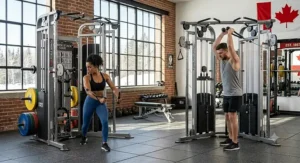
Real-World Scenarios: Which Canadian Buyer Are You?
The Winnipeg Basement Builder — Budget-Conscious Beginner: James, 34, works a desk job and wants to get consistent gym training through Manitoba winters without the $80/month gym membership. His basement has a 2.4 m (8-foot) ceiling and about 3 m × 3 m of clear floor space. He trains three days a week, primarily strength circuits, and has no current experience with cable machines. Best match: Bells of Steel Plate Loaded Functional Trainer. At around $500–$800 CAD, it fits his space and budget, it’s Canadian-made so warranty and parts support are realistic, and it covers every exercise he’ll need for his first 18 months of cable training. Once he outgrows it, he can sell it locally and upgrade.
The Vancouver Condo Athlete — Space-Constrained Intermediate: Priya, 28, trains five days a week in a dedicated gym room carved out of a spare bedroom — approximately 3.5 m × 3 m. She plays recreational tennis, is aware of a right shoulder dominant pattern, and wants to address it properly. She has $1,500–$1,800 CAD to spend. Best match: Body-Solid GDCC210. It fits against a wall in her space, delivers the independent dual stacks she needs for proper unilateral shoulder work, and the fine 2.5 lb effective increments make progressive overload in shoulder rehab-adjacent work genuinely manageable.
The Ottawa Serious Lifter — Garage Gym Devotee: Marcus, 42, has a two-car garage converted to a full gym. He trains six days a week, has an existing power rack and bumper plates, and wants a functional trainer that won’t be an afterthought in the space. Budget: up to $2,500 CAD. Best match: ALTAS Strength AL-3073. The light commercial build means it handles his training frequency without degrading, and the Canadian dealer network gives him peace of mind on long-term service — something you simply don’t get with direct-import machines.
Common Mistakes When Buying a Functional Trainer in Canada
Ignoring the effective resistance vs. stated stack weight. Most functional trainers on Amazon.ca use a 2:1 pulley ratio. A machine advertised as “200 lb weight stack” delivers 100 lb of effective resistance per arm. This is not a flaw — it’s a deliberate engineering choice that creates smoother cable feel and finer increment steps. But it does mean that if your training requires heavy loads (think 90 lb+ single-arm rows), you need to verify the machine’s stated weight and the pulley ratio before purchasing.
Assuming Amazon.com products ship to Canada without issue. This is the biggest Canadian-specific mistake. Many well-reviewed functional trainers on Amazon.com either don’t ship to Canada at all, or ship at freight costs that add $300–$600 CAD to the price, completely eroding the apparent savings vs. buying on Amazon.ca directly. Always start your search on Amazon.ca and verify shipping to your province before making assumptions.
Underestimating assembly complexity. Most dual stack functional trainers in the $1,200–$2,000 CAD range are not one-person assembly jobs. Multiple Canadian reviewers report assembly times of 3–5 hours for two people. If you’re in a northern or remote community where getting a second person to help might be logistically complicated, factor this in.
Overlooking the cable weight increment detail for beginners. A single stack entry-level cable machine for beginners is excellent — but check the minimum starting resistance and increment size. Some budget machines have minimum weights and increment steps that are too large for rehabilitation-focused training or for users who are genuinely new to resistance training. The 2:1 ratio machines that deliver 2.5–5 lb effective increments are meaningfully better for the beginner progression curve than those with 10 lb jumps.
What to Expect: Real-World Performance in Canadian Conditions
Functional trainers are largely indifferent to Canadian climate — unlike outdoor equipment, they live inside and aren’t exposed to the -30°C conditions a Manitoba winter delivers. That said, there are a few Canadian-specific performance considerations worth knowing.
Basement humidity and cable longevity. Canadian basements, particularly older construction in Ontario and Quebec, can experience significant humidity swings — humid summers, dry heated winters. This matters for cable life. Cables on cheaper machines can develop stiffness and micro-cracking in low-humidity winter conditions if the gym space isn’t temperature-controlled. The premium machines with aircraft-grade steel cables (common in the ALTAS and Titan Fitness range) handle these conditions better than budget steel cables. A simple remedy for all machines: keep your gym space temperature-regulated and periodically wipe down cables and pulleys with a dry cloth after humid summer sessions.
Floor loading in Canadian basements. The heavier dual stack machines — 250–305 kg (550–672 lbs) fully assembled — require careful consideration of floor loading capacity. Older Canadian residential construction may have basement floors rated for 150 kg/m² or less. Placing a heavy machine on rubber gym mats (which help distribute load and protect the concrete) is standard practice; for older homes, a quick check with a structural engineer costs less than a cracked floor slab.
Remote delivery. For Canadian buyers in smaller cities and rural areas, functional trainer delivery is almost always freight — not standard parcel. This means scheduling a delivery window, being present for the drop, and often managing the move from the driveway to the gym yourself. Plan for this, and consider whether your community has a fitness equipment dealer who can provide local delivery and setup.
Long-Term Value & Cost of Ownership in Canada
The true cost of a functional trainer in Canada isn’t just the purchase price — it’s the full lifecycle cost over 5–10 years of ownership.
| Machine Tier | Price Range (CAD) | Expected Lifespan | Cable Replacement Cost (CAD) | Annual Cost Estimate |
|---|---|---|---|---|
| Single stack entry (GF, Bells of Steel) | $500–$900 | 5–7 years | $80–$150 | ~$120–$200/yr |
| Mid-range dual stack (GDCC210, PFT100) | $1,200–$1,600 | 7–10 years | $150–$250 | ~$160–$250/yr |
| Premium dual stack (Titan, XMark, ALTAS) | $1,500–$2,800 | 10–15 years | $200–$350 | ~$150–$250/yr |
| Commercial gym membership | N/A | Ongoing | N/A | ~$600–$1,200/yr |
The maths on ownership vs. membership is stark: even a mid-range dual stack functional trainer at $1,400 CAD, maintained properly, costs less over 5 years than 18 months of a standard Canadian gym membership in a major city. In cold-weather months when commuting to the gym genuinely impacts workout consistency, the home gym advantage compounds further.
Cable replacement is the most likely maintenance cost you’ll face. For most mid-range machines, this runs $150–$250 CAD for a replacement set when done by a local equipment service technician. Annual lubrication of pulleys and guide rods — a 20-minute job with silicone spray — extends cable and pulley life significantly.
Features That Actually Matter (And Those That Don’t)
Matters more than most buyers realise:
- Pulley material (aluminium vs. nylon) — aluminium lasts years longer and feels significantly smoother under load
- Cable ratio (1:1 vs. 2:1) — determines effective resistance and increment size; understand this before purchase
- Weight stack upgradeability — the ability to add weight later is a genuine long-term value multiplier
- Number of height adjustment positions — more positions = more exercise variety and better body proportion fit
Matters less than marketing suggests:
- The exact number of included exercises listed by manufacturers — this is marketing. A machine with 16 height positions and good attachments accesses more exercises than you’ll ever need.
- Colour and finish options — powder coat holds up well in all Canadian home gym environments; colour choice is purely aesthetic
- LCD display features on some higher-end models — functional trainers are cable machines, not cardio equipment; you don’t need a screen
The one spec most buyers miss: The distance between the cable columns on dual stack machines. Standard commercial trainers have columns 150 cm (60 inches) apart or more, allowing full cable crossover range of motion. Some compact home gym dual stack machines narrow this to 107 cm (42 inches) — technically functional for crossovers but noticeably cramped. Check this measurement if cable fly range of motion matters to your training.
FAQ
❓ Is a single stack functional trainer enough for a full-body workout?
❓ What cable weight increments should I look for on a functional trainer in Canada?
❓ Can I get a functional trainer shipped to a remote area of Canada?
❓ Is unilateral training possible on a single stack functional trainer?
❓ Are functional trainers on Amazon.ca covered by Canadian warranty law?
Conclusion
The single stack vs dual stack functional trainer debate doesn’t have a universal winner — it has the right answer for your situation. If you’re building your first home gym on a Canadian budget, want reliable cable training through the seasons, and aren’t yet programming complex unilateral or crossover movements, a quality single stack entry-level cable machine is genuinely sufficient and will serve you well for years. If you’re past the beginner phase, play sport, have known strength imbalances, or simply want the freedom to train everything a cable machine can offer — including true cable crossovers and independent arm loading — a dual stack is the machine you’ll actually keep and use long-term.
The Canadian market has strong options at both ends of this spectrum on Amazon.ca, from the Canadian-made Bells of Steel Plate Loaded trainer to the commercial-grade ALTAS AL-3073. The key is matching the machine to your training reality today, with enough headroom for where you’ll be in 12–18 months.
Whatever you choose, a home gym functional trainer pays for itself in saved gym membership costs within 18–24 months in most Canadian cities — and it trains rain, snow, or -30°C outside.
✨ Don’t Miss These Exclusive Deals!
🔍 Ready to upgrade your home gym? Click on any highlighted product above to check current pricing and availability on Amazon.ca. These functional trainers represent the best value for Canadian home gym builders in 2026 — your progress doesn’t have to wait for a better day to start.
Recommended for You
- Best Single Stack Functional Trainer Canada: 7 Top Picks (2026)
- 7 Best Dual Adjustable Pulley Machines in Canada (2026): Honest Buyer’s Guide
- 7 Best All-In-One Home Gym Machines in Canada (2026 Guide)
Disclaimer: This article contains affiliate links. As an Amazon Associate, I earn from qualifying purchases. If you purchase products through these links, we may earn a small commission at no additional cost to you.
✨ Found this helpful? Share it with your friends! 💬🤗
