In This Article
Let me be direct with you: if you’re still running between a lat pulldown machine, a cable crossover station, and a squat rack to get a complete workout, you’re doing it the hard way — especially when Canadian winters make that drive to the gym feel like an expedition to the Arctic. A dual stack functional trainer is the single piece of equipment that collapses all of that into one compact, incredibly versatile cable system.
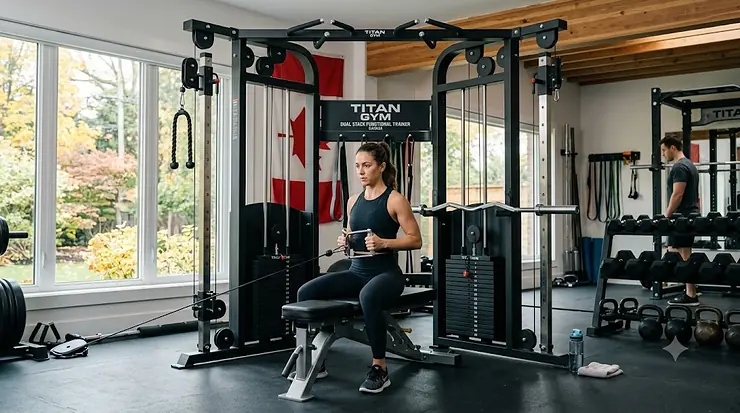
So, what exactly is a dual stack functional trainer? In simple terms, it’s a cable machine with two independent weight stacks — one on each side — connected to a pair of fully adjustable pulleys. Unlike a single-stack system where both arms share one source of resistance, the independent weight stacks allow you to set different loads on each side, train one limb at a time, or perform bilateral movements simultaneously. That’s bilateral resistance training and unilateral isolation in a single footprint.
Here’s why this matters for Canadian buyers specifically: with the average home gym carved out of a basement or garage — spaces that already shrink come November when storage boxes reclaim their territory — you need equipment that punches above its weight. A commercial dual stack functional trainer for home use delivers well over 100 distinct exercises from a floor footprint that’s often no larger than 1.5 m × 1.2 m (about 5 ft × 4 ft). That’s not marketing language; it’s practical physics.
The Canadian Society for Exercise Physiology, backed by the Public Health Agency of Canada, recommends that adults perform muscle- and bone-strengthening activities at least twice per week. A dual stack functional trainer checks that box entirely on its own, serving beginners, intermediate lifters, athletes in rehab, and advanced strength trainees with equal competence.
I’ve reviewed the top dual stack trainers currently available on Amazon.ca, priced in CAD, and verified for Canadian availability. Here’s the definitive guide.
Quick Comparison: Top 7 Dual Stack Functional Trainers on Amazon.ca
| Product | Weight Stack | Pulley Positions | Best For | Price Range (CAD) |
|---|---|---|---|---|
| XMark XM-7626 | Dual 200 lb (90 kg) | 19 | Home & light commercial | $1,200–$1,600 |
| Body-Solid GFT100 | Dual 160 lb (72 kg) | 20 | Intermediate home gym | $2,000–$2,500 |
| Body-Solid GDCC210 | Dual 160 lb (72 kg) | 19 | Budget commercial | $1,500–$2,000 |
| Powerline PFT50 | 210 lb (95 kg) single | 180° swivel | Compact/small spaces | $800–$1,100 |
| Inspire Fitness FT1 | Dual 165 lb (75 kg) + Smith | 20 | All-in-one premium | $2,500–$3,500 |
| SpaceSmart Wall-Mount | Dual 110 lb (50 kg) | 26 | Condos & wall-mount | $600–$900 |
| ALTAS Strength 3073 | Commercial-grade | 20 | Heavy-duty commercial | $1,800–$2,400 |
Analysis: The table above tells a clear story. The XMark XM-7626 hits the best balance of weight capacity and price for most Canadian home gym owners. If you’re in a condo in Vancouver or Toronto and wall space is your primary constraint, the SpaceSmart is the smart choice — though its 110 lb stacks will limit advanced lifters. Premium buyers who want a Smith machine built in should look past the $2,500 CAD threshold at the Inspire FT1; the added cost genuinely replaces two or three separate pieces of equipment.
💬 Just one click — help others make better buying decisions too!😊
✨ Don’t Miss These Exclusive Deals!
🔍 Take your strength training to the next level with these carefully selected cable machines. Click on any highlighted item to check current pricing and availability on Amazon.ca. These machines will help you build real, functional strength from the comfort of your own home gym!
Top 7 Dual Stack Functional Trainers: Expert Analysis
1. XMark XM-7626 Functional Trainer Cable Machine — Dual 200 lb Weight Stacks
The XMark XM-7626 is arguably the most well-known top dual stack trainer in the Canadian home gym space, and after looking closely at what it delivers, that reputation is mostly earned.
The specs start strong: dual 200 lb (90 kg) weight stacks — which at a 2:1 cable ratio means you’re working with 100 lbs (45 kg) of actual resistance per side — combined with 19 height adjustments spaced at 8.9 cm (3.5 inches) apart. The 11-gauge, 2″ × 3″ steel mainframe is the same spec you’d find on light commercial equipment in a boutique training studio in Calgary or Ottawa. What most buyers overlook about this model is the forged steel swivel attached to the cable handles: it’s precision-engineered for continuous rotation, meaning the cable doesn’t bind mid-rep when you’re doing rotational wood chops or single-arm cable rows — movements your grip and core stability depend on.
Who is this for? The XM-7626 suits the serious intermediate-to-advanced home lifter who wants commercial quality without commercial pricing. At the $1,200–$1,600 CAD range, it competes aggressively. For Canadians in provinces with higher living costs (BC, Ontario), this represents genuine value compared to gym memberships that can run $70–$120 CAD per month.
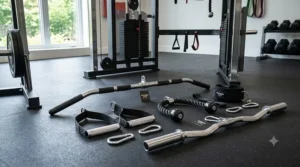
Canadian reviewers consistently praise the smooth cable action and the included accessory package — which was upgraded to include a chinning triangle, single grip handles, and a triceps rope. A few noted assembly takes two people and about three hours, which is worth planning around, particularly if your home gym is in a basement with tight stairwell access.
✅ Dual 200 lb independent stacks allow true bilateral resistance training per side
✅ 19-position quick-adjust pulleys with no tool changes required
✅ Commercial-grade 11-gauge steel frame built for daily use
❌ 2:1 pulley ratio means effective resistance per side is 100 lb, not 200 lb — know this before purchasing
❌ Assembly requires two people; plan for 2–3 hours minimum
At the $1,200–$1,600 CAD range, this is excellent value — a heavy duty cable machine that won’t feel underpowered as your strength develops.
2. Body-Solid GFT100 Functional Trainer — Dual 160 lb Weight Stacks
Body-Solid has been building commercial-grade fitness equipment for over 30 years, and the GFT100 carries that legacy into the home gym category with genuine authority.
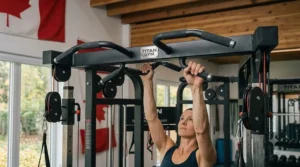
The GFT100 features dual 160 lb (72 kg) fully adjustable swiveling pulleys — those pulleys rotate through a full range, not just vertically, which matters enormously when you’re doing exercises that require lateral cable angles like cable flyes or hip abductions. The integrated chinning bar adds pull-ups, chin-ups, and leg raises to the repertoire without occupying additional floor space — a detail Canadians with finished basements of 8 m × 6 m (about 26 ft × 20 ft) or less will genuinely appreciate. The optional 50 lb stack upgrade per side (bringing each stack to 210 lb) is a smart future-proofing option.
What separates the GFT100 from similarly-priced competitors is construction quality. The 11-gauge 2″ × 3″ steel frame uses four-sided welds — not the two-sided welds that are common in lower-tier machines. In a cold garage in Edmonton or Winnipeg, where freeze-thaw cycles stress metal joints over time, that construction difference becomes relevant after year three or four of ownership.
Canadian customer reviews skew positive, particularly around the quality of the cable system and frame stability. A few note the 160 lb stacks can feel limiting for pressing movements if you’re an advanced lifter — the optional upgrade resolves this.
✅ Fully swiveling pulleys for multi-angle cable work
✅ Integrated chinning bar eliminates need for a separate pull-up station
✅ Four-sided welded frame; Body-Solid’s lifetime warranty on frame and welds
❌ 160 lb stacks may feel limiting for advanced lifters without the paid stack upgrade
❌ Premium pricing sits at the upper end of the home gym category
Priced in the $2,000–$2,500 CAD range, the GFT100 is a long-term investment that justifies its cost through durability and warranty coverage.
3. Body-Solid GDCC210 Cable Crossover Functional Training Centre
The GDCC210 is Body-Solid’s more compact dual-stack offering, and it’s the model I’d point a budget-conscious Canadian buyer toward before the GFT100.
This machine runs dual 160 lb (72 kg) independent weight stacks with 19 independent height adjustments and 180° cable positioning — meaning you can set each arm at a completely different angle simultaneously. That’s what true isolateral movement capability looks like in practice. The 11-gauge 2″ × 4″ oval tubing construction is commercial-rated, and the lifetime warranty on frames, welds, weight plates, and guide rods is the most comprehensive coverage in this price category.
Here’s the practical kicker for Canadian buyers: the GDCC210 measures approximately 109 cm × 185 cm × 213 cm (43″ × 73″ × 84″), weighing in at around 233 kg (514 lbs). That weight means it stays planted during heavy cable rows and chest flyes — no rocking on uneven garage floors. However, getting it down a basement stairwell requires disassembly and a second pair of hands; budget a weekend afternoon for this.
Customer feedback highlights the smooth cable operation and wide exercise variety. The optional 50 lb stack upgrade (available per side, bringing each to 210 lb) is the same offer as the GFT100 — worth adding immediately for anyone over 80 kg (175 lbs) of bodyweight who trains to failure regularly.
✅ Commercial-rated construction with lifetime frame warranty
✅ True 180° independent cable positioning on each arm
✅ Weight plates and guide rods also covered under lifetime warranty
❌ At 233 kg, delivery and placement require significant planning
❌ 160 lb base stacks can feel modest for bilateral pressing exercises
In the $1,500–$2,000 CAD range, the GDCC210 is the strongest value play among Body-Solid’s dual-stack lineup.
4. Powerline PFT50 by Body-Solid — 210 lb Single-Stack Compact Trainer
Before anyone objects — yes, the PFT50 is technically a single-stack functional trainer, not a dual-stack design. I’m including it here because for Canadian buyers in condos, shared rental spaces, or sub-20 m² home gyms, this machine deserves serious consideration as a space-efficient alternative to a full dual-stack setup.
The 210 lb (95 kg) shared weight stack feeds into two 180°-swiveling pulleys via a no-cable-change design. You can transition from triceps pressdowns to cable crossovers to bent-over rows without rethreading cables — something that feels insignificant until you’ve wasted 90 seconds re-threading a cable mid-superset in a cold garage. The professional carriage system uses patented nylon bushings gliding on chrome guide rods, producing a notably smooth action that punches above this machine’s price point.
The limitations are real: because both arms share a single 210 lb stack, you cannot independently load each side — bilateral resistance training requires both handles to share the same total resistance. For advanced unilateral training or two people training simultaneously, this creates a bottleneck.
That said, for a solo home gym user in a Toronto apartment or Montréal condo unit where floor space is calculated by the centimetre, the PFT50’s compact 140 cm × 155 cm × 213 cm footprint (55″ × 61″ × 84″) is a serious advantage.
✅ 210 lb weight stack is generous for a compact trainer
✅ No-cable-change design speeds up transitions between exercises
✅ 180° swiveling pulleys provide versatile cable positioning
❌ Single shared stack limits true bilateral independent resistance training
❌ Not suitable for two users training simultaneously
Priced around $800–$1,100 CAD, this is the top compact pick for Canadians prioritizing space efficiency.
5. Inspire Fitness FT1 Home Gym Functional Trainer — Dual 165 lb + Selectorized Smith Bar
The Inspire Fitness FT1 (also listed as the SF3 variant on Amazon.ca) is the premium all-in-one solution in this category, and it earns that designation through genuine innovation rather than marketing hype.
Dual 165 lb (75 kg) weight stacks feed both the cable system and — uniquely — a selectorized Smith machine bar that can multiply resistance up to 330 lb (150 kg) for pressing movements. This isn’t a conventional Smith machine; Inspire’s SF3 bar uses a resistance multiplication system that lets you bench, squat, or overhead press at heavy loads without needing a spotter, and without storing Olympic plates. For a Canadian home gym owner who trains alone — which describes the majority of us — that’s a genuine safety upgrade. The built-in pull-up bar, seven included accessories, and dual 5 lb add-on weights round out a package that truly replaces five or six individual pieces of equipment.
The only catch I see is availability: at the time of research, Canadian stock appeared limited — “only 1 left in stock” was noted on Amazon.ca, fulfilled by a Canadian sporting equipment supplier. This is a machine worth acting on when stock is available, or checking for restocks during major Canadian retail events (Amazon.ca Prime Day, Boxing Day sales).
Canadian reviewers who’ve purchased this cite the all-in-one convenience as its standout quality, particularly for shared family home gyms where multiple users have different training goals.
✅ Smith bar functionality eliminates the need for a separate power rack
✅ Dual 165 lb independent stacks plus Smith resistance up to 150 kg
✅ 7 included accessories and integrated pull-up bar
❌ Premium pricing in the $2,500–$3,500 CAD range requires serious budget commitment
❌ Canadian stock can be limited; availability varies
For Canadian families building a home gym that covers every training base, the Inspire FT1 is the most complete single-machine solution available on Amazon.ca.
6. SpaceSmart Wall-Mounted Functional Trainer — Dual 110 lb Stacks
The SpaceSmart is one of the few wall-mounted dual-stack options currently available on Amazon.ca, and it solves a specific problem that a lot of Canadian apartment and condo gym owners face: zero available floor space.
With a stainless-steel mirror finish and dual 110 lb (50 kg) weight stacks divided into 5.5 lb (2.5 kg) increments across 20 levels, and 26 levels of pulley adjustment per side, this trainer delivers precise resistance control that most selectorized machines twice its price don’t match. The rubber-grip handles are ergonomically designed for comfort during high-rep work — important for the rehabilitation-focused user or someone returning to training after injury.
Here’s the honest limitation: 110 lb per side at a 2:1 ratio translates to 55 lbs (25 kg) of effective resistance. For rehabilitation, mobility work, and moderate hypertrophy training, that’s sufficient. For heavy strength training — loaded cable squats, heavy rows, or serious chest pressing — this machine will top out quickly for intermediate-to-advanced lifters. It’s best positioned as a primary machine for beginners or a supplementary cable station for advanced trainees who already own a barbell setup.
Canadian condo owners in BC’s Lower Mainland or downtown Toronto, where suite square footage can run under 60 m² and floor-mounted equipment simply isn’t viable, will find the SpaceSmart to be the most practical solution in this category.
✅ Wall-mounted design preserves all floor space
✅ 26 pulley adjustment levels — most in its price range
✅ Mirror-finish stainless steel suits modern home gym aesthetics
❌ 110 lb stacks limit advanced lifters; effective resistance is ~55 lbs per side at 2:1 ratio
❌ Wall mounting requires proper stud-anchoring — concrete or masonry walls in some Canadian constructions may require professional installation
At $600–$900 CAD, the SpaceSmart is the most affordable true dual-stack option on Amazon.ca and the top pick for condo dwellers.
7. ALTAS Strength 3073 Functional Trainer — Light Commercial Grade
The ALTAS Strength 3073 occupies a unique position in the Canadian market: it’s built to light commercial standards with a 2,000 lb cable rating, which means the cables alone are overbuilt for home use in a way that translates to a dramatically extended service life.
The machine features a full pulley adjustment system with 20 positions, heavy-duty powder-coated steel construction, and included accessories covering the most common cable attachment needs. What distinguishes the ALTAS 3073 for Canadian buyers specifically is that ALTAS is a Canadian-connected brand with some distribution infrastructure in Canada — parts availability and customer support tend to be more accessible domestically than with purely US-focused brands that treat Canada as an aftermarket.
The weight stack configuration is designed for progressive overload through a commercial-use cycle, meaning daily use by multiple users won’t wear it out the way it would a lighter home-grade machine. For Canadian personal trainers setting up a small studio, physiotherapists building a rehab space, or home gym owners who run high weekly training volumes, the ALTAS 3073 is worth the premium.
Customer feedback notes the build quality is exceptional for the price, though assembly documentation could be clearer — budget three to four hours and recruit a second person.
✅ 2,000 lb cable rating — significantly overbuilt for home use, excellent longevity
✅ Canadian-connected brand with better parts availability in Canada than some US competitors
✅ 20-position pulley system covers full-body exercise range
❌ Premium pricing in the $1,800–$2,400 CAD range reflects commercial build specs
❌ Assembly instructions can be unclear; allow extra time
For serious Canadian home gym owners or small fitness studios, the ALTAS 3073 delivers commercial durability at a non-commercial price.
How to Set Up Your Dual Stack Functional Trainer: A Practical Guide for Canadian Home Gyms
Getting the most out of a heavy duty cable machine starts well before your first rep. Here’s what most buyers skip, and what most Amazon product listings won’t tell you.
Space planning first. Measure your floor space and ceiling height before ordering. For standard dual-stack trainers, you need a minimum of approximately 2.4 m × 2.4 m (8 ft × 8 ft) of clear space — and at least 2.1 m (7 ft) of ceiling clearance for overhead cable work like lat pulldowns and straight-arm pulldowns. Many Canadian basements have duct work or beam structures that eat into that ceiling height; check this before purchase.
Flooring matters more than you think. Rubber gym flooring — ideally 1.9 cm (¾ inch) thick horse stall mats — is the Canadian home gym standard for good reason. It protects the concrete from equipment damage, reduces noise transmission to living spaces above (important in condos and townhouses), and provides grip stability during heavy cable movements. Budget an additional $150–$300 CAD for flooring if you haven’t already sorted this.
Cold-weather assembly and care. Many Canadians assemble gym equipment in garages during fall or spring shoulder seasons when temperatures hover around 0–5°C. In cold conditions, lubricant on guide rods and cable sheaths stiffens — warm the space to at least 10°C before assembly and lubrication. Once in use, inspect cables every 3–4 months for fraying, and wipe down guide rods monthly with a clean cloth followed by a light silicone spray. Road salt tracked in on gym shoes can accelerate corrosion on non-powder-coated components over Canadian winters — worth wiping down the base frame occasionally.
First 30 days: go lighter than you think. New cable systems benefit from a break-in period. Run each stack through its full range of motion at low resistance for the first two to three sessions to seat the cables and pulleys properly. This reduces the chance of early cable wear and helps you learn the machine’s feel before loading it heavily.
Real Canadian Buyer Scenarios: Who Should Buy What
Understanding which dual stack trainer fits your situation is more valuable than any spec sheet. Here are three realistic Canadian buyer profiles with direct product matches.
Profile 1: The Suburban Toronto Family Home Gym. Marcus and Priya, both in their late 30s, have converted their Mississauga detached garage (about 5 m × 6 m) into a shared gym. They have different training goals — Marcus focuses on hypertrophy and sports conditioning, Priya on rehabilitation post-knee surgery and general fitness. Budget is around $2,500–$3,000 CAD all in. Best match: Inspire Fitness FT1. The dual independent stacks let them train simultaneously without waiting, the Smith bar gives Marcus a safe solo pressing option, and the lighter cable settings serve Priya’s rehabilitation work without feeling like a compromise.
Profile 2: The Downtown Vancouver Condo Lifter. Kenji, 28, has a 65 m² condo in Kitsilano with a 3 m × 2 m dedicated gym corner. He’s an intermediate lifter who trains four days a week and needs a machine that fits the space and impresses clients he occasionally trains. Best match: SpaceSmart Wall-Mounted. Wall mounting reclaims all floor space, the mirror finish suits a modern condo aesthetic, and the dual stack design gives him enough versatility for a complete program. When he graduates to heavier loads in a year or two, he can layer in a barbell setup.
Profile 3: The Small Fitness Studio in Calgary. Natalie runs a personal training studio in Beltline with four clients at peak morning hours. She needs commercial-rated equipment that handles daily multi-user cycles without maintenance headaches through Alberta’s dry winters. Best match: ALTAS Strength 3073. The 2,000 lb cable rating and commercial construction mean the machine serves multiple clients daily without the wear patterns that would appear on a home-grade unit within 18–24 months.
Dual Stack Functional Trainer vs. Traditional Weight Machines: What the Comparison Actually Reveals
| Training Factor | Dual Stack Functional Trainer | Traditional Pin-Select Machines | Free Weights (Barbell/Dumbbell) |
|---|---|---|---|
| Exercise Variety | 100+ cable movements | 1–3 per machine | Near unlimited |
| Space Required | 1 machine | Multiple machines | Multiple pieces |
| Progressive Overload | ✅ Easy with selector pin | ✅ Easy | ✅ Plate-loaded |
| Bilateral Independent Training | ✅ Yes (per side) | ❌ Usually shared resistance | ✅ Yes (dumbbells) |
| Injury Rehab Suitability | ✅ Excellent (constant tension) | 🟡 Moderate | ❌ Higher risk |
| Solo Training Safety | ✅ High | ✅ High | ❌ Lower without spotter |
Analysis: The comparison above highlights why a commercial dual stack functional trainer for home use outperforms both traditional pin-select machines and free weights for the solo Canadian home gym owner. Constant cable tension throughout the full range of motion — rather than the momentary tension drop-off you get at the top of a dumbbell curl — produces superior time-under-tension for muscle development. Research published in Frontiers in Physiology confirms that both unilateral and bilateral resistance training produce meaningful strength adaptations, and a dual stack cable system is the only single machine that lets you do both optimally. Where a barbell wins on maximum load capacity, the cable trainer wins on safety for solo training — a real consideration for Canadians who train without partners.
✨ Don’t Miss These Exclusive Deals!
🔍 These are the exact machines powering Canada’s best home gyms. Click any highlighted product name to check current pricing and stock levels on Amazon.ca. Prime members enjoy free shipping — non-Prime orders over $35 CAD typically qualify for standard free shipping too.
How to Choose a Dual Stack Functional Trainer in Canada: 6 Key Criteria
Choosing among the top dual stack trainers isn’t just about picking the heaviest stack or the lowest price. Here’s a framework that actually works for Canadian buyers.
1. Confirm actual effective resistance, not stack weight. A 200 lb dual stack functional trainer with a 2:1 pulley ratio delivers 100 lbs of effective resistance per side. A 160 lb stack with a 1:1 ratio delivers 160 lbs per side. The XMark XM-7626 runs 2:1; the AmStaff DF2104 (available from Canadian retailers including Fitness Avenue) runs 1:1. Know which you’re buying before committing.
2. Match stack capacity to your actual strength level. Most intermediate lifters performing cable chest flyes, face pulls, and lateral raises will never exceed 50–70 lbs of resistance. For compound movements like cable squats or loaded rows, 80–110 lbs per side is more typical. Size your stacks accordingly — overspending on a 200 lb commercial-grade stack when you’re training at 60 lbs per side is real money left on the table.
3. Verify ceiling height. Lat pulldowns and straight-arm pulldowns require 60–90 cm (2–3 feet) of clearance above the machine’s highest pulley position. Standard Canadian basement ceiling height of 2.1–2.4 m (7–8 ft) is workable but tight. Measure precisely before ordering a 213 cm (84″) tall machine.
4. Factor in delivery logistics. Most dual-stack trainers on Amazon.ca arrive by freight delivery, not standard courier. They typically require a scheduled delivery window, a signature, and the ability to receive freight at your door. Buyers in rural Manitoba, northern Ontario, or remote BC should expect longer delivery windows and potentially additional freight surcharges.
5. Assess warranty coverage carefully. The best warranties in this category cover frames and welds for life, weight plates for 10+ years, and cables for at least 1–3 years. Body-Solid’s lifetime frame warranty is the category benchmark. Shorter warranties from less-established brands often reflect thinner construction, not just policy differences.
6. Consider long-term upgrade paths. Some machines — like the Body-Solid GDCC210 and GFT100 — offer purchasable stack upgrades (typically a 50 lb add-on per side) that extend the machine’s useful life as your strength progresses. Buying a machine with this upgrade path available is smarter than overshooting your current needs on stack weight.
Common Mistakes When Buying a Dual Stack Functional Trainer in Canada
The Canadian fitness equipment market has a few trap doors that catch buyers every year. Here’s what to avoid.
Mistake 1: Confusing listed stack weight with working resistance. This is the single most common confusion I see. The majority of dual-stack trainers operate on a 2:1 pulley ratio, meaning a “200 lb stack” provides 100 lbs of working resistance. If you’re looking for true 200 lb per-side resistance, you need a 1:1 ratio machine — and you’ll pay a premium for it. Always verify the ratio in the product specifications, not just the headline stack weight.
Mistake 2: Ignoring cross-border warranty implications. Some brands popular on Amazon.ca are US companies with US-only warranty service centres. If your machine needs a cable replacement or guide rod warranty claim, a US-only service network means shipping your equipment across the border — expensive, time-consuming, and sometimes complicated by Canadian customs duties. Prioritize brands with Canadian service infrastructure, or at minimum, brands with strong cross-border policies like Body-Solid.
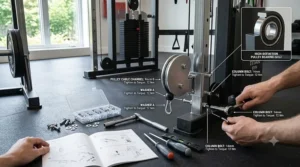
Mistake 3: Underestimating assembly complexity. These machines typically weigh 150–250 kg and arrive in multiple boxes. Assembly in a finished basement with a narrow stairwell is genuinely challenging. Failing to plan for two people, three to four hours, and the right tools (usually metric and imperial hardware — check the manual beforehand) leads to frustration and the occasional stripped bolt. Read assembly reviews, not just product reviews, before purchasing.
Mistake 4: Skipping the flooring investment. Placing a 200 kg cable machine on bare concrete is hard on the machine (vibration damage over time), hard on your joints (no shock absorption), and hard on your relationship with downstairs neighbours. Rubber gym flooring isn’t optional; it’s necessary infrastructure.
Mistake 5: Buying a home-grade machine for commercial use. If you’re running a small fitness studio or personal training space in Canada, a consumer-grade Amazon.ca purchase with a one-year cable warranty will not hold up to multi-user daily cycles. The ALTAS Strength 3073 and commercial Body-Solid models exist precisely for this reason.
Long-Term Cost and Maintenance of a Dual Stack Functional Trainer in Canada
The upfront price of a dual stack trainer is only part of the ownership equation. Here’s what the next five years actually look like in CAD.
Initial investment: $800–$3,500 CAD depending on model, as outlined in this guide.
Accessories: Budget $150–$300 CAD for essential attachments not included with most machines — a lat pulldown bar, a triceps rope, ankle straps, and a stirrup handle set. These are available individually on Amazon.ca and expand exercise variety significantly.
Flooring: $150–$300 CAD for rubber gym matting, as noted above. A one-time cost that protects a $2,000 machine from concrete-induced wear.
Cable replacement: Aircraft-grade steel cables typically last 5–8 years under home gym use. Replacement cables run $60–$120 CAD depending on model and Canadian availability. This is the most common maintenance cost — budget for it rather than being surprised.
Annual maintenance: A $30–$50 CAD can of silicone lubricant lasts two to three years. Monthly application to guide rods and quarterly inspections of pulley bearings is the complete maintenance schedule for most machines. Canadian climate consideration: in heated indoor spaces, there’s no winter-specific maintenance needed. In unheated garages, condensation during freeze-thaw cycles can affect non-sealed components — a silicone spray and periodic inspection are your best defences.
Total 5-year cost of ownership (mid-range machine at $1,500 CAD): Approximately $2,100–$2,400 CAD all in, or roughly $35–$40 CAD per month. Compare that to a mid-tier gym membership in Toronto or Vancouver ($70–$120 CAD/month) and the math strongly favours home gym ownership, even before factoring in the time saved on commuting.
According to Statistics Canada’s Canadian Health Measures Survey (2022–2024), strength training participation among Canadians is growing — but the majority still don’t meet the minimum recommended frequency. A home cable machine removes the single most common barrier: travel time and gym access.
Independent Weight Stacks: Why Bilateral Resistance Training Changes Everything
If you’ve only ever trained on machines that use a single shared weight stack — like most cable crossover setups at commercial gyms — the independent weight stacks on a dual-stack trainer will feel like a revelation.
With independent stacks, each side of your body works against its own resistance. This isn’t just a technical nicety; it’s the foundation of what exercise scientists call bilateral resistance training in its truest form, as well as unilateral isolation. Research published in Frontiers in Physiology found that bilateral training produces greater improvements in bilateral power tasks — think cable squats, two-arm rows, and chest flyes — while unilateral training on the same machine addresses individual limb weaknesses and muscle imbalances.
In practice, this means you can load your dominant side at 40 kg (88 lbs) and your non-dominant side at 35 kg (77 lbs) during a bilateral cable row, correcting the strength asymmetry rather than masking it. That correction transfers directly to injury prevention — particularly relevant in a Canadian context where sports like hockey, skiing, and curling create predictable dominant-side imbalances.
The other practical advantage of independent stacks: two people can train simultaneously on the same machine. For family home gyms, this doubles training efficiency during busy mornings before school runs or work commutes.
FAQ: Dual Stack Functional Trainer in Canada
❓ What is the difference between a 1:1 and 2:1 pulley ratio on a dual stack functional trainer?
❓ Can I use a dual stack functional trainer in a cold garage in Canada during winter?
❓ Does Amazon.ca offer free shipping on dual stack functional trainers in Canada?
❓ Is a commercial dual stack functional trainer suitable for home use in Canada?
❓ How many exercises can I do on a dual stack functional trainer?
Conclusion: Your Investment in Strength Starts Here
A dual stack functional trainer isn’t an impulse purchase — it’s infrastructure. When you buy one, you’re building the centrepiece of a home gym that will serve you through every Canadian season, regardless of whether it’s minus 30°C in Winnipeg or a rainy November afternoon in Vancouver. You train on your schedule, your terms, and with equipment that, if chosen well, outlasts any gym membership by decades.
The XMark XM-7626 is the standout pick for most Canadian buyers — strong independent weight stacks, commercial-grade construction, and a price range that makes sense for a serious home gym. If budget is the primary driver, the SpaceSmart wall-mounted trainer delivers real dual-stack capability at an entry-level price. For the all-in-one family solution, the Inspire Fitness FT1 remains unmatched in its category on Amazon.ca.
Whatever you choose, prioritize proper setup, good flooring, and a machine with a warranty that reflects the manufacturer’s confidence in what they’ve built. Your body — and your future self — will benefit from that decision every single training day.
ParticipACTION’s 2025 Report Card on Physical Activity reports that only 35% of Canadian adults meet the muscle-strengthening activity guideline. A dual stack functional trainer sitting in your home — available at 6 a.m. before work or 10 p.m. after the kids are in bed — removes every excuse from that statistic.
✨ Don’t Miss These Exclusive Deals!
🔍 Ready to build your home gym centrepiece? Click any highlighted product above to check current pricing, stock availability, and shipping estimates on Amazon.ca. These picks represent the best the Canadian market has to offer in 2026 — choose confidently and train well.
Recommended for You
- Single Stack vs Dual Stack Functional Trainer: 7 Best in Canada
- Best Single Stack Functional Trainer Canada: 7 Top Picks (2026)
- 7 Best Dual Adjustable Pulley Machines in Canada (2026): Honest Buyer’s Guide
Disclaimer: This article contains affiliate links. As an Amazon Associate, I earn from qualifying purchases. If you purchase products through these links, we may earn a small commission at no additional cost to you.
✨ Found this helpful? Share it with your friends! 💬🤗
