
In This Article
Somewhere between “I’ll just use resistance bands forever” and “I’m buying a commercial rig for my garage,” most Canadian lifters hit the same wall: the cable machine question. A dual stack functional trainer worth it for one household might be total overkill for another, and the marketing copy on most product pages won’t tell you which camp you’re in. This guide exists to fix that. Two independent weight stacks, two pulleys that move on their own schedule, and a footprint that swallows roughly what a fridge would — that’s the pitch, and on paper it sounds like a no-brainer for anyone training at home in 2026.
Canadian movement guidance already recommends muscle-strengthening work at least twice weekly for adults, and a cable machine is one of the more efficient ways to hit that target at home — but “sounds great” and “earns its floor space” are different conversations. A dual stack functional trainer is a cable machine built around two separate, independently loaded weight stacks rather than one shared column, which lets two people train at once or lets one person superset opposing muscle groups without re-pinning the weight between sets. Whether that’s worth the cost — and for most full-size dual stack units, you’re looking at a serious chunk of your home gym budget — depends entirely on how you train, who else uses the space, and what you’re replacing. We dug through real product specs, aggregated owner feedback, and Canadian strength-training data to answer it properly, not with a marketing slogan.
Quick Comparison Table
Before the deep dive, here’s the at-a-glance version for anyone short on time.
| Model | Stack Weight (per side) | Pulley Ratio | Best For |
|---|---|---|---|
| Mikolo Cable Crossover Machine | Plate-loaded, ~159 kg (350 lb) capacity | 1:1 / 2:1 switchable | First-time buyers on a tight budget |
| Body-Solid Powerline PFT100 | 73 kg (160 lb) | 2:1 | Simple budget selectorized setup |
| Bells of Steel Functional Trainer | 73 kg (160 lb) | 2:1 | Compact garages, smoothest budget pulleys |
| Titan Fitness Functional Trainer | 91 kg (200 lb) | 2:1 | Heavier rows and pulldowns on a mid budget |
| REP Fitness Arcadia | 77 kg (170 lb), upgradeable to 100 kg (220 lb) | 2:1 | Smallest footprint per dollar of capability |
| Inspire Fitness FT1 | 75 kg (165 lb), upgradeable to 98 kg (215 lb) | 2:1 | Narrow spaces, long-term frame warranty |
| Force USA G3 | 73 kg (160 lb) | 2:1 | One machine to replace a rack, Smith, and cable station |
Looking at this lineup, the spread between roughly C$950 and C$4,300 isn’t really about which machine is “better” in the abstract — it’s about how much functional trainer you actually need versus how much you’re paying for attachments, frame thickness, and pulley smoothness you might never notice. Budget shoppers gravitate toward the Mikolo or Bells of Steel, while anyone planning to train heavy rows or share the machine with a workout partner should weight the comparison toward the REP, Inspire, or Force USA end of the table. The big lesson from this table alone is that stack weight and price climb together almost in lockstep, so the real decision is figuring out where your training intensity actually plateaus.
💬 Just one click — help others make better buying decisions too! 😊
💬 Found a model that fits your space already? Check current pricing before stock shifts.
Top 7 Dual Stack Functional Trainers: Expert Analysis
This dual stack functional trainer review focuses on machines that are genuinely available right now, span budget to premium, and have enough real owner history to judge honestly — not press-release specs dressed up as opinions. Every entry below blends manufacturer data with aggregated review sentiment, so you’re getting the version of the spec sheet that actually matters once the machine is bolted to your floor.
1. Mikolo Cable Crossover Machine
The standout here is the price-to-position ratio: 17 to 28 adjustable height settings per side on a frame that routinely undercuts every other entry on this list. Built from 50mm square 16-gauge steel with a switchable 1:1/2:1 pulley ratio, it’s plate-loaded rather than selectorized, meaning you’ll need your own weight plates — a real cost most budget shoppers forget to add to the total. What most buyers overlook about this model is that the pulley feel, while smooth for the price, is a home-equipment experience rather than a commercial one; reviewers consistently note the cables work fine for moderate loads but the carriage bearings need occasional lubrication to stay quiet. It’s the right call for someone building their very first cable station who isn’t yet sure how often they’ll use it. Aggregated buyer feedback on major retail platforms skews positive for value and assembly clarity, with the most common complaint being that the included accessories feel basic compared to pricier rivals.
✅ Compact 1.9 sq m (20 sq ft) footprint
✅ Switchable pulley ratio for both strength and rehab-style work
✅ Genuinely low entry price for a dual-pulley design
❌ Requires you to supply your own weight plates
❌ Plastic-and-nylon components in the carriage feel budget-grade over time At the time of research, pricing sits in the C$950-C$1,250 range before plates — solid value if you already own or are buying plates anyway, less so if you’re starting from zero.
2. Body-Solid Powerline PFT100
The standout feature is straightforward selectorized simplicity: dual 73 kg (160 lb) weight stacks with a pin-select system that needs no plate loading at all. Specs aside, the 2:1 ratio means you’re moving roughly 36 kg (80 lb) of felt resistance at the top of the stack, which covers the vast majority of accessory and isolation work most home lifters do. Based on the spec comparison with similarly priced rivals, the PFT100’s main weakness is pulley quality — reviewers and several independent test labs flag that the pulleys glaze and lose smoothness faster than aluminum-pulley competitors, which matters more the longer you own it. It suits a beginner-to-intermediate lifter who wants a no-fuss, plate-free setup and isn’t chasing the silkiest possible cable feel. Aggregated review sentiment is mixed-to-positive: people like the simplicity and price point, but a recurring theme is that the pulleys need attention after a year or two of regular use.
✅ No separate plate purchase required
✅ Familiar Body-Solid brand backing and parts availability
✅ Straightforward pin-select system, easy for beginners
❌ Nylon pulleys reported to wear faster than aluminum alternatives
❌ Pull-up station less versatile than newer competitors Price typically falls in the C$1,900-C$2,200 range, putting it solidly in “best dual stack cable machine under $2000” territory if you catch it near the lower end.
3. Bells of Steel Functional Trainer
What separates this from the Body-Solid is the pulley hardware: aluminum instead of nylon, and reviewers report that smoothness holding up noticeably better at the five-year mark. The dual 73 kg (160 lb) stacks with a 2:1 ratio aren’t the heaviest on this list, but the narrower 1.0 sq m (11 sq ft) footprint is the smallest among the serious dual-stack options here, which matters enormously in a Canadian basement or single-car garage. Here’s what to weigh: this machine starts resistance at a 4.5 kg (10 lb) increment, finer than most competitors, which is genuinely useful for anyone doing controlled accessory work or rehab-adjacent training. Reviewers consistently report assembly is the rough patch — the hardware kit isn’t clearly labelled, and several buyers recommend following the company’s video guide rather than the printed manual. For a lifter who wants real durability in the smallest possible footprint and doesn’t mind a longer build day, this is hard to beat.
✅ Aluminum pulleys hold smoothness far longer than nylon
✅ Smallest footprint among genuine dual-stack trainers on this list
✅ Lifetime frame warranty backs long-term ownership
❌ Assembly instructions are reported as confusing by multiple owners
❌ 73 kg (160 lb) stacks may cap out strong intermediate lifters on heavy pulldowns At the time of research, this lands around C$2,550-C$2,750 — just over the C$2,000 mark, making it the natural “next step up” once a pure budget pick stops being enough.
4. Titan Fitness Functional Trainer
The standout spec is stack size: dual 91 kg (200 lb) weight stacks in 4.5 kg (10 lb) increments put this in the upper tier of resistance among home-priced trainers, and that headroom matters once you’re doing heavy seated rows or lat pulldowns where lighter stacks run out fast. The 2:1 ratio and 20 vertical pulley positions give a genuinely commercial-feeling range of motion, and the included accessory set — seven handle attachments plus bars — is more generous than most competitors bundle in standard. Based on aggregated owner feedback, the build quality earns consistent praise for stability under load, with the most common critique being that it’s heavier and bulkier to assemble than the Bells of Steel or REP options. This one’s for the lifter who has outgrown lighter stacks but isn’t ready to s
✅ 91 kg (200 lb) per-side stacks handle heavy rows and pulldowns comfortably
✅ Generous included accessory bundle compared to most rivals
✅ Commercial-grade steel construction at a home gym price
❌ Larger footprint and heavier overall build to assemble
❌ 10 lb increments are coarser than some premium competitors Pricing generally sits in the C$2,450-C$2,750 range, overlapping closely with the REP Arcadia — making the choice between them mostly about footprint versus stack size.
5. REP Fitness Arcadia
The standout here is footprint efficiency: 1.3 sq m (13.75 sq ft), about the same as a large double-door fridge, while still housing dual 77 kg (170 lb) stacks upgradeable to 100 kg (220 lb) each. Aluminum pulleys with a 180-degree swivel are the headline feature, and independent testers rate the smoothness near the top of the field — what most buyers overlook about this detail is that swivel range directly affects how natural cable crossovers and rotational core work feel, not just how “premium” the machine looks. Reviewers consistently note that the standard accessory kit is sparse — just two D-handles and a pull-up bar — so budget an extra C$100-C$200 for a tricep rope, curl bar, and ankle strap if you want full versatility on day one. This machine suits a lifter who values smooth cable feel and minimal floor space over having every attachment box checked out of the gate. Assembly is reported as labour-intensive at roughly four hours even with two pre-welded sections, so plan an afternoon rather than an hour.
✅ Smallest footprint relative to stack capacity in this price tier
✅ Aluminum pulleys rated highly for smoothness by independent testers
✅ Upgrade path to 100 kg (220 lb) stacks without buying a new machine
❌ Standard accessory kit is minimal — extra handles cost more
❌ Assembly reported as a multi-hour project At the time of research, expect a range of roughly C$2,950-C$3,150, putting it just above the Titan and squarely in mid-premium territory.
6. Inspire Fitness FT1
The defining feature is the narrow footprint paired with expandability: dual 75 kg (165 lb) stacks that upgrade to 98 kg (215 lb) per side, inside a frame just 1.2 m (47 in) deep and 1.4 m (54 in) wide. On paper this means it slots into garages and basements that would reject bulkier units outright, while still leaving real room to grow into heavier resistance later. Reviewers consistently describe the glide rails as exceptionally smooth with almost no drag — a long-time owner cited in independent coverage reported near-flawless condition after roughly two years of regular use, which speaks to the build quality Inspire is known for. What the spec sheet won’t tell you, but user reports suggest, is that the pull-up bar offers fewer grip variations than rivals like Titan or Force USA, a minor but real trade-off for taller lifters who want a wide-grip option. This is the pick for someone prioritizing long-term reliability and a tight footprint over maximum included accessories.
✅ Exceptionally smooth glide rails per long-term owner reports
✅ Compact 1.2 m x 1.4 m (47 in x 54 in) footprint with expandable stacks
✅ Limited lifetime warranty on frame and parts
❌ Pull-up bar has fewer grip position options than competitors
❌ Among the pricier selectorized-only options on this list Pricing typically runs C$3,450-C$3,700, positioning the FT1 as the premium selectorized choice for buyers who’ve decided a dual stack functional trainer is worth it long-term.
7. Force USA G3
The standout feature is scope: this is a plate-loaded functional trainer built into a full Smith machine and power rack combo, with 14 included attachments covering everything from cable crossovers to barbell squats in one footprint. The dual 73 kg (160 lb) stacks run a 2:1 ratio, translating to roughly 36 kg (80 lb) felt resistance per side, which is plenty for most isolation and accessory movements even if it’s not the heaviest stack on this list. Based on independent testing coverage, the frame itself draws strong praise for stability and the sheer number of training modalities it replaces, while the included Smith bar knurling is consistently flagged as below the standard of a dedicated power bar. You’ll also need your own weight plates for the Smith and rack functions, which is an added cost worth budgeting before you commit. This suits a buyer who wants to consolidate a squat rack, Smith machine, and functional trainer into a single purchase rather than buying three separate pieces of equipment over time.
✅ Replaces a rack, Smith machine, and cable station in one unit
✅ 14 included attachments cover an enormous range of movements
✅ Strong frame stability reported across independent testing
❌ Smith bar knurling quality rated below dedicated barbells
❌ Requires separately purchased weight plates for full functionality At the time of research, this sits around C$4,050-C$4,400 — the highest price here, but arguably the lowest cost-per-station if it genuinely replaces three other purchases.
Real-World Scenario: Who Actually Uses a Dual Stack Trainer Well
Picture three different Canadian households eyeing the same machine for completely different reasons. First, a couple in a Calgary basement who both lift but on staggered schedules — for them, independent dual stacks mean one partner can load 45 kg per side for rows while the other sets up light cable curls minutes later without re-pinning anything, which is the single clearest case for choosing dual stacks over a single-column trainer like the Bells of Steel base model. Second, a personal trainer running small-group sessions out of a converted Mississauga garage, where two clients training simultaneously on opposite stacks turns a 30-minute session into something that actually pays for the machine within a year of bookings. Third, a solo intermediate lifter in a Halifax apartment who mostly trains alone — for this person, the second stack adds almost nothing functionally beyond superset speed, and a single-stack unit or even the budget-tier Mikolo would likely deliver 90% of the benefit at a fraction of the footprint and price. The pattern across all three: dual stacks earn their cost fastest when more than one body is actually loading the machine, not just because the spec sounds impressive on a listing page.
✨ Don’t Miss These Exclusive Deals!
🔍 Take your home gym to the next level with these carefully selected dual stack functional trainers. Click on any highlighted model to check current pricing and availability before you commit your floor space and budget.
Practical Usage Guide: Setup, First 30 Days, and Maintenance
Getting a dual stack functional trainer running well starts before the first rep. Allow a full afternoon for assembly on premium models like the REP Arcadia or Force USA G3 — rushing this step is the single most common reason owners report wobble or misaligned pulleys later. In your first 30 days, resist the urge to max out the stack pin; most reviewers and trainers recommend two to three weeks of moderate loading to let cables seat and bearings break in evenly on both sides. Lubricate carriage bearings every two to three months in a garage setting, since Canadian temperature swings between winter cold and summer humidity accelerate dry-out compared to a climate-controlled basement. A common first-month mistake is mismatching pulley height between the two stacks for bilateral moves like chest presses — even a 5 cm difference throws off symmetry and can create uneven strength development over time. Wipe down cables monthly with a dry cloth to prevent dust buildup, and check that the carabiners and quick-clips on attachments aren’t developing burrs, since these are the parts most likely to fail first under regular use. Treat the first month as calibration, not maximum output, and the machine will reward you with years of smooth, predictable resistance.
Dual Stack Trainer vs Dual Adjustable Pulley: What’s the Real Difference
These two terms get used almost interchangeably in product listings, which causes real confusion at checkout. A dual adjustable pulley system describes the cable mechanism itself — two pulleys that move independently up and down a column — while “dual stack” specifically refers to having two separate weight stacks behind those pulleys, rather than one shared stack feeding both sides. In practice, nearly every modern dual stack functional trainer also has dual adjustable pulleys, but not every dual adjustable pulley machine has two stacks; some lower-cost designs share a single weight stack between both pulleys using a connector, which saves money but eliminates the ability for two people to train independently or to load each side differently.
| Feature | Dual Stack System | Single-Stack, Dual-Pulley System |
|---|---|---|
| Independent loading | Yes, each side fully separate | No, both sides pull from one stack |
| Two-person training | Fully supported | Not practical |
| Typical price impact | Higher | Lower |
| Best For | Shared households, trainers, supersets | Solo lifters on a tighter budget |
The practical upshot of this table is that the price premium for true dual stacks buys independence, not raw resistance — a single-stack machine can offer just as much weight on paper, but it forces both sides to match. If you’re training alone and rarely supersetting opposing movements, that premium may not earn its keep; if two people share the space, it almost always does.
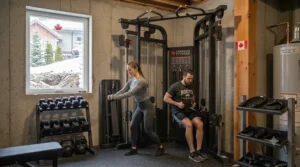
How to Choose a Dual Stack Functional Trainer
Five-second answer: match stack weight, footprint, and pulley quality to how many people will use the machine and how heavy your heaviest cable movement gets, in line with the resistance-training frequency recommended in CSEP’s national movement guidelines. The longer version:
- Measure your space first, including 2.4-2.7 m (8-9 ft) of clearance in front for cable crossovers and presses, not just the machine’s footprint itself.
- Decide your realistic heaviest cable lift — if seated rows or lat pulldowns regularly exceed 45 kg (100 lb) felt resistance, lean toward 91 kg-plus (200 lb-plus) stacks like the Titan or REP Arcadia.
- Weigh plate-loaded versus selectorized based on whether you already own weight plates; plate-loaded machines like the Mikolo or Force USA G3 cost less upfront but more once plates are added.
- Check pulley material specifically — aluminum holds smoothness years longer than nylon, based on consistent aggregated owner feedback across this entire category.
- Confirm how many people will realistically train on it; solo users rarely recoup the dual-stack premium, while households or small training studios usually do within a year or two.
- Budget separately for attachments — sparse standard kits like REP’s mean an extra C$100-C$300 to reach full versatility.
- Read the warranty terms closely, since frame warranties (often lifetime) and cable/pulley warranties (often one year) cover very different failure points.
Best Dual Stack Cable Machine Under $2000: What You Actually Get
Staying under C$2,000 narrows the field considerably, and it’s worth being honest about the trade-offs rather than pretending this tier matches premium performance. In this range you’re realistically looking at the Mikolo Cable Crossover Machine or, right at the ceiling, the Body-Solid Powerline PFT100 — both genuine dual-pulley designs, but neither with the aluminum pulleys or 91 kg-plus (200 lb-plus) stacks found one tier up. The Bells of Steel Functional Trainer sits just over this line, which matters because it’s frequently the machine reviewers point to when asked “what would you buy if you stretched the budget by a few hundred dollars.”
| Price Tier | What You Get | What You Trade Off |
|---|---|---|
| Under C$1,500 | Plate-loaded dual pulley, basic frame | Pulley smoothness, included accessories |
| C$1,500-C$2,000 | Selectorized stacks, no plate purchase needed | Pulley material quality, premium warranty terms |
| C$2,000-C$2,800 | Aluminum pulleys, bigger stacks, lifetime frame warranty | Higher upfront cost, longer assembly |
What this table makes clear is that the under-$2,000 tier genuinely delivers a functional, durable cable station — it just asks you to accept nylon pulleys and lighter stacks in exchange for the lower price, which is a perfectly reasonable trade for a beginner or intermediate lifter who isn’t moving serious weight on cables yet.
Common Mistakes When Buying a Functional Trainer
The most expensive mistake buyers make is sizing for the machine alone and forgetting clearance space; a dual stack trainer that fits against the wall on paper often can’t actually be used for wide cable flys or rotational core work without bumping a nearby rack or shelf. The second is chasing stack weight without checking pulley ratio — a 220 lb stack on a 2:1 ratio delivers the same felt resistance as a 110 lb stack on a 1:1 ratio, so comparing raw stack numbers across machines with different ratios is comparing apples to oranges. Third, buyers frequently underestimate assembly time, especially on premium models, and end up rushing bolt torque or pulley alignment to “just get it done,” which reviewers tie directly to early wobble complaints. Fourth, skipping the accessory budget is common — several models on this list ship with as few as two handles standard, and a genuinely versatile setup needs a rope, straight bar, and ankle strap at minimum. Finally, some buyers assume a dual stack automatically beats a single stack for their situation when, as covered above, solo lifters rarely recoup that premium in practical training value.
Simultaneous Independent Loading: Why It Matters
Simultaneous independent loading is the technical term for what actually separates a true dual stack functional trainer from everything else on the market: each weight stack moves, loads, and unloads completely independent of the other, in real time, with zero interaction between sides. Practically, that means one person can be mid-set on a heavy low row at 50 kg while a second person adjusts the opposite stack to 15 kg for a banded-style tricep pressdown, and neither setup affects the other’s resistance or position. This is the feature that turns a cable machine from a single-user tool into something a household or small training studio can genuinely share without constant re-pinning. It’s also the feature most responsible for the price gap between dual stack machines and single-stack, dual-pulley designs covered earlier in this guide — you’re paying for two complete weight systems, not just two cable arms. For anyone training with a partner, coaching clients, or simply wanting to superset opposing muscle groups without walking back and forth to re-pin a shared stack, simultaneous independent loading is the single specification worth prioritizing above almost everything else on the spec sheet.
Long-Term Cost & Maintenance: Strength and Conditioning Equipment ROI
Treating a dual stack functional trainer as strength and conditioning equipment with a real return on investment, rather than a one-time purchase, changes how the price tag looks. A mid-tier machine in the C$2,500-C$3,200 range, used consistently three to five times weekly, works out to well under a dollar per session over five years — cheaper per use than a single month of many commercial gym memberships once you cross the two-to-three-year mark. That consistency matters beyond the wallet, too: a large Canadian review of resistance training research covering hundreds of thousands of participants found regular resistance training associated with meaningfully lower all-cause mortality risk, which is a return on investment no gym membership receipt captures. Maintenance costs stay modest if you stay ahead of them: budget roughly C$30-C$60 annually for replacement cables or lubricant over a five-year ownership window, far less than a single year of gym dues. The real ROI math depends on consistency, not the machine itself — a C$4,000 Force USA G3 used twice weekly costs more per session over five years than a C$2,000 Bells of Steel unit used five times weekly, which is the calculation most buyers skip when they’re comparing sticker prices instead of cost-per-workout.
Cable Machine Upgrade: When to Move From a Single Stack
Knowing when a cable machine upgrade actually makes sense — rather than just sounding appealing — comes down to three signals worth tracking honestly. First, if you’re regularly maxing out your current stack’s top pin on rows or pulldowns and still wanting more resistance, that’s a clear ceiling signal a heavier dual stack model solves directly. Second, if a partner, roommate, or training client now wants to use the machine at the same time you do, a single-stack setup becomes a scheduling problem that dual stacks eliminate entirely. Third, if your training has shifted toward supersetting opposing muscle groups — say, alternating chest presses and rows — re-pinning a shared stack between every set adds real friction that a true dual stack design removes completely. None of these signals alone guarantees an upgrade is worth it; the cost only pays off when at least two of the three are consistently true for how you actually train, not how you imagine training six months from now.
Safety, Setup Space & Floor Considerations in Canada
Functional trainers carry real load, and a few Canadian-specific factors deserve attention before installation. Pandemic-era demand for home fitness equipment in Canada pushed prices up and created waitlists at major retailers almost overnight, a trend that underscored just how unevenly equipment gets installed when buyers are rushing — careful setup matters even more when demand spikes push people toward DIY assembly under time pressure. Canadian physical activity guidance recommends muscle-strengthening activities targeting major muscle groups at least twice weekly for adults, which is squarely the kind of training a dual stack trainer supports — but that guidance assumes the equipment itself is set up safely. Garage installations in particular face condensation risk through Canadian winter-to-summer temperature swings, which can corrode cables and pulley bearings faster than indoor placement; a basic dehumidifier or insulated garage door meaningfully slows this. Bolt the frame to studs or use the manufacturer’s floor-anchor kit if your unit isn’t already free-standing with sufficient base weight, since an unanchored frame under heavy unilateral pulling can shift slightly over time. Always check local building or strata bylaws before installing heavier units like the Force USA G3 on an upper floor or in a condo, as floor-load limits vary by building. Finally, give yourself at minimum 2.4 m (8 ft) of unobstructed space in front of the machine, both for safe range of motion and for a clear exit path if a cable or attachment fails mid-set.
Frequently Asked Questions
❓ Is a dual stack functional trainer worth it for one person training alone?
❓ What's the difference between a dual stack and a single stack functional trainer?
❓ How much weight do I actually need on each stack?
❓ Can two people really use a dual stack trainer at the same time?
❓ Do I need a power rack in addition to a functional trainer?
Conclusion
So, is a dual stack functional trainer worth it? The honest answer is: it depends on whether you’re training alone or sharing the machine, and whether your heaviest cable lifts are already pushing past what a budget single-stack unit offers. For solo lifters easing into cable training, the Mikolo or Body-Solid options under C$2,000 genuinely cover the fundamentals without overspending. For households, training partners, or anyone running small-group sessions, the math shifts decisively toward dual stacks like the Bells of Steel, Titan, REP Arcadia, or Inspire FT1, where simultaneous independent loading turns a shared piece of equipment into something that doesn’t create a queue. And for buyers consolidating a rack, Smith machine, and cable station into one purchase, the Force USA G3 makes a strong case despite its higher price tag. Whichever tier fits your space and budget, the underlying lesson from this entire comparison holds: match the machine to how many people actually train on it and how heavy your real working sets get, not to the most impressive-sounding spec on the page.
✨ Don’t Miss These Exclusive Deals!
🔍 Ready to add real cable versatility to your space? Check current pricing on the model that matched your training style above — availability and CAD pricing shift often, so confirm before you order.
Recommended for You
- Best Dual Stack Functional Trainer in Canada 2026: Top 7 Expert Picks
- Single Stack vs Dual Stack Functional Trainer: 7 Best in Canada
- Best Single Stack Functional Trainer Canada: 7 Top Picks (2026)
Disclaimer: This article contains affiliate links. As an Amazon Associate, I earn from qualifying purchases. If you purchase products through these links, we may earn a small commission at no additional cost to you.
✨ Found this helpful? Share it with your friends! 💬🤗
