In This Article
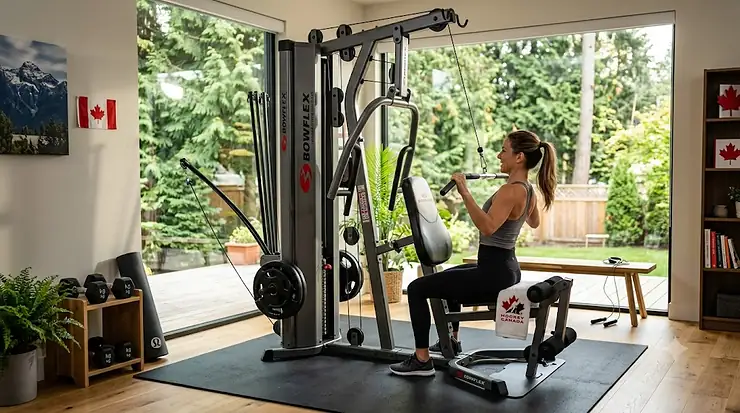
If your basement, garage, or spare bedroom has been “almost ready” for a workout corner since last winter, you’re not alone. An all in one home gym machine is the single piece of equipment most Canadians ask about when they finally decide to stop paying for a membership they only use twice a month. Done right, one machine can replace a bench, a cable station, a squat rack, and a lat pulldown tower — all inside a footprint that fits next to the furnace.
This guide compares seven real machines sold on Amazon.ca, from compact stack gyms under $600 CAD to commercial-grade Smith machine combos that rival a small studio. We’ll also dig into things most spec sheets skip: how these machines actually hold up through a Canadian winter, what a realistic home gym footprint looks like in a typical condo or bungalow, and how to read weight stack capacity so you don’t outgrow your machine in six months.
As an Amazon Associate, I earn from qualifying purchases — full disclosure is at the bottom of this article.
What Is an All-In-One Home Gym Machine?
An all in one home gym machine is a single strength-training unit that combines several stations — typically a weight stack or Smith bar, a cable pulley system, a lat pulldown, and a leg developer — into one compact frame. Instead of buying a rack, a bench, and separate cable towers, you get most of a full gym in one footprint, which is why these machines are so popular in smaller Canadian homes.
Quick Comparison Table
| Machine | Type | Weight Stack Capacity | Best For | Price Range (CAD) |
|---|---|---|---|---|
| Marcy 150 lb Multifunctional Home Gym | Single-stack home gym | 68 kg (150 lb) | First-timers, small basements | $400–$600 |
| Soozier All-in-One Home Gym System | Single-stack home gym | ~45 kg (100 lb) | Apartments, light training | $450–$650 |
| Body-Solid G3S Multi-Station | Single-stack selectorized gym | 73–95 kg (160–210 lb) | Intermediate lifters | $1,650–$1,950 |
| Body-Solid G5S Multi-Station | Single-stack selectorized gym | 73–95 kg (160–210 lb) | Families sharing one machine | $2,050–$2,350 |
| Sunny Health & Fitness Total Body Trainer | Compact functional trainer | Resistance bands/cable, no plates | Condo dwellers, beginners | $420–$700 |
| Major Fitness Drone2 Smith Machine | Smith machine + cable crossover | Plate-loaded, up to 900 kg (2,000 lb) frame rating | Multi-user home garages | $2,200–$3,400 |
| Body-Solid G9B Dual-Stack Gym | Dual-stack commercial gym | 2 × 95 kg (210 lb), upgradable | Large families, semi-commercial use | $3,800–$4,400 |
Looking at the table, the gap between the budget single-stack gyms and the Body-Solid or Major Fitness units isn’t really about “more exercises” — it’s about how long the machine lasts under daily use and how much weight it can grow into. A $500 CAD Marcy or Soozier unit is genuinely useful for a beginner doing bodyweight-plus-cable training, but a 90 kg lifter chasing strength gains will hit the weight stack’s ceiling within a year. Heavier, plate-loaded systems like the Drone2 or G9B cost more upfront but remove that ceiling entirely, which is the real argument for spending more in a multi function home gym review like this one.
💬 Just one click — help others make better buying decisions too! 😊
✨ Don’t Miss These Exclusive Deals!
🔍 Take your home training to the next level with these carefully selected machines. Click on any highlighted product to check current pricing and availability on Amazon.ca. These picks can help you build a gym routine your whole household will stick with!
Top 7 All-In-One Home Gym Machines: Expert Analysis
1. Marcy 150 lb Multifunctional Home Gym Station
The Marcy 150 lb Multifunctional Home Gym is the machine most Canadian first-time buyers land on, and for good reason — it’s one of the few full home gym stations that regularly sits under $600 CAD on Amazon.ca. The 68 kg (150 lb) weight stack runs a lat pulldown, leg developer, and dual press arms off one no-cable-change pulley system, which in practice means you’re not constantly re-threading cables between exercises — a small detail that matters a lot at 7 a.m. before work.
What most Canadian buyers overlook about this model is the steel gauge: at 14-gauge tubing, it’s noticeably lighter-duty than the 12-gauge frames used on Body-Solid’s gyms, so it’s better suited to consistent, moderate-intensity training than to maxing out every session. In a cold garage, the steel frame itself is fine, but the vinyl upholstery on the bench pad can stiffen in near-freezing temperatures — worth knowing if your gym corner isn’t heated.
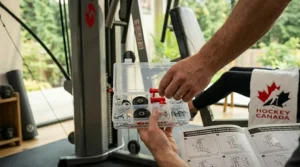
Reviewers consistently mention smooth, manageable assembly and good value for the price, with the leg developer and preacher curl pad called out as nice extras most budget machines skip.
✅ Compact footprint that suits condos and small basements
✅ Genuinely beginner-friendly with a low entry weight
✅ Reliably priced under $600 CAD on Amazon.ca
❌ 150 lb ceiling limits long-term strength progression
❌ Lighter-gauge steel than premium alternatives
Best for: A renter or first apartment gym in Toronto or Montreal who wants real strength training without a five-figure floor plan. Around $400–$600 CAD — strong value for a true beginner setup.
2. Soozier All-in-One Home Gym System
The Soozier All-in-One Home Gym System plays in the same budget tier as the Marcy but trims the weight stack slightly in exchange for a built-in sit-up bench and push-up stand — two stations the Marcy doesn’t include in its base package. For a Canadian buyer training in a shared basement, that combo of strength plus core work in one unit can mean skipping a second piece of equipment entirely.
The 45 kg (100 lb) stack means this is genuinely an entry-level machine — once you’re comfortably doing 12+ reps at the top pin, you’ve outgrown it for pressing movements, though the cable-based lat pulldown and ab work still hold value. Customers describe assembly as straightforward with clear instructions, and the all-in-one layout as space-efficient for smaller rooms.
✅ Lowest footprint on this list — fits tight spare rooms
✅ Sit-up bench and push-up stand built in
✅ Budget-friendly entry point
❌ 100 lb stack tops out fast for pressing exercises
❌ Not built for heavier or advanced lifters
Best for: Someone easing back into fitness in a downtown condo with limited square footage. Roughly $450–$650 CAD.
3. Body-Solid G3S Multi-Station Gym
The Body-Solid G3S is where this list moves from “starter machine” to genuine long-term equipment. Body-Solid backs every G-Series gym with a lifetime warranty on parts, which matters in Canada specifically — replacement parts for off-brand budget gyms can take weeks to source if they’re not stocked domestically, while Body-Solid has an established North American parts network.
The base 73 kg (160 lb) stack is upgradeable to 95 kg (210 lb), and the 12-gauge steel frame with military-spec aircraft cables is a real step up in durability from the Marcy or Soozier. In practice, the no-cable-change pulley design means you move between lat pulldowns, triceps pressdowns, and seated rows without manually rerouting a single cable — a feature that sounds minor until you’re mid-circuit and don’t want to stop.
✅ Lifetime warranty on a North American-supported brand
✅ Upgradeable stack avoids re-buying as you get stronger
✅ 12-gauge steel frame built for years of daily use
❌ Higher upfront cost than entry-level stack gyms
❌ Larger footprint needs a dedicated 6×8 ft (about 1.8×2.4 m) area
Best for: An intermediate lifter in a Calgary or Ottawa suburb who’s outgrown a budget machine and wants one purchase to last a decade. Around $1,650–$1,950 CAD.
4. Body-Solid G5S Multi-Station Gym
The Body-Solid G5S shares the G3S’s frame quality and lifetime warranty but adds a sixth station and a slightly more refined seat and pulley geometry, which Body-Solid markets as its best-in-class single-stack option. For a household where two or three people are sharing one machine — a common setup in a multi-generational Canadian home — that extra station and adjustability reduce the wait time between users doing different exercises.
The trade-off is price: the G5S typically runs a few hundred dollars CAD above the G3S for what is, in real-world use, an incremental upgrade rather than a different category of machine. If you’re buying for one person, the G3S delivers nearly identical value for less money; if multiple family members with different builds will use it daily, the G5S’s extra adjustability earns its premium.
✅ Best-in-class single-stack adjustability
✅ Same Body-Solid lifetime warranty and steel quality
✅ Six stations reduce switching downtime for multiple users
❌ Marginal gain over the G3S for solo users
❌ Among the pricier single-stack options on this list
Best for: A family of three or four in a suburban Canadian home sharing one machine across different body types. Roughly $2,050–$2,350 CAD.
5. Sunny Health & Fitness Total Body Trainer
The Sunny Health & Fitness Total Body Trainer is the outlier on this list — it skips a steel weight stack entirely in favour of a compact, cable-based functional trainer design, which makes it dramatically lighter and easier to move than anything else here. Sunny ships to Canadian addresses and maintains a dedicated Amazon.ca storefront, which matters because some U.S. fitness brands quietly stop shipping certain SKUs across the border.
Because there’s no heavy weight stack, this unit is genuinely apartment-friendly — it can tuck into a closet or behind a door in a way a 160 lb steel-stack gym never will. The trade-off is resistance ceiling: this machine suits conditioning, mobility, and light-to-moderate strength work rather than serious progressive overload.
✅ Lightest, most apartment-friendly machine on this list
✅ Confirmed Canadian shipping and dedicated support
✅ Easy to assemble without a second person
❌ Lower resistance ceiling than weight-stack machines
❌ Less suited to heavy strength training goals
Best for: A renter in a high-rise who needs something that won’t anger the downstairs neighbour or violate a building’s floor-load rules. Around $420–$700 CAD.
6. Major Fitness Drone2 Smith Machine
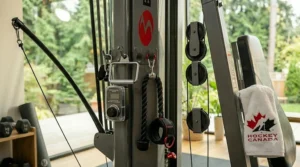
The Major Fitness Drone2 Smith Machine is the first plate-loaded option on this list, combining a Smith bar, power cage, dual 1:1 cable crossover, and pull-up station in one frame rated to handle up to roughly 900 kg (2,000 lb) of total structural load. For a Canadian buyer who already owns Olympic plates or plans to build toward heavier barbell work, that’s a meaningfully different category from the selectorized stack gyms above — you’re not capped by a fixed-weight pin.
The dual independent pulley system is a genuine standout: it lets two people train on opposite sides simultaneously, which suits a garage shared between a couple or a parent and teenager. The 2×2-inch upright profile is commercial-grade, though Garage Gym Revisited’s testing notes it’s less compatible with third-party attachments than larger 3×3-inch rack standards — something to confirm before buying add-ons separately.
✅ Plate-loaded design has no fixed strength ceiling
✅ Dual independent cable system supports two simultaneous users
✅ Lifetime after-sales support from Major Fitness
❌ Requires you to already own or separately buy Olympic plates
❌ 2×2-inch uprights limit third-party attachment compatibility
Best for: A garage gym in suburban Ontario or BC where two household members lift together and want to scale weight without limits. Roughly $2,200–$3,400 CAD depending on the bench-and-plate package selected.
7. Body-Solid G9B Dual-Stack Gym
The Body-Solid G9B sits at the top of this list as a genuinely commercial-grade dual-stack system, built so up to three people can train on it at once without waiting. Two independent 95 kg (210 lb) stacks (upgradable to 118 kg/260 lb) mean one person can do a leg press at 420 lb of leverage-multiplied resistance while another runs a lat pulldown on the second stack — no turn-taking required.
For Canadian buyers, the In-Home Lifetime Warranty plus a separate light-commercial warranty is a real point of difference: if you’re outfitting a rec room that doubles as a small training space for extended family, that dual coverage reduces long-term risk. The footprint is substantial, though — this is not a machine for a condo; budget closer to a two-car garage bay or a finished basement with high ceilings for the pull-up station clearance.
✅ Dual stacks let two to three users train simultaneously
✅ Both in-home and light-commercial warranty coverage
✅ 420 lb leg press capacity via 2:1 leverage ratio
❌ Largest footprint on this list — needs serious floor space
❌ Highest price point of the seven machines reviewed
Best for: A large household or a basement gym that occasionally hosts friends or extended family for training. Around $3,800–$4,400 CAD.
Real-World Canadian Scenarios: Matching a Machine to Your Life
The Toronto condo dweller. With a 250-square-foot spare room and strata rules about floor loading, a steel weight stack over 150 lb can be a non-starter. The Sunny Health & Fitness Total Body Trainer or the Soozier system both keep total weight low enough to move solo and store against a wall when guests come over.
The Ottawa family of four. Two teenagers and two parents with different strength levels make a single-stack gym a bottleneck. The Body-Solid G5S’s extra station and adjustability — or stepping up to the dual-stack G9B if the basement has the ceiling height — cuts down on the “whose turn is it” problem entirely.
The Calgary garage lifter prepping for winter. Garages here swing from -20°C overnight to a heated 18°C during a session, which is hard on vinyl pads and cable sheathing. A plate-loaded frame like the Major Fitness Drone2 tolerates temperature swings better than a sealed weight-stack mechanism, since there’s less precision hardware exposed to condensation.
Practical Usage & Canadian Climate Maintenance Guide
Getting a multi-station machine assembled correctly matters more in Canada than the instructions usually let on, mostly because of where these machines end up living.
- Anchor it properly. Most stack gyms and Smith machines aren’t bolted to a wall by default, but if your basement floor is uneven (common in older Canadian homes), use the included levelling feet before tightening any bolts — an unlevel frame wears cables unevenly.
- Watch humidity, not just cold. A finished basement is usually fine, but an unheated garage sees condensation every time it’s opened on a humid spring day. Wipe down chrome posts and cable runs monthly to prevent surface rust, especially on budget machines with thinner plating.
- Re-tension cables after the first 30 days. New steel cables stretch slightly under their first few hundred reps. Most manufacturers, including Body-Solid and Marcy, note this in their manuals — a quick check after a month avoids a slack feeling at the top of pulldown movements.
- Store loose plates off the concrete. If you’re using a plate-loaded machine like the Drone2 in a garage, concrete floors pull moisture from the air faster than you’d expect; a rubber mat under your plate storage pegs prevents rust rings.
- Common early mistake: skipping the manufacturer’s bolt-torque spec during assembly. Both Body-Solid and Major Fitness flag loose multi-grip press arm bolts as the most common early-use issue — a five-minute re-check after the first week prevents most of it.
How to Choose an All-In-One Home Gym Machine in Canada
- Measure your actual footprint first, not the floor model’s footprint. Add at least 60 cm of clearance around any pulley or Smith bar for safe range of motion — a machine that “just fits” on paper often doesn’t in practice.
- Match weight stack capacity to your real strength, not your goals. If you’re already pressing more than 80% of a stack’s max, buy upgradable or plate-loaded.
- Decide if you’re training solo or sharing. Dual-stack or dual-cable machines (G9B, Drone2) remove waiting time for households of three or more.
- Check the warranty structure, not just the length. “Lifetime” warranties vary — Body-Solid’s covers frame and parts; budget brands often limit lifetime coverage to the frame only.
- Confirm Amazon.ca shipping and stock, not just the U.S. listing. Some SKUs and colour variants are .com-exclusive; cross-check before assuming a model ships to your province.
- Budget for accessories separately. Olympic plates, a bench, or extra attachments for plate-loaded machines like the Drone2 typically add $200–$500 CAD on top of the base unit price.
- Think about your specific climate. An unheated garage favours simpler, plate-loaded mechanisms over precision cable systems that can stiffen in the cold.
All-In-One Gym Machines vs. Traditional Multi-Equipment Home Gyms
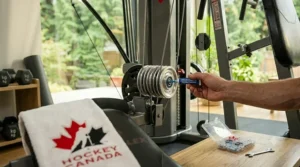
Buying a rack, a bench, a cable tower, and a lat pulldown separately gives more flexibility to upgrade each piece independently, and serious lifters often prefer that modularity long-term. But for most Canadian households, the math favours the all-in-one route: a single Body-Solid or Major Fitness unit typically costs less than buying four separate name-brand pieces, and it occupies one footprint instead of four scattered ones — a real difference in a basement that also needs to fit a furnace, a freezer, and a couch.
The trade-off is repair risk: if a single component fails on an all-in-one unit, in rare cases the whole station can be down until a replacement part ships, whereas a standalone cable tower failure doesn’t touch your separate squat rack. For most home users training three to five times a week, that’s a manageable risk against the space and cost savings.
Long-Term Cost & Maintenance in Canada
Buying through Amazon.ca rather than cross-border ordering from a U.S. site generally avoids Canada Border Services Agency duties and brokerage fees that can otherwise add 10–20% to a large equipment order, since Amazon.ca-fulfilled listings are already cleared for Canadian sale. Over a five-year ownership period, total cost of ownership for these machines is mostly assembly time and the occasional replacement cable — Body-Solid and Marcy both sell direct-fit cable kits, typically in the $30–$80 CAD range, far cheaper than a gym membership renewal.
Compared to a typical Canadian gym membership running roughly $50–$70 CAD a month, even the priciest machine here — the Body-Solid G9B at around $4,000 CAD — breaks even against five to six years of membership fees, and that’s before counting commute time or the convenience of training at 6 a.m. without leaving the house.
Common Mistakes When Buying a Home Gym Machine
- Ignoring ceiling height. Pull-up stations on the Drone2 and G9B need real headroom; basements with low joists or ductwork often can’t fit the full range of motion.
- Buying the cheapest stack and outgrowing it in months. A 100 lb stack is fine for someone new to resistance training but frustrating within a year for anyone training consistently.
- Assuming all Amazon.com listings ship to Canada. Some bundles or colour options are U.S.-only; always confirm on the Amazon.ca listing page before ordering.
- Skipping a second pair of hands for assembly. Stack gyms over 150 lb routinely take two people for the heaviest steel sections — most warranty claims for frame damage trace back to solo assembly drops.
- Overlooking warranty coverage on wear parts. Cables and pulleys see the most use; check whether they’re covered the same length as the frame.
Canadian Regulations, Safety Standards & Bilingual Labelling
Fitness equipment sold in Canada doesn’t require a specific federal safety certification the way electrical appliances need CSA approval, but Health Canada does monitor consumer product safety broadly, and recalls are tracked through its public database. Packaging on equipment sold nationally is generally required to carry bilingual English-French labelling under Canadian consumer packaging rules, so a listing showing English-only text on the box (rather than the manual) can be a sign of a grey-market import rather than an authorized Canadian distribution unit. None of the seven machines above raise that concern based on their official Amazon.ca listings.
If you’re outfitting a space that could ever be used commercially — a condo gym, an Airbnb fitness room, or a small studio — check with your municipality and insurer, since “light commercial” warranty language (used by Body-Solid and Major Fitness) refers to manufacturer coverage, not a legal commercial-use certification.
For broader context on recommended physical activity levels while planning a home training routine, the Canadian 24-Hour Movement Guidelines from the Canadian Society for Exercise Physiology are a useful, evidence-based reference. Background on resistance training principles is also available via Wikipedia’s overview of weight training, and Canadian advertising disclosure standards referenced in this article fall under the Competition Bureau of Canada.
F AQ
AQ
❓ Can I use an all in one home gym machine in an unheated Canadian garage?
❓ How much weight stack capacity do I actually need?
❓ Do all of these home gym machines ship across Canada?
❓ Is a Smith machine or a selectorized stack gym better for a beginner?
❓ What's the real difference between a $500 and a $4,000 CAD home gym machine?
Conclusion
There’s no single best all in one home gym machine for every Canadian household — there’s a best one for your space, your strength level, and how many people are sharing it. A renter in a Vancouver high-rise and a family running a basement gym in suburban Winnipeg have completely different “right answers” here, and that’s exactly why this list spans from a $450 Soozier stack to a $4,000 Body-Solid dual-stack system.
If you’re buying your first machine and aren’t sure you’ll stick with it, start with the Marcy or Soozier — low financial risk, real strength training, and an easy resale if it’s not for you. If you’ve already got a year or more of consistent training behind you, the Body-Solid G3S or the Major Fitness Drone2 are where the long-term value really shows up. And if space and budget aren’t constraints, the Body-Solid G9B is about as close to a private studio as a home machine gets.
Whichever you choose, double-check the current Amazon.ca listing for stock, exact dimensions, and any active promotions before you buy — pricing and availability shift often.
✨ Found Your Next Home Gym?
🔍 Compare these picks one more time on Amazon.ca before you commit, and check current availability for your province. A few minutes of research now saves a return shipment later!
Recommended for You
- 7 Best Smith Machine Power Rack Combo Canada (2026 Guide)
- Angled vs Straight Smith Machine: Which Is Better in Canada? (2026)
- Best Angled Smith Machine Canada 2026: 7 Top Picks Reviewed
Disclaimer: This article contains affiliate links. As an Amazon Associate, I earn from qualifying purchases. If you purchase products through these links, we may earn a small commission at no additional cost to you.
✨ Found this helpful? Share it with your friends! 💬🤗
