
In This Article
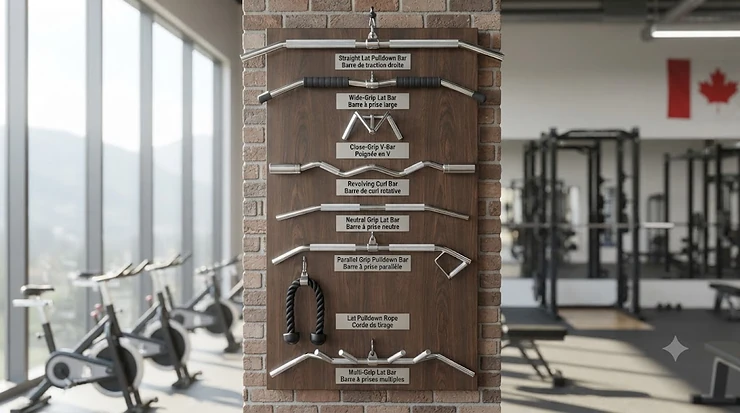
Walk into any garage gym and you’ll spot the same crime scene: a single, sad, straight bar dangling from the cable tower, doing the job of seven different tools. That’s the trap most lifters fall into with types of lat pulldown bars — they buy one, assume it’s universal, and wonder why their back day feels stuck on repeat. It isn’t your effort. It’s your hardware.

A lat pulldown bar is a cable-machine attachment — straight, angled, or multi-handled — that clips onto a pulley system so you can pull weight down (or across) to train your back, shoulders, and arms from different angles. Swap the bar, and you shift which muscle fibres do the heavy lifting.
Here’s the honest version of what’s coming: this guide walks through seven real bars you can actually buy, from a scuffed-up C$30 straight bar to a stainless-steel unit that’ll outlive your gym membership. Along the way, we’ll dig into the straight bar vs EZ bar cable attachment debate, unpack why a cambered bar attachment saves cranky wrists, and look at what the research — not gym-bro folklore — actually says about the latissimus dorsi, the large, flat back muscle these bars are built to train, and grip position.
This isn’t a rewritten spec sheet. It’s commentary grounded in real product details and aggregated review sentiment, built so a Canadian buyer shopping amazon.ca can walk away knowing exactly which bar solves which problem — and why the cheapest option isn’t automatically the wrong one.
Quick Comparison Table
| Bar Type | Best For | Price Range (CAD) | Grip Style |
|---|---|---|---|
| CAP Barbell 20″ LAT Pull Down Bar | Budget all-rounder | around C$30-40 | Straight, pronated |
| Yes4All 39″ Wide Grip Curl Bar | Cheap wide-grip starter | under C$35 | Cambered, wide |
| CAP Barbell Deluxe Cambered Pro-Style Bar | Wrist comfort | C$45-60 range | Cambered, angled |
| Titan Fitness Stainless Steel LAT Bar | Long-term durability | C$90-120 range | Straight, knurled |
| Titan Fitness Pro Duty Lat Pulldown Bar | Multi-position training | C$60-80 range | D-shaped, multi-grip |
| Yes4All Neutral Paddle Grip Bar | Shoulder-friendly pulls | C$35-50 range | Neutral, spreader |
| Titan Fitness Double D-Handle | Close-grip isolation | under C$40 | Neutral, close |
A quick scan tells you most of what you need: the budget straight bars cluster under C$40, the multi-grip and stainless options push past C$60, and grip style — not price — is really what separates them functionally. Notice that three of the seven skew toward neutral or angled grips; that’s not an accident, it reflects a broader shift toward wrist- and shoulder-friendly training that shows up again and again in this guide. If your shoulders already bark at you during pressing days, start your shortlist with the neutral and cambered options rather than the straight bars.
💬 Just one click — help others make better buying decisions too!😊
Top 7 Types of Lat Pulldown Bars: Expert Analysis
1. CAP Barbell 20″ LAT Pull Down Bar — most reliable budget straight bar
The standout here is simplicity: a 20-inch chrome-plated straight bar with a revolving hanger, and honestly, that’s most of what a beginner needs. The revolving hanger matters more than it sounds — it lets the bar rotate freely as you pull, so the cable doesn’t twist and fight your wrists mid-set, a small design detail cheaper knockoffs frequently skip. Solid steel construction and knurled handgrips round out the spec sheet, and at 20 inches it’s short enough to fit tight garage-gym cable towers without clanging into the frame.
Based on the spec comparison, this is the bar for someone building their first cable station or replacing a stock attachment that’s gone slick with age — it’s not fancy, but it does the core straight-bar pulldown and seated row without complaint. Reviewers consistently note the knurling holds up better than expected for the price, though a few mention the finish shows wear after heavy daily use in shared gym settings.
Pros:
- ✅ Revolving hanger prevents cable twist mid-set
- ✅ Compact 20-inch length fits small home setups
- ✅ Genuinely budget-friendly entry point
Cons:
- ❌ Chrome finish wears with heavy commercial use
- ❌ No grip variety — straight bar only
Priced around C$30-40 at the time of research, this is the best value pick if you just need a dependable straight bar and nothing else.
2. Yes4All 39″ Wide Grip Curl Bar — best cheap wide-grip starter
What jumps out first is the length: at 39 inches, this bar lets you set your hands genuinely wide, which is the whole point of a wide-grip pulldown. Steel construction with rubber-covered handles keeps the price down without turning the grip into a slip hazard, and the curved (cambered) shape angles your wrists slightly inward instead of forcing a dead-flat pronated position.
What most buyers overlook about a bar like this is that the anti-slip rubber matters more once your palms get sweaty three sets in — a plain steel grip turns treacherous fast, and this one is built specifically to avoid that. Aggregated review sentiment on this style of bar is consistently strong for the price bracket, with reviewers frequently mentioning the rubber grip holding up well and the length being genuinely usable for wide-grip work rather than a marketing exaggeration.
Pros:
- ✅ Full 39-inch length allows a true wide grip
- ✅ Rubber handles resist sweaty-hand slippage
- ✅ Very low cost of entry
Cons:
- ❌ Cambered curve limits close-grip variations
- ❌ Carabiner-style attachment feels basic
At under C$35, this is the wide-grip pick to grab if you want the classic lat-width movement without spending big.
3. CAP Barbell Deluxe Cambered Pro-Style LAT Bar — best wrist-friendly angle
This 38-inch bar’s standout feature is its cambered — angled — profile, which is designed specifically to reduce wrist strain compared to a flat straight bar. The solid steel core is wrapped in rubber handgrips and finished in protective chrome, and at roughly 11.5 pounds it has enough heft to feel stable under load without being unwieldy to hang and unhang.
Here’s what the spec sheet won’t tell you outright: that camber angle isn’t cosmetic — it lets your wrists sit in a more neutral-ish position through the pull, which is exactly why physiotherapists and coaches often steer lifters with cranky elbows or wrists toward cambered bars over dead-straight ones. This is the bar for anyone whose shoulders or wrists complain on straight-bar pulldowns but who isn’t ready to jump to a fully neutral-grip attachment. Reviewers on comparable CAP cambered bars frequently cite the rubber grip comfort and finish quality as strong points for a mid-tier price.
Pros:
- ✅ Cambered shape reduces wrist strain vs straight bars
- ✅ Rubber handgrips stay comfortable across high reps
- ✅ Sturdy 11.5-lb solid steel build
Cons:
- ❌ Chrome coating can show scratches over time
- ❌ Wider footprint needs more storage space
In the C$45-60 range, it’s a smart step up for lifters prioritizing joint comfort over raw price.
4. Titan Fitness Stainless Steel LAT Bar 48″ — best premium grip and durability
The headline feature is full-length knurling — this 48-inch, 304 stainless-steel bar is knurled across its entire surface, not just at the handles, so wherever you grab it, you get real traction. That 28mm diameter mimics the feel of a proper barbell rather than a hollow tube, and the horizontal grip spread runs from 4 to 30 inches wide, with an angled spread stretching to 48 inches for genuinely extreme wide-grip work.
Based on the spec comparison, the jump from chrome to 304 stainless steel is the real story here — stainless resists corrosion and pitting in a way chrome-over-steel simply can’t match over years of sweaty use, which is why this bar shows up as a common upgrade pick once lifters outgrow their starter equipment. Reviewers frequently compare it directly to premium competitor bars costing nearly double, consistently noting the knurling feels aggressive enough for serious grip work without tearing up bare hands.
Pros:
- ✅ Full-length knurling for grip anywhere on the bar
- ✅ 304 stainless steel resists rust long-term
- ✅ Wide 4-48 inch grip spread options
Cons:
- ❌ Highest price point in this lineup
- ❌ Knurling may feel aggressive for sensitive palms
Expect to pay in the C$90-120 range — it’s the buy-it-once option for anyone training seriously for years, not months.
5. Titan Fitness Pro Duty Lat Pulldown Bar — best multi-position versatility
The defining trait of this attachment is its D-shaped, ergonomic design with multiple hand placement options built into one bar — you’re not locked into a single grip width the way you are with a plain straight bar. Stainless-steel chrome construction with knurled, non-slip rubber handles and a revolving hanger rounds out the build, aimed squarely at lifters who want lat pulldowns, seated rows, and face pulls off a single piece of equipment.
What most buyers overlook about multi-grip bars like this is how much they reduce shoulder strain during high-volume back sessions — being able to shift hand position between sets (or even mid-workout) takes repetitive stress off the same joint angle every single rep, something a fixed straight bar simply can’t offer. This is squarely the pick for intermediate lifters who’ve outgrown a basic bar but aren’t ready to buy three separate attachments. Aggregated review sentiment highlights the versatility as the main draw, with the ergonomic D-shape frequently praised for feeling easier on the wrists during face pulls specifically.
Pros:
- ✅ Multiple grip positions on one attachment
- ✅ D-shape design eases wrist and joint strain
- ✅ Doubles for rows, pulldowns, and face pulls
Cons:
- ❌ Bulkier profile than single-grip bars
- ❌ Mid-range price versus basic straight bars
Typically priced in the C$60-80 range, this is the best “one bar replaces three” value play in the lineup.
6. Yes4All Neutral Paddle Grip LAT Pull Down Bar — best for shoulder-friendly neutral grip
This spreader-style attachment’s standout feature is its neutral, palms-facing-each-other grip — a genuinely different animal from the pronated (palms-down) grip every straight bar forces on you. The paddle-style handles sit at a fixed neutral angle, which keeps your forearms and shoulders in a more natural rotational position throughout the pull.
Here’s what most spec sheets skip: a neutral grip shifts a meaningful share of the work toward the mid-back and rear-delt region compared with a wide pronated grip, making it a genuinely different training stimulus rather than just “a different bar.” Based on the spec comparison, this is the pick for lifters managing shoulder impingement history or elbow tendinitis who still want a proper compound pulling movement rather than switching to isolation-only work. Review sentiment for this style of bar tends to emphasize the shoulder-friendly feel as the main selling point, with a smaller subset of buyers wishing the handles were slightly longer for bigger hands.
Pros:
- ✅ Neutral grip reduces shoulder rotation stress
- ✅ Great alternative for elbow/wrist sensitivity
- ✅ Compact and easy to store
Cons:
- ❌ Fixed grip width, no adjustability
- ❌ Handle length can feel tight for larger hands
Priced in the C$35-50 range, it’s a smart, affordable way to add genuine grip variety to a home gym.
7. Titan Fitness Double D-Handle Cable Attachment — best for close-grip isolation work
The core feature of this attachment is its double D-shaped handle, purpose-built for a close, neutral grip that isolates the arms and back without dragging the shoulders and elbows into an uncomfortable wide position. Chrome-plated solid steel construction with knurled grip sections makes it feel closer to a piece of barbell hardware than a flimsy accessory.
Based on the spec comparison, the ergonomic promise here is specific and testable: a close neutral grip eliminates a lot of the wrist, elbow, and shoulder strain that shows up on wide-grip work, which is exactly why this handle shows up constantly for close-grip lat pulldowns, seated cable rows, and tricep pressdowns alike. This is the bar for lifters chasing a controlled, joint-friendly finishing exercise rather than a max-effort compound movement. Reviewers frequently mention the knurling providing a genuinely secure grip during high-rep row and pulldown finishers, with the occasional note that a carabiner isn’t included and needs to be bought separately.
Pros:
- ✅ Close neutral grip reduces joint strain
- ✅ Knurled sections give a secure, non-slip hold
- ✅ Doubles for rows and tricep pressdowns
Cons:
- ❌ Carabiner not included in the box
- ❌ Not suited for wide-grip variations
At under C$40, it’s an easy, affordable add-on for anyone rounding out a home cable station.
Top 7 Bars at a Glance: Specs, Price, and Best Use
| Product | Grip Style | Length | Price Range (CAD) | Best For |
|---|---|---|---|---|
| CAP Barbell 20″ LAT Pull Down Bar | Straight, pronated | 20″ | C$30-40 | Beginners, small spaces |
| Yes4All 39″ Wide Grip Curl Bar | Cambered, wide | 39″ | under C$35 | Budget wide-grip work |
| CAP Barbell Deluxe Cambered Pro-Style Bar | Cambered | 38″ | C$45-60 | Wrist comfort |
| Titan Fitness Stainless Steel LAT Bar | Straight, knurled | 48″ | C$90-120 | Long-term, serious lifters |
| Titan Fitness Pro Duty Lat Pulldown Bar | D-shaped, multi-grip | ~24″ | C$60-80 | Versatility, intermediate lifters |
| Yes4All Neutral Paddle Grip Bar | Neutral, spreader | ~20″ | C$35-50 | Shoulder-friendly pulling |
| Titan Fitness Double D-Handle | Neutral, close | ~6″ | under C$40 | Isolation finishers |
Looking at the table, the pattern is clear once you stop staring at price tags: the Titan Fitness Stainless Steel LAT Bar costs roughly three times the CAP Barbell 20″ LAT Pull Down Bar, but the gap is really about metallurgy and knurling coverage, not core function — both are straight bars doing the same basic pull. Where the real functional split happens is between straight bars (bars 1 and 4), cambered bars (bars 2 and 3), and neutral/close-grip options (bars 5, 6, and 7), because that’s the axis that actually changes which muscles fire hardest. If your home gym budget only stretches to one attachment beyond a basic straight bar, the neutral or cambered options give you the most new training stimulus per dollar.
✨ Ready to Round Out Your Cable Station?
🔍 Take your back day to the next level with a bar that actually matches your grip needs. Click through on any bolded pick above to check current pricing and availability on amazon.ca — a C$30 attachment swap is a cheap way to break a stubborn back-training plateau.
Practical Usage Guide: Setting Up, Swapping, and Maintaining Your Cable Bar Attachments
Getting a new lat pulldown bar right starts before your first rep. First-use tip one: always check the carabiner or clip rating against your machine’s weight stack — a cheap carabiner rated for 200 lbs has no business hanging off a stack loaded to 250. Second, inspect the revolving hanger (if your bar has one) by spinning it a few times under light load before you go heavy; a stiff hanger means the cable will twist and your set will feel oddly uneven.
For maintenance, wipe down rubber and knurled grips after sweaty sessions — salt residue slowly eats away at rubber coatings and dulls knurling faster than most people expect. A light coat of a corrosion-safe metal polish every few months keeps chrome bars from developing the rust spots that eventually flake onto your palms. Most lifters make one common mistake in their first 30 days: they leave the bar attached to the cable permanently, which lets dust and grime build up in the pulley clip and eventually seize it. Detach and store attachments when not in use, especially in a garage gym exposed to humidity or temperature swings.
Optimization trick worth stealing: rotate between two grip styles (say, a straight bar and a neutral bar) every training block instead of every single session — this gives your joints time to adapt to a new angle without whiplashing between extremes week to week.

Real-World Scenarios: Matching the Bar to Your Training Style
Picture Priya, a 28-year-old who trains in her condo gym three times a week and has mild wrist discomfort from years at a keyboard. For her, the Yes4All Neutral Paddle Grip LAT Pull Down Bar or Titan Fitness Double D-Handle makes more sense than a wide straight bar — the neutral position keeps her wrists in a pain-free range while she still builds real back strength.
Then there’s Marcus, a university student squeezing workouts into a shared gym with a battered stock straight bar. He’s budget-constrained and just wants variety without dropping serious cash, so the Yes4All 39″ Wide Grip Curl Bar or the CAP Barbell 20″ LAT Pull Down Bar fit his C$30-40 ceiling while still letting him practice both wide and standard grip work.
Finally, consider Dana, a five-year lifting veteran building a permanent home gym in her garage. She trains four to five days a week, values durability over saving C$50, and wants one attachment that handles multiple grip widths without owning three bars. The Titan Fitness Pro Duty Lat Pulldown Bar or the Titan Fitness Stainless Steel LAT Bar suit her long-term investment mindset far better than the entry-level options.
Problem → Solution: Fixing Common Lat Pulldown Frustrations
Problem: Wrists ache during straight-bar pulldowns. Solution: switch to a cambered bar attachment like the CAP Barbell Deluxe Cambered Pro-Style LAT Bar, which angles the wrist away from a dead-flat pronated position.
Problem: Shoulders feel pinched on wide-grip work. Solution: try a neutral grip bar such as the Yes4All Neutral Paddle Grip LAT Pull Down Bar — the palms-facing position takes external rotation stress off the shoulder joint.
Problem: The bar spins awkwardly or twists the cable mid-set. Solution: confirm your bar has a genuine revolving hanger (both CAP Barbell options here include one) and that it isn’t gummed up with dust — clean and lightly lubricate the swivel point.
Problem: You’ve plateaued on lat width despite consistent training. Solution: rotate in a true wide-grip attachment like the Titan Fitness Stainless Steel LAT Bar‘s 48-inch angled spread to shift the stimulus away from your habitual grip.
Problem: One bar isn’t enough but you don’t have storage space for five. Solution: a multi-grip attachment like the Titan Fitness Pro Duty Lat Pulldown Bar consolidates several grip widths into a single hanging attachment.
Straight Bar vs EZ Bar Cable Attachment: Which Should You Grab First?
The straight bar vs EZ bar cable attachment question comes up constantly, and the honest answer is: they’re not really competing for the same job. A straight bar — like the CAP Barbell 20″ LAT Pull Down Bar — locks your wrists into a flat, pronated grip through the entire pull, which is simple and effective for classic wide-grip lat pulldowns and seated rows.
An EZ or cambered bar, such as the CAP Barbell Deluxe Cambered Pro-Style LAT Bar, introduces a zig-zag or curved profile that lets your wrists sit at a slight angle instead of dead flat. Based on the spec comparison, this small angle change matters most for lifters doing high-volume pulling work, where a flat wrist position over many sets can aggravate the forearm and elbow tendons. What most buyers overlook is that an EZ-style bar isn’t “better” outright — it’s a joint-comfort trade, not a bigger-muscle trade. If your wrists and elbows feel fine on a straight bar, there’s little reason to switch. If they don’t, the cambered option is the fix, not a fancier version of the same tool.
Wide Grip vs Close Grip Pulldown Bar: What Actually Changes
This is where fitness-industry mythology outpaces the data. The old belief is that a wide grip pulldown bar builds more back width than a close grip pulldown bar because it “stretches the lats further.” Research tells a more nuanced story: an EMG study comparing narrow, medium, and wide pronated grips on the lat pulldown found similar latissimus dorsi activation across all three grip widths, with narrow and medium grips actually allowing slightly heavier loads than the wide grip.
So what does change? Based on that same research, biceps brachii involvement trends higher with medium and narrow grips, meaning a close grip pulldown bar — like the Titan Fitness Double D-Handle — shifts more work onto your arms relative to a wide bar, while a true wide grip on something like the Titan Fitness Stainless Steel LAT Bar spreads the load differently through your shoulders and upper back. Here’s what most buyers overlook: choosing wide vs close grip should be about joint comfort, arm involvement, and exercise variety — not a mythical “width machine” that only a wide bar can deliver.
Cambered Bar Attachment: When the Curve Changes Everything
A cambered bar attachment earns its keep almost entirely through wrist mechanics. Picture the difference between carrying a flat plank versus a curved handle — the curve lets your hand naturally rotate a few degrees rather than staying pinned flat, and over hundreds of reps a month, that small mercy adds up. The CAP Barbell Deluxe Cambered Pro-Style LAT Bar and Yes4All 39″ Wide Grip Curl Bar both use this profile, and reviewers on cambered-style bars in this category consistently cite reduced wrist fatigue as the standout benefit versus flat straight bars.
What the spec sheet won’t tell you is that cambered bars also change your pulling angle slightly, which can bias the movement toward the lower lats and away from the traps compared with a flat wide bar — useful if your upper traps already dominate your pulling work and you want the lats to earn their share.
Neutral Grip Bar Options: The Shoulder-Friendly Choice
A neutral grip bar — palms facing each other, like the Yes4All Neutral Paddle Grip LAT Pull Down Bar or Titan Fitness Double D-Handle — keeps your shoulder in a more anatomically “neutral” rotational position than a pronated straight bar demands. For lifters managing a shoulder impingement history, this isn’t just comfort talk; physiotherapy guidance on shoulder impingement consistently emphasizes controlled, progressive strengthening in positions that avoid provoking the joint, and neutral-grip pulling fits that brief better than a maximally pronated wide grip.
Based on the spec comparison, neutral grip bars trade some raw back-width stimulus for a genuinely lower-risk pulling pattern — a fair swap for anyone whose shoulders have a history of complaining. Reviewers on neutral-grip attachments frequently describe them as a “finally, something that doesn’t hurt” addition to their routine, particularly among lifters over 40 rebuilding a training habit after time off.
Lat Activation and Grip Position: What the Research Really Shows
Here’s the myth-busting section nobody asked for but everyone needs: lat activation and grip position research doesn’t support the idea that wider automatically means more lat engagement. The EMG study referenced above found comparable latissimus dorsi activation across narrow, medium, and wide grips, with the medium grip showing a slight edge during the eccentric (lowering) phase of the movement — not the wide grip lifters instinctively reach for.
What most buyers overlook is that grip position affects secondary muscles — biceps, trapezius, posterior deltoid — more dramatically than it affects the lats themselves. Based on the spec comparison, that means switching between the Titan Fitness Pro Duty Lat Pulldown Bar‘s multiple grip options isn’t really about “hitting the lats from more angles” in the way marketing copy implies — it’s about varying which assisting muscles share the workload, which still matters for balanced development and joint health, just not for the reason most buyers assume.
How to Choose Types of Lat Pulldown Bars
Choosing the right attachment comes down to seven practical checkpoints:
- Assess joint history first. If wrists, elbows, or shoulders have given you trouble, prioritize neutral or cambered bars over flat straight bars.
- Match grip width to your goals, not folklore. Since research shows similar lat activation across grip widths, pick width based on comfort and arm involvement preference.
- Check the hanger mechanism. A genuine revolving hanger prevents cable twist and extends the life of both bar and cable.
- Confirm weight capacity against your stack. A bar rated for 300 lbs has no business on a 400 lb-capable machine.
- Consider storage and space. Longer bars like the 48-inch stainless option need more wall or hook space than compact D-handles.
- Budget for durability if you train often. Frequent lifters get more long-term value from stainless or heavier-gauge steel.
- Follow sound general training guidance. Resources like the Canadian Society for Exercise Physiology offer evidence-based frameworks for structuring strength training safely, which pairs well with picking the right equipment.
Common Mistakes When Buying Cable Bar Attachments
The most frequent misstep is buying based on price alone and ending up with a bar that doesn’t match any real training need — a wide bar when your shoulders need neutral grip, for instance. A close second: ignoring the carabiner or clip rating, which several budget bars — including the Titan Fitness Double D-Handle — don’t include in the box, leading buyers to pair a premium bar with a bargain-bin clip that’s the actual weak link.
Buyers also commonly overestimate how much a single “do everything” bar can replace. A multi-grip option like the Titan Fitness Pro Duty Lat Pulldown Bar covers a lot of ground, but it still won’t replicate the extreme wide spread of a 48-inch bar or the extreme close isolation of a D-handle. Finally, many skip checking bar length against their actual cable tower clearance — a 48-inch bar that’s perfect on a commercial lat tower may bang against the frame of a compact home unit.
Best Cable Bar Attachments for Back Training: Long-Term Cost and Value
Thinking in cost-per-year rather than sticker price changes the math considerably. A C$30 straight bar that needs replacing every 18 months due to worn knurling and finish can cost more over five years than a single C$100 stainless bar bought once. Based on the EMG research on grip variation and back muscle activation, training benefits scale more with consistent, varied grip use over years than with any single “magic” attachment — which argues for investing early in two or three genuinely different grip styles rather than one expensive bar and calling it done.
For most home-gym owners, a sensible long-term setup pairs one durable straight or multi-grip bar (Titan Fitness Stainless Steel LAT Bar or Titan Fitness Pro Duty Lat Pulldown Bar) with one affordable neutral or cambered option (Yes4All Neutral Paddle Grip LAT Pull Down Bar or CAP Barbell Deluxe Cambered Pro-Style LAT Bar) — covering both durability and grip variety without buying all seven at once.
Frequently Asked Questions
❓ What is the best type of lat pulldown bar for beginners?
❓ Does a wide grip lat pulldown build a bigger back than a close grip?
❓ Is a cambered bar better than a straight bar for lat pulldowns?
❓ How much does a lat pulldown bar cost in Canada?
❓ Can I use a lat pulldown bar for exercises other than pulldowns?
Conclusion
Types of lat pulldown bars aren’t a niche curiosity — they’re the cheapest lever you have for fixing wrist pain, breaking a back-training plateau, or finally getting a real close-grip finisher into your routine. The seven bars covered here span a genuine range: the CAP Barbell 20″ LAT Pull Down Bar and Yes4All 39″ Wide Grip Curl Bar for anyone starting out on a tight budget, the CAP Barbell Deluxe Cambered Pro-Style LAT Bar and Yes4All Neutral Paddle Grip LAT Pull Down Bar for joint-friendly variety, and the Titan Fitness Stainless Steel LAT Bar, Titan Fitness Pro Duty Lat Pulldown Bar, and Titan Fitness Double D-Handle for lifters ready to invest in gear built to last.
What the research keeps confirming, over and over, is that grip choice matters most for comfort and secondary muscle involvement — not some mythical width-equals-growth shortcut. Pick the bar that matches your joints and your goals, not the one with the biggest marketing claim, and rotate in a second grip style before you assume your back day has hit a real plateau. Whichever direction you go, checking current pricing and availability on amazon.ca before you buy is always worth the thirty seconds it takes.
Recommended for You
- Lat Pulldown Bar Attachment: 7 Top Picks for 2026 (Canada Guide)
- Plate Loaded Row Machine vs Cable Stack Row Machine: 7 Picks (2026)
- Plate Loaded Seated Row Machine: 7 Best Picks for Canada (2026)
Disclaimer: This article contains affiliate links. As an Amazon Associate, I earn from qualifying purchases. If you purchase products through these links, we may earn a small commission at no additional cost to you.
✨ Found this helpful? Share it with your friends! 💬🤗
