
In This Article
Somewhere around the third week of a Prairie January, the math on a gym membership stops working. You’re paying for a parking lot you can’t see through the windshield frost, a locker room that smells like eucalyptus and regret, and forty-five minutes of commute for a forty-minute workout. Meanwhile, your garage, basement, or spare bedroom is just… sitting there. Empty. Judging you a little.
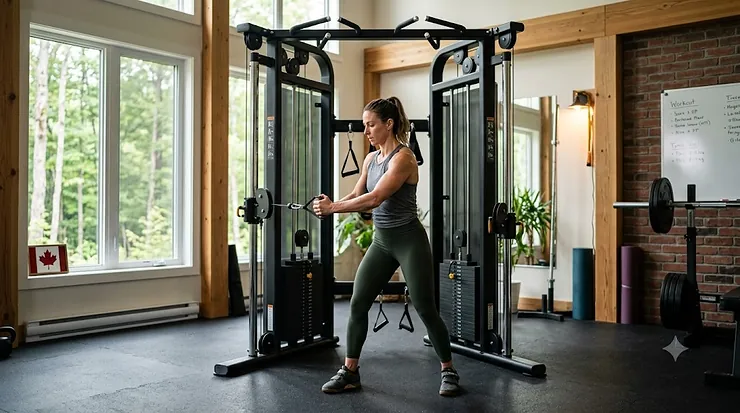
That’s usually the moment someone starts typing “single stack functional trainer” into a search bar at 11 p.m., half-watching a hockey game, half-convincing themselves this is the year the home gym actually happens. Good news: it’s a smart pivot. A single stack functional trainer packs the lat pulldowns, cable rows, chest flies, and tricep pushdowns of an entire commercial cable station into a footprint that’s often smaller than a love seat — and it does it on one weight stack instead of two, which keeps both the price tag and the assembly headache more reasonable.
This guide walks through what these machines actually are, seven real models you can find on Amazon.ca right now across every budget tier, and the practical stuff — winterizing your garage gym, sorting marketing fluff from features that matter, and figuring out which Canadian buyer profile you actually fit. All prices below are estimates in CAD, current as of this writing, because cable machine prices shift more often than Toronto weather. Always check Amazon.ca for the live number before you click “buy.”
As an Amazon Associate, I earn from qualifying purchases — more on that in the disclaimer below, but it doesn’t change a single opinion in this article.
What Is a Single Stack Functional Trainer?
A single stack functional trainer is a freestanding or wall-anchored cable machine built around one central weight stack — usually between 100 and 220 lb (45–100 kg) — that feeds two adjustable pulleys through a system of cables. Instead of free weights or fixed machine paths, you get smooth, multi-directional resistance that lets you train chest, back, shoulders, arms, and legs from a single compact station, with a far smaller footprint and price than a dual-stack commercial unit.
That’s the textbook version. In practice, it’s the difference between needing a 200-square-foot home gym and needing a corner.
Quick Comparison: 7 Single Stack Functional Trainers in Canada
| Machine | Stack Weight | Style | Price Range (CAD) | Best For |
|---|---|---|---|---|
| GF Single Stack Functional Trainer | 176 lb | Freestanding, no anchoring | $500–$700 | No-drill renters |
| Soozier Home Gym (143 lb model) | 143 lb | Compact stack home gym | $400–$550 | Tightest budgets |
| Marcy MWM-990 | 150 lb | Classic stack home gym | $700–$950 | First-timers |
| Valor Fitness BD-62 | 200 lb capacity (plate-loaded) | Wall-mounted | $400–$550 | Condos & small rooms |
| Body-Solid Powerline PFT50 | 210 lb | Freestanding single tower | $900–$1,200 | Serious lifters, single stack |
| ALTAS Strength AL-3073 | 2 x 200 lb (440 lb combined) | Freestanding, dual stack | $1,900–$2,150 | Heavy training, Canadian brand |
| Body-Solid Powerline PFT100 | 2 x 160 lb | All-in-one tower | $1,400–$1,800 | Long-term, two-person households |
A glance at that table tells most of the story: weight stack and price climb together, but not in a straight line. The Valor BD-62 punches well above its price tag because it’s wall-mounted and plate-loaded rather than stack-based, which trades convenience for cost savings — you load your own plates instead of paying for an enclosed steel stack. Meanwhile the ALTAS Strength and Body-Solid PFT100 aren’t technically single-stack machines at all; they’re included here because plenty of Canadian shoppers searching for a “single stack” unit actually outgrow it within a year and end up wishing they’d gone dual-stack from the start. More on that trade-off shortly.
How to Choose a Single Stack Functional Trainer in Canada
Before you fall in love with a product photo, run through this checklist:
- Measure your ceiling, not just your floor. Most single stack units run 80–85 inches (203–216 cm) tall. Basements with low joists or drop ceilings are the number one reason these machines get returned.
- Decide: freestanding or wall-mounted. Renters in Toronto or Montreal condos often can’t drill into load-bearing walls, which pushes them toward freestanding models like the GF trainer or Marcy MWM-990.
- Match the stack to your strength, not your ego. A 100 lb stack with a 2:1 pulley ratio only delivers 50 lb of felt resistance — fine for rehab or beginners, frustrating for an experienced lifter within a few months.
- Check the weight ratio. A 1:1 ratio (like the Valor BD-62) means what you load is what you feel. A 2:1 ratio means you’re only feeling half the stack — smoother on the joints, but you’ll need a bigger stack to get the same challenge.
- Confirm Amazon.ca availability and shipping. Some listings ship from the U.S. or have provincial shipping restrictions, especially to the territories and parts of rural Quebec and Newfoundland.
- Budget for assembly time, not just dollars. Several of these ship in 3–4 separate boxes; block off a Saturday afternoon, not a lunch break.
- Think about who else uses the space. A single stack works fine solo. If two people in the household train at the same time, a dual-stack like the ALTAS Strength or Body-Solid PFT100 avoids the “wait your turn” problem entirely.
✨ Don’t Miss These Exclusive Deals!
🔍 Take your home gym to the next level with these carefully selected cable machines. Click on any highlighted product to check current pricing and availability on Amazon.ca. These tools will help you build the strength training setup your future self will thank you for!
The Top 7 Single Stack Functional Trainers — Expert Analysis
1. GF Single Stack Functional Trainer (176 lb Stack)
The GF Single Stack Functional Trainer is the freestanding option for anyone who’d rather not explain drywall anchors to a landlord. Its 176 lb stack runs through dual swivel pulleys with all-aluminum wheels, and the whole unit stands on its own — no wall, no joist-finding, no awkward conversation with a building super.
What that spec sheet doesn’t say plainly: the dual carriage system means two people can technically train on opposite sides at once, which matters if you’re sharing a basement gym with a partner who also wants their reps in before dinner. At roughly 85 inches tall, it clears most standard basement ceilings, but measure twice if you’ve got ductwork running low. Canadian reviewers note assembly takes a patient afternoon — budget two hours, have a second set of hands for the stack installation.
Customer feedback consistently calls out smooth pulley action and a surprisingly small footprint for the resistance on offer. GF‘s machine is best for renters or anyone who expects to move within a few years and doesn’t want their gym bolted to someone else’s wall.
✅ Freestanding, zero wall mounting required
✅ Dual swivel pulleys for wide exercise variety
✅ Compact enough for spare bedrooms
❌ Assembly is a two-person job
❌ 176 lb ceiling may feel light within a year for advanced lifters
Price: around $500–$700 CAD. Solid value for a no-commitment, no-drilling setup.
2. Marcy MWM-990 (150 lb Stack)
If you picture a “home gym” in your head, you’re probably picturing something close to the Marcy MWM-990. It’s the machine that’s been in garages across North America for over a decade, and there’s a reason: a 150 lb selectorized stack, dual-action press arms for chest flies and presses, a preacher curl pad, and a leg developer station, all built into one steel frame.
What most Canadian buyers overlook is that the MWM-990 isn’t trying to be a true cable crossover — it’s a hybrid home gym with cable elements bolted on. That’s exactly why it’s so approachable for a first-timer who’s never touched a pin-loaded machine before. The pin-select system means no plate-loading and no spotter required, which matters more than people expect when you’re training alone in a basement at 6 a.m. before a Canadian winter sunrise even shows up.
Reviewers consistently flag the build as sturdy for the price point, with the most common complaint being that taller users (over roughly 6’1″) may find the seat positions a touch cramped.
✅ No spotter needed, beginner-friendly
✅ 30+ exercises from one compact station
✅ Recognizable, well-supported brand
❌ Taller users may find positioning tight
❌ Ships in multiple boxes that can arrive on separate days
Price: around $700–$950 CAD, reasonable for the brand recognition and exercise variety.
3. Soozier Home Gym (143 lb Weight Stack)
The Soozier Home Gym with its 143 lb weight stack is the budget cable machine Amazon.ca shoppers gravitate toward when the MWM-990 feels like one expense too many. It ships from Aosom Canada, so the logistics stay domestic rather than crossing the border, which Canadian buyers should appreciate — fewer customs surprises, more predictable delivery windows.
Here’s the practical read: the 143 lb stack with over 35 possible exercises makes this a genuinely capable starter machine, not a toy. The dual-action press arms cover chest press and pec fly, and the leg extension station rounds it out for a real full-body circuit. What the listing doesn’t emphasize is that at this price point, you’re trading some refinement for accessibility — the nylon-coated cables are rated to 1,000 lb of tensile strength, which is plenty for home use, but the overall feel is noticeably less premium than a Body-Solid unit costing three times as much.
✅ Lowest entry price on this list
✅ Ships from Aosom Canada, domestic logistics
✅ Compact 53″ x 40″ footprint
❌ 143 lb may limit long-term progression for strength athletes
❌ Less refined cable feel than premium brands
Price: around $400–$550 CAD. The pick for anyone testing whether home training sticks before investing more.
4. Valor Fitness BD-62 Wall Mount Cable Station
The Valor Fitness BD-62 flips the script entirely: instead of a weight stack, it’s plate-loaded, supporting up to 200 lb of standard or Olympic plates you already own (or buy separately). It mounts to the wall at both the top and bottom, which is the space-saving cable machine solution for anyone whose home gym is really just “that one wall in the garage.”
The genuinely clever part is the dual pulley system with 16 height positions and an approximate 1:1 weight ratio — what you load is close to what you feel, no pulley math required. For a Canadian condo dweller with maybe 4 feet of usable wall space, this is often the only realistic option, since freestanding stack machines simply don’t fit. The trade-off is real, though: you need wall studs in the right place, and renters in older Toronto or Vancouver buildings sometimes discover their walls aren’t built for this kind of anchored load without extra hardware.
Customer reviews are split between people who call it the best value cable station they’ve owned and a smaller group who found the included cables required upgraded washers and re-routing to stop fraying — a fixable but mildly annoying first-week project.
✅ True space-saving cable machine for tiny rooms
✅ 1:1 ratio, intuitive resistance feel
✅ Compatible with plates you may already own
❌ Requires solid wall studs and proper anchoring
❌ Plates not included, adding to total cost
Price: around $400–$550 CAD, plus the cost of plates if you don’t already have a set.
5. Body-Solid Powerline PFT50
The Body-Solid Powerline PFT50 is the single tower cable unit for buyers who’ve outgrown entry-level machines but aren’t ready for a dual-stack commitment. Its 210 lb stack, 20 adjustable pulley positions with 3.2-inch hole spacing, and integrated chin-up bar make it feel closer to commercial equipment than anything else in this price tier.
What most spec sheets skip: the “no cable change” design means you move from a tricep pushdown to a bicep curl to a seated row without re-threading anything — just slide the pulley and grab a different handle. For Canadian buyers training through a long winter when motivation is already running thin, removing every bit of setup friction between exercises is a bigger deal than it sounds. Body-Solid backs the frame with a genuinely long warranty, which matters in a category where cheaper competitors often quietly shorten coverage.
✅ Integrated chin-up bar adds upper-body variety
✅ 210 lb stack with room to grow into real strength
✅ Strong frame warranty from an established brand
❌ Heavier unit (470+ lb), harder to relocate once assembled
❌ Premium price relative to entry-level competitors
Price: around $900–$1,200 CAD. The realistic upgrade pick once you’ve outgrown a starter machine.
6. ALTAS Strength AL-3073 (Canadian Brand)
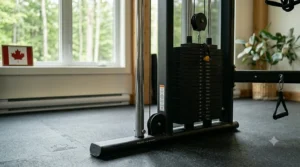
The ALTAS Strength AL-3073 is, technically, a dual-stack machine — two 200 lb stacks for 440 lb combined — but it earns a spot here because Canadian shoppers searching for a single stack functional trainer are often really searching for “something that won’t feel small in two years,” and this answers that directly. ALTAS Strength is a Canadian brand, which matters for warranty support and parts availability in a category dominated by U.S. and overseas manufacturers.
The steel tubes are rated to handle roughly 150 kg (330 lb) of bearing load, and the sealed pulley bearings keep movement smooth even under heavy use. What most listings won’t tell you in practical terms: with 2,000 lb-rated cables and a 1,000 lb total weight capacity, this is built for a household where more than one person trains seriously, or where a single lifter expects to keep progressing for years rather than months.
✅ Canadian brand with domestic support
✅ Two independent 200 lb stacks for true dual-user training
✅ Heavy-duty 2.5 mm steel frame construction
❌ Larger footprint than true single-stack competitors
❌ Highest upfront cost on this list
Price: around $1,900–$2,150 CAD, based on the brand’s own published Canadian pricing — expect to verify the current figure on Amazon.ca, since cross-listing prices can vary from the manufacturer’s direct site.
7. Body-Solid Powerline PFT100
Rounding out the list, the Body-Solid Powerline PFT100 packs two 160 lb stacks (upgradable to 210 lb each) into a single tower design with a 2:1 weight ratio and a knurled chin-up bar. It’s the all-in-one tower pick for buyers who want commercial-style versatility without buying two separate machines.
The practical advantage over a true single-stack unit: independent stacks mean true unilateral training — one arm can pull 40 lb while the other holds 20, which matters for athletes correcting muscle imbalances or anyone doing rehab work after an injury. Body-Solid’s 10-year frame warranty is among the longest in this category, a detail that quietly tells you how confident the company is in the build quality.
✅ Independent dual stacks enable true unilateral training
✅ 10-year frame warranty
✅ 20 starting positions with fine hole spacing
❌ Heaviest, most space-demanding unit on this list (476+ lb, large footprint)
❌ Freight delivery requirements can complicate condo or apartment delivery
Price: around $1,400–$1,800 CAD, depending on whether you select the 160 lb or upgraded 210 lb stacks.
Real Canadian Buyers, Real Picks
The downtown Toronto condo dweller with 200 square feet and a strict no-drilling lease leans toward the Valor BD-62 if there’s wall access, or the GF freestanding trainer if there isn’t. Either way, the win is footprint, not stack size.
The Calgary garage gym owner who’s already lifting seriously and tired of driving to a CrossFit box in -25°C wind chill is the natural fit for the Body-Solid PFT50 or, if budget allows, the ALTAS Strength AL-3073 — enough resistance to actually progress for years, not months.
The Ottawa family of four sharing one basement space benefits most from a dual-stack option like the PFT100, simply because two people training back-to-back on a single stack turns “quick workout” into “who’s waiting in line in my own house.”
The rural Manitoba or Northern Ontario buyer facing longer shipping windows should prioritize machines confirmed to ship within Canada (the Soozier line from Aosom Canada is a safer bet here than anything routed cross-border) and double-check that Amazon.ca’s freight delivery terms cover their postal code before ordering anything in the PFT100’s weight class.
Setting Up and Winterizing Your Cable Machine
A few things Amazon listings never mention: if your machine lives in an unheated garage, cold steel cables stiffen and pulleys can stick on the first few reps of a January workout — a two-minute warm-up pull on each station before loading weight prevents most of that. Wipe down exposed cables and pulley wheels every few weeks during winter, since salt-laden boot residue tracked in from outside corrodes metal faster than people expect. If you’re storing the machine in a space prone to humidity swings — a damp basement is the classic Canadian offender — a light coat of silicone lubricant on moving cable points every couple of months keeps things gliding instead of grinding.
First 30 days, the most common mistake is overloading the stack before the cables and pulleys have “broken in.” Start at roughly 60% of your eventual working weight for the first two weeks; it lets the system settle without the early-cable stretch that causes uneven tension later.
Single Stack vs. Dual Stack: Which One Actually Fits Your Goals?
| Factor | Single Stack | Dual Stack |
|---|---|---|
| Price (CAD) | $400–$1,200 | $1,400–$2,400+ |
| Footprint | Smaller | Larger |
| Best for | Solo training, beginners-to-intermediate | Households with multiple users, advanced lifters |
| Unilateral training | Limited | True independent-arm resistance |
| Long-term headroom | Moderate | High |
The honest analysis: a single stack wins on price and space every time, but dual stacks win on longevity. If you’re buying for one person who’s new to cable training, a single stack like the Soozier or Marcy MWM-990 will likely outlast your patience for the routine before it outlasts your strength gains. If you’re buying for a household, or you already know you lift seriously, the ALTAS Strength or Body-Solid PFT100 avoids the “I should’ve just bought the bigger one” regret that shows up in roughly every online forum thread about this exact decision.
Common Mistakes Canadians Make When Buying a Functional Trainer
Buyers consistently underestimate ceiling height, especially in older homes with dropped basement ceilings under 7.5 feet — measure before, not after delivery. Another frequent misstep: ignoring the weight ratio printed in fine print, then being confused why a “200 lb” machine feels light at 100 lb selected. Cross-border ordering trips people up too; a listing that ships from a U.S. warehouse can mean customs delays or surprise duties that erase the savings versus a Canadian-fulfilled option. Finally, skipping warranty terms is a costly habit — Body-Solid’s decade-long frame coverage and ALTAS Strength’s domestic parts support exist precisely because cheaper imports often offer a fraction of that protection.
Features That Actually Matter (And the Marketing Noise to Ignore)
Sealed pulley bearings matter — they’re the difference between smooth cable travel for years and a squeaky, sticky machine within a season. Adjustable pulley height with fine increments (3-inch spacing or tighter) genuinely expands your exercise range. What matters far less than marketing copy suggests: the exact number of “included attachments,” since most serious lifters end up buying two or three core accessories (a straight bar, a rope, ankle straps) and ignoring the rest of the bundled extras within a month.
Long-Term Cost and Maintenance in CAD
Beyond the sticker price, budget roughly $30–$60 CAD a year for replacement cables or pulleys on a machine used three-plus times weekly — steel cables don’t last forever, and Canadian winters that swing a garage gym from -20°C to 22°C accelerate wear on rubber pulley coatings. A basic cable lubricant runs under $15 CAD and should last most home users a full season. Compared to even a modest $50–$70 monthly gym membership, a $700 CAD machine like the Marcy MWM-990 pays for itself in well under a year of consistent use — the math that convinces most people to finally pull the trigger.
Safety and What the Spec Sheet Won’t Tell You
Look for a frame rated well above the stack weight itself — most quality units rate their steel to 1,000 lb or more even on a 150–210 lb stack, which is the safety margin that matters during explosive movements like cable rows. Check that the manufacturer publishes a Canadian or North American contact for warranty claims, since some imported listings route support through overseas channels that move slowly. None of these machines require electrical certification since they’re purely mechanical, but bilingual product labelling is a legal requirement for goods sold in Canada — a small detail worth glancing at if a listing’s packaging photos look entirely English-only.
Canadian Brand Spotlight: ALTAS Strength
ALTAS Strength stands out on this list simply for being a Canadian-headquartered brand in a category where most competitors manufacture and ship from the U.S. or overseas. That matters practically for warranty turnaround and replacement parts, and it’s worth a premium for buyers who’ve been burned before by chasing down customer service across a border. It’s not the cheapest option here, but for anyone planning to use a machine daily for the next decade, domestic support is its own kind of insurance.
Frequently Asked Questions
❓ Can I use a single stack functional trainer in an unheated Canadian garage?
❓ Does Amazon.ca ship functional trainers to rural Canada?
❓ What's the difference between a 1:1 and 2:1 cable ratio?
❓ Is a 150 lb weight stack enough for strength training?
❓ Do these machines need to be bolted to the floor in Canada?
The Bottom Line
A single stack functional trainer is the rare home gym purchase that actually delivers on its promise: real cable resistance training in a footprint that fits a Canadian basement, condo corner, or garage without demanding a second mortgage. Start with your space and budget, not the biggest stack number you can find — the Canadian 24-Hour Movement Guidelines call for muscle-strengthening activity at least twice a week for adults, and a machine sitting unused in the corner because it didn’t fit your room won’t help anyone hit that target. Whether that’s the budget-friendly Soozier, the do-it-all Body-Solid PFT50, or the Canadian-made ALTAS Strength for the long haul, the right pick is simply the one you’ll actually use on a grey Tuesday in February.
Recommended for You
- 7 Best Dual Adjustable Pulley Machines in Canada (2026): Honest Buyer’s Guide
- 7 Best All-In-One Home Gym Machines in Canada (2026 Guide)
- 7 Best Smith Machines with Cable Attachment in Canada (2026)
Disclaimer: This article contains affiliate links. As an Amazon Associate, I earn from qualifying purchases. If you purchase products through these links, we may earn a small commission at no additional cost to you.
✨ Found this helpful? Share it with your friends! 💬🤗
