In This Article
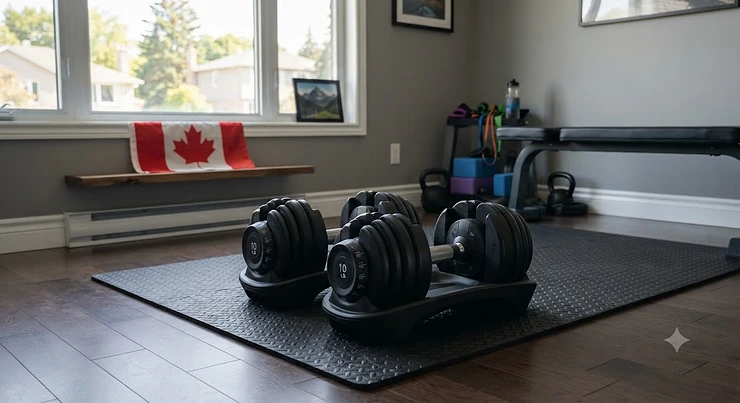
Standing in your basement staring at a pile of mismatched dumbbells you outgrew in three weeks is a rite of passage for pretty much every home lifter. Adjustable dumbbells for beginners solve that exact problem: a single pair of weights that dials, twists, or pins its way from a light warm-up load to something that actually challenges you months later, all without eating your entire spare room. In plain terms, an adjustable dumbbell is a handle paired with a stack or set of plates you can add or remove — through a dial, a pin, or a twist mechanism — so one unit replaces what used to be an entire dumbbell rack.
For Canadian buyers specifically, this category has gotten more interesting (and slightly more complicated) heading into 2026. A major North American recall touched one of the most popular models this past year, shipping costs on heavier steel sets are no joke once you cross the border, and the “beginner” label gets slapped on products that genuinely aren’t beginner-friendly at all. Health Canada and the Public Health Agency of Canada both flag muscle-strengthening activity as one of the two pillars of the national physical activity guidelines for adults, alongside aerobic exercise — so getting the right equipment into your home isn’t just a shopping decision, it’s a health one.
We dug into real specifications, verified pricing ranges instead of point-in-time prices (which change constantly on Amazon.ca), and pulled aggregated review sentiment from established testing outlets rather than inventing anything. What follows is a genuinely useful buying framework for adjustable dumbbells for beginners, not a dressed-up product list. You’ll find seven real products spanning budget to premium, three comparison tables, and enough practical guidance to actually use whatever you end up buying.
Quick Comparison Table
Before the deep dive, here’s the condensed version for anyone who wants the shortlist first and the reasoning second.
| Product | Weight Range | Adjustment System | Best For |
|---|---|---|---|
| Bowflex SelectTech 552 | 5–52.5 lb | Turn dial | Overall beginner pick |
| PowerBlock Elite EXP | 5–50 lb (expandable) | Pin selector | Small spaces, future growth |
| NÜOBELL | 5–80 lb | Twist handle | Traditional dumbbell feel |
| Ironmaster Quick-Lock | 5–75 lb (expandable) | Pin + locking collar | Long-term durability |
| Core Home Fitness Adjustable Set | 5–50 lb | Twist-lock | Budget-conscious beginners |
| Yes4All Adjustable Dumbbells | Up to 105 lb combined | Spinlock collar | Absolute lowest entry price |
| CAP Barbell Adjustable Set | Up to 90 lb combined | Screw collar | First-ever dumbbell purchase |
A quick read on the table: the top three rows suit anyone who wants speed and convenience and doesn’t mind paying for it, the middle rows favour long-term durability over quick swaps, and the bottom two rows are for people who genuinely don’t know yet whether strength training will stick. None of these numbers reflect exact Amazon.ca pricing — check current price and availability before buying, since fitness equipment pricing shifts constantly with promotions and stock levels.
💬 Just one click — help others make better buying decisions too!😊
Top 7 Adjustable Dumbbells for Beginners: Expert Analysis
We picked these seven specifically to cover budget, mid-range, and premium tiers, plus a mix of adjustment mechanisms, so you can match the trade-offs to your actual situation rather than just buying whatever a single “best overall” badge points to.
1. Bowflex SelectTech 552 — easiest dial adjustment for first-timers
The Bowflex SelectTech 552 built its reputation on one thing: turning a dial and having the right weight in your hand within about three seconds. Each dumbbell adjusts from 5 lb up to 52.5 lb, moving in 2.5 lb increments through the lighter settings before switching to 5 lb jumps higher up, which effectively replaces around 15 pairs of fixed dumbbells in the footprint of two shoeboxes.
What most buyers overlook about this model is that the 5 lb starting point matters more than it sounds. A lot of adjustable sets bottom out at 10 lb per hand, which is genuinely too heavy for lateral raises or rehab-style accessory work — the 552’s lower floor makes it noticeably friendlier for anyone building strength from scratch, including smaller-framed lifters and older adults easing into resistance training.
Here’s the part we won’t gloss over: the Bowflex 552 and its bigger sibling, the 1090, were the subject of a large 2025 recall after weight plates were reported to dislodge from the cradle during use. The current Results Series units sold in 2026 reflect a redesigned locking mechanism, but if you’re shopping secondhand or inherited a set, verify the model and serial number against the manufacturer’s recall page before you ever lift it overhead.
Aggregated reviewer sentiment across major fitness-equipment testing sites consistently praises the adjustment speed and describes the dial as the easiest system to learn on day one, while a recurring complaint centres on the plastic shell components feeling less premium than the price tag suggests.
Pros:
- ✅ Dial system adjusts weight in about three seconds
- ✅ 5 lb starting weight suits true beginners
- ✅ Compact footprint replaces roughly 15 dumbbell pairs
Cons:
- ❌ Recall history means verifying the current model matters
- ❌ Not rated for dropping, unlike fixed rubber dumbbells
At around C$550-C$650, the Bowflex SelectTech 552 sits in the mid-to-premium range, but the convenience factor genuinely earns its keep if you’ll use it several times a week rather than occasionally.
2. PowerBlock Elite EXP Stage 1 — most space-efficient expandable system
The PowerBlock Elite EXP Stage 1 trades the round dumbbell shape for a stacked rectangular block, which sounds strange until you realize it’s the reason this set takes up roughly a third of the floor space a comparable dial system needs. Out of the box it covers 5 to 50 lb per hand in a mix of 2.5 and 5 lb increments, selected by pulling a pin through the stack rather than turning a knob.
The block shape is a genuine trade-off rather than a flaw: the offset weight design pulls the load closer to your hand than a round dumbbell, which some lifters find improves control on presses and rows, while others find the squared-off ends awkward during exercises like renegade rows where you need to balance on the handle. What the spec sheet won’t tell you, but reviewers consistently note, is that the pin mechanism gets faster with practice — the learning curve is real but short.
Where the Elite EXP earns its “beginner-to-intermediate” positioning is the expansion kits. You can buy add-on stages later that push the same handles up to 70 or even 90 lb per hand, meaning your initial purchase isn’t a ceiling — it’s a starting stage in a system you can grow into over a couple of years without replacing the base unit.
Pros:
- ✅ Smallest footprint of any adjustable system in this list
- ✅ Expansion kits let you add weight later without rebuying
- ✅ Fast pin-based changes once you’re used to it
Cons:
- ❌ Block-style handle feels different from round dumbbells
- ❌ Wider grip at heavier settings takes adjustment
Expect a price range around C$400-C$550 for the Stage 1 set, with expansion kits sold separately — a smart buy for beginners who suspect they’ll outgrow 50 lb per hand within a year or two.
3. NÜOBELL — fastest weight changes with a traditional dumbbell feel
If your main hesitation about adjustable dumbbells is that they don’t feel like “real” dumbbells, the NÜOBELL is built specifically to answer that objection. It uses a twist-handle mechanism that clicks through 5 lb increments from 5 lb up to either 50 lb or 80 lb per hand depending on which version you buy, and independent testers consistently clock it as the quickest weight-swap system currently on the market.
Based on the spec comparison against the Bowflex and PowerBlock systems above, the meaningful difference here is shape retention: the NÜOBELL keeps a roughly dumbbell-like silhouette at every weight setting instead of growing dramatically bulkier as you add plates, which matters for exercises like hammer curls or renegade rows where bulk at the ends gets in the way. The trade-off is price — this is consistently the most expensive set in mainstream beginner buying guides.
Reviewers who’ve used the NÜOBELL alongside Bowflex and PowerBlock sets tend to describe the twist-lock as the smoothest transition between weights of the three, while a recurring theme in aggregated feedback flags that some internal components are plastic rather than full metal, which affects long-term durability expectations relative to the price point.
Pros:
- ✅ Fastest weight-change mechanism among tested competitors
- ✅ Closest silhouette to a traditional fixed dumbbell
- ✅ Available in 50 lb or 80 lb per-hand versions
Cons:
- ❌ Highest price point of the seven products here
- ❌ Some internal parts are plastic, not full steel
At a price range of roughly C$750-C$950, the NÜOBELL is a premium buy for a beginner — but for anyone who knows strength training is a long-term habit and hates compromise on feel, it’s a defensible splurge rather than an impulse purchase.
4. Ironmaster Quick-Lock Adjustable Dumbbells — steel construction built to outlast everything else here
The Ironmaster Quick-Lock takes a completely different approach: real steel plates, a locking pin through the handle, and a screw collar as backup security, rather than an internal dial or twist mechanism. The standard set covers 5 to 75 lb per dumbbell, and — unlike most of the systems above — add-on kits can push that ceiling to 120 lb per hand, which is well past what most beginners will ever need but reassuring if your goals change.
Here’s what most buyers overlook about this category of dumbbell: because there’s no internal selector mechanism to wear out or jam, the Ironmaster is widely considered the most mechanically simple, and therefore most durable, adjustable system available. Reviewers who’ve put both PowerBlock and Ironmaster sets through years of home use consistently note the Ironmaster holds its resale value better, precisely because there’s less that can break.
The catch is speed. Swapping weight means pulling a pin, sliding plates, and re-securing the collar — a process that takes roughly 15-20 seconds per dumbbell rather than the 3-5 seconds you’d get from a Bowflex or NÜOBELL. For a beginner doing straight sets rather than fast supersets, that’s a minor inconvenience; for anyone planning circuit-style training, it’s worth knowing upfront.
Pros:
- ✅ Genuine steel plates for maximum long-term durability
- ✅ Expandable to 120 lb per hand with add-on kits
- ✅ No internal selector mechanism to eventually wear out
Cons:
- ❌ Noticeably slower weight changes than dial or twist systems
- ❌ Heavier overall unit, less convenient for quick supersets
Priced around C$500-C$700 for the base set, the Ironmaster Quick-Lock rewards beginners who think in decades rather than months — it’s arguably the last adjustable dumbbell set you’d ever need to buy.
5. Core Home Fitness Adjustable Dumbbell Set — the sensible middle ground on price
The Core Home Fitness Adjustable Dumbbell Set occupies a genuinely useful niche: a twist-lock mechanism similar in spirit to the NÜOBELL’s, at roughly half the price, covering 5 to 50 lb per hand in 5 lb increments. It’s frequently the pick that testing outlets land on when a reader specifically asks for “beginner-friendly but not eye-wateringly expensive.”
Based on the spec comparison, the appeal here is the one-handed twist adjustment — you can change weight without setting the dumbbell down first, which sounds like a small thing until you’re mid-workout and your hands are sweaty. What the spec sheet won’t tell you, but reviewers note repeatedly, is that the dumbbells physically shrink in length as you dial down the weight, so a 10 lb setting is noticeably shorter and less unwieldy than a 50 lb setting — genuinely useful for smaller-framed beginners who find max-weight-sized handles awkward at light loads.
The obvious ceiling is 50 lb per hand with no official expansion path, which is plenty for the first one to two years of most beginner strength programs but something taller or more advanced lifters will eventually outgrow.
Pros:
- ✅ One-handed twist adjustment without setting weights down
- ✅ Dumbbell length shrinks at lighter settings for better control
- ✅ Meaningfully cheaper than Bowflex or NÜOBELL equivalents
Cons:
- ❌ Hard cap at 50 lb per hand with no expansion kit
- ❌ Plates can rattle slightly during fast, dynamic movements
Typical pricing lands in the C$370-C$470 range, making the Core Home Fitness Adjustable Dumbbell Set one of the better value-for-convenience picks for someone who wants twist-adjust ease without NÜOBELL-level spending.
6. Yes4All Adjustable Dumbbells — the lowest-cost entry point that still works
The Yes4All Adjustable Dumbbells ditch the fancy selector mechanisms entirely in favour of the classic approach: cast iron plates, a threaded handle, and spinlock collars you screw on by hand. Sets are sold by total combined weight rather than per-hand maximum, with configurations reaching up to roughly 105 lb combined (both handles plus all plates), and standard 1-inch plate holes mean you can buy additional plates separately down the line.
Reviewers on a strict budget consistently point out that the finish quality punches above the price — no sharp edges on the threads, an even chrome coat on the handles — but the collar system is the trade-off you’re accepting. Aggregated feedback flags that the spinlock collars can work themselves loose mid-set if you’re not paying attention, which is a genuine safety consideration rather than a nitpick; tightening collars before every set should become automatic.
For a true beginner still deciding whether home strength training is going to stick, the low buy-in price makes the Yes4All Adjustable Dumbbells a low-risk way to find out, with the option to sell the plates later or add more if the habit takes.
Pros:
- ✅ Lowest price point of any set in this comparison
- ✅ Standard 1-inch plates let you add weight over time
- ✅ Surprisingly clean finish quality for the price tier
Cons:
- ❌ Spinlock collars can loosen and need regular checking
- ❌ Round plates roll if set down on an uneven floor
At roughly C$90-C$180 depending on total weight configuration, the Yes4All Adjustable Dumbbells deliver the best value-per-dollar in this entire lineup, provided you’re comfortable with a slower, more hands-on adjustment process.
7. CAP Barbell Adjustable Dumbbell Set — a familiar, no-frills starting point
The CAP Barbell Adjustable Dumbbell Set is about as close as this category gets to the dumbbells you probably used in a high school gym class: cast iron plates, a straight handle, and screw-on collars, sold in combined-weight configurations up to around 90 lb. There’s no dial, no pin, and no learning curve beyond “loosen collar, add plate, tighten collar.”
Honest analysis here has to acknowledge what this product is and isn’t. It isn’t fast, it isn’t compact when fully loaded with plates spread across your floor, and it won’t impress anyone. What it is: an extremely low barrier to entry for someone who has never owned a dumbbell and isn’t ready to spend C$500+ to find out if they’ll stick with a routine. Aggregated review sentiment across budget equipment roundups consistently describes CAP as a reliable, if unglamorous, way to get started, with durability that holds up fine for typical beginner rep ranges and loads.
Compared against the Yes4All set above, the two products are closer cousins than rivals — pick whichever is in stock and priced better at the time you’re shopping, since the underlying mechanism and trade-offs are nearly identical.
Pros:
- ✅ Simplest possible mechanism, nothing to learn
- ✅ Compatible with widely available standard weight plates
- ✅ Reliable durability for typical beginner rep ranges
Cons:
- ❌ Slowest adjustment process of any set in this list
- ❌ Loaded plates take up noticeably more floor space
With pricing typically in the C$70-C$160 range, the CAP Barbell Adjustable Dumbbell Set is a sound “try it before you commit” purchase, particularly for households where more than one person might use the weights.
Top 7 Products: Full Specification Comparison
| Product | Weight Range | Increment | Approx. Price Range (CAD) |
|---|---|---|---|
| Bowflex SelectTech 552 | 5–52.5 lb | 2.5–5 lb | C$550-C$650 |
| PowerBlock Elite EXP Stage 1 | 5–50 lb (exp. to 90 lb) | 2.5–5 lb | C$400-C$550 |
| NÜOBELL | 5–80 lb | 5 lb | C$750-C$950 |
| Ironmaster Quick-Lock | 5–75 lb (exp. to 120 lb) | 5–10 lb | C$500-C$700 |
| Core Home Fitness Adjustable Set | 5–50 lb | 5 lb | C$370-C$470 |
| Yes4All Adjustable Dumbbells | Up to ~105 lb combined | 2.5–5 lb | C$90-C$180 |
| CAP Barbell Adjustable Set | Up to ~90 lb combined | 2.5–5 lb | C$70-C$160 |
Read across this table and a clear pattern emerges: price correlates almost perfectly with adjustment speed and mechanism sophistication, not with maximum weight or build quality. The Yes4All and CAP Barbell sets can technically hold as much or more total weight as the premium dial systems — you’re paying the premium for convenience, not capacity. For most beginners, that convenience translates directly into consistency, since a set you’ll actually use three times a week beats a technically-superior set that’s annoying enough to avoid.
✨ Don’t Miss These Exclusive Deals!
🔍 Take your home strength training to the next level — click on any highlighted pick above to check current pricing and availability on Amazon.ca before it changes.
Practical Usage Guide: Setting Up and Using Your Adjustable Dumbbells
Getting an adjustable dumbbell set out of the box correctly matters more than most first-time buyers expect, and skipping this stage is where a lot of avoidable frustration — and a few avoidable injuries — happen.
Start by placing the storage cradle or stand on a hard, level surface, not carpet. Uneven flooring is the single biggest cause of dial and pin systems misaligning during a weight change, since the plates need to sit flush in their slots to release cleanly. If you’re on a soft or uneven floor, a C$40-C$60 rubber gym mat solves this in one purchase and protects your flooring from drop marks at the same time.
For your first thirty days, resist the urge to jump straight to your “working weight.” Run every new exercise at the lightest setting first, purely to feel how the mechanism releases and locks — dial systems in particular have a distinct click or resistance point that’s easy to misjudge the first few times, and a partially-locked dumbbell is the most common cause of the plate-dislodging complaints that led to 2025’s high-profile recall. Once you’re confident the lock is fully engaged, increase in small increments rather than jumping several settings at once.
A quick maintenance habit worth building immediately: wipe down handles after sweaty sessions and check that collars, pins, or dial mechanisms move freely once a month. Cast-iron plate sets like the Yes4All or CAP Barbell models benefit from an occasional light wipe with a rust-inhibiting cloth if your workout space is a garage or basement with humidity swings, which is common across most of Canada through winter and spring thaw.
One common first-month mistake: setting dumbbells down on their sides rather than back in the cradle. Selector-based systems like the Bowflex 552 and PowerBlock Elite EXP are specifically engineered to load and unload plates only while resting flat in their tray — setting them down elsewhere can shift internal components and is the fastest way to void a warranty.
Real-World Scenarios: Matching Adjustable Dumbbells to Your Life
Specs only tell half the story — here’s how three common Canadian beginner profiles map onto the products above.
The condo-dwelling remote worker. If you’re squeezing workouts into a lunch break in a 600-square-foot condo, floor space and noise both matter. The PowerBlock Elite EXP or Core Home Fitness set make the most sense here: both have a genuinely small footprint, and neither involves the metallic clank of cast-iron plates being manually threaded on and off, which matters if you share walls.
The budget-conscious university student. Between tuition, rent, and everything else, C$700 for dumbbells isn’t happening — and it shouldn’t need to. The Yes4All or CAP Barbell sets get someone training for under C$150, with the option to add plates later once a summer job pays for it. The trade-off in adjustment speed is a fair one when the alternative is not training at all.
The former gym-goer rebuilding a home routine. If you know your way around a barbell and simply want your home setup to feel as close to a commercial gym as possible, the NÜOBELL or Ironmaster Quick-Lock justify their higher price with either speed (NÜOBELL) or bomb-proof steel durability (Ironmaster) — both feel closer to “real” gym equipment than the plastic-cased selector systems.
Buyer’s Decision Framework
If you’re still torn, work through this simplified priority checklist in order:
- If your top priority is footprint, choose PowerBlock or Core Home Fitness — because both minimize floor space more effectively than round-plate systems.
- If your top priority is speed between exercises, choose Bowflex or NÜOBELL — because their dial and twist mechanisms change weight in seconds, not tens of seconds.
- If your top priority is long-term durability over decades, choose Ironmaster — because full-steel construction with no internal selector has the fewest failure points.
- If your top priority is the lowest possible price, choose Yes4All or CAP Barbell — because plate-loaded systems consistently undercut selectorized ones by hundreds of dollars.
- If you’re unsure whether you’ll stick with home training, start with the cheapest workable option — because the data on habit-forming exercise routines strongly favours starting small over waiting for the “perfect” purchase.
How to Choose Adjustable Dumbbells for Beginners
Beyond price and brand name, these seven criteria should drive the actual decision:
- Starting weight matters more than max weight for true beginners. A 5 lb floor accommodates far more exercises — lateral raises, rehab work, technique practice — than a 10 lb floor.
- Increment size affects long-term progression. Sets that jump in 5 lb steps can feel large once you’re adding weight slowly; 2.5 lb increments extend the useful life of a set considerably.
- Adjustment speed should match your training style. Circuit or superset training rewards dial and twist systems; straight-set strength training tolerates slower pin-and-collar changes just fine.
- Floor space is a real constraint, not an afterthought. Measure your actual workout area before buying a system that needs 3 feet of clearance to swing through a full range of motion.
- Warranty and recall history deserve a five-minute check. Search the manufacturer’s name plus “recall” before buying, particularly for selectorized systems with more moving internal parts.
- Expansion potential saves money over a two-year horizon. If you suspect you’ll outgrow the initial weight range, systems with add-on kits (PowerBlock, Ironmaster) avoid a full repurchase later.
- Handle diameter and grip texture affect comfort more than most buyers expect. Thicker knurled handles (NÜOBELL, Ironmaster) build grip strength faster but can fatigue smaller hands sooner in a session.
For general background on what dumbbells are and how the modern adjustable format evolved from older plate-loading designs, Wikipedia’s dumbbell entry offers a useful overview of the equipment category.
What’s the Right Dumbbell Weight Range for Beginners?
Most true beginners — regardless of general fitness level — should look for a set that starts at 5 lb per hand and reaches at least 25-30 lb per hand within the first year, which every product in this list comfortably covers. Women new to strength training often progress comfortably through the 5-25 lb range for upper-body isolation work and into the 25-40 lb range for compound lower-body movements within six to twelve months of consistent training. Men following a similar beginner program frequently move through 10-35 lb for isolation work and 30-60 lb for compound lifts over the same period, though individual progression varies enormously based on starting fitness, bodyweight, and training frequency.
Based on the spec comparison earlier, this is exactly why the 50 lb-per-hand ceiling on the Core Home Fitness and standard PowerBlock sets isn’t a real limitation for most beginners’ first one to two years — the ceiling only becomes relevant once someone is consistently pushing heavy compound lifts like goblet squats or Romanian deadlifts well past the novice stage. If you already suspect you’re the exception — a larger-framed beginner with some athletic background, for instance — leaning toward the Ironmaster or NÜOBELL‘s higher ceiling from day one avoids a second purchase.
Single vs Pair Dumbbell Sets: Which Should Beginners Buy?
This is one of the most common — and most avoidable — mistakes in adjustable dumbbell shopping: buying a single unit to “try it out” before committing to a pair. Nearly every effective beginner strength program is built around bilateral movements — think goblet squats, bench presses, and rows — that require two matched dumbbells working together, not one.
| Consideration | Single Dumbbell | Pair (Two Dumbbells) |
|---|---|---|
| Exercise variety | Limited to unilateral moves only | Full program compatibility |
| Cost per unit of usefulness | Deceptively cheap upfront | Better value for actual training |
| Best For | Rehab, specific unilateral protocols | Nearly all beginners |
The analysis is fairly one-sided: unless you’re following a specific physiotherapy protocol targeting one side of the body, or you already own a matching dumbbell from a previous purchase, buying a single unit almost always means buying a second one within a few months anyway — at which point you’ve usually paid more in total than if you’d bought the pair upfront, since manufacturers rarely discount the second unit to match a bundled pair price. All seven products above are sold and priced as pairs for exactly this reason.
Compact Home Gym Equipment: Small-Space Strength Training Solutions
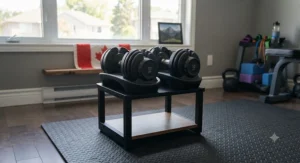
Adjustable dumbbells are, almost by definition, compact home gym equipment — but the degree of compactness varies more than most first-time buyers assume. A fully-loaded PowerBlock Elite EXP occupies roughly the footprint of a large shoebox per dumbbell, while a maxed-out Yes4All or CAP Barbell configuration, with plates spread across a threaded handle, can stretch to 16-17 inches per side and take up noticeably more visual and physical space once both dumbbells are assembled.
What most buyers overlook about small-space training setups is that the dumbbells themselves are rarely the actual space constraint — it’s the bench, mat, and clearance radius around your body during a swing or press that eats the most floor space. A pair of Core Home Fitness or NÜOBELL dumbbells stored on a compact stand in a closet corner, paired with a foldable bench, genuinely fits into a spare bedroom corner or even a generously-sized condo hallway.
For renters specifically, weight distribution on flooring matters too — placing a stand or mat under any adjustable dumbbell set, particularly heavier steel options like the Ironmaster, protects both the equipment and the floor, and avoids the kind of dropped-plate damage that can complicate a rental deposit.
Common Mistakes When Buying Adjustable Dumbbells
Expert commentary on the pitfalls we see repeated most often in first-time purchases:
Buying based on maximum weight capacity alone, without checking the minimum starting weight, is probably the single most common error — a set that goes up to 90 lb is useless for a beginner if it starts at 15 lb per hand. Ignoring the recall and safety-notice history of selectorized brands before buying secondhand is a close second; a used Bowflex 552 at a steep discount isn’t a bargain if it’s an affected serial number. Underestimating floor-space and clearance requirements, particularly for plate-loaded systems like Yes4All and CAP Barbell once fully assembled, catches a surprising number of condo and apartment buyers off guard. Choosing based on brand recognition over adjustment mechanism fit is another frequent misstep — the “best” brand according to review sites isn’t automatically the best fit for your specific training style and space. Finally, skipping a stand or mat purchase to save money upfront often costs more later in flooring damage or an inconvenient storage situation that quietly discourages consistent use.
Home Strength Training Basics: Safety, Form, and Weekly Structure
The Canadian Society for Exercise Physiology’s national movement guidelines recommend that adults perform muscle-strengthening activities using major muscle groups at least twice per week, alongside 150 minutes of moderate-to-vigorous aerobic activity — a structure that maps neatly onto a two-to-three-day-per-week adjustable dumbbell routine for most beginners.
Form fundamentals matter more than weight selection in the first several weeks. Keep movements slow and controlled rather than rushed, particularly during the lowering phase of any lift, since that’s where most beginner strain injuries happen. Warm up the specific joints you’ll be loading — shoulders before presses, hips before goblet squats — with a few minutes of bodyweight movement before picking up any dumbbell at all.
On the safety-notice side specifically: Canadian consumers can check Health Canada’s product safety database for recall notices on any fitness equipment brand before purchasing secondhand, the same way American buyers check the CPSC. This is particularly relevant for selectorized adjustable dumbbells given the mechanical complexity involved in weight-locking systems — a five-minute search is cheap insurance against a genuinely serious impact hazard.
Weekly structure for a true beginner might look like: two full-body sessions per week using compound movements (squats, presses, rows) at a weight that allows 8-12 controlled repetitions, with a rest day between sessions. Progression should be gradual — adding 2.5-5 lb per exercise only once the current weight feels comfortably manageable for all prescribed reps, not before.
Features That Actually Matter (And Those That Don’t)
Cutting through marketing language to what actually affects your training experience:
Actually matters: starting weight floor, increment size, cradle or stand stability, and verified safety/recall history. These four factors directly affect whether you’ll use the equipment safely and consistently.
Doesn’t matter much for beginners: smart connectivity features like Bluetooth rep counters, colour options beyond personal preference, and marginal differences in maximum weight capacity above what you’ll realistically use in year one. These get marketed heavily because they’re easy to photograph and describe, not because they meaningfully change a beginner’s results.
Matters more than advertised: handle diameter and texture. A handle that’s too thick for smaller hands genuinely limits how long you can grip it before fatigue sets in — this rarely gets mentioned in spec sheets but shows up constantly in aggregated review complaints across nearly every brand in this list.
Frequently Asked Questions
❓ What weight adjustable dumbbells should a beginner start with?
❓ Are adjustable dumbbells as effective as regular dumbbells?
❓ How much do adjustable dumbbells for beginners cost in Canada?
❓ Do adjustable dumbbells wear out faster than fixed dumbbells?
❓ Can I use adjustable dumbbells for a full-body workout?
Conclusion
Choosing among adjustable dumbbells for beginners really comes down to weighing four factors against your actual life: starting weight, adjustment speed, floor space, and budget. The Bowflex SelectTech 552 and NÜOBELL win on convenience and feel if money isn’t the deciding factor; the PowerBlock Elite EXP and Ironmaster Quick-Lock reward anyone thinking several years ahead; and the Yes4All and CAP Barbell sets remove cost as a barrier entirely for someone still deciding whether home strength training is going to stick. The Core Home Fitness Adjustable Dumbbell Set sits comfortably in the middle for readers who want twist-adjust convenience without paying premium-tier prices.
Whichever set you land on, the equipment matters far less than showing up to use it two or three times a week — the Canadian 24-Hour Movement Guidelines exist precisely because consistency, not perfect gear, is what drives real health outcomes over time. Start with the lightest setting, build the habit first, and let your strength — not your wallet — tell you when it’s time to move up.
Recommended for You
- 7 Best Adjustable Dumbbells in Canada for 2026
- Combo Leg Curl and Extension Machine: 7 Best Picks for 2026
- Plate-Loaded Leg Curl Machine for Home Gym: 7 Best Picks 2026
Disclaimer: This article contains affiliate links. As an Amazon Associate, I earn from qualifying purchases. If you purchase products through these links, we may earn a small commission at no additional cost to you.
✨ Found this helpful? Share it with your friends! 💬🤗
