
In This Article
Somewhere in a Mississauga basement right now, someone is standing over a pair of dumbbells mid-superset, staring at a stuck dial like it personally betrayed them. That moment — weights half-loaded, forearms burning, patience gone — is exactly why the quick-change adjustable dumbbells vs dial adjustable dumbbells debate refuses to die down. Both styles promise the same thing: a rack’s worth of iron folded into two compact handles. But how they deliver on that promise, and how long they keep delivering on it, is where things get interesting.
This guide breaks down quick-change adjustable dumbbells vs dial adjustable dumbbells using real products sold in Canada, real aggregated reviewer sentiment, and an honest look at where each mechanism tends to wear out. You’ll get seven actual sets spanning budget to premium, a side-by-side on weight-change speed, and a plain-language breakdown of mechanism failure points so you’re not gambling C$500 on a guess. Metric equivalents are noted where useful, and every price below is a range in Canadian dollars, because exact figures shift too often to print responsibly.
By the end, you’ll know whether a plate-loaded quick-lock system or a spinning dial actually fits your training style, your budget, and your tolerance for the occasional stuck pin.
What Is the Difference Between Quick-Change and Dial Adjustable Dumbbells?
Quick-change adjustable dumbbells use a sliding pin or a threaded/locking collar to select plates directly, while dial adjustable dumbbells use a rotating knob or twisting handle that engages an internal selector mechanism. Both replace 10 to 17 pairs of fixed dumbbells in one compact unit, but they trade off differently on speed, durability, and feel.
It’s worth separating three distinct families rather than two, because lumping them together hides useful detail:
- Pin-selector quick-change (PowerBlock-style): a magnetic or spring pin slides into a weight stack.
- Turn-dial systems (Bowflex, Core Home Fitness, NordicTrack, NÜOBELL): a knob or the handle itself rotates to engage internal gears.
- Plate-loaded/screw-lock quick-change (Ironmaster, Yes4All): plates are threaded on and secured with a locking collar or ribbed screw pin.
That third category is the one people forget about, and it’s central to the plate-loaded vs turn-dial systems conversation later in this guide.
Quick Comparison Table
| Mechanism Type | Typical Weight-Change Speed | Moving Parts | Best For |
|---|---|---|---|
| Turn-Dial | 3–8 seconds per side | Internal gears, plastic/nylon selector disks | Fast-paced circuits, drop sets |
| Pin-Selector Quick-Change | 2–5 seconds | Magnetic/spring pin, steel rails | Progressive overload, expandability |
| Plate-Loaded Quick-Change | 15–40 seconds per side | Screw pin or threaded collar, minimal electronics | Maximum durability, heavy loading |
Looking at the table, the speed gap between turn-dial and pin-selector systems is smaller than most shoppers assume — a couple of seconds per side, tops. The real divide is between those two families and plate-loaded quick-change gear, which trades speed for a mechanism so simple there’s almost nothing left to fail. If your workouts hinge on rapid-fire supersets, that time difference compounds fast over a 45-minute session with 15+ weight changes.
💬 Just one click — help others make better buying decisions too!😊
Top 7 Adjustable Dumbbells: Expert Analysis
1. Bowflex SelectTech 552 — the dial classic, rebuilt after a major recall
The Bowflex SelectTech 552 popularized the modern adjustable dumbbell category, and its dual end-dials remain instantly recognizable in gym-selfie backgrounds across the country. Each dumbbell adjusts from roughly 2.3 kg to 23.6 kg (5 to 52.5 lb) in 2.5-lb increments up to 25 lb, then 5-lb jumps beyond that, replacing about 15 pairs of fixed weights in one footprint the size of a large shoebox. Based on the spec comparison, that granular low-end progression is genuinely useful for anyone easing into strength training or rehabbing an injury.
Here’s what to weigh, though: in June 2025, Johnson Health Tech Trading recalled roughly 3.8 million units of the 552 and 1090 after the weight plates were found to dislodge from the handle mid-use, with over 100 reported injuries including concussions and broken toes. The current retail versions include revised trays and brackets, and reviewers testing post-recall units report the dial action feels as smooth as ever. Reviewers consistently note the dial mechanism itself is fast and tactile; the recall centred on the plate-locking bracket, not the dial knob.
Pros:
- ✅ Fine 2.5-lb increments up to 25 lb for smooth progression
- ✅ Compact single-length design that doesn’t grow as you add weight
- ✅ Widely available with strong secondary-market and accessory support
Cons:
- ❌ 2025 recall highlighted a real bracket failure point on earlier units
- ❌ Two separate dials per dumbbell means twice the adjustment motion
Check current price for the Bowflex SelectTech 552 — expect a range around C$550-C$700 for the post-recall Results Series version, with pricing fluctuating around sales events.
2. Core Home Fitness Adjustable Dumbbell Set — best budget dial for tight spaces
The Core Home Fitness Adjustable Dumbbell Set swaps Bowflex’s dual-dial layout for a single twist-of-the-wrist mechanism at one end, and testers consistently describe it as the faster of the two to operate. It covers 2.3 kg to 22.7 kg (5 to 50 lb) per hand, with steel pins locking plates into a rubber-lined cradle that several reviewers say cuts down on the rattle common in cheaper dial sets. What most buyers overlook about this model is how much the flat-ended shape matters during floor presses — no dial digging into your palm or the floor mid-rep.
The trade-off shows up in the fine print: the twist direction for adding versus removing weight isn’t always intuitive on first use, and the plates can require a firm tug out of the tray once you’re past 30 lb per side. Aggregated reviewer sentiment leans favourable overall, with several long-term owners reporting a full year of regular use without a mechanical failure, though a few early reviews flagged occasional sticking during weight transitions.
Pros:
- ✅ Single twist mechanism is faster than dual-dial competitors
- ✅ Rubber-lined cradle reduces plate rattle during overhead work
- ✅ Ships around C$70-C$100 less than the comparable Bowflex set
Cons:
- ❌ Twist direction for +/- isn’t intuitive for every user at first
- ❌ Plates can stick and need a firm pull above roughly 30 lb
Check current price for the Core Home Fitness Adjustable Dumbbell Set — typically in the C$400-C$500 range at the time of research.
3. NordicTrack Select-a-Weight / iSelect — the smart dial with app-guided workouts
The NordicTrack Select-a-Weight dumbbells layer a digital display and, in the iSelect version, voice control through a smart speaker on top of a traditional dial mechanism. You dial or speak your target weight, wait for the numbers to stop flashing, and the plates lock in — usually in the 3 to 5 second range, according to hands-on reviewers. On paper this means beginners get a genuinely low barrier to entry, since the increments start at 2.5 lb and the companion app can preset weights to specific movements like an overhead press.
Here’s the honest catch: the plastic weight-changing pin inside the mechanism is the component reviewers flag most often as a wear point, and NordicTrack’s 90-day warranty is noticeably shorter than the two- to five-year coverage offered by competing brands. Health Canada and the U.S. CPSC issued a joint recall on the iSelect Voice-Controlled model after weight plates were found to dislodge during use, affecting roughly 640 units sold in Canada. That’s a meaningful data point for anyone weighing mechanism failure points against a flashy feature set.
Pros:
- ✅ Small 2.5-lb increments suit beginners building confidence gradually
- ✅ Voice and app control genuinely speeds up transitions between exercises
- ✅ Smooth tray re-racking with minimal reported wobble
Cons:
- ❌ Plastic selector pin is the most commonly cited failure point
- ❌ Only a 90-day warranty versus multi-year coverage elsewhere
Check current price for the NordicTrack Select-a-Weight — generally found in the C$500-C$650 range depending on the model and any active promotions.
4. NÜOBELL Adjustable Dumbbells — fastest turn-dial change on the market
The NÜOBELL Adjustable Dumbbells take the turn-dial concept and strip away the separate knob entirely — you twist the whole handle, and reviewers independently clock it as the quickest change in this roundup, often under five seconds per side. Available in 5-50 lb and 5-80 lb pairs, the knurled steel handle is a deliberate departure from the rubber-coated grips found on most rivals, and multiple testers note it feels closer to a genuine gym dumbbell than anything else on this list. What most buyers overlook about this model is that it physically shortens as you dial down the weight, which sidesteps the “long-bar catching your thigh” complaint common with fixed-length dial systems during curls.
That authenticity comes at a price, and the NÜOBELL consistently sits above Bowflex and Core Home Fitness in cost. Reviewers consistently report the mechanism holds up well over time, with several noting they’ve used the sets for years of drop-set-heavy training without a hiccup, though the per-hand base weight is a touch heavier than some ultra-light dial rivals when set to their lowest increment.
Pros:
- ✅ Fastest reported adjustment time of any dial-style dumbbell here
- ✅ Knurled steel handle mimics a real barbell grip
- ✅ Variable length reduces leg-catch during isolation movements
Cons:
- ❌ Priced well above budget and mid-range dial competitors
- ❌ Heavier minimum per-hand weight than lighter dial alternatives
Check current price for the NÜOBELL Adjustable Dumbbells — expect the 50-lb pair in the C$750-C$900 range, with the 80-lb version priced higher.
5. PowerBlock Elite EXP — best pin-selector for expandable strength
The PowerBlock Elite EXP ditches the round-dumbbell silhouette for a stacked rectangular block, and its magnetic selector pin is the clearest example of quick-change done through pure mechanical simplicity. Slide the pin into the desired slot, lift, and the unused plates stay behind in the base — reviewers consistently time this at two to three seconds, edging out most dial systems. Stage 1 covers 5-50 lb per hand, and expansion kits push that to 70 or 90 lb without buying a whole new set, which is a genuinely useful long-term-value angle for anyone still building strength.
Based on the spec comparison, the trade-off is shape rather than speed: the boxy cage changes how the dumbbell sits during overhead presses and tricep extensions, and more than one reviewer with larger hands describes the cage as mildly restrictive. On the durability side, owners reporting 10+ years of use without a mechanical failure is a recurring theme across independent reviews, and the pin itself is rated for loads far beyond what most home users will ever apply.
Pros:
- ✅ Magnetic pin locks with an audible, confidence-inspiring click
- ✅ Expansion kits grow the set from 50 lb to 90 lb per hand
- ✅ Multiple long-term owners report zero mechanical failures after years
Cons:
- ❌ Rectangular cage design feels less natural for overhead movements
- ❌ Higher upfront cost if your training rarely needs the top end
Check current price for the PowerBlock Elite EXP — Stage 1 sets typically land in the C$400-C$500 range before expansion kits.
6. Ironmaster Quick-Lock Adjustable Dumbbells — the most durable plate-loaded system, period
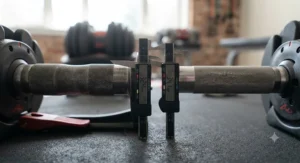
The Ironmaster Quick-Lock Adjustable Dumbbells represent the plate-loaded end of the quick-change spectrum, using a ribbed locking pin threaded through iron plates rather than any dial or selector mechanism at all. It’s genuinely the slowest system in this article — reviewers consistently clock full adjustments at around 20 seconds per side, or roughly 40 seconds total between sets — but that manual simplicity is exactly why it’s the standout for adjustable dumbbell mechanism durability. Ironmaster’s own product page explicitly states these can be dropped like fixed dumbbells, backed by a lifetime warranty, a claim that would void most competitors’ coverage instantly.
What most buyers overlook about this model is how few parts there are to fail in the first place: a steel handle, locking pins, and iron plates, full stop. Reviewers who’ve owned other systems and switched to Ironmaster consistently cite that simplicity as the reason they stopped worrying about mid-set failures. The trade-off is speed — if your programming leans on rapid weight jumps or shared-equipment supersets, that 20-second-per-side change time will grate.
Pros:
- ✅ All-metal build with almost nothing plastic to wear out or break
- ✅ Manufacturer explicitly rates these safe to drop, unlike most rivals
- ✅ Lifetime warranty backs genuinely long-term ownership plans
Cons:
- ❌ Slowest adjustment of any set in this roundup, around 20 seconds per side
- ❌ Locking pins can loosen slightly after repeated heavy drops
Check current price for the Ironmaster Quick-Lock Adjustable Dumbbells — the base 45-lb kit typically runs C$450-C$600, with 75-lb and 120-lb expansion kits priced higher.
7. Yes4All Adjustable Dumbbells — the most affordable plate-loaded option
The Yes4All Adjustable Dumbbells take the plate-loaded concept to its budget extreme: chrome handles, star-lock or spin-lock collars, and solid cast-iron plates you thread on by hand. Sets scale from roughly 40 lb up to 200 lb total, in 5-lb increments, at what reviewers repeatedly note is the lowest cost per pound of any adjustable option on the market. Here’s what to weigh: these are the slowest system in this entire lineup to adjust, since every change means unscrewing a collar, swapping plates, and screwing it back down — no pin slide, no dial twist.
Reviewers consistently report the fit and finish punches above the price point, with tight threading and minimal sharp edges, though a handful mention surface coating wearing thin on concrete floors after extended use. The round plate design also means they can roll if set down carelessly, which is a minor but real annoyance compared to the flat-sided plates on every other product in this guide. For anyone building a home gym from zero on a tight budget, though, the ability to simply buy more plates later — rather than a whole new dumbbell system — is a legitimate long-term value argument.
Pros:
- ✅ Lowest cost per pound of any set in this comparison
- ✅ Solid cast-iron plates resist cracking or chipping over time
- ✅ Expandable indefinitely by purchasing additional plates as you progress
Cons:
- ❌ Slowest weight-change mechanism of any product in this guide
- ❌ Round plates can roll if not stored carefully
Check current price for the Yes4All Adjustable Dumbbells — a mid-size set (around 105 lb total) is generally in the C$150-C$250 range.
Practical Usage Guide: Setup, Maintenance and Optimization
Getting your adjustable dumbbells dialled in — pun fully intended — takes more than opening the box. Start by setting the tray or stand on a completely flat, hard surface; even a slight tilt causes plates to seat unevenly, which is the number-one cause of “stuck” selector complaints in the first 30 days. For turn-dial models like the Bowflex SelectTech 552 or Core Home Fitness Adjustable Dumbbell Set, always fully seat the dumbbell in its cradle before twisting; forcing a partial turn is how internal gears wear prematurely.
For pin-selector and plate-loaded systems including the PowerBlock Elite EXP, Ironmaster Quick-Lock, and Yes4All Adjustable Dumbbells, a light coat of dry lubricant on the pin or threads every few months keeps the action smooth without attracting dust the way oil-based products do. Reviewers of the NordicTrack Select-a-Weight specifically warn against yanking the handle before the display stops flashing — that half-second of impatience is the most common cause of a dropped plate mid-adjustment. Across every mechanism type, the single biggest first-month mistake is dropping the dumbbell to test its limits; even Ironmaster’s drop-safe rating assumes controlled setdowns, not repeated slams.
Real-World Scenarios: Which System Fits Your Training Style
If you’re a shift worker squeezing in 20-minute circuits between hospital rounds, weight-change speed isn’t a luxury, it’s the difference between finishing your workout and not. The NÜOBELL or PowerBlock Elite EXP fit this scenario well, since both keep transitions under five seconds and let you chain supersets without losing momentum.
If you’re a university student sharing a basement gym with three roommates on a combined C$300 budget, the Yes4All Adjustable Dumbbells make more sense than any dial system — the slower changes matter less when you’re mostly doing straight sets, and the low cost-per-pound stretches further across multiple users. And if you’re someone who’s cycled through two cheaper adjustable sets already and just wants the last dumbbells you’ll ever buy, the Ironmaster Quick-Lock system’s lifetime warranty and all-metal build directly answer that fatigue, even if the 20-second change time takes some adjustment.
Problem → Solution: Common Weight-Change Headaches
Problem: The dial won’t turn past a certain point. This usually means the dumbbell isn’t fully seated in its tray. Lift it out, realign it flush against the cradle, and try again before assuming mechanical failure — this resolves the majority of reported “stuck dial” cases on models like the Core Home Fitness Adjustable Dumbbell Set.
Problem: A pin won’t slide smoothly on a PowerBlock-style system. Dust and chalk buildup around the rails is the usual culprit. A quick wipe with a dry cloth, followed by a light dry-lubricant application, restores the click-lock feel on the PowerBlock Elite EXP within seconds.
Problem: Plates rattle during overhead pressing. This is more common on dial systems with looser plastic cradles. Double-checking the dial has clicked fully into its detent, rather than resting between numbers, eliminates most of the rattle reviewers describe.
Problem: Threaded collars won’t grip tightly on plate-loaded dumbbells. On the Yes4All Adjustable Dumbbells, worn rubber gaskets inside the collar are the usual cause, and they’re inexpensive to replace rather than a sign the whole handle has failed.
How to Choose Between Quick-Change and Dial Adjustable Dumbbells
- Define your weight-change speed threshold first. If your programming includes supersets or drop sets, anything over five seconds per side will genuinely slow your session down.
- Weigh your budget against expected mechanism lifespan. Cheaper dial systems trade some longevity for a lower entry price; plate-loaded quick-change systems front-load durability instead.
- Consider your maximum realistic weight need in five years, not today. Expandable systems like PowerBlock and Ironmaster save you from re-buying entirely later.
- Factor in warranty length as a durability proxy. A 90-day warranty on a digital dial system tells you something different than a lifetime warranty on an all-metal build.
- Test the ergonomics if at all possible. Fixed-length dial dumbbells can catch your thigh during curls; variable-length twist systems like NÜOBELL avoid this.
- Check whether the model has any active recalls. Both Bowflex and NordicTrack have issued dumbbell recalls tied to plate-dislodging hazards in recent years.
- Match the mechanism to who else uses the equipment. Shared households benefit more from forgiving, simple plate-loaded systems than from finicky dial mechanisms multiple people are still learning.
Quick-Change Adjustable Dumbbells vs Dial Adjustable Dumbbells: The Real Differences
The quick-change adjustable dumbbells vs dial adjustable dumbbells comparison isn’t really a two-way fight — it’s closer to a three-way split once you separate pin-selector systems from plate-loaded ones. Pin-selector quick-change, as seen on the PowerBlock Elite EXP, edges out most dial systems on raw speed by a second or two, but the real distinguishing factor is mechanical complexity: a sliding pin has far fewer failure-prone parts than the internal gearing inside a dial mechanism like the one in the NordicTrack Select-a-Weight.
Plate-loaded vs turn-dial systems is really where durability philosophy diverges. Turn-dial systems including the Bowflex SelectTech 552, Core Home Fitness Adjustable Dumbbell Set, and NÜOBELL all rely on some combination of gears, tracks, or cams that must engage precisely every single time — smooth when new, but a documented recall history shows what happens when tolerances loosen. Plate-loaded quick-change designs like the Ironmaster Quick-Lock and Yes4All Adjustable Dumbbells sacrifice speed almost entirely in exchange for a mechanism so simple there’s structurally little that can dislodge mid-lift. Neither approach is universally “better” — a CrossFit-style athlete chasing fast transitions will feel every extra second on an Ironmaster, while a home-gym owner who values fixed-dumbbell peace of mind will find the plate-loaded trade-off obviously worthwhile.
Mechanism Failure Points: What Actually Breaks Over Time
Every adjustable dumbbell mechanism has a weak point, and being honest about it is more useful than pretending otherwise. On turn-dial systems, the recurring failure point across independent reviews and recall data is the plastic bracket or tray interface that holds the plates in position — this was the specific issue behind the 2025 Bowflex SelectTech 552/1090 recall and the Health Canada-flagged NordicTrack iSelect recall. The dial knob itself is rarely the problem; it’s the plate-locking hardware behind it.
On pin-selector systems like the PowerBlock Elite EXP, the selector pin is the component most likely to show wear, though reviewers overwhelmingly describe this as a multi-year, not multi-month, timeline, and the magnetic engagement style reduces the risk of a false lock. Plate-loaded systems shift the failure risk elsewhere entirely: on the Ironmaster Quick-Lock, the main long-term concern is locking pins loosening slightly after repeated drops, while on the Yes4All Adjustable Dumbbells, it’s the rubber gasket inside the collar wearing out — a cheap, replaceable part rather than a structural failure. Understanding which failure point you’re comfortable managing is arguably more useful than chasing the fastest possible weight-change speed.
💬 Already leaning toward one mechanism type? Share this comparison with a workout buddy before you both commit!
Common Mistakes When Buying Adjustable Dumbbells
Buyers consistently underestimate how much floor space a fully-loaded set needs, particularly with rectangular pin-selector designs like PowerBlock, which sit wider than round dial dumbbells at their maximum weight. Another frequent misstep is buying based on maximum weight capacity alone without checking increment size — a set that jumps straight from 20 to 30 lb offers far less useful progression than one with 2.5-lb steps, something both the Bowflex SelectTech 552 and NordicTrack Select-a-Weight handle well at the lower end.
Shoppers also tend to skip checking a brand’s recall history entirely, which is a genuinely avoidable oversight given that Health Canada’s public recall database is free to search. Finally, plenty of first-time buyers assume all quick-change mechanisms are equally fast, when in reality plate-loaded systems like Ironmaster and Yes4All are quick-change in name only compared to pin-selector or dial alternatives — “quick” describes the category, not a universal speed guarantee.
Safety, Recalls and Regulations in Canada
Home strength equipment isn’t heavily regulated the way, say, bicycle helmets are, but Canada’s product safety framework still applies, and it’s worth knowing before you buy. Under the Canada Consumer Product Safety Act, recalled products cannot legally be redistributed, sold, or even given away in this country, which matters if you’re eyeing a used adjustable dumbbell set on a local marketplace. You can check any specific model against Health Canada’s public recall database before purchasing, which is exactly where the NordicTrack iSelect Voice-Controlled Dumbbells recall — tied to roughly 640 units sold in Canada — is documented in detail.
The Public Health Agency of Canada’s own physical activity guidance for adults recommends muscle-strengthening activity at least twice weekly using major muscle groups, which is precisely the use case adjustable dumbbells are built for — just make sure whichever mechanism you choose is one you trust enough to actually use consistently. If you already own a recalled Bowflex SelectTech 552 or 1090 unit, Johnson Health Tech Trading’s official recall page walks through the refund and replacement process step by step.
Long-Term Cost & Maintenance
Sticker price only tells part of the ownership story. A Yes4All Adjustable Dumbbells set costs the least upfront but carries essentially zero ongoing mechanism maintenance beyond the occasional gasket swap, since there’s no gearing to wear out. By contrast, a turn-dial system like the NordicTrack Select-a-Weight costs more initially and, per its notably short 90-day warranty, implicitly signals a shorter expected mechanism lifespan than its price tag might suggest.
The Ironmaster Quick-Lock and PowerBlock Elite EXP sit at an interesting middle ground: higher upfront cost than budget dial sets, but both offer expansion kits that let a single purchase scale with your strength for years, avoiding the sunk cost of re-buying an entirely new set once you outgrow a fixed weight ceiling. When you annualize cost over an expected five- to ten-year ownership window, the Ironmaster‘s lifetime warranty and all-metal durability arguably make it the strongest long-term value in this roundup, even though it’s far from the cheapest option on day one.
Frequently Asked Questions
❓ Is a quick-change or dial adjustable dumbbell better for fast workouts?
❓ What actually breaks on adjustable dumbbells over time?
❓ Are plate-loaded adjustable dumbbells safer than dial models?
❓ How fast can you really change weight on quick-change dumbbells?
❓ Were any adjustable dumbbells recalled in Canada?
Conclusion
There’s no single winner in the quick-change adjustable dumbbells vs dial adjustable dumbbells debate, and honestly, anyone promising you one is skipping the nuance. Dial systems like the Bowflex SelectTech 552, Core Home Fitness Adjustable Dumbbell Set, NordicTrack Select-a-Weight, and NÜOBELL win on speed and modern convenience, but their internal gearing is the documented weak point behind recent recalls. Pin-selector quick-change gear like the PowerBlock Elite EXP splits the difference nicely, while true plate-loaded systems like the Ironmaster Quick-Lock and Yes4All Adjustable Dumbbells trade speed for a mechanism so simple it’s genuinely hard to break.
The right call depends on whether you value seconds saved between sets or years saved between replacements. Either way, checking a model’s recall history and warranty length before buying will tell you more about long-term reliability than any spec sheet on its own.
✨ Ready to build a home gym you won’t outgrow? Explore the picks above and compare current prices before your next workout! 🏋️♀️
Recommended for You
- Plate-Loaded Leg Extension Machine: 7 Top Picks for Canada (2026)
- 7 Best Bowflex SelectTech Dumbbells; Rivals in 2026
- 7 Best Adjustable Dumbbells for Beginners in Canada
Disclaimer: This article contains affiliate links. As an Amazon Associate, I earn from qualifying purchases. If you purchase products through these links, we may earn a small commission at no additional cost to you.
✨ Found this helpful? Share it with your friends! 💬🤗
