
In This Article
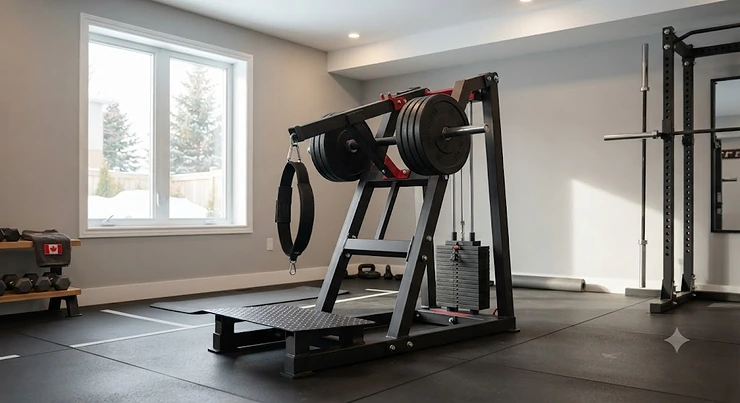
Your lower back has opinions about barbell squats, and lately it’s been pretty vocal about them. Maybe it’s an old disc injury, maybe it’s just the accumulated wear of a decade under a loaded bar, or maybe you simply want to train your legs without turning every set into a referendum on your spine’s mood that day. Whatever brought you here, a belt squat machine solves a problem that barbell squats can’t: it lets you load your quads, glutes, and hamstrings hard while keeping the weight entirely off your shoulders and spine.
Here’s the short version: a belt squat machine is strength equipment that suspends resistance from a hip belt instead of a barbell, so the load travels straight down through your legs rather than compressing your spinal column. Public health guidance frames muscle-strengthening work as a core pillar of staying healthy at every stage of adult life, and a belt squat is one of the more forgiving ways to check that box when your back needs a break from axial loading — see the Physical Activity Guide for Adults 18-64 for the full picture.
We dug through real product listings, manufacturer specs, and aggregated review sentiment from verified buyers to shortlist seven genuinely different belt squat machines — from a C$60 rack attachment to a full standalone unit with a vertical loading track. This is not a rewritten spec sheet. It’s a practical comparison built for Canadian buyers shopping amazon.ca, with honest commentary on who each machine actually suits.
Quick Comparison Table
| Machine | Type | Weight Capacity | Best For |
|---|---|---|---|
| Bells of Steel Belt Squat Machine 2.0 | Standalone, lever horns | 700 lb | All-around Canadian value |
| Titan Fitness SquatMax-MD | Standalone, vertical track | 1,000+ lb | Serious lifters, true feel |
| Titan Fitness Belt Squat Machine | Standalone, lever arm | 1,000 lb | Budget standalone unit |
| syedee BS01 Belt Squat Machine | Standalone, compact | 800 lb | Small home gyms |
| REP Fitness Belt Squat Attachment | Rack attachment (cable) | 600 lb | REP rack owners |
| Fringe Sport Mammoth Belt Squat | Rack attachment (lever) | Rack-dependent | Universal rack fit |
| Sunny Health & Fitness Belt Squat Attachment | Rack attachment (basic) | Rack-dependent | First-time buyers on a tight budget |
Looking at this lineup, the split really comes down to floor space and budget more than raw performance. The three rack attachments — REP Fitness Belt Squat Attachment, Fringe Sport Mammoth Belt Squat, and Sunny Health & Fitness Belt Squat Attachment — let you skip a four-figure purchase entirely if you already own a power rack, while the four standalone units trade that convenience for a dedicated, always-ready station. Weight capacity numbers matter less than they look like they should; unless you’re loading well past 400 lb on the belt, every machine here has room to spare.
💬 Just one click — help others make better buying decisions too!😊
Top 7 Belt Squat Machines: Expert Analysis
1. Bells of Steel Belt Squat Machine 2.0 — best all-around Canadian value
The standout here is logistics as much as engineering: Bells of Steel Belt Squat Machine 2.0 ships from Calgary or Toronto warehouses, which means Canadian buyers skip the cross-border duty headaches that plague a lot of American-made gym equipment. Under the hood, it’s an 11-gauge steel frame rated to 700 lb, with vertically-mountable weight horns and commercial-grade Zerk bearings on the pivot points — the kind of detail that keeps the movement smooth after a year of heavy use instead of developing that gritty, worn-in feel cheaper units get by month six.
What most buyers overlook about this model is the vertical horn-mounting trick: by loading plates vertically instead of horizontally, you shrink the machine’s floor footprint and — more usefully — let taller lifters break parallel without the plates bottoming out early, which is a common complaint on cheaper belt squat units. Reviewers consistently note smooth pivot action and solid welds, though a handful mention the platform could be a touch wider for lifters over 6’2″, and shorter users sometimes need a small elevation block to hit full depth.
This is the machine for someone who wants a dedicated, no-compromise belt squat station without importing it from the US. It handles squats, rows, RDLs, and calf raises with equal competence, and the 13 adjustable heights mean it fits a wide range of body types out of the box.
Pros:
- ✅ Ships from Canadian warehouses, avoiding import duties
- ✅ Vertical horn mounting saves floor space and depth
- ✅ Commercial-grade bearings hold up under repeated heavy loading
Cons:
- ❌ Platform runs narrow for lifters over 6’2″
- ❌ Assembly takes longer than the instructions suggest
Expect this one to land in the C$1,050-C$1,300 range depending on promotions, and at that price it’s genuinely hard to beat for a Canadian buyer who wants a purpose-built machine without the shipping gamble.
2. Titan Fitness SquatMax-MD — best true vertical loading experience
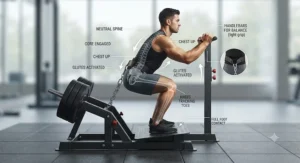
The Titan Fitness SquatMax-MD does something most belt squat machines don’t: it uses a vertical guide rod instead of a lever arm, so 100 lb loaded on the pin genuinely feels like 100 lb under your hips — no mechanical advantage smoothing things out or pulling you forward mid-rep. That 1:1 loading ratio is the entire reason serious lifters gravitate toward this model over cheaper lever-based alternatives.
Built from 11-gauge steel with a 1,000 lb capacity on the belt and 1,300 lb on the loading pin, it’s engineered for people who actually intend to load heavy plates rather than just dabble. The included box squat seat and band pegs extend its usefulness well past squats — you can layer in accommodating resistance or work on depth consistency with the pull-pin seat adjustment. Reviewers who’ve compared it against lever-arm competitors describe the feel as remarkably close to a real barbell squat, minus the spinal loading, and rate its overall value highly given the versatility on offer.
Here’s what the spec sheet won’t tell you: the true vertical path means your stabilizer muscles work slightly harder than they would on a lever machine, since there’s no mechanical assist smoothing out your balance. That’s a feature for anyone chasing carryover to barbell squats, but beginners sometimes find the first few sessions a little less “guided” than expected.
Pros:
- ✅ True 1:1 loading ratio mimics real barbell squat feel
- ✅ 1,300 lb pin capacity leaves massive headroom to progress
- ✅ Box squat seat and band pegs add real training versatility
Cons:
- ❌ Premium pricing compared to lever-arm alternatives
- ❌ Slightly steeper learning curve for total beginners
Pricing sits in the premium tier — think somewhere around C$1,900-C$2,400 depending on sales — which puts it well above entry-level options, but reviewers consistently frame it as a buy-once purchase rather than a stepping stone.
3. Titan Fitness Belt Squat Machine — best budget-friendly standalone unit
If the SquatMax-MD is the enthusiast’s pick, the Titan Fitness Belt Squat Machine is the pragmatist’s one. This is Titan’s original lever-arm design, and it remains, dollar for dollar, one of the most affordable ways to get a dedicated standalone unit into a home gym rather than settling for a rack attachment.
The lever arm pulls the weight sleeves in an arc rather than a straight vertical line, which does mean the resistance isn’t a perfect 1:1 feel — but it also means the unit is mechanically simpler and, as a result, considerably cheaper to manufacture and buy. Three weight-stopper positions let you dial in exactly how deep you squat before hitting the safety catch, which matters more than it sounds like: training to failure on a belt squat without a stopper is how people end up folding awkwardly at the bottom of a rep. Horizontal weight sleeves offer 16.5 inches of loadable length each, and the diamond-plate footplate gives genuinely good traction even when your shoes are dusty from chalk.
Aggregated buyer feedback is a mixed bag on build consistency — most reviewers report smooth assembly and solid function, but a handful note cosmetic issues like light rust on the handle straight out of the box, likely a powder-coating inconsistency rather than a structural flaw. For a budget-conscious lifter who just wants a working belt squat without spending on the premium vertical-track models, this remains a sensible entry point.
Pros:
- ✅ Most affordable standalone belt squat in Titan’s lineup
- ✅ Three stopper positions control squat depth safely
- ✅ Diamond-plate footing holds traction even when dusty
Cons:
- ❌ Lever arm doesn’t give a true 1:1 weight feel
- ❌ Occasional finish/rust issues reported on the handle
Look for it in the C$1,300-C$1,600 range, often discounted during seasonal sales — worth watching if you’re not in a rush to buy.
4. syedee BS01 Belt Squat Machine — most compact footprint for small spaces
Not everyone has a three-car garage to dedicate to a home gym, and that’s exactly the gap the syedee BS01 Belt Squat Machine fills. Front and rear weight-loading pins are positioned to minimize the overall footprint compared to a standard hack-squat-style frame, and the whole unit is sized for basements, condos, and garage corners where every square foot counts.
Extra-large 17.7″ x 15.2″ knurled pedals give plenty of room to plant your feet through a wide stance, and two hydraulic rods automatically return the bar to the top position after each rep — a small but genuinely convenient touch that saves you from manually resetting the mechanism between sets. The hanging belt design routes the load straight down through the hips, and four adjustable positions accommodate users roughly 5’7″ to 6’2″ without needing extra risers.
Based on the spec comparison against pricier standalone units, the syedee trades some premium finishing and long-term durability testing for a genuinely lower price point — which is a completely reasonable trade if your priority is simply owning a working belt squat station rather than a commercial-grade one. It’s also sold under a few different retail names (BS00 and BS01 variants), so double-check the listing specs before buying, since weight capacities and dimensions differ slightly between versions.
Pros:
- ✅ Compact design fits small basements and garages
- ✅ Hydraulic auto-return rods speed up rep transitions
- ✅ Extra-large pedals accommodate a wide squat stance
Cons:
- ❌ Multiple product variants can cause listing confusion
- ❌ Less brand history than Titan or Bells of Steel
Expect a price in the C$550-C$700 range, making it one of the more accessible standalone (non-attachment) options on this list.
5. REP Fitness Belt Squat Attachment — best add-on for REP rack owners
If you already own a REP PR-4000 or PR-5000 V2 power rack with the lat tower attachment installed, the REP Fitness Belt Squat Attachment turns that existing setup into a fully functional belt squat station for a fraction of what a standalone machine costs. It taps into the rack’s cable and pulley system, using aluminum pulleys and 11-gauge steel construction to deliver consistent tension through the full range of motion — something lever-arm machines can’t always claim.
The catch, and it’s a real one: this only works if you’re already invested in REP’s ecosystem. You need the specific rack model and the lat tower attachment as prerequisites, so it’s not a universal solution. Reviewers who do have the compatible setup describe the tension as smooth and consistent, praising the quick-release pin assembly that takes just minutes. On the flip side, some note the front leg lifts slightly during the movement, which shortens usable cable travel and can make hitting full depth tricky unless you stand on a small riser or plyo box.
What most buyers overlook here is the space savings — this attachment stores flat against the rack rather than occupying its own floor real estate, which matters enormously in a one-car-garage gym. For committed REP rack owners, it’s genuinely the most budget-efficient way to add belt squats to an existing setup.
Pros:
- ✅ Dramatically cheaper than any standalone machine
- ✅ Consistent cable tension throughout the full range of motion
- ✅ Stores flat against the rack, saving floor space
Cons:
- ❌ Only compatible with specific REP rack models
- ❌ Front-leg lift can reduce achievable squat depth
Priced around C$375-C$425 CAD depending on current promotions, this is squarely a budget pick — but only for the right rack owner.
6. Fringe Sport Mammoth Belt Squat — most universal rack-mount design
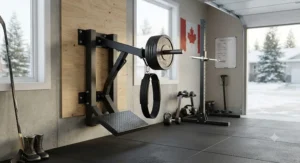
Where the REP attachment locks you into one ecosystem, the Fringe Sport Mammoth Belt Squat goes the other direction: it’s built to clip into virtually any power rack on the market, fitting both 5/8″ and 1″ hole patterns. That universality makes it the more flexible rack-attachment option if you’re not already committed to a single brand’s rack system.
The standout feature is the spring-loaded kickstand, which holds the lever arm at a 17-inch upright position between sets so you can clip in from a standing start rather than bending all the way down to hook the belt — a genuinely useful convenience that a lot of competing attachments skip. Beyond squats, the attachment handles lunges, deadlifts, calf raises, and bent-over rows, giving it more exercise range than its price tag would suggest. Reviewers who’ve used it alongside dedicated standalone machines tend to describe it as a solid stepping stone rather than an endpoint — good enough to build real leg strength, but with a noticeably shorter lever arm than premium units, which some taller lifters find limits their range of motion slightly.
The black powder coat finish holds up reasonably well in aggregated feedback, and the black zinc hardware resists the light surface rust that plagues cheaper attachments. For a lifter who wants belt squat access without buying a dedicated frame, this remains one of the more versatile choices on the market.
Pros:
- ✅ Fits nearly all racks with 5/8″ or 1″ hole patterns
- ✅ Kickstand lets you clip in from a standing position
- ✅ Handles rows, lunges, and deadlifts beyond squats
Cons:
- ❌ Shorter lever arm limits range of motion for tall lifters
- ❌ Requires an existing compatible power rack to function
Typical pricing lands around C$300-C$375, positioning it as a genuinely accessible entry into belt squat training for existing rack owners.
7. Sunny Health & Fitness Belt Squat Attachment — cheapest way to try belt squats
Sometimes the honest answer to “which belt squat machine should I buy” is “the cheapest one that actually works,” and that’s exactly the role the Sunny Health & Fitness Belt Squat Attachment plays. At a fraction of the cost of any other machine on this list, it converts a compatible power rack or cage into a basic belt squat station without requiring a serious financial commitment.
Construction is straightforward steel, and the attachment itself is minimal by design — this isn’t trying to compete with lever-arm or cable-based systems on smoothness or range of motion. What it does is give first-time buyers a genuinely low-risk way to find out whether belt squat training suits their body and their training goals before spending C$1,000-plus on a dedicated standalone machine. Aggregated marketplace feedback describes it as functional and simple, without the finishing touches found on pricier attachments, and buyers should note that a compatible weightlifting belt is typically sold separately.
Reviewers consistently frame this less as a long-term solution and more as a genuinely useful trial run — if you end up loving belt squats after a few months on this attachment, upgrading to something like the Fringe Sport Mammoth Belt Squat or a standalone unit becomes a much easier decision because you already know the movement works for your body.
Pros:
- ✅ Lowest price point of any option on this list
- ✅ Low financial risk to test belt squat training
- ✅ Simple design with minimal assembly required
Cons:
- ❌ Basic construction lacks smoothness of pricier attachments
- ❌ Weightlifting belt usually sold separately
At roughly C$60-C$110, this is squarely the entry point — not a forever machine, but a smart way to test the waters.
Belt Squat Machine for Beginners: Setup, First Sessions & Common Mistakes
Getting a new machine into your gym is only step one — the first month of actually using it determines whether it becomes a staple or a coat rack. If you’re weighing beginner squat machine options for the first time, start light. Seriously light. Even bodyweight-only reps on the belt for your first session or two will tell you whether your natural stance is narrow, wide, or somewhere in between, and getting that dialed in before you add plates saves you from baking a bad movement pattern into your training.
During setup, double-check that the belt sits low on your hips rather than up around your waist — a belt riding too high transfers more strain into your lower back than the exercise is supposed to eliminate, which defeats the entire purpose. Most standalone machines and rack attachments include an owner’s manual with torque specs for the mounting bolts; don’t skip re-checking those after the first two or three sessions, since new hardware tends to settle slightly under load.
A common first-30-days mistake is loading weight too aggressively because the exercise “feels easier” without spinal compression — but your quads and glutes are still doing real work, and delayed-onset soreness after your third or fourth session can catch beginners off guard. Build up gradually over three to four weeks before pushing toward heavier top sets. For maintenance, a light coat of machine oil on pivot points or pulleys every few months keeps lever-arm and cable systems moving smoothly, and it’s worth a quick bolt-tightening pass once a season regardless of which machine you own.
✨ Don’t Miss These Exclusive Deals!
🔍 Take your leg day to the next level with these carefully selected picks. Click on any highlighted item to check current pricing and availability. These machines will help you build serious lower-body strength your back will actually thank you for!
Real-World Scenarios: Which Belt Squat Machine Fits Your Life
The condo-dwelling beginner. Priya just moved into a one-bedroom condo with a small storage locker for gym gear and no interest in a permanent standalone machine taking up her living room. Budget is tight, and she’s not even sure belt squats will feel right for her knees. The Sunny Health & Fitness Belt Squat Attachment paired with a rack she already owns lets her test the movement for under C$110 before committing further — low risk, low regret if it turns out not to be her thing.
The garage-gym lifter chasing PRs. Marcus trains four days a week, squats heavy on his barbell days, and wants a way to add leg volume without accumulating spinal fatigue that would compromise his next barbell session. He’s not short on space, and he’s not short on budget either. The Titan Fitness SquatMax-MD fits his situation well — the true 1:1 loading ratio means the weight he loads is genuinely the weight he’s moving, which matters when he’s tracking progressive overload seriously.
The recovering athlete. After a disc injury sidelined her from barbell squats for months, Sarah’s physiotherapist recommended belt squat training as a way to maintain leg strength without axial spinal loading. She’s working with moderate weights, prioritizes control over max loads, and needs a machine that won’t punish imperfect setup days. The Bells of Steel Belt Squat Machine 2.0, with its adjustable heights and smooth bearing action, gives her the consistency she needs while she rebuilds confidence in loaded movement.
How to Choose a Belt Squat Machine
- Measure your space before anything else. Standalone units need roughly 4 to 7 feet of dedicated floor space; rack attachments need only what your existing power rack already occupies.
- Decide between lever arm, cable, and vertical track systems. Lever arms are cheaper but pull you slightly forward; cable systems offer smooth tension but depend on your rack’s pulley setup; vertical tracks like the SquatMax-MD give the truest 1:1 feel at a premium price.
- Check your existing equipment for compatibility first. If you already own a REP or similarly-specced power rack, an attachment can save hundreds of dollars over a standalone machine.
- Match weight capacity to your actual training ceiling, not your aspirations. Most lifters never load past 400-500 lb on a belt squat, so a 600 lb-rated attachment is plenty for the vast majority of home gym users.
- Factor in assembly time and tools required. Standalone machines can take two to four hours to assemble; attachments are usually done in under 30 minutes.
- Read aggregated review sentiment for build consistency, not just star ratings. A 4.5-star average can still hide a recurring complaint about a specific bolt or bracket — scan for patterns, not just the number.
- Budget for a belt separately if it’s not included. Several attachment-style options, including the Sunny Health & Fitness pick, sell the platform and the belt as separate purchases.
Belt Squat Machine vs Hack Squat Machine
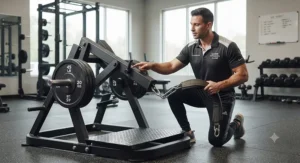
This comparison comes up constantly, and for good reason: both machines target quads, glutes, and hamstrings, and both remove some of the technical demand of a barbell squat. But they solve genuinely different problems. A hack squat machine locks you into a fixed sled path at an angle, with your back supported against a pad — brilliant for isolating quad hypertrophy with minimal balance demand, but it still places compressive load through your spine and lower back against that pad, just distributed differently than a barbell.
A belt squat machine, by contrast, removes spinal loading almost entirely by routing the resistance through your hips via a belt. A peer-reviewed kinetic analysis comparing the two loading patterns found that belt squats can produce loading on the lower extremities that’s similar to or greater than a back squat, while measurably reducing the load placed on the lower back — and hack squats, while gentler on the spine than a free barbell squat, still don’t eliminate that compressive element the way a true belt squat does. Full details are in the Kinetic Analysis of Isometric Back Squats and Isometric Belt Squats, Journal of Strength and Conditioning Research.
| Factor | Belt Squat Machine | Hack Squat Machine |
|---|---|---|
| Spinal loading | Minimal to none | Reduced but present |
| Range of motion | Highly adjustable | Fixed sled angle |
| Balance demand | Moderate (upright, unsupported) | Low (back supported) |
| Best For | Bells of Steel Belt Squat Machine 2.0, spine-sensitive lifters | Pure quad hypertrophy focus |
The takeaway from this comparison is that these aren’t really competing products — they’re complementary. Someone managing a back injury benefits more from a belt squat’s spinal decompression, while someone chasing maximum quad size with zero balance concerns might prefer the guided sled path of a hack squat. If you can only choose one and back health is a genuine concern, the belt squat wins that specific matchup decisively.
Belt Squat Training Benefits: What the Research Actually Shows
It’s easy to find marketing copy claiming a belt squat machine will transform your legs and save your spine simultaneously, but what does the actual research say? A kinetic analysis published in the Journal of Strength and Conditioning Research found that belt squats can match or exceed the loading placed on lower-extremity muscles during a back squat, while meaningfully reducing the moments placed on the lower back. That’s a fairly significant finding — it means you’re not sacrificing leg training stimulus in exchange for spinal safety; in many cases, you’re getting comparable stimulus with a genuinely different risk profile.
A separate line of research out of Aalborg University in Denmark is currently investigating belt squat training specifically as an intervention for people with chronic non-specific low back pain, recruiting both healthy volunteers and people managing persistent pain to evaluate the movement’s feasibility as a therapeutic tool. That a university research team considers this worth studying formally says something about how the exercise physiology community views the movement — not as a gimmick, but as a legitimate training and rehabilitation option worth rigorous investigation. Belt Squat Training for Non-Specific Low Back Pain, Aalborg University
Practically, what this means for you: belt squat training genuinely builds strength and muscle in the quads, glutes, and hamstrings, it demands less shoulder and hip mobility than a barbell squat (helpful if you’re dealing with an old shoulder injury), and it lets you train legs hard on days when your back needs a break from axial loading. What it isn’t, according to the same body of research, is a guaranteed treatment for existing spinal pathology — it’s a training tool, not a medical intervention, and anyone managing a diagnosed back condition should still loop in a physiotherapist before loading up.
Spine-Friendly Squat Alternatives for Bad Backs
If a belt squat machine still isn’t accessible to you — maybe you’re training at a commercial gym that doesn’t stock one, or you’re easing back into training after injury — there are other spine-friendly squat alternatives worth knowing about. The trap bar deadlift places the load at your sides rather than across your back, reducing shear force through the spine compared to a conventional barbell squat. Goblet squats, holding a single dumbbell or kettlebell at chest height, keep the load centred and close to your body, which minimizes the forward-lean that increases spinal shear in a loaded back squat.
Leg press machines are another common substitute, though it’s worth noting they still involve some lower-back loading against the pad, particularly if the seat angle is steep or your range of motion is aggressive. Resistance band squats and bodyweight step-ups can also maintain training stimulus during a deload period without meaningful spinal load at all.
None of these fully replicate what a dedicated belt squat machine offers, though — the ability to load genuinely heavy weight through a natural squat pattern with essentially zero spinal compression is a fairly unique combination. For someone who has decided belt squats work for their body, these alternatives are best thought of as complements for variety or as bridge options while you save up for or gain access to a proper machine, rather than permanent substitutes.
Belt Squat Machine Reviews: What Real Buyers Report
Rather than repeating the individual product reviews already covered above, it’s worth stepping back and looking at what patterns show up across aggregated feedback for belt squat machines as a category. The most consistent praise, regardless of price point, centres on the actual training experience — buyers across nearly every product in this roundup report reduced back discomfort compared to their barbell squat sessions, which tracks with what the research shows about spinal loading.
The most consistent complaint, especially on budget and mid-range machines, involves assembly. Multiple products in this comparison — including standalone units from both Titan Fitness and syedee — draw feedback noting that assembly instructions could be clearer, and that video guides (when available) genuinely help close that gap. A second recurring theme is platform sizing: taller lifters, generally above 6’2″, consistently report needing extra elevation or noting that certain platforms feel cramped, a pattern that shows up across multiple brands rather than being isolated to one product.
On the positive side, reviewers across price tiers consistently note that once assembled and dialed in, belt squat machines tend to require minimal ongoing maintenance beyond occasional bolt checks and pivot lubrication — a genuinely low-hassle piece of equipment once it’s set up correctly. If there’s one honest takeaway from scanning review patterns across this entire category, it’s that the buying decision matters less for satisfaction than the setup process does; machines that get assembled correctly and adjusted to the user’s height tend to earn consistently positive feedback regardless of price tier.
Common Mistakes When Buying a Belt Squat Machine
The single most common buying mistake is skipping the measuring tape. Standalone machines list their footprint in the specs, but people routinely underestimate how much clearance they’ll need around the unit to actually load and unload plates comfortably — add at least a foot of buffer beyond the machine’s listed dimensions on each side.
A second frequent error is buying a rack attachment without confirming rack compatibility first. The REP Fitness Belt Squat Attachment, for instance, only works with specific REP rack models and requires the lat tower attachment as a prerequisite — a detail that’s easy to miss when scrolling through product photos rather than reading the fine print. A third mistake is underestimating belt sizing; some attachments sell the platform and belt separately, and a poorly fitted belt undermines the entire spinal-decompression benefit the machine is supposed to provide.
Finally, buyers sometimes chase weight capacity numbers as though they’re the primary differentiator, when in practice almost every machine on this list comfortably exceeds what the average home gym user will ever load. Prioritize fit, footprint, and build quality over headline capacity figures, and you’ll end up with a machine that actually gets used rather than one that just sounded impressive on paper.
Features That Actually Matter (And Those That Don’t)
Cutting through the marketing noise: weight capacity above roughly 600 lb matters far less than manufacturers imply, since very few home gym users will ever approach that ceiling on a belt squat. What genuinely matters is the smoothness of the pivot or pulley mechanism, since a machine that catches or binds mid-rep is both annoying and, at heavier loads, a real safety concern.
Adjustability — in height, stopper position, and stance width — matters considerably more than raw steel gauge once you’re above the 11-gauge baseline that most reputable brands already use. A machine that fits your specific height and mobility will get used consistently; one that technically supports twice the weight you’ll ever load but doesn’t adjust to your body will gather dust. Included accessories like a box squat seat or band pegs, seen on the Titan Fitness SquatMax-MD, add genuine training value beyond marketing flourish, since they extend what the machine can do without requiring separate purchases.
What doesn’t matter nearly as much: cosmetic finish variations, colour options, and marginal weight capacity differences between otherwise similar machines. Focus your comparison energy on mechanism type, adjustability range, and footprint — those three factors predict day-to-day satisfaction far better than anything else on a spec sheet.
Long-Term Cost & Maintenance
| Machine | Est. Price Range (CAD) | Ongoing Maintenance |
|---|---|---|
| Sunny Health & Fitness Belt Squat Attachment | C$60-C$110 | Minimal; occasional bolt check |
| Fringe Sport Mammoth Belt Squat | C$300-C$375 | Light coat lever pivot oil seasonally |
| REP Fitness Belt Squat Attachment | C$375-C$425 | Cable/pulley inspection every few months |
| syedee BS01 Belt Squat Machine | C$550-C$700 | Hydraulic rod check, bolt tightening |
| Bells of Steel Belt Squat Machine 2.0 | C$1,050-C$1,300 | Zerk bearing grease, seasonal bolt pass |
| Titan Fitness Belt Squat Machine | C$1,300-C$1,600 | Lever pivot lubrication, hardware check |
| Titan Fitness SquatMax-MD | C$1,900-C$2,400 | Guide rod cleaning, seat pin lubrication |
Looking at total cost of ownership rather than just sticker price, the rack attachments hold a clear long-term advantage for anyone who already owns a compatible power rack — there’s no duplicate frame cost, and maintenance is largely limited to the moving parts rather than an entire standalone structure. Standalone machines cost more upfront but eliminate the compatibility dependency entirely, which matters if you ever change racks or move to a new home gym setup down the line.
Across nearly every product in this comparison, maintenance costs are genuinely low once you account for occasional lubrication and hardware checks — this isn’t equipment with consumable parts that wear out on a predictable schedule, unlike, say, a treadmill belt or an exercise bike’s resistance magnet. Canadian movement guidance recommends muscle-strengthening activity at least twice a week, and even the budget-tier attachments here provide years of genuine training value toward that goal for a relatively modest upfront investment — more on that from ParticipACTION: Canadian 24-Hour Movement Guidelines.
Problem → Solution: Fixing the Most Common Belt Squat Frustrations
Problem: You can’t hit full depth before the plates bottom out. This is one of the most common complaints on lever-arm and vertical-pin machines alike. Solution: stand on a stackable pull block, bumper plate, or small platform to add a few extra inches of range of motion — most manufacturers, including Bells of Steel, explicitly acknowledge this as a normal fix rather than a defect.
Problem: The belt digs into your hips uncomfortably during heavier sets. Solution: check that the belt is sitting on your hip bones rather than your soft tissue, and consider a padded aftermarket belt if the included one is thin — this single adjustment resolves the majority of comfort complaints in aggregated reviews.
Problem: Assembly instructions are unclear or missing steps. Solution: search the manufacturer’s support page or YouTube for a video walkthrough before starting; Bells of Steel, Titan Fitness, and REP Fitness all maintain video assembly guides that catch details paper manuals sometimes skip.
Problem: The machine feels wobbly or shifts slightly during heavy reps. Solution: recheck all mounting bolts after the first several sessions, since new hardware settles under initial loading — a five-minute bolt-tightening pass typically eliminates the wobble entirely.
FAQ
❓ Is a belt squat machine actually better than a regular squat rack?
❓ Can beginners use a belt squat machine without a spotter?
❓ How much weight can you belt squat compared to a barbell squat?
❓ Do belt squat machines fit in a small home gym?
❓ Is a belt squat machine worth it if my back is completely healthy?
Conclusion
A belt squat machine isn’t a magic fix for a bad back, and it isn’t a barbell squat replacement for someone chasing raw total-body strength — but for the very specific, very common problem of wanting serious leg training without spinal compression, it’s genuinely one of the best tools available. Whether that means the budget-friendly entry point of the Sunny Health & Fitness Belt Squat Attachment, the Canadian-shipped convenience of the Bells of Steel Belt Squat Machine 2.0, or the true vertical-loading feel of the Titan Fitness SquatMax-MD, there’s a genuinely appropriate option here across every budget tier covered in this comparison.
The research backs up what the aggregated reviews already suggest: belt squats deliver comparable lower-body training stimulus to back squats while meaningfully reducing spinal loading, which is exactly the trade-off that makes this equipment worth the investment for so many lifters. Match your choice to your space, your budget, and your rack situation using the framework above, and you’ll end up with a machine that actually earns its spot in your training routine rather than becoming an expensive clothes rack.
Recommended for You
- Hack Squat Machine for Home Gym: 7 Top Picks for 2026
- 7 Best Seated Row Machines for Home Gym in 2026 (No Duds)
- Plate-Loaded Leg Press Machines: 7 Best Picks for Canadian Home Gyms (2026)
Disclaimer: This article contains affiliate links. As an Amazon Associate, I earn from qualifying purchases. If you purchase products through these links, we may earn a small commission at no additional cost to you.
✨ Found this helpful? Share it with your friends! 💬🤗
