In This Article
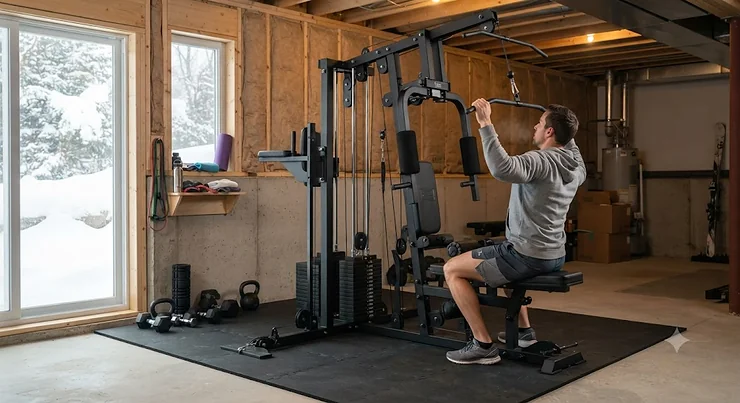
A multi-stack home gym machine is a strength-training station built around two or more independent, pin-loaded weight stacks connected to a shared pulley and cable system, letting one person train unilaterally or two people train side by side without swapping plates. If you’ve ever stood in a cramped spare room trying to decide between a squat rack, a cable tower, and a stack of dumbbells that keeps rolling under the couch, you already know the problem this thing solves. It’s the Swiss Army knife of home strength equipment — one footprint, dozens of exercises, and none of the awkward plate-loading dance that single-stack machines force on you mid-set.
Amazon.ca is flooded with listings that all promise “commercial-grade” quality, and frankly, most of them aren’t lying so much as they’re not telling the whole story. Dual weight stacks range anywhere from a modest 130 lb per side up to a genuinely brutal 220 lb per side, and the difference between a 1:1 and a 2:1 pulley ratio can mean the top pin setting either challenges an advanced lifter or leaves them laughing. This guide walks through seven real, currently available machines — from a no-frills budget trainer to a Smith-machine hybrid that could anchor a small commercial studio — with honest analysis of who each one actually suits, not just a rehash of the spec sheet.
We’ll also dig into how a multi-stack home gym machine stacks up against a single-stack multi-gym, what “strength training variety” really buys you beyond bragging rights, and how to think about home gym expansion if this is just your first serious piece of equipment. Let’s get into it.
Quick Comparison Table: Multi-Stack Home Gym Machines at a Glance
| Machine | Weight Stacks | Pulley Ratio | Best For |
|---|---|---|---|
| Titan Fitness Functional Trainer | Dual 200 lb (10 lb increments) | 2:1 | Best budget entry point |
| REP Fitness Arcadia | Dual 170 lb (upgradeable to 220 lb) | 2:1 | Best fit-and-finish for the price |
| Mikolo ANUBIS 2.0 Ultimate | Dual 175 lb | 2:1 | Best all-in-one with Smith machine |
Even at a glance, the spread here tells a story: the entry point and the flagship differ by roughly C$2,500, but the middle machine isn’t necessarily the compromise pick. The REP Fitness Arcadia punches well above its price bracket on build quality, while the Titan Fitness Functional Trainer wins purely on attachment value for anyone furnishing a first home gym on a tight budget. Cable ratio matters just as much as stack size here — a 2:1 ratio effectively doubles your usable resistance range, which is why several “smaller” stacks on this list actually out-lift bigger 1:1 competitors.
💬 Just one click — help others make better buying decisions too!😊
Top 7 Multi-Stack Home Gym Machines: Expert Analysis
Choosing among multi-stack gym machines for strength training really comes down to matching stack size, pulley ratio, and attachment ecosystem to how you actually plan to train — not just picking whatever has the biggest number on the spec sheet. Here’s how seven real, currently listed machines stack up.
1. Titan Fitness Functional Trainer — most attachments per dollar
Titan built this as a standalone dual-column trainer, and it shows in how much they crammed into the box for the price. You get dual 200 lb weight stacks moving in 10 lb increments at a 2:1 ratio, plus 20 vertical pulley positions for adjusting cable angle up and down the columns.
What that means in practice: 10 lb jumps are fine granularity for compound cable movements like rows and presses, but if you’re doing isolation work like tricep pressdowns, you’ll wish for 5 lb steps sooner than you’d expect. The unit stands 82 inches tall on a 64-by-44-inch base, so it needs real floor space and roughly 7 feet of ceiling clearance — measure your basement before you order, not after.
Based on the spec comparison against pricier trainers on this list, the Titan Fitness Functional Trainer earns its spot through sheer attachment value: a rope handle, single and double D-handles, long and short straight bars, dual short strap handles, and integrated pull-up handles all ship in the box, which is a genuinely generous package most budget competitors charge extra for. Reviewers consistently note that the trolley action isn’t as buttery-smooth as the premium options further down this list, which tracks with the lower price point — you’re trading a bit of glide for a much lower barrier to entry.
Pros:
- ✅ Comes with the largest attachment package at this price point
- ✅ Dual 200 lb stacks outclass many pricier competitors on paper
- ✅ 20 pulley positions cover almost every angle you’d need
Cons:
- ❌ Trolley glide is noticeably less refined than premium trainers
- ❌ Requires a large floor footprint and tall ceiling clearance
Expect the Titan Fitness Functional Trainer to land in the C$1,800-C$2,300 range at the time of research — check current price and availability before buying, as fitness equipment pricing shifts with shipping and exchange rates.
2. Body-Solid Powerline PFT100 — widest pulley swing range
The Powerline by Body-Solid PFT100 leans on a genuinely clever feature: pulleys that swivel through a full 180 degrees, so you’re not stuck locking a handle into one fixed angle before every set.
Standard units ship with dual 160 lb stacks, upgradeable to 210 lb each, adjustable across 20 starting positions with 3.2-inch hole spacing. What that swivel range actually buys you is fluid transitions between exercises like low-to-high cable crossovers and high-to-low wood-choppers without repositioning the whole pulley carriage — a small mechanical detail that saves real time mid-workout.
Here’s what most buyers overlook about a machine like this: the standard 160 lb ceiling is plenty for pressing and pulling movements for most intermediate lifters, but advanced trainees doing heavy lat pulldowns or seated rows may hit the top pin faster than expected, which is exactly why Body-Solid sells the 210 lb upgrade separately rather than bundling it. A knurled chin-up bar and integrated accessory storage round out the frame, and the company backs the PFT100 with a notably long 10-year warranty — a signal of genuine confidence in the welds and bearings, not just marketing copy.
Pros:
- ✅ 180-degree pulley swivel adds real exercise versatility
- ✅ Backed by an unusually long 10-year structural warranty
- ✅ Integrated chin-up bar adds bodyweight training options
Cons:
- ❌ Standard 160 lb stacks may feel light for advanced lifters
- ❌ 210 lb stack upgrade is sold separately, adding to total cost
Price sits in the C$2,000-C$2,700 range depending on whether you add the 210 lb stack upgrade — prices may vary, so confirm the current configuration before purchasing.
3. REP Fitness Arcadia — smoothest trolley feel in its class
REP designed the Arcadia’s trolley system in-house rather than sourcing an off-the-shelf overseas component, and reviewers who’ve put hands on both versions consistently describe the difference as immediately noticeable.
The base REP Fitness Arcadia ships with dual 170 lb stacks at a 2:1 ratio (340 lb total effective resistance), moving in clean 10 lb increments across 32 cable positions, with stainless steel uprights and aluminum pulleys instead of the nylon pulleys common on cheaper trainers. An Arcadia Max upgrade bumps each stack to 220 lb for 440 lb total, plus band pegs on the base and headplate for an additional 540 lb of banded resistance if you really want to chase strength ceilings.
What the spec sheet won’t tell you, but hands-on reviewers note, is how much the aluminum pulleys and reengineered trolley change the actual feel of a set — smooth, low-friction cable travel matters enormously for controlled tempo work, and it’s the kind of quality difference that’s hard to appreciate until you’ve used a cheaper trainer that catches or judders mid-rep. This machine is squarely aimed at buyers who’ve done their research and are willing to pay a premium for finish quality over raw spec-sheet numbers.
Pros:
- ✅ In-house trolley design delivers noticeably smoother cable travel
- ✅ Stainless steel uprights resist wear better than painted steel
- ✅ Upgrade path to 220 lb stacks and banded resistance exists
Cons:
- ❌ Base price sits above several competitors with similar stack sizes
- ❌ Max stack upgrade is a separate purchase, not included standard
The REP Fitness Arcadia runs in the C$2,700-C$3,100 range at base configuration, with the Max stack upgrade adding roughly C$400-C$500 more — check current pricing, as REP adjusts availability by region.
4. Fringe Sport Dane 2.0 — functional trainer built into a half rack
Instead of bolting a cable trainer beside a rack, Fringe Sport folded the two into one four-post structure, so the dual weight stacks sit inside the rack’s footprint rather than sprawling across your floor plan.
The Fringe Sport Dane 2.0 ships with dual 160 lb weight stacks, upgradeable to 220 lb each, moving at a 1:1 cable ratio across 32 cable positions. The rack itself carries a lifetime warranty, with the pulley system backed separately for 5 years — a meaningfully longer commitment than most standalone trainers offer on moving parts.
Based on the spec comparison, the 1:1 ratio here is worth pausing on: unlike the 2:1 trainers elsewhere on this list, pulling 100 lb on the pin genuinely feels like 100 lb, not 50, which some lifters prefer for strength-focused work but which does mean the 160 lb stacks won’t go as “heavy-feeling” as a 2:1 machine with a similar number. Reviewers note the front uprights can be upgraded to stainless steel for smoother trolley travel, and that this combo unit is a strong pick specifically for anyone who was going to buy a squat rack anyway and would rather not also find floor space for a second cable station.
Pros:
- ✅ Combines a half rack and functional trainer in one footprint
- ✅ Lifetime warranty on the rack structure itself
- ✅ 1:1 ratio suits lifters who want true-to-pin resistance
Cons:
- ❌ 1:1 ratio means the top stack setting feels lighter than 2:1 rivals
- ❌ Pricier than most standalone trainers due to the rack combo
Expect a price in the C$3,000-C$3,800 range depending on the stainless steel upright upgrade — availability shifts with import timing, so confirm before ordering.
5. XMARK Functional Trainer — commercial-grade 800 lb build
The moment you unbox the parts for this one, the weight tells the story: this is an 800-pound total machine, considerably heavier than most home-oriented functional trainers, and it carries itself accordingly in a training session.
Dual 200 lb weight stacks at a 2:1 pulley ratio give you up to 400 lb of effective resistance, spread across 19 cable positions for angle adjustment. Here’s what that heft actually buys you in practice: mass translates directly into stability, so heavy compound pulls and presses don’t rock the frame the way lighter-gauge trainers sometimes do under load.
Reviewers consistently describe the build quality as closer to what you’d find in a commercial studio than a typical home unit, which tracks with the steel gauge and overall footprint. The trade-off is exactly what you’d expect — assembly is a bigger project, and you’ll want a helper and a free afternoon, not a rushed Sunday evening. For buyers whose priority is a machine that will still feel rock-solid after five years of heavy daily use, the XMARK Functional Trainer is built for that specific brief rather than for someone optimizing for the smallest possible footprint.
Pros:
- ✅ 800 lb total build delivers exceptional frame stability under load
- ✅ Dual 200 lb stacks at 2:1 ratio give real strength headroom
- ✅ Commercial-grade steel gauge built for years of heavy use
Cons:
- ❌ Substantial weight and footprint make assembly a bigger project
- ❌ Overkill for casual users who won’t approach the top pin settings
The XMARK Functional Trainer typically lands in the C$3,400-C$4,100 range at the time of research — always confirm current price and shipping before purchasing, as freight costs on 800 lb equipment can shift the final number.
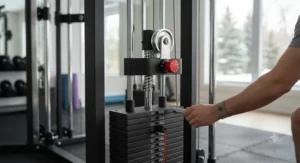
6. Major Fitness B17 Flying Fortress — Smith machine plus dual stacks in one cube
This is the machine for someone who wants to stop buying equipment after this purchase. The Major Fitness B17 Flying Fortress packs a Smith machine, pull-up station, power rack, and dual-stack cable pulleys into a single cube-shaped frame.
Each of the dual 130 lb stacks can be expanded up to 260 lb using built-in selector rods that accept added weight plates — a feature you genuinely don’t see on most functional trainers, where you’re simply stuck once you hit the top factory pin. The pulley ratio switches on the fly between 2:1 and 1:1, which lets one machine serve both “feels heavier for beginners” and “true resistance for advanced lifters” depending on the exercise.
What most buyers overlook about a combo unit like this is the assembly and footprint cost of that versatility: this thing occupies roughly 37 square feet and weighs just under 880 lb fully built, so it’s genuinely a room commitment, not a corner accessory. Reviewers who’ve spent real time on it report the pulleys move well overall, though the switching mechanism between ratios isn’t always the smoothest experience compared to dedicated single-ratio trainers — a reasonable trade-off for a machine trying to do the job of four separate pieces of equipment. The one-year warranty is noticeably shorter than several rivals here, which is worth weighing against how hard you plan to use the Smith machine specifically.
Pros:
- ✅ Smith machine, rack, and dual-stack cables in a single footprint
- ✅ Expandable stacks from 130 lb up to 260 lb per side
- ✅ Switchable 2:1/1:1 ratio adapts to beginner or advanced lifters
Cons:
- ❌ Large 37 sq ft footprint and nearly 880 lb assembled weight
- ❌ One-year warranty is shorter than most competitors on this list
Pricing for the Major Fitness B17 Flying Fortress generally falls in the C$4,100-C$4,800 range given its Smith machine and rack components — prices vary by bundle, so check the current listing configuration carefully.
7. Mikolo ANUBIS 2.0 Ultimate — most decked-out all-in-one on the list
If the B17 is a cube trying to replace a garage gym, the Mikolo ANUBIS 2.0 Ultimate is the version with the deluxe trim package. It bundles a Smith machine, dual weight stacks, and generous built-in storage into a single rack structure, and ships with ten included attachments — D-handles, a lat pulldown bar, a landmine, and more.
The dual 175 lb weight stacks run at a 2:1 pulley ratio through aluminum pulleys, and the rack itself is rated for 1,200 lb on the J-cups with a substantial 2,000 lb rating on the spotter arms. Mikolo uses 12-gauge steel rather than the thicker 11-gauge steel found on some heavy-duty racks — a cost-saving choice that trims the price slightly without gutting the weight capacity numbers.
Based on the spec comparison, the trade-off here is honest and fairly minor: reviewers rate the construction and stability around 4 to 4.5 out of 5, reflecting that thinner steel gauge, though the aluminum pulleys still deliver smooth, steady cable travel that punches above the machine’s price tier. For a household that wants Smith machine squats, dual-stack cable work, and ten attachment options without buying three separate pieces of equipment, this is the most complete single answer on this list — priced accordingly at the top of the range.
Pros:
- ✅ Ships with ten attachments included, not sold separately
- ✅ Spotter arms rated to a substantial 2,000 lb capacity
- ✅ Aluminum pulleys deliver smooth cable travel despite thinner steel
Cons:
- ❌ 12-gauge steel is thinner than some heavy-duty competitor racks
- ❌ Sits at the top of this list’s price range
The Mikolo ANUBIS 2.0 Ultimate generally lands in the C$4,200-C$5,000 range at the time of research — given the attachment count and Smith machine functionality, confirm current pricing and any bundle promotions before buying.
Practical Usage Guide: Setting Up and Maintaining Your Multi-Stack Home Gym Machine
Getting a multi-stack home gym machine from cardboard box to first working set is a bigger job than most listings let on — budget a full afternoon and a second set of hands for anything over 400 lb of total weight stack, since bolting the columns plumb to each other is fiddly solo work. Once assembled, check that both weight stacks travel freely through their full range before loading any real weight; a sticking pin or a cable that’s routed over instead of through a pulley groove is far easier to fix on day one than after three weeks of use.
For maintenance, a light coat of white lithium grease on the guide rods every 60-90 days keeps stack travel smooth, and it’s worth inspecting cable-to-pulley alignment monthly since a cable riding slightly off-groove will fray faster than most owners expect. The single most common first-30-days mistake is overtightening the frame bolts before fully squaring the uprights — snug everything loosely first, stand back and eyeball the frame for square, then torque down for good. Reviewers across nearly every model in this guide mention that a five-minute post-assembly “wiggle test” — pushing on each column to check for play — catches loose hardware before it becomes a mid-set surprise.
✨ Ready to Build Your Setup? Take a look at the full lineup above, click through on the model that fits your space, and check current pricing before it changes.
Real-World Scenarios: Who Actually Needs a Multi-Stack Home Gym Machine
Picture a couple sharing a basement gym on opposite schedules — one lifts at 6 a.m., the other after the kids are in bed. A dual-stack setup like the REP Fitness Arcadia means neither person has to reload plates the other left behind; each stack holds its own pin position independently, which single-stack multi-gyms simply can’t offer.
Now picture a college student in a small apartment who wants one machine to replace a home gym’s worth of dumbbells. The Titan Fitness Functional Trainer or Body-Solid PFT100 covers presses, rows, curls, and pulldowns in one compact footprint, at a price point that still beats furnishing a full rack-and-dumbbell setup from scratch. And picture a household treating this as the last major equipment purchase for years — that’s the buyer the Mikolo ANUBIS 2.0 Ultimate or Major Fitness B17 Flying Fortress is actually built for, since the Smith machine and rack functionality remove the need to ever add a squat station separately.
Home Gym Expansion: Building Around a Multi-Stack Machine
If you already own a bench, a few dumbbells, or a basic power rack, adding a multi-stack home gym machine is usually the single highest-impact expansion move available, since it replaces an entire category of isolation and cable exercises in one purchase. If floor space is your real constraint, choose a rack-combo unit like the Fringe Sport Dane 2.0 so the cable station shares a footprint with equipment you’d need anyway rather than adding a second standalone structure. If your household includes more than one lifter, prioritize a genuine dual-independent-stack design over a single-stack multi-gym so training schedules never collide. And if budget forces a phased approach, buying a trainer with an upgrade path — like the REP Fitness Arcadia‘s Max stack option — lets you start lighter and add resistance later without replacing the whole machine.
Multi-Stack Gym Machines for Strength Training: What Sets Them Apart
The core advantage of multi-stack gym machines for strength training isn’t really about the weight numbers — it’s about training continuity. On a single-stack machine, switching from a row to a chest press means physically re-pinning the same stack, which breaks up supersets and forces rest between exercises that programming often doesn’t call for. With two independent stacks, you can superset a pulling movement on one side against a pushing movement on the other without touching a single pin.
Reviewers across nearly every dual-stack machine in this guide note that this independence also matters for unilateral training — single-arm rows, split-stance presses, and anti-rotation core work all benefit from a cable that isn’t tethered to whatever weight the opposite side happens to be set at. For anyone whose programming leans on supersets, circuits, or unilateral corrective work, this single structural difference outweighs almost every other spec on the page.
Multi-Stack Machine vs Single Stack Multi-Gym: Which Is Right for You?
A multi-stack machine vs single stack multi-gym decision usually comes down to how many people train and how varied your programming is. Single-stack multi-gyms — the classic all-in-one units with one weight stack feeding a leg press, lat pulldown, and chest press station — are typically cheaper and more compact, and they suit a single user running a fairly fixed routine.
| Factor | Multi-Stack Machine | Single-Stack Multi-Gym |
|---|---|---|
| Simultaneous users | Two people can train independently | One person at a time |
| Superset flexibility | High — both sides load separately | Low — one stack, one exercise at a time |
| Typical footprint | Larger, often 60-85 sq ft | Smaller, often 30-45 sq ft |
| Best For | Households, serious lifters, varied programming | Solo users, tighter budgets, fixed routines |
Looking at the comparison above, a single-stack multi-gym still makes sense for a solo lifter with a small space and a straightforward routine of presses, pulldowns, and leg extensions. But the moment a second person joins the household routine, or your programming starts leaning on supersets and unilateral work, a true dual-stack machine like the REP Fitness Arcadia or XMARK Functional Trainer earns back its extra footprint and cost fairly quickly.
Multi-Station Home Gym Setups: Space, Layout and Family Use
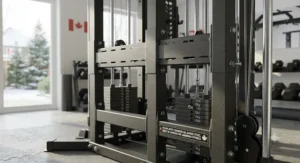
A multi-station home gym built around a dual-stack trainer works best when the machine sits against a wall with at least 3 feet of clearance on the open side for cable pulls and lateral movements. For family use, look specifically at models with a wide range of pulley height positions — the Body-Solid PFT100‘s 20 starting positions and the REP Fitness Arcadia‘s 32 cable positions both make it realistic for a taller adult and a shorter teenager to share the same machine without constantly re-adjusting the whole frame.
Ceiling height deserves a second mention here: most functional trainers in this guide run 80-90 inches tall, so a basement with ductwork or a dropped ceiling under 7.5 feet may rule out several of these models before price even enters the conversation. Measuring the space honestly before shopping saves a return shipment nobody wants to deal with on 800 lb of steel.
How to Choose a Multi-Stack Home Gym Machine
- Confirm your ceiling height first. Most models need 7-7.5 feet of clearance; measure before you fall in love with a spec sheet.
- Match stack weight to your actual strength level, not your aspirational one — a 200 lb stack at 2:1 ratio outlifts a 260 lb stack at 1:1.
- Check the pulley ratio, since 2:1 machines feel roughly half as heavy on the pin as 1:1 machines at the same stack number.
- Count included attachments, because handles, bars, and ropes sold separately can add C$150-C$300 to your real total cost.
- Read the warranty terms carefully — structural frame warranties and pulley/cable warranties are often listed separately.
- Decide if you need a Smith machine or rack combo now, since retrofitting one later usually means buying a whole second unit.
- Factor in assembly help — anything over 600 lb total realistically needs two people for a safe, accurate build.
Common Mistakes When Buying a Multi-Stack Home Gym Machine
The most frequent mistake buyers make is sizing the weight stack around their current strength rather than where they’ll be in 12-18 months, which leads to hitting the top pin and needing an upgrade sooner than expected. A close second is ignoring pulley ratio entirely and comparing stack numbers head-to-head, which is a bit like comparing car prices without checking whether they include the engine — a 175 lb stack at 2:1 can out-resist a 220 lb stack at 1:1 depending on the exercise. Buyers also commonly underestimate footprint, measuring the machine’s stated base dimensions but forgetting to add clearance for cable pulls and trolley travel on both sides. Finally, skipping the warranty fine print is a quiet but costly error — some listings separate frame warranty from pulley and cable warranty, and the latter is what actually wears out first under regular use.
Strength Training Variety: Why It Matters More Than You Think
Strength training variety isn’t just about staving off boredom, though that’s a real factor in long-term adherence. Varying cable angles, grip widths, and unilateral versus bilateral movements changes which stabilizer muscles get recruited on otherwise “the same” exercise, which is part of why a 32-position trainer like the REP Fitness Arcadia offers more genuine training value than its stack size alone suggests. Reviewers consistently note that machines with more pulley height options get used more creatively over time, simply because the friction of re-angling a cable is lower than digging out a different attachment or piece of equipment entirely.
There’s also a practical injury-management angle here: swapping a barbell-only pressing routine for cable variations on a functional trainer can reduce joint stress during recovery periods while keeping training volume roughly intact, which is one reason physiotherapists and strength coaches often recommend cable stations for clients working around minor shoulder or elbow issues.
Long-Term Cost & Maintenance
Sticker price is only part of the real cost of ownership here. Replacement cables typically run C$40-C$80 per side when they eventually fray, and most dual-stack machines will need at least one cable replacement over a decade of regular use. Attachment ecosystems matter too — machines like the Titan Fitness Functional Trainer or Mikolo ANUBIS 2.0 Ultimate that ship with a full handle and bar set avoid the creeping C$20-C$40-per-attachment costs that thinner packages force onto owners later.
Weighed against a comparable commercial gym membership — often C$50-C$70 per month in many Canadian cities — even a C$4,000 premium machine breaks even against five to six years of membership fees, before accounting for commute time or the simple convenience of training on your own schedule. For households of two or more lifters splitting that cost, the payback period shortens considerably.
Safety, Certification, and Compliance Guide
Because most multi-stack home gym machines are purely mechanical — no motor, no plug — they generally fall outside Canada’s electrical certification requirements that apply to powered fitness equipment. Still, it’s worth knowing what those marks mean: for any electrical fitness gear you do buy, Health Canada advises checking for a CSA, cUL, or cETL certification mark before purchase, since uncertified electrical products aren’t assessed against Canadian national safety standards. On the mechanical side, look for stated weight capacities on J-cups, spotter arms, and pull-up bars rather than assuming — reputable manufacturers publish these numbers precisely because a rack or trainer’s structural rating matters as much as its weight stack size.
Beyond the equipment itself, it’s worth grounding your training plan in something evidence-based. ParticipACTION’s guidance on Canada’s 24-Hour Movement Guidelines recommends muscle-strengthening activity at least twice a week for adults — a target any of the seven machines above can comfortably support, whether you’re training solo or sharing the stack with a partner.
Frequently Asked Questions
❓ What is a multi-stack home gym machine used for?
❓ Is a multi-stack machine better than a single stack multi-gym?
❓ How much floor space does a multi-station home gym need?
❓ Can two people use a multi-stack home gym machine at once?
❓ What weight stack size is enough for strength training variety?
Conclusion
Seven machines, one clear takeaway: the “best” multi-stack home gym machine depends far more on your ceiling height, your household size, and your programming style than on chasing the single biggest stack number on a spec sheet. Budget-conscious buyers furnishing a first home gym will get outsized value from the Titan Fitness Functional Trainer‘s attachment package, while anyone who wants to stop shopping for equipment entirely should seriously weigh the Mikolo ANUBIS 2.0 Ultimate or Major Fitness B17 Flying Fortress and their built-in Smith machines. For most households landing in the middle, the REP Fitness Arcadia offers the rare combination of genuinely smooth engineering and a sane footprint, with an upgrade path if your strength outgrows the base stacks.
Whatever you land on, measure your space honestly, budget for attachments the listing doesn’t include, and remember that price ranges shift — always confirm current pricing on amazon.ca before you commit. This article contains affiliate links, and as an Amazon Associate, purchases made through them support this site at no extra cost to you.
Recommended for You
- Commercial Multi-Gym for Small Gym Business: 7 Picks (2026)
- Single Stack Home Gyms: 7 Best Picks for Canadian Homes (2026)
- Cable Row Handles 2026: 7 Picks That Won’t Wreck Your Wrists
Disclaimer: This article contains affiliate links. As an Amazon Associate, I earn from qualifying purchases. If you purchase products through these links, we may earn a small commission at no additional cost to you.
✨ Found this helpful? Share it with your friends! 💬🤗
