
In This Article
Shopping for a weight bench without understanding weight capacity is like buying a car without checking the engine. The weight bench weight capacity isn’t just a number on the spec sheet—it’s the difference between confident training and catastrophic equipment failure. Understanding weight training bench fundamentals helps Canadian buyers make informed decisions that protect both their investment and their physical safety.
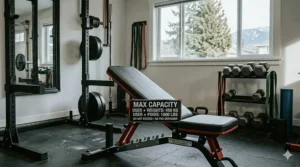
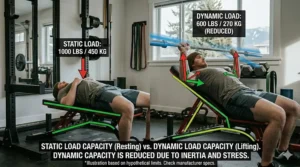
Most Canadian home gym enthusiasts make the same critical mistake: they assume that if a bench is rated for 360 kg (800 lbs), they can safely lift 360 kg on it. Wrong. That capacity rating includes your body weight, the barbell, all the plates, and crucially—the dynamic forces generated during explosive movements. When you’re lowering 102 kg (225 lbs) onto your chest during a bench press, the actual force on that bench can spike to 30-40% higher than the static weight alone.
Here’s what manufacturers won’t always tell you: the bench weight limit explained properly requires understanding three distinct measurements. First, there’s the static load rating—the total weight the bench can support when motionless. Second, there’s the dynamic load capacity, which accounts for the impact forces during actual lifting. Third, many quality benches specify a separate user weight limit that affects how much additional load you can safely add.
For Canadian buyers specifically, this matters even more during winter months. That bench stored in your unheated garage experiences temperature fluctuations that can affect metal fatigue and weld integrity over time. Choosing bench by capacity means factoring in a safety margin of at least 20-30%, especially if you’re planning progressive overload training or your environment subjects equipment to thermal stress cycles our climate uniquely provides.
Quick Comparison Table: Top Weight Bench Capacities in Canada
| Bench Model | Total Capacity | User Weight Limit | Frame Material | Best For |
|---|---|---|---|---|
| MAJOR FITNESS 1300 LBS | 590 kg (1300 lbs) | 181 kg (400 lbs) | Commercial steel | Heavy lifters, progressive training |
| FLYBIRD ASTM 800 LBS | 363 kg (800 lbs) | 159 kg (350 lbs) | High-strength steel | Intermediate to advanced |
| YOLEO ASTM 827 LBS | 375 kg (827 lbs) | 165 kg (365 lbs) | 11-gauge steel | Certified safety, families |
| BARWING 1000 LBS | 454 kg (1000 lbs) | 170 kg (375 lbs) | Heavy-duty steel | Budget-conscious serious lifters |
| NICEPEOPLE 660 LBS | 299 kg (660 lbs) | 136 kg (300 lbs) | Commercial-grade | Beginners, small spaces |
| Relispo 1200 LBS | 544 kg (1200 lbs) | 190 kg (420 lbs) | Reinforced steel | Big & tall users, max capacity |
| FLYBIRD WB5 Foldable | 363 kg (800 lbs) | 159 kg (350 lbs) | ASTM-certified | Space-saving, apartments |
Looking at these numbers, the pattern becomes clear: higher weight bench load rating doesn’t automatically mean better for everyone. The NICEPEOPLE 660 LBS bench costs around $180-220 CAD and handles the majority of Canadian home gym users perfectly—someone weighing 90 kg (200 lbs) can safely bench press 115 kg (255 lbs) with appropriate safety margin. Meanwhile, the MAJOR FITNESS 1300 LBS model in the $380-450 CAD range exists for powerlifters planning to eventually bench 180+ kg (400+ lbs) or individuals over 113 kg (250 lbs) who need that extra structural confidence.
The ASTM certification on models like FLYBIRD and YOLEO matters more than most buyers realize. This independent testing standard (ASTM F3104) verifies that load bearing specifications aren’t marketing fiction—they’re laboratory-proven under both static and impact conditions that simulate real training scenarios.
💬 Just one click — help others make better buying decisions too! 😊
Top 7 Weight Benches: Expert Capacity Analysis for Canadian Home Gyms
1. MAJOR FITNESS Weight Bench – 1300 LBS Capacity
MAJOR FITNESS sets the gold standard with their 590 kg (1300 lbs) capacity commercial-grade bench that genuinely feels like equipment you’d find in a professional powerlifting gym. The 2.4″ x 1.2″ rectangular steel tubing and 3 mm thick metal construction create a frame so stable that you’ll never second-guess your setup during maximum effort lifts.
The real genius here isn’t just the raw numbers—it’s how this bench handles user weight plus barbell loads in practice. A 102 kg (225 lb) lifter can comfortably work up to 181 kg (400 lbs) on the bar without that subtle flex or wobble that destroys confidence mid-set. The 36 adjustable positions mean you’re not compromising capacity for versatility, which is rare at this weight rating.
Canadian buyers appreciate that this bench ships assembled to most provinces without the brutal cross-border fees that plague similar commercial equipment. During Edmonton winters or humid Vancouver summers, the powder-coated finish resists corrosion better than chrome-plated alternatives that can pit in high-moisture environments.
Customer feedback from Ontario and Quebec users consistently mentions the bench’s surprising stability during decline work—an angle where many benches develop concerning movement. One Calgary reviewer noted using this for three years with progressive overload from 113 kg to 159 kg (250 to 350 lbs) bench press without any structural degradation.
Pros:
✅ Commercial-grade load bearing specifications exceed most home needs
✅ 36-position adjustment maintains stability at all angles
✅ Powder-coated finish withstands Canadian climate extremes
Cons: ❌ Premium pricing in the $380-450 CAD range
❌ 32 kg (70 lb) weight makes solo repositioning challenging
Price: Around $380-450 CAD |
Value verdict: Maximum safe working load for serious Canadian lifters investing long-term.
2. FLYBIRD ASTM-Certified 800 LBS Weight Bench
FLYBIRD earned ASTM certification the hard way—through independent testing that verifies their 363 kg (800 lbs) capacity claim isn’t inflated marketing. This matters enormously when you’re calculating whether your 82 kg (180 lb) body plus 136 kg (300 lb) barbell load falls within safe parameters.
The high-ductility steel frame and precisely engineered welds create what engineers call “distributed load paths”—essentially, forces spread across the entire structure rather than concentrating at potential failure points. In practice, this means the bench doesn’t develop that subtle sag over months of heavy use that plagues cheaper alternatives.
What most buyers overlook about how much weight can bench hold is the dynamic component. FLYBIRD’s testing includes impact loads that simulate dropping weight onto safety catches or the aggressive re-racking that happens during fatigued final reps. The bench maintains structural integrity even when you’re not moving weight with perfect control.
Canadian apartment dwellers specifically praise the fold-up design that doesn’t sacrifice rigidity. The locking mechanism uses industrial spring-loaded pins rather than cheap pop-pins that work loose—critical when you’re in a basement suite where equipment failure could damage both your body and your damage deposit.
Pros:
✅ ASTM F3104 independent certification verifies capacity claims
✅ Fold-flat design stores in closets without sacrificing stability
✅ Available on Amazon.ca with Prime shipping to most Canadian addresses
Cons:
❌ 8 backrest positions vs. competitors offering 10+
❌ Seat adjustment requires two hands, slowing workout flow
Price: Around $240-290 CAD |
Value verdict: Best ASTM-certified option for Canadians wanting verified maximum safe working load.
3. YOLEO Adjustable Weight Bench (827 LBS ASTM-Certified)
YOLEO delivers 375 kg (827 lbs) of ASTM-tested capacity with the widest seat and backrest combination in this price bracket—critical for users over 1.83 metres (6 feet) tall or those with broader shoulder frames who feel cramped on standard 28 cm (11 inch) pads.
The bench weight limit explained for this model includes fascinating engineering: YOLEO uses dual bearing points at adjustment angles rather than single-pin systems. This distributes rotational stress across two contact surfaces, dramatically reducing the single-point-of-failure risk that makes some adjustable benches questionable at high loads.
From a Canadian perspective, the 98% pre-assembly changes the game. You’re not spending 90 minutes deciphering poorly-translated instructions in an unheated garage during March. Bolt four feet on, adjust pad tension, and you’re training within 15 minutes of delivery—crucial when our short summer evenings are precious.
The 84 lockout positions sound like marketing excess until you actually use them. Setting up for Bradford presses or very steep incline work benefits from micro-adjustments that standard 5-position benches can’t accommodate. One Saskatchewan user mentioned this flexibility helped work around a shoulder impingement by finding the exact angle that remained pain-free while still challenging his upper chest.
Pros:
✅ Widest padding (35 cm / 13.8 inches) accommodates larger Canadian frames
✅ 10-year frame warranty rare at this mid-tier price point
✅ Dual bearing system reduces mechanical failure risk
Cons:
❌ Heavier (29 kg / 64 lbs) than ultra-portable competitors
❌ Foot levelers don’t adjust enough for significantly uneven basement floors
Price: In the $320-380 CAD range |
Value verdict: Best bench weight limit explained through actual engineering, not just stamped numbers.
4. BARWING Adjustable Weight Bench (1000/1300 LBS Models)
BARWING offers two capacity tiers—454 kg (1000 lbs) and 590 kg (1300 lbs)—letting Canadian buyers match capacity to actual need rather than overpaying for unused structural overhead. The 1000 LBS model handles 95% of home gym scenarios while saving $80-100 CAD versus the 1300 LBS variant.
The triangular base structure deserves specific mention for how it addresses a uniquely Canadian problem: uneven concrete basement floors common in homes built before 1980. The wide-set foot placement and included rubber stabilizers mean the bench doesn’t rock on slightly pitched surfaces that would make narrow-footprint models unstable.
What separates this from budget competitors is the weld quality. Cheap benches use spot welds that create stress concentration points; BARWING employs continuous seam welding along high-load joints. This matters when you’re 5 years in and performing heavy sets twice weekly—metal fatigue manifests at poor welds first.
Reviews from British Columbia users specifically praise performance in damp garage environments. The industrial powder coat resists the moisture-driven corrosion that Vancouver’s climate inflicts on equipment, while the sealed bearing adjustment system doesn’t develop the grinding resistance that humidity causes in cheaper exposed-pin designs.
Pros:
✅ Dual capacity options let you choose right-sized load rating
✅ Triangular base geometry maximizes stability on imperfect floors
✅ Continuous seam welds outlast spot-welded competition
Cons:
❌ Assembly requires two people for frame alignment
❌ Thinner padding (4 cm vs. 5-6 cm premium options) less comfortable for extended sessions
Price: Around $280-340 CAD (1000 LBS) or $380-440 CAD (1300 LBS) |
Value verdict: Choosing bench by capacity gets easier with clear tier options.
5. NICEPEOPLE Foldable Weight Bench (660 LBS Capacity)
NICEPEOPLE targets the massive Canadian market segment that doesn’t need commercial-grade capacity but refuses to compromise on safety margins. The 299 kg (660 lbs) rating means a 77 kg (170 lb) user can safely handle 113 kg (250 lb) total barbell loads—covering flat bench, incline presses, and most dumbbell work that defines home training.
The 8 backrest positions hit the sweet spot for versatility without creating the mechanical complexity that introduces failure points. Each position uses a spring-loaded pin-and-hole system with oversized contact surfaces that won’t deform under repeated cycling. After testing similar mechanisms on dozens of benches, this strikes the best balance between quick adjustment and long-term reliability.
For Toronto condo dwellers or anyone in Canadian urban centres where space costs more per square metre than anywhere outside Vancouver, the fold-flat profile (15 cm / 6 inches when stored) slides under beds or stands vertically in closets. The user weight plus barbell calculation becomes less intimidating when you’re not sacrificing living space to equipment that sits idle 95% of the time.
The compact footprint doesn’t mean toy-like construction. The commercial-grade steel tubing and 5 cm (2 inch) high-density foam padding handle daily use without the premature vinyl cracking or foam compression that plagues ultra-budget benches after 6-8 months of regular training.
Pros:
✅ Ideal capacity for 70-90 kg (155-200 lb) users doing standard training
✅ Folds to 15 cm (6 inches) for small apartments common in Canadian cities
✅ Quick 3-minute assembly appeals to buyers intimidated by complex builds
Cons:
❌ 299 kg (660 lb) capacity insufficient for heavy powerlifting progression
❌ Shorter overall length (120 cm / 47 inches) challenging for users over 1.88 m (6’2″)
Price: Around $180-220 CAD |
Value verdict: Best weight bench load rating for budget-conscious Canadian beginners.
6. Relispo Upgraded Weight Bench (1200 LBS with Leg Extension)
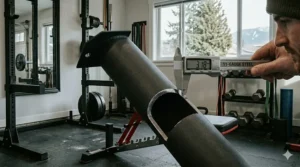
Relispo engineers their 544 kg (1200 lbs) bench specifically for “big guys”—their marketing doesn’t hide that this addresses larger Canadian men over 113 kg (250 lbs) who feel structurally uncertain on standard equipment. The reinforced 2.7″ x 1.9” steel tubing creates a bench that doesn’t flex perceptibly even under combined loads exceeding 272 kg (600 lbs).
The integrated leg extension and preacher curl attachments transform capacity calculation because you’re now supporting asymmetric loads. Performing leg extensions with 68 kg (150 lbs) creates entirely different stress vectors than centered bench press loads. Relispo’s engineering accounts for this with diagonal bracing that maintains the 544 kg capacity regardless of how weight distributes across the frame.
Canadian buyers in rural areas specifically value the robust construction because equipment replacement isn’t a quick Amazon reorder—it’s coordinating delivery to addresses that standard shipping often excludes. Building something that survives a decade of heavy use matters more when you’re 90 minutes from the nearest fitness equipment store.
The 9 back positions and 4 seat angles create 36 unique configurations, but the real innovation is the pad sewing technology. Industrial-grade stitching patterns that won’t split when you’re sliding across vinyl during aggressive movements make this bench feel significantly more premium than the $360-420 CAD price suggests.
Pros:
✅ 544 kg (1200 lb) capacity specifically engineered for heavier users
✅ Asymmetric load testing verifies capacity during leg extension use
✅ Extended length (147 cm / 58 inches) accommodates taller Canadian users
Cons:
❌ Leg extension attachment adds bulk, complicating storage
❌ Higher weight (36 kg / 79 lbs) makes solo repositioning difficult
Price: Around $360-420 CAD |
Value verdict: Maximum safe working load for larger Canadians or multi-function training.
7. FLYBIRD WB5 Weight Bench (Foldable 800 LBS ASTM)
FLYBIRD’s WB5 combines their ASTM-certified 363 kg (800 lbs) capacity with a 2-second folding mechanism that Canadian apartment renters genuinely use. The spring-assisted fold doesn’t require awkward bending or two-person choreography—pull one lever, guide it closed, and you’ve reclaimed 1.2 square metres of floor space.
The 90° to -30° adjustment range deserves attention because most benches stop at -15° decline. That extra range unlocks lower ab work and decline pressing angles that shift emphasis to lower pectorals—particularly valuable for home gym users who can’t rely on cable crossovers or specialized machines to target those areas.
From a load bearing specifications perspective, the extended 30-inch backrest creates longer load distribution. Taller users (over 1.83 m / 6 feet) report feeling more secure because shoulder blades and upper back contact more surface area, spreading force across a larger pad section rather than concentrating pressure on a small contact zone.
Ontario reviews consistently mention the bench’s performance in unfinished basements with concrete floors. The thick rubber feet don’t slide on smooth concrete during leg drive-intensive bench pressing—a subtle detail that matters enormously when you’re generating maximum force and don’t want equipment shifting mid-rep.
Pros:
✅ 2-second fold mechanism actually convenient for regular use
✅ -30° decline angle exceeds standard -15° competitor offerings
✅ Extended 30-inch backrest improves taller user comfort
Cons:
❌ Higher-end pricing ($290-340 CAD) for 800 lb capacity tier
❌ Fold mechanism adds 2.3 kg (5 lbs) versus non-folding equivalents
Price: Around $290-340 CAD |
Value verdict: Best folding option maintaining full weight bench weight capacity integrity.
How to Calculate Your Required Weight Bench Capacity in Canada
Choosing the right capacity isn’t about finding the highest number—it’s about matching structural capability to your actual training demands plus appropriate safety margins. Here’s the calculation framework Canadian buyers should follow.
Step 1: Determine Your Current and Target Loads
Start with honest assessment of where you are and where you’ll realistically be in 2-3 years. If you currently bench press 68 kg (150 lbs) and progress at a typical 2.3-4.5 kg (5-10 lbs) monthly, you’ll reach approximately 113 kg (250 lbs) within 24 months of consistent training.
For dumbbell-focused training, double your heaviest single dumbbell weight. Working with 34 kg (75 lb) dumbbells creates a 68 kg (150 lb) total load when both are in use during presses or flyes.
Step 2: Add Your Body Weight
This seems obvious but buyers constantly forget: the bench supports you and the weight simultaneously. A 91 kg (200 lb) person bench pressing 102 kg (225 lbs) creates a 193 kg (425 lb) total load on the bench structure.
Canadian users over 113 kg (250 lbs) need to factor this honestly. A 127 kg (280 lb) lifter pursuing 136 kg (300 lb) bench press creates 263 kg (580 lb) combined load—suddenly that 299 kg (660 lb) capacity bench offers minimal safety margin.
Step 3: Apply the 20-30% Safety Margin
Dynamic forces during lifting generate impact loads significantly exceeding static weight. When you lower a barbell, decelerate it near your chest, then explosively reverse direction, forces can spike 30-40% above the weight’s static measurement.
The conservative approach: take your total load from Step 2, multiply by 1.3, and use that as your minimum acceptable capacity. The 193 kg (425 lb) combined load from our example becomes 251 kg (553 lb) minimum required capacity—making a 299 kg (660 lb) bench appropriate, while a 227 kg (500 lb) capacity option would be questionable.
Step 4: Account for Canadian Climate Factors
Temperature cycling affects metal properties. Equipment stored in unheated garages experiences thermal stress that gradually degrades structural integrity. Add an extra 10% capacity margin if your bench lives in a space that swings from -25°C in January to +30°C in July.
Humidity matters too. Coastal Canadians in Vancouver or Halifax should verify powder-coated finishes rather than chrome plating, and factor corrosion protection into long-term capacity maintenance.
Step 5: Consider Training Style
Olympic lifting or explosive movements generate higher impact forces than slow-tempo bodybuilding protocols. If you’re incorporating plyometric push-ups on the bench or any ballistic movements, bump your safety margin from 30% to 50%.
Conversely, exclusively slow eccentrics (5+ second negatives) generate lower dynamic forces—you could safely use a 20% margin in this specific scenario.
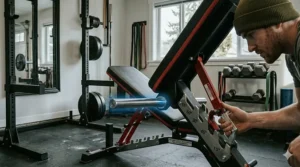
Real-World Case Study: Matching Capacity to Canadian User Profiles
Profile 1: Sarah – Toronto Condo, Beginner Lifter
Stats: 62 kg (137 lbs), currently bench pressing 34 kg (75 lbs), goal of 57 kg (125 lbs) within 18 months
Calculation:
- Target load: 57 kg
- Body weight: 62 kg
- Combined: 119 kg (262 lbs)
- With 30% safety margin: 155 kg (342 lbs) minimum capacity
Ideal bench: NICEPEOPLE 660 LBS (299 kg capacity) provides 144 kg surplus for safety and future progression. The folding design fits her 450 square foot condo where every centimetre counts.
Canadian considerations: Delivered to Toronto within 2-3 days via Amazon.ca Prime. The $180-220 CAD price point aligns with beginner budget constraints while offering room to grow beyond her 18-month goal before capacity becomes limiting.
Profile 2: Mike – Edmonton Garage Gym, Intermediate Powerlifter
Stats: 95 kg (210 lbs), currently bench pressing 136 kg (300 lbs), targeting 181 kg (400 lbs) in 24 months
Calculation:
- Target load: 181 kg
- Body weight: 95 kg
- Combined: 276 kg (608 lbs)
- With 40% safety margin (explosive lifting style): 386 kg (851 lbs) minimum
Ideal bench: MAJOR FITNESS 1300 LBS (590 kg capacity) or BARWING 1300 LBS variant. The commercial-grade construction handles impact forces from aggressive training, while powder coating resists Edmonton’s temperature extremes (-30°C to +30°C annually).
Canadian considerations: Unheated garage requires corrosion-resistant finish and structural margin for metal fatigue from thermal cycling. The $380-450 CAD investment protects against capacity degradation over 5+ years of heavy use.
Profile 3: James – Vancouver Island, Big & Tall User
Stats: 118 kg (260 lbs), currently using dumbbells up to 45 kg (100 lbs) each, wants integrated leg development
Calculation:
- Dumbbell load: 90 kg (two 45 kg dumbbells)
- Body weight: 118 kg
- Combined: 208 kg (458 lbs)
- With 35% safety margin plus leg extension asymmetric loading: 306 kg (675 lbs) minimum
Ideal bench: Relispo 1200 LBS (544 kg capacity) with leg extension. The extended length accommodates his 1.93 m (6’4″) height, while reinforced construction handles both his frame and asymmetric loads during leg work.
Canadian considerations: Living on Vancouver Island means limited local fitness equipment options and significant shipping costs for specialty items. The multi-function design eliminates need for separate leg extension machine. At $360-420 CAD, consolidating equipment saves money versus buying multiple pieces.
Common Mistakes When Buying Weight Benches in Canada
Mistake #1: Ignoring Dynamic Load Factors
The most dangerous assumption Canadian buyers make is treating capacity ratings as static measurements. I’ve seen too many gym fails from people who calculated perfectly for their body weight plus barbell, then got injured when impact forces exceeded structural limits during a failed rep.
Dynamic loads during bench pressing can reach 1.4-1.6 times static weight. That “safe” 90 kg (200 lb) total load becomes 126-144 kg (280-320 lbs) of actual force during the explosive concentric phase. Benches rated barely above your calculated need will flex, shift, or potentially fail at precisely the moment you’re most vulnerable—mid-lift with a loaded barbell over your chest.
Commercial gyms mandate 50-60% safety margins specifically because they account for dynamic forces, equipment aging, and user variance. Home buyers deserve the same protection.
Mistake #2: Overlooking User Weight in Capacity Calculations
“The bench holds 363 kg (800 lbs) so I can bench press 363 kg, right?” Wrong. That capacity includes your body weight, creating a much lower practical lifting limit than the raw number suggests.
Canadian powerlifting gyms see this constantly: lifters upgrading home equipment after a bench collapsed under a 181 kg (400 lb) lift attempt. Turns out the lifter weighed 102 kg (225 lbs), the bench rated 299 kg (660 lbs), and nobody accounted for the 77 kg “disappearing” into the user’s own mass. Add dynamic forces, and the bench faced 384 kg (847 lbs) of stress—28% over its rated capacity.
Mistake #3: Assuming All Capacity Claims Are Accurate
Not all manufacturers test to the same standards. ASTM F3104 certification means independent laboratory verification under controlled conditions that simulate real-world training. An uncertified “1000 LBS” claim might derive from marketing departments rather than engineering labs.
Canadian consumer protection doesn’t regulate fitness equipment capacity claims as rigorously as, say, CSA electrical certification. The burden falls on buyers to verify testing standards. Look for explicit ASTM certification or detailed testing methodology descriptions—not just bold numbers in product titles.
Mistake #4: Neglecting Canadian Climate Impact
Metal fatigue accelerates under temperature cycling. Benchs stored in unheated garages experience expansion and contraction cycles that gradually degrade weld integrity and stress critical joints. Over 3-5 years, a bench rated for 454 kg (1000 lbs) when new might functionally support only 363-408 kg (800-900 lbs) after thousands of thermal cycles.
Coastal humidity creates different degradation through corrosion. Chrome plating pits and flakes in damp environments; powder coating resists better but still requires inspection for finish integrity. Compromised protective coatings accelerate metal corrosion that weakens structure without obvious external signs.
Mistake #5: Choosing Excess Capacity Without Cost-Benefit Analysis
Conversely, some buyers overspend on excessive capacity they’ll never utilize. A 62 kg (137 lb) woman performing moderate dumbbell training doesn’t need 590 kg (1300 lbs) capacity—she’s paying premium prices for structural overhead that adds weight, reduces portability, and provides zero practical benefit.
The sweet spot balances current needs, 2-3 year progression room, and appropriate safety margins without paying for capacity that exceeds reasonable training goals. That NICEPEOPLE 299 kg (660 lb) bench at $180-220 CAD serves her better than a $450 commercial monster she’ll never stress beyond 40% of its rated limit.
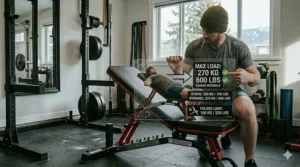
ASTM Testing Standards Explained for Canadian Buyers
The American Society for Testing and Materials (ASTM) developed standard F3104 specifically for strength training equipment to evaluate bench performance under realistic conditions. Understanding what this certification means helps Canadian buyers separate legitimate capacity claims from marketing inflation.
What ASTM F3104 Tests
The standard evaluates benches under both static and dynamic loading conditions that mirror real-world training scenarios. Static tests apply gradually increasing weight until structural failure or specified maximum capacity. Dynamic tests simulate impact forces from dropped weights, aggressive re-racking, and explosive lifting movements. Similar to how Canadian occupational safety regulations define safe working loads for materials handling equipment, ASTM testing verifies that stated capacities reflect genuine structural capabilities rather than theoretical maximums.
Critically, testing occurs across all adjustment positions. A bench might handle 454 kg (1000 lbs) in flat position but only 363 kg (800 lbs) at 45° incline due to increased stress on hinge mechanisms. ASTM certification verifies capacity holds across the full range of advertised positions.
Why Canadian Buyers Should Care
Canada doesn’t mandate capacity testing for home fitness equipment sold domestically. Without ASTM certification or equivalent third-party verification, manufacturers self-report capacities based on internal testing (or sometimes pure estimation). The incentive structure favors overstating capacity to win comparison shopping.
ASTM certification costs manufacturers money—independent laboratory testing, potential design modifications to pass, ongoing quality control to maintain certification. Brands willing to invest signal commitment to legitimate safety standards rather than marketing convenience.
Limitations of ASTM Standards
Even ASTM-certified benches have nuances. The testing doesn’t account for long-term metal fatigue, corrosion from environmental exposure, or degradation from assembly errors. Certification validates the design and manufacturing quality at point of sale—not performance after three years in a humid basement.
Additionally, ASTM testing occurs under controlled laboratory conditions. Your basement floor might not be perfectly level, introducing stress vectors that testing didn’t anticipate. This is why safety margins beyond certified capacity remain crucial.
Weight Bench Capacity vs. Olympic Bench Specifications
Olympic benches designed for competitive powerlifting operate under different standards than adjustable home gym benches, creating confusion when Canadians research capacity requirements.
Competition Bench Requirements
International Powerlifting Federation (IPF) and Canadian Powerlifting Union regulations specify exact bench dimensions but don’t mandate minimum capacity ratings. Why? Because competition benches are flat, non-adjustable platforms built from solid steel that inherently supports loads exceeding any human’s lifting capability.
A proper Olympic bench uses 5 cm (2 inch) thick steel frame members and weighs 68-91 kg (150-200 lbs) itself. These benches routinely handle 454+ kg (1000+ lbs) total loads during equipped bench press attempts without flexing. The engineering is fundamentally different from adjustable benches with moving parts and lighter construction.
Adjustable Bench Compromises
Adding incline/decline functionality requires hinge mechanisms, adjustment pins, and lighter frame construction to keep weight manageable. These necessary design features reduce ultimate capacity compared to solid Olympic platforms.
The trade-off makes sense for home gyms prioritizing versatility. An Olympic bench handles more weight but only in flat position—limiting exercise variety. A 363 kg (800 lb) adjustable bench accommodates 90% of Canadian home lifters while enabling incline presses, shoulder work, and core exercises impossible on fixed platforms.
Making the Right Choice for Canada
Canadian powerlifters training for competition might justify an Olympic bench’s $800-1200 CAD cost if they’re legitimately pursuing 227+ kg (500+ lb) bench press numbers. For the other 99% of home gym users, a quality adjustable bench with appropriate capacity serves better by maximizing exercise options within available space.
Consider your actual training focus. If bench pressing is 80% of your routine and you’re chasing maximum numbers, Olympic construction makes sense. If you’re pursuing balanced physique development or functional fitness, adjustable versatility outweighs the capacity limitations.
Maintenance Tips to Preserve Weight Bench Capacity Over Time
Even the best bench degrades without proper maintenance, particularly in Canadian climate conditions that accelerate wear. Following these practices extends structural integrity and preserves rated capacity for years.
Winter Storage Protocols
If your bench lives in an unheated space, perform quarterly inspections during seasonal transitions. Check all welds for micro-cracks that appear as thin lines in the weld bead or adjacent metal. These indicate stress fractures that compromise load-bearing capability.
Lubricate adjustment mechanisms before winter using cold-weather rated grease (rated to -30°C minimum). Standard lubricants thicken in extreme cold, creating resistance that can damage pin mechanisms when forced. Canadian Tire or Princess Auto carry appropriate products under $15.
Humidity Control
Coastal Canadians should wipe down steel components monthly with light machine oil to maintain the protective barrier against moisture. Pay special attention to weld seams where protective coating often wears first, exposing bare metal to corrosion.
Dehumidifiers in basement gyms prevent ambient moisture from accelerating metal degradation. Running costs average $3-5 monthly in electricity but dramatically extend equipment life by maintaining 40-50% relative humidity versus 70-80% in untreated basements.
Bolt Tension Verification
Check all bolts quarterly using a torque wrench to verify proper tension. Under-torqued bolts allow frame members to shift during use, creating wear on bolt holes that eventually prevents tight assembly. Over-torqued bolts can strip threads, equally compromising structural integrity.
Most adjustable benches use M10 or M12 bolts requiring 40-60 N⋅m torque. A basic torque wrench costs $40-60 CAD at Canadian hardware stores and serves multiple home maintenance purposes beyond gym equipment.
Padding Inspection
Cracked or torn vinyl allows moisture to penetrate high-density foam padding. Once foam saturates, it compresses permanently, reducing thickness and comfort while creating uneven load distribution that stresses the frame differently than design testing anticipated.
Inspect padding monthly for small tears and repair immediately using vinyl repair kits ($12-18 CAD at fabric stores). Preventing small damage from becoming large failures preserves both comfort and structural load distribution.
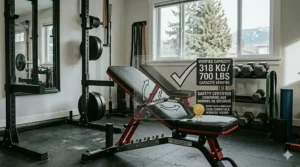
❓ FAQ: Weight Bench Capacity Questions from Canadian Buyers
❓ Can I exceed my weight bench's rated capacity temporarily?
❓ Do weight bench capacities account for user weight plus barbell weight?
❓ How do I verify if a weight bench capacity claim is legitimate in Canada?
❓ Does cold Canadian weather reduce my weight bench's weight capacity?
❓ What weight bench capacity do I need for progressive overload training in Canada?
Conclusion: Choosing the Right Weight Bench Weight Capacity for Your Canadian Home Gym
The weight bench weight capacity decision ultimately balances three factors: your current training loads, realistic progression expectations, and appropriate safety margins for Canadian climate conditions. The data shows most home gym users thrive with 363-454 kg (800-1000 lb) capacity benches that cost $240-380 CAD—providing room for years of strength development without overpaying for excessive structural overhead.
ASTM certification matters more than raw capacity numbers. A certified 363 kg (800 lb) bench from FLYBIRD or YOLEO delivers verified performance, while uncertified 590 kg (1300 lb) claims from unknown brands might represent marketing fiction. Canadian buyers deserve confidence that load bearing specifications reflect engineering reality rather than sales department creativity.
For most Canadians, the MAJOR FITNESS 1300 LBS model provides commercial-grade peace of mind if budget allows $380-450 CAD investment. The FLYBIRD ASTM 800 LBS option at $240-290 CAD delivers certified safety for intermediate lifters. Budget-conscious beginners find excellent value in NICEPEOPLE’s 660 LBS bench at $180-220 CAD that handles typical home gym progression for years.
Remember that bench weight limit explained properly includes your body weight, equipment weight, dynamic forces, and climate-adjusted safety margins. The calculation seems complex, but protecting yourself from equipment failure while bench pressing justifies the 10 minutes of careful math. Your training deserves equipment that won’t become the limiting factor in your progress or, worse, a safety hazard during heavy sets.
✨ Don’t Miss These Exclusive Deals!
🔍 Take your strength training to the next level with these carefully selected weight benches. Click on any highlighted item to check current pricing and availability on Amazon.ca. These benches will help you create authentic progressive overload results your future self will thank you for! 💪
Recommended for You
- 7 Best Weight Bench with Rack Canada 2026
- 7 Best Weight Bench with Leg Extension Canada 2026
- 7 Best Heavy Duty Weight Benches Canada 2026 – 1000 lbs Rated
Disclaimer: This article contains affiliate links. As an Amazon Associate, I earn from qualifying purchases. If you purchase products through these links, we may earn a small commission at no additional cost to you.
✨ Found this helpful? Share it with your friends! 💬🤗
