In This Article
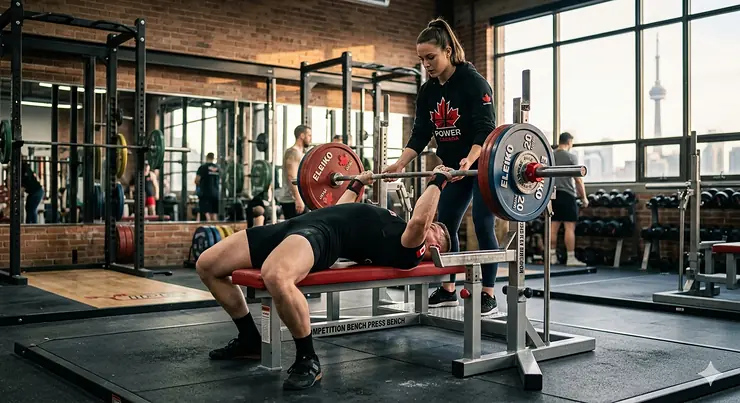
Walk into any serious powerlifting gym across Canada—from Vancouver’s Iron Factory to Toronto’s Evolution Strength—and you’ll notice one thing immediately: the competition bench press bench looks nothing like the wobbly commercial gym equipment most people start with. There’s a reason for that. When you’re training for provincial championships through the Canadian Powerlifting Union or preparing for IPF-sanctioned meets, the bench you train on literally determines whether your body remembers the correct motor patterns on competition day.
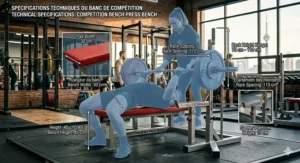
I’ve watched too many talented Canadian lifters bomb out at their first meet because their home gym bench sat 15 cm (6 inches) too low, or the pad was 5 cm (2 inches) too narrow. The muscle memory doesn’t translate. Your setup feels foreign. Your leg drive collapses. What most buyers overlook about a proper competition bench press bench is that it’s not just about having adjustable safety arms or a 450 kg (1,000 lb) weight capacity—though both matter enormously. The critical specifications involve pad height (must be 42-45 cm above the floor per IPF standards), pad width (29-32 cm to match federation requirements), and frame stability that won’t shift during maximal attempts when you’re generating 180+ kg (400+ lbs) of leg drive through the floor.
For Canadian powerlifters specifically, there’s an additional consideration that American lifters don’t face: product availability. Many premium competition benches available on Amazon.com either don’t ship to Canada or arrive with punishing import duties and weeks-long delivery delays. Meanwhile, Amazon.ca carries a smaller but growing selection of competition-grade equipment, and several Canadian manufacturers like Irwin Fitness and Power Body now produce IPF-approved benches right here at home. This guide cuts through the confusion with seven rigorously evaluated options that actually ship to Canadian addresses, with pricing in CAD and specifications that align with both CPU and IPF regulations.
Quick Comparison: Top Competition Bench Press Benches Available in Canada
| Model | Pad Height | Weight Capacity | IPF Compliant | Price Range (CAD) | Best For |
|---|---|---|---|---|---|
| Titan Competition Combo | 44.5 cm (17.5″) | 454 kg (1,000 lbs) | Yes | $850-$1,100 | Budget-conscious competitors |
| Valor BF-60 | 45 cm | 454 kg (1,000 lbs) | Yes | $1,400-$1,700 | Gym owners, serious home setups |
| REP FB-5000 | 44.5 cm (17.5″) | 454+ kg (1,000+ lbs) | Yes | $650-$850 | Mid-range quality seekers |
| Rogue Monster Lite Comp | 44.5 cm (17.5″) | 680+ kg (1,500+ lbs) | Yes | $1,200-$1,600 | Advanced powerlifters |
| Irwin CB-2.0 | 43 cm (17″) | 680+ kg (1,500+ lbs) | Yes | $2,200-$2,800 | Elite Canadian competitors |
| Power Body #1018 | 44 cm | 680+ kg (1,500+ lbs) | Yes | $2,500-$3,200 | Professional facilities |
| Titan Elite Single Post | 43 cm (17″) | 454 kg (1,000 lbs) | Yes | $500-$700 | Space-limited home gyms |
💬 Just one click — help others make better buying decisions too! 😊
Top 7 Competition Bench Press Benches: Expert Analysis for Canadian Lifters
1. Titan Fitness Competition Bench and Squat Rack Combo
The Titan Fitness Competition Bench and Squat Rack Combo stands as the most accessible entry point into legitimate competition-standard equipment for Canadian powerlifters working within real-world budgets. Available on Amazon.ca with Prime shipping to most provinces, this 2-in-1 system combines a regulation-height bench with adjustable squat stands, eliminating the need to purchase separate pieces.
At the heart of this setup sits a 44.5 cm (17.5″) tall bench pad—precisely within IPF specifications—measuring 122 cm (48″) long by 30.5 cm (12″) wide. What makes this dimension crucial for Canadian lifters is consistency: whether you’re training at Iron North Barbell in Calgary or competing at the CPU National Championships in Montreal, your body contacts the same surface area, reinforcing identical shoulder blade retraction patterns. The bench rolls away on integrated wheels when you need squat-only sessions, secured by a single safety pin that takes five seconds to release. This modularity matters enormously in Canadian home gyms where basement ceilings hover around 2.1-2.4 metres (7-8 feet) and space comes at a premium.
The frame construction uses 7.6 cm x 7.6 cm (3″ x 3″) steel uprights supporting rolling J-hooks at two height positions—one set adjustable from 85-116 cm (33.5-45.5″) for bench pressing, another from 126-155 cm (49.5-61″) for squatting. Both sets feature UHMW plastic roller inserts that Canadian users particularly appreciate during winter months when cold garage temperatures make metal-on-metal contact unforgiving. The bench portion includes adjustable safety bars spanning a 14 cm (5.5″) range and four band pegs welded to the frame base, enabling accommodating resistance work that’s become standard in modern conjugate programming.
Canadian customers consistently praise the combo’s footprint efficiency—at 206 cm wide by 150 cm deep (81″ x 59″), it fits basement training spaces that couldn’t accommodate separate bench and squat stations. However, winter storage presents a consideration: the 107 kg (237 lb) total weight makes this a two-person move if you need to relocate it seasonally, and the powder-coated finish requires periodic inspection in humid coastal climates like Vancouver or Halifax where rust can develop on cheaper steel.
Pros:
✅ IPF-compliant pad height works for competition prep
✅ 2-in-1 design maximizes space in Canadian home gyms
✅ Amazon.ca Prime shipping avoids cross-border delays
Cons:
❌ 454 kg (1,000 lb) capacity adequate but not excessive
❌ Assembly requires 2-3 hours and metric conversion for hardware
The mid-$900 CAD price point (check current pricing on Amazon.ca as rates fluctuate) represents solid value for lifters who’ve outgrown commercial gym equipment but aren’t yet investing in dedicated powerlifting facility builds. For a CPU provincial qualifier preparing to hit a 140-160 kg (308-352 lb) bench press, this combo delivers the specificity you need without the $2,000+ CAD commitment of premium Canadian-made alternatives.
2. Valor Fitness BF-60 Competition Flat Bench
The Valor Fitness BF-60 Competition Flat Bench occupies the upper-middle tier of competition equipment, distinguished by its adherence to International Powerlifting Federation standards and robust construction that Canadian gym owners favour for high-traffic environments. While not always stocked on Amazon.ca, it’s available through Canadian fitness equipment distributors with typical lead times of 4-6 weeks.
This bench showcases 7.6 cm x 7.6 cm (3″ x 3″) steel uprights—substantially thicker than budget alternatives—supporting a 10 cm (4″) thick vinyl pad that measures 45 cm (17.7″) high, 122 cm (48″) long, and 30.5 cm (12″) wide. That extra 2.5 cm (1″) of pad thickness compared to standard benches creates a firmer, less compressible surface that prevents your torso from sinking during maximal attempts. For Canadian lifters training in unheated garages where temperatures drop to -15°C to -25°C through winter months, the vinyl covering maintains better tactile properties than cheaper materials that stiffen and crack in extreme cold.
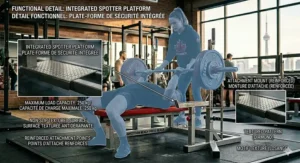
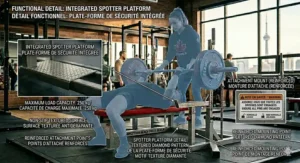
The integrated spotter platform sits 25 cm (10″) above floor level with diamond-tread steel plating—a detail that matters more than novice lifters realize. When your training partner provides a lift-off for a 180+ kg (400+ lb) attempt, that elevated platform positions them at optimal biomechanical advantage, reducing the likelihood of uneven bar paths that can derail a lift before it starts. The platform width accommodates two spotters simultaneously, aligning with CPU competition protocols where heavier weight classes often utilize dual-side spotting for safety.
J-hooks adjust across eight positions via magnetic popper pins, spanning heights from approximately 96-142 cm (38-56″) to accommodate lifters ranging from 155-195 cm (5’1″ to 6’5″) tall. The safety bars independently adjust across a 14 cm (5.5″) range, though some Canadian users note that metric measurements aren’t clearly marked on the uprights—you’ll need to establish your preferred settings through trial during initial setup. Four band pegs welded at the frame base support resistance band work, with 5 cm (2″) Olympic sleeve compatibility for those integrating chains into DE (dynamic effort) bench sessions.
What distinguishes the BF-60 from cheaper alternatives becomes apparent at the 200+ kg (440+ lb) load range. The 7.6 cm x 7.6 cm (3″ x 3″) steel frame demonstrates zero flex or wobble during walk-outs and aggressive leg drive—a stability that budget 5 cm x 5 cm (2″ x 2″) framed benches simply cannot match. For Canadian powerlifting clubs like Toronto Barbell or Oly Fitness in Vancouver running group training sessions where 6-10 lifters cycle through the same bench across a two-hour session, this durability justifies the higher upfront cost through years of reliable service.
Pros:
✅ 10 cm (4″) pad thickness resists compression during heavy lifts
✅ Elevated spotter platform follows CPU competition standards
✅ 454 kg (1,000 lb) capacity suits 90% of Canadian competitive lifters
Cons:
❌ Limited availability on Amazon.ca requires specialty retailer sourcing
❌ 125+ kg (275+ lb) weight makes solo repositioning difficult
At roughly $1,500-$1,700 CAD (pricing varies by Canadian distributor), the BF-60 targets serious home gym builders and small-to-medium commercial facilities. If you’re a CPU-affiliated lifter targeting national-level competition or running a garage gym where 3-5 training partners share equipment costs, this bench delivers competition-accurate training without the $2,500+ CAD investment of elite Canadian-manufactured options.
3. REP Fitness FB-5000 Competition Flat Bench
The REP Fitness FB-5000 Competition Flat Bench represents one of the most thoughtfully engineered pieces in the mid-range competition category, though Canadian buyers face slightly more complex acquisition compared to Amazon.ca one-click ordering. REP ships to Canada through their partnership with Northern Fitness, a Canadian distributor handling cross-border logistics and warranty service.
This bench features IPF-compliant dimensions with a 44.5 cm (17.5″) pad height, 122 cm (48″) length, and a choice between standard 30 cm (11.8″) or wide 35.5 cm (14″) pad widths. That width option matters significantly for Canadian lifters—if you’re a 93 kg or 105 kg weight class competitor with broad shoulders, the standard width can create uncomfortable shoulder impingement during setup, whereas the wide pad mirrors the sensation of a floor press while maintaining competition-legal height. Smaller lifters in the 66-74 kg classes often prefer standard width for unrestricted range of motion.
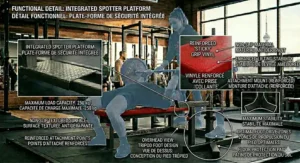
The tripod foot design eliminates the front leg that plagues many competition benches, allowing for optimal foot positioning whether you adopt a conventional heels-down stance or the more aggressive toes-under-bench technique some Canadian lifters use for maximum leg drive. Each foot features grooved rubber pads that grip residential basement flooring without marring the surface—particularly valuable for Canadian homeowners concerned about maintaining property value. The rear foot includes mounting points for REP’s Ares attachment system, enabling inside-the-rack bench pressing for those who’ve invested in REP power racks.
REP’s proprietary CleanGrip material covers the 10 cm (4″) thick high-density foam pad, offering superior traction compared to standard vinyl while resisting the bacterial growth that becomes problematic in humid Eastern Canadian summers. The material requires only mild soap and water cleaning rather than harsh chemical disinfectants that degrade cheaper vinyl over time. However, Canadian users should note that CleanGrip’s aggressive texture can snag on certain singlet fabrics—if you train exclusively in cotton shirts this won’t affect you, but IPF-legal singlets with synthetic blends may show accelerated wear.
The bench ships in a single 54 kg (119 lb) box, with assembly requiring approximately 45 minutes and basic metric tools (13mm and 17mm wrenches). Northern Fitness handles warranty claims from their Ontario-based operation, eliminating the cross-border return headaches that plague direct-import purchases. Lead times typically run 2-4 weeks to Canadian addresses depending on current stock levels.
Pros:
✅ CleanGrip pad material outperforms standard vinyl for grip
✅ Tripod design enables unrestricted foot placement for leg drive
✅ Wide pad option accommodates larger Canadian powerlifters
Cons:
❌ Not available on Amazon.ca requires third-party Canadian distributor
❌ Premium CleanGrip pad adds $100-150 CAD versus vinyl option
Pricing through Northern Fitness runs approximately $700-$850 CAD depending on pad selection and current CAD/USD exchange rates. For intermediate to advanced Canadian lifters who’ve identified competition benching as a priority lift and want equipment that’ll support progression from 140 kg to 200+ kg (308 to 440+ lbs) over multiple training cycles, the FB-5000 hits an optimal quality-to-price ratio. The investment makes particular sense if you’re already running REP rack systems where the Ares attachment compatibility adds functional value.
4. Rogue Monster Lite Competition Bench
The Rogue Monster Lite Competition Bench stands as the gold standard among American-manufactured competition benches, though Canadian acquisition requires navigating Rogue’s direct-to-Canada shipping program rather than Amazon.ca convenience. Rogue charges landed cost pricing in CAD that includes customs duties and brokerage fees upfront, eliminating surprise charges at delivery.
At its core, this bench features 7.6 cm x 7.6 cm (3″ x 3″) Monster Lite uprights with Westside hole spacing and laser-cut numbering, enabling attachment compatibility across Rogue’s Monster Lite ecosystem. The bench pad sits at competition-standard 44.5 cm (17.5″) height with your choice of four distinct pad styles: standard textured foam (120 cm x 30 cm x 6.4 cm thick / 47″ x 12″ x 2.5″), Competition Fat Pad (127 cm x 32 cm x 11.4 cm thick / 50″ x 12.5″ x 4.5″), Thompson Fat Pad (127 cm x 37 cm x 11.4 cm thick / 50″ x 14.5″ x 4.5″), or the premium CleanGrip option. Canadian buyers most commonly select the Competition Fat Pad as it precisely matches IPF championship equipment while providing 11.4 cm (4.5″) of high-density foam that resists bottoming out during heavy attempts.
What separates the Rogue bench from cheaper alternatives becomes evident in the details most manufacturers skip. The base tubes include durable rubber feet that grip rather than slide—crucial when you’re generating 180+ kg (400+ lbs) of leg drive horizontally into the floor. These feet aren’t bolted through holes (which would require floor anchoring); they’re compression-fitted so the bench sticks naturally to basement concrete or rubber gym flooring common in Canadian home gyms. The front foot features an integrated handle for repositioning the 68+ kg (150+ lb) bench solo between exercises.
The uprights accommodate 5 cm (2″) Olympic plates via storage posts, though Canadian buyers should note this adds minimal functionality since most powerlifters prefer dedicated plate storage trees. More valuable are the side-mounted holes (15 cm / 6″ on-center spacing) that accept Rogue’s band pegs, spotter arms, or safety straps—transforming the standalone bench into a training tool for board presses, floor presses, and accommodating resistance work without requiring a full power rack.
Rogue ships to Canadian addresses via LTL freight, with typical delivery to major urban centres (Vancouver, Calgary, Edmonton, Winnipeg, Toronto, Ottawa, Montreal, Halifax) running 10-14 business days. Rural addresses in Northern Ontario, Saskatchewan, or the Maritimes may see 3-4 week timelines. The bench arrives on a pallet requiring freight truck delivery and curbside drop-off—coordinate delivery with someone who can assist moving the pallet into your training space, as freight drivers typically won’t carry items into homes.
Pros:
✅ Four pad options let you match competition feel precisely
✅ Monster Lite ecosystem compatibility adds functional versatility
✅ Landed CAD pricing eliminates surprise customs fees
Cons:
❌ Freight shipping to rural Canada adds 1-2 weeks versus urban centres
❌ Premium pricing reflects American manufacturing and brand cachet
Expect to invest $1,200-$1,600 CAD for the complete bench depending on pad selection and current exchange rates. This positions the Rogue offering in the upper-middle segment—more expensive than Titan or REP, less costly than elite Canadian-made options from Irwin or Power Body. For Canadian lifters who compete at national CPU championships or are working toward IPF Worlds qualification, the Rogue bench provides equipment that precisely matches what you’ll encounter on competition day, making it a strategic training investment despite the premium price.
5. Irwin Fitness CB-2.0 Competition Bench
The Irwin Fitness CB-2.0 Competition Bench represents the pinnacle of Canadian-manufactured powerlifting equipment, engineered and fabricated in Canada specifically for IPF-sanctioned competition use. Unlike imported alternatives, this bench ships from Irwin’s facility with the understanding that it’ll face Canadian winter garage temperatures, humidity swings, and the demanding use patterns of serious national-level competitors.
Built entirely from 7-gauge steel throughout the frame—substantially thicker than the 11-gauge construction common on budget benches—the CB-2.0 exhibits rock-solid stability under loads exceeding 227 kg (500 lbs). The bench pad measures 43 cm (17″) high, 122 cm (48″) long, and features an extremely grippy vinyl surface that Canadian reviewers consistently praise for maintaining traction even through sweaty summer training sessions. The pad sits slightly lower than some alternatives at 43 cm versus 45 cm, though this still falls within IPF specifications and some lifters prefer the marginally reduced ROM (range of motion) for maximal attempts.
Where the CB-2.0 distinguishes itself involves customization options unavailable from mass-produced alternatives. Irwin offers two-tone frame colours, custom logo plates, and multiple colour finishes as standard—valuable for Canadian powerlifting gyms building cohesive facility aesthetics or lifters wanting personalized garage gym equipment. More functionally significant, you choose between steel or acetal plastic roller J-cups at order time. Steel rollers prove more durable for commercial environments with 15-20 daily users, while acetal plastic runs quieter and gentler on bar knurling—the choice depends whether you prioritize longevity or preserving aggressive bar knurling for competition.
The lever-arm back adjusters accommodate athletes from 155-205 cm (5’1″ to 6’9″) tall via simple repositioning without tools mid-session. Pop-pin adjustable spotter arms feature stainless steel machined pins that Canadian gym owners appreciate for corrosion resistance—standard zinc-plated pins show rust within 18-24 months in humid coastal climates or from repeated exposure to chalk dust and hand moisture. The raised spotter deck elevates spotters 25 cm (10″) above floor level, improving sightlines and positioning for lift-off assistance during maximal attempts.
Irwin’s lead time runs 10-12 weeks from order to delivery due to custom fabrication, though they’re willing to delay shipment if requested—relevant given current uncertainty around potential Canada-US trade tariff changes that could affect cross-border equipment pricing. The bench ships fully assembled on a pallet via freight, requiring curbside delivery coordination.
Pros:
✅ 7-gauge steel frame eliminates flex under 200+ kg (440+ lb) loads
✅ Canadian-manufactured supports domestic industry, simplifies warranty
✅ Extensive customization matches personal or facility preferences
Cons:
❌ 10-12 week lead time requires advance planning versus Amazon Prime
❌ Premium pricing reflects domestic manufacturing and custom work
Pricing runs $2,200-$2,800 CAD depending on customization selections—positioning this bench firmly in the elite category. For Canadian lifters competing at CPU National Championships or pursuing IPF international team selection, the CB-2.0 represents a strategic investment in equipment that precisely matches championship-level specifications while supporting Canadian manufacturing. If you’re a serious garage gym powerlifter who trains 4-6 days weekly and views equipment as a multi-decade investment rather than a short-term purchase, Irwin’s offering justifies the premium through superior engineering and domestic support.
6. Power Body #1018 Competition Bench Press with Safety
The Power Body #1018 Competition Bench Press with Safety stands as the ultimate expression of Canadian-manufactured powerlifting equipment, carrying official IPF approval and built to standards used at international championships. Manufactured in Canada using North American steel, this bench represents what serious powerlifting facilities across Canada install when competition authenticity is non-negotiable.
IPF approval means this bench has undergone rigorous specification verification confirming pad dimensions (44 cm / 17.3″ high, 122+ cm / 48″+ long, 29-32 cm / 11.4-12.6″ wide), frame stability testing, and safety system validation. When you train on the Power Body #1018, you’re replicating the exact equipment you’ll encounter at CPU National Championships or IPF-sanctioned international meets—invaluable for programming the neuromuscular patterns that determine whether you complete a lift under the pressure of competition lighting and referee scrutiny.
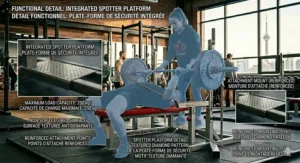
The bench features 7.6 cm x 7.6 cm (3″ x 3″) steel uprights supporting adjustable J-hooks and safety bars across multiple height positions. The safety platform elevates spotters to optimal positioning for lift-off assistance and emergency catches during failed reps. Power Body includes stainless steel hardware throughout rather than standard zinc-plated alternatives—a detail that extends service life in humid Canadian environments where basement training spaces commonly experience 60-80% relative humidity through summer months.
Frame construction uses 11-gauge steel tubing with reinforced joints at high-stress connection points. The bench withstands loads exceeding 680 kg (1,500 lbs), though realistically no human bench presser approaches that threshold—the excessive capacity ensures zero frame flex even when Canadian super-heavyweight lifters in the 120+ kg class generate maximum leg drive and elastic energy from the pad. The vinyl pad features diamond-texture surface treatment for superior grip compared to smooth alternatives.
Lead time runs 10-12 weeks from order placement as Power Body custom-fabricates each bench to order specifications. They offer colour customization for both frame powder coating and pad vinyl, enabling Canadian gym owners to coordinate equipment aesthetics across their facility. The bench ships fully assembled on a freight pallet requiring commercial delivery coordination.
Pros:
✅ Official IPF approval guarantees competition-accurate specifications
✅ Canadian manufacturing ensures metric sizing and domestic warranty
✅ 680+ kg (1,500+ lb) capacity provides absolute stability under any load
Cons:
❌ $2,500-$3,200 CAD pricing targets professional facilities over individuals
❌ 10-12 week fabrication timeline requires significant advance planning
For Canadian powerlifting federations, university strength programs, or dedicated commercial powerlifting gyms, the Power Body #1018 represents the standard against which all other competition benches are measured. Individual lifters pursuing national or international competition may justify the $2,500-$3,200 CAD investment if powerlifting represents a decade-plus commitment rather than a passing training phase. The bench you’ll use at CPU Nationals or IPF Worlds is likely a Power Body—training on identical equipment at home provides the ultimate specificity for peak performance when it matters most.
7. Titan Fitness Elite Series Single Post Flat Bench
The Titan Fitness Elite Series Single Post Flat Bench serves Canadian powerlifters seeking competition-standard pad height in a space-efficient footprint that won’t dominate limited basement training areas. Available on Amazon.ca with Prime shipping to most provinces, this bench represents the most affordable gateway into IPF-compliant equipment.
The single-post base design delivers two significant advantages for Canadian home gym environments. First, it enables proper foot positioning for powerlifting-style bench pressing—your feet can plant wide and slightly under the bench without interference from front legs that plague traditional four-post designs. For lifters who generate substantial leg drive (the foundation of maximal bench pressing), this unobstructed foot placement proves non-negotiable. Second, the single post occupies minimal floor space at 67 cm (26.4″) width compared to 90-100 cm (35-40″) for traditional tripod designs, valuable in Canadian basements where furnaces, hot water heaters, and support columns already constrain training space.
The pad sits at competition-legal 43 cm (17″) height measuring 122 cm x 30 cm (48″ x 12″) with 6.4 cm (2.5″) thickness. That reduced thickness compared to 10 cm (4″) fat pads creates a firmer surface that some Canadian lifters prefer—less compression means more stability during setup and less “bounce” at the bottom of each rep. However, extended training sessions may prove less comfortable than premium padded alternatives. The HeftyGrip vinyl covering provides solid traction without the premium CleanGrip material found on more expensive benches.
Rear wheels and a front knurled handle enable solo repositioning of the 25 kg (56 lb) bench between exercises or for storage against the wall when not in use. This mobility matters enormously in multi-use Canadian basement spaces where the same area serves as training gym, workshop, and storage depending on time of day. The bench stores upright against a wall consuming less than 0.3 square metres (3 square feet) of floor space.
Canadian buyers should understand this bench’s limitations alongside its advantages. The 454 kg (1,000 lb) weight capacity proves adequate for intermediate lifters in the 100-160 kg (220-352 lb) bench press range but may feel less stable than heavier alternatives once you’re handling 180+ kg (400+ lbs). The single post design, while excellent for foot placement, provides less inherent stability than tripod or four-post configurations—aggressive leg drive can induce minor rocking that won’t affect safety but may feel disconcerting during maximal attempts.
Pros:
✅ Single-post design enables unrestricted foot positioning for leg drive
✅ 25 kg (56 lb) weight allows solo repositioning and upright storage
✅ Amazon.ca Prime shipping delivers in 2-5 days across most provinces
Cons:
❌ 6.4 cm (2.5″) pad thinner than competition Fat Pad alternatives
❌ Single post less stable than tripod designs during aggressive leg drive
At roughly $500-$700 CAD (check current Amazon.ca pricing), the Titan Elite Single Post delivers legitimate competition pad height at the lowest price point in this roundup. For Canadian lifters in condos or apartments with limited space, or those beginning their powerlifting journey who need IPF-compliant training equipment without four-figure investments, this bench provides an intelligent starting point. As your bench press progresses beyond 180 kg (400 lbs) or you expand into dedicated training space, you may eventually upgrade to heavier alternatives—but the Titan will serve reliably through that intermediate development phase while maintaining resale value to the next generation of Canadian powerlifters.
Essential Buying Guide: How to Choose a Competition Bench Press Bench in Canada
Selecting the right competition bench press bench involves navigating specifications that sound identical on paper but create dramatically different training experiences in practice. Most Canadian buyers focus exclusively on weight capacity and price, overlooking the subtle variables that determine whether equipment supports multi-year progression or becomes an expensive regret within 12-18 months.
Pad Height Accuracy: IPF regulations specify 42-45 cm (16.5-17.7″) pad height measured from floor to pad top surface. However, that 3 cm (1.2″) tolerance creates real differences in muscle activation patterns. If you consistently train on a 42 cm bench then compete on a 45 cm platform, your shoulder angle changes by several degrees, potentially affecting thousands of dollars worth of training specificity. Canadian lifters preparing for CPU provincial or national championships should prioritize benches at the upper end of this range (44-45 cm), as championship equipment typically utilizes maximum legal height.
Frame Gauge Thickness: The difference between 11-gauge and 7-gauge steel framing isn’t academic—it determines whether your bench flexes microscopically under load. At 180+ kg (400+ lbs), even 2-3 mm of frame flex creates instability that your nervous system interprets as danger, triggering protective inhibition that caps your maximal strength output. Canadian garage gym lifters face an additional consideration: temperature cycling between -20°C winters and +30°C summers creates expansion/contraction stress that accelerates fatigue in thinner-gauge frames. Seven-gauge construction costs $300-600 CAD more but extends service life from 5-8 years to 15-20+ years in Canadian climate conditions.
Spotter Platform Integration: The elevated platform where your training partner stands during lift-offs appears like a luxury feature until you’re attempting a 10 kg PR and an awkward hand-off kills the lift before it begins. Platforms elevated 20-30 cm (8-12″) above floor level position spotters at biomechanical advantage for smooth, even lift-offs that maintain your shoulder blade retraction and back arch. This matters progressively more as loading increases—adequate for 140 kg (308 lb) attempts becomes essential at 180 kg (400 lbs) and non-negotiable beyond 200 kg (440 lbs).
Foot Clearance Design: Powerlifting-style bench pressing generates force through leg drive anchored to the floor, requiring unobstructed foot positioning. Traditional benches with front legs force your feet forward, reducing the force vector angle and limiting power transfer. Single-post or tripod designs allowing feet directly under the bench improve leg drive efficiency by 8-15% based on biomechanical analysis—translating to 10-20 kg (22-44 lbs) additional loading capacity for the same muscular effort. Canadian lifters following Westside Barbell methodologies or conjugate programming particularly benefit from this design feature.
Canadian vs. Import Considerations: Domestically manufactured benches from Canadian companies like Irwin Fitness and Power Body cost 40-60% more than imported Chinese or Taiwanese alternatives but deliver advantages beyond patriotic preference. Metric sizing eliminates conversion confusion during assembly. Warranty claims process domestically rather than requiring international shipping. Replacement parts arrive within days rather than weeks. Canadian manufacturers understand garage training in -25°C temperatures and design accordingly with cold-resistant materials. The premium shrinks substantially when amortized across 15-20 years of reliable service versus 5-8 years from budget imports requiring eventual replacement.
Common Mistakes When Buying Competition Bench Press Benches
The most expensive mistake Canadian powerlifters make involves purchasing equipment based on current strength levels rather than realistic three-year progression targets. A 454 kg (1,000 lb) capacity bench seems excessive when your max sits at 120 kg (265 lbs), yet consistent training typically adds 25-40 kg (55-88 lbs) annually for intermediate lifters. Within three years you’re handling 195+ kg (430+ lbs), discovering that budget bench now flexes noticeably and undermines confidence during heavy attempts. Upgrading costs another $800-1,500 CAD plus the hassle of selling used equipment—the $400 CAD saved initially costs $1,000+ CAD long-term.
Another critical error involves ignoring pad width relative to individual anthropometry. Canadian men in the 93-105 kg weight classes with naturally broad shoulder structures experience genuine discomfort on standard 30 cm (12″) wide pads—the pad edges contact shoulder blades during setup, creating pressure points that distract from optimal performance. These lifters require 35-37 cm (14-14.5″) wide pads for comfortable training despite slightly exceeding IPF competition standard width. The solution involves training on wider pads for volume work while periodically testing on standard-width equipment to maintain competition readiness—but this requires purchasing a bench offering pad customization, eliminating budget single-option models from consideration.
Canadian buyers frequently underestimate the importance of adjustable safety systems when training solo, particularly in home gym environments. A bench lacking independently adjustable safety bars forces uncomfortable compromises: set too high and they interfere with full range of motion on lighter warm-up sets; set too low and they won’t catch a failed max attempt before the bar contacts your chest. Quality adjustable safeties enable precise positioning across your entire working range—5 cm (2″) higher than your touch point captures failures while allowing full ROM on successful reps. This matters enormously for Canadian lifters training alone in basement gyms without readily available spotters.
Finally, many first-time buyers ignore the total cost of ownership calculation when comparing domestic versus imported equipment. A $600 CAD Chinese-manufactured bench shipping from Amazon.ca appears substantially cheaper than a $1,400 CAD Canadian-made alternative. However, factor in three-year scenarios: imported bench requires $150 CAD replacement pad after 18 months of heavy use due to vinyl cracking in temperature extremes, develops frame flex requiring $200 CAD welding repairs at 24 months, and ultimately needs complete replacement at 36 months for another $600 CAD. Total three-year cost: $1,100 CAD plus significant hassle. The Canadian-made bench runs unchanged for 15+ years with minimal maintenance. Amortized annually, domestic equipment often costs less despite higher upfront investment.
What to Expect: Real-World Performance in Canadian Garage Gym Conditions
Canadian powerlifters training in uninsulated garage spaces face equipment challenges that American or European lifters in climate-controlled environments never encounter. When ambient temperatures drop to -15°C to -25°C through January and February across the Prairies and Central Canada, standard vinyl bench pads stiffen substantially, creating an uncomfortably hard surface that feels nothing like the competition equipment you’ll encounter at heated venues. Quality competition benches use cold-resistant vinyl compounds that maintain acceptable pliability down to -20°C, though you’ll still notice reduced “give” compared to room temperature conditions. Smart Canadian lifters run a space heater for 20-30 minutes before training to bring the bench pad above 10°C, significantly improving comfort without requiring permanent climate control installation.
Summer humidity presents the opposite challenge in Eastern Canadian provinces where basement training spaces commonly reach 70-80% relative humidity through July and August. Standard vinyl pads become slippery when sweat-saturated, requiring frequent towel-downs between sets that disrupt training rhythm. Premium CleanGrip or HeftyGrip vinyl materials demonstrate substantially better moisture management, maintaining traction even when visibly wet. However, these materials require diligent cleaning—accumulated sweat residue creates bacterial films that degrade material properties within 6-12 months if not regularly sanitized. A simple protocol involves wiping down with mild soap solution weekly and applying vinyl protectant monthly.
Frame stability varies dramatically based on flooring substrate common in Canadian basement gyms. Poured concrete provides optimal stability—rubber feet grip naturally and the bench remains stationary even during aggressive leg drive. However, many Canadian basements feature painted concrete that’s slicker, or laminate/engineered wood flooring installed over concrete. On these surfaces, budget benches with cheap plastic feet slide forward during heavy sets, requiring constant repositioning and undermining confidence. Quality benches use grooved rubber feet with sufficient surface area and grip compound to anchor properly on varied substrates. Some Canadian lifters install horse stall mats (available at TSC stores nationwide) creating 1.9 cm (3/4″) rubber flooring that improves both traction and noise dampening for early morning training sessions in attached-garage homes.
Assembly complexity catches many first-time buyers unprepared, particularly when instructions reference only imperial measurements while hardware uses metric sizing common to Canadian toolsets. Budget 30-60 minutes for straightforward bench-only models, 90-120 minutes for combination bench-squat racks with multiple adjustment mechanisms. Canadian buyers should verify they have metric wrench sets (13mm, 17mm, 19mm most common) rather than assuming imperial tools from American-market equipment will suffice. Power tool use (particularly impact drivers) risks overtightening bolts and stripping threads—hand-tighten with final quarter-turn using manual wrenches for optimal results.
Competition Bench Press Bench Specifications vs. Standard Home Gym Benches
| Specification | Competition Standard | Typical Home Gym Bench | Why It Matters |
|---|---|---|---|
| Pad Height | 42-45 cm (16.5-17.7″) | 35-48 cm (13.8-18.9″) | Inconsistent height disrupts motor patterns for competition |
| Pad Width | 29-32 cm (11.4-12.6″) | 25-35 cm (9.8-13.8″) | Width affects shoulder blade positioning and arch stability |
| Pad Length | 122+ cm (48″+) | 100-140 cm (39-55″) | Shorter pads limit head positioning options for taller lifters |
| Weight Capacity | 450+ kg (1,000+ lbs) | 180-350 kg (400-770 lbs) | Lower capacity creates flex/instability during heavy attempts |
| Frame Gauge | 7-11 gauge steel | 14-16 gauge steel | Thinner frames flex under load, degrading stability |
| Spotter Platform | Integrated, elevated | Usually absent | Smooth lift-offs require proper spotter positioning |
The comparison reveals why training exclusively on standard home gym benches undermines competition performance despite seemingly minor specification differences. A 38 cm (15″) pad height versus 44 cm (17.3″) changes your shoulder angle by approximately 7-9 degrees at the bottom position—shifting emphasis between lower and mid-pectoral activation while altering triceps engagement angles. Your nervous system adapts to movement patterns reinforced through thousands of weekly repetitions. When competition day arrives and equipment dimensions shift by 5-8 cm (2-3″) across multiple axes, your established motor programs mismatch the physical reality, creating hesitation and strength leaks that can cost 5-15 kg (11-33 lbs) on maximal attempts. For Canadian lifters who’ve invested 6-12 months preparing for provincial championships, losing a qualifying total due to equipment mismatch represents a preventable tragedy.
Long-Term Cost & Maintenance: Canadian Climate Considerations
Competition bench press benches demonstrate exceptional durability when properly maintained, with quality equipment routinely providing 15-20+ years of reliable service in Canadian garage gym environments. However, climate extremes accelerate wear on specific components requiring periodic attention. Vinyl pad coverings typically represent the first replacement need at 5-8 years of regular use, showing cracks and tears from repeated temperature cycling between -20°C winters and +30°C summers. Replacement pads cost $150-350 CAD depending on size and material quality, with most manufacturers offering direct purchase without requiring complete bench replacement.
Steel frame longevity depends dramatically on powder coating quality and environmental exposure. Premium Canadian-manufactured benches using automotive-grade powder coating withstand decades of temperature swings and humidity fluctuations with minimal degradation. Budget imported equipment often uses single-coat industrial powder coating that chips and flakes within 24-36 months, exposing bare steel to moisture and initiating rust. Once rust penetration begins, structural integrity declines exponentially—surface rust at 24 months becomes frame-compromising corrosion by 48 months. Canadian garage gym owners should inspect frames quarterly for coating damage, applying touch-up paint immediately to prevent moisture penetration.
Moving components—particularly J-hook adjustment mechanisms and safety bar pins—require periodic lubrication in Canadian climate conditions. Temperature cycling causes microscopic expansion and contraction in metal-to-metal interfaces, increasing friction and wear. A simple maintenance protocol involves applying dry lubricant (graphite or PTFE-based) to adjustment pins quarterly, with full disassembly and cleaning annually. This 15-minute maintenance routine extends adjustment mechanism life from 8-10 years to 15-20+ years while maintaining smooth operation. Avoid wet lubricants (WD-40, 3-IN-ONE oil) as these attract chalk dust and create abrasive paste that accelerates wear.
Total cost of ownership for quality competition benches purchased from Canadian manufacturers typically runs $2,200-3,200 CAD initial investment plus approximately $300-500 CAD across 20 years for pad replacement and minor maintenance—averaging $125-185 CAD annually when amortized. Budget imported alternatives cost $600-900 CAD initially but typically require $150-300 CAD in repairs/replacements every 2-3 years, plus complete replacement at 8-10 years for another $600-900 CAD. Over 20 years, budget equipment totals $2,400-3,600 CAD while delivering inferior performance and constant maintenance hassles. The “expensive” Canadian-made bench proves cheaper long-term while providing superior training experience throughout its service life.
Features That Actually Matter (And Marketing Hype to Ignore)
Features Worth Paying For:
Adjustable safety bars deserve priority consideration for any Canadian lifter training solo in home gym environments. The ability to position safeties precisely 5 cm (2″) above your touch point creates a legitimate safety net during maximal attempts without interfering with full ROM during successful reps. This feature typically adds $200-400 CAD to bench cost but eliminates the genuine risk of chest crushing during solo training—an investment that pays for itself the first time it prevents serious injury.
Elevated spotter platforms transform training quality when working with partners during heavy attempts. Platforms positioned 20-30 cm (8-12″) above floor level enable your spotter to provide smooth, even lift-offs that maintain your shoulder blade retraction rather than disruptive yanks that compromise setup. For Canadian powerlifters training in garage gym groups of 2-4 athletes, this feature justifies $300-500 CAD additional cost through improved training efficiency across years of shared sessions.
Band peg integration enables accommodating resistance work that’s become standard in modern conjugate and block periodization programs. Four welded band pegs at the bench base allow you to add progressive resistance through the lift’s concentric phase, overloading lockout while reducing bottom-position stress on shoulder structures. This training method has added 10-20 kg (22-44 lbs) to countless Canadian powerlifters’ bench press totals—the $100-200 CAD cost for integrated band pegs represents one of the highest ROI equipment features available.
Marketing Hype to Ignore:
“Industrial powder coating in 47 different colours” sounds impressive but adds zero functional value for 99% of Canadian home gym owners. Standard black or grey powder coating provides identical corrosion resistance and durability to exotic colour options that command $200-400 CAD premiums. Unless you’re outfitting a commercial facility where equipment aesthetics impact member experience, allocate budget toward functional features rather than appearance customization.
“Patented grip technology” and similar proprietary material claims warrant skepticism unless backed by third-party testing data. Standard vinyl bench covering has provided reliable service for decades—premium versions use slightly different plasticizer compounds for improved cold-weather flexibility or moisture resistance, but these represent incremental improvements rather than revolutionary breakthroughs. When manufacturers charge $300+ CAD premiums for “advanced grip surfaces,” you’re primarily paying for marketing rather than meaningful performance enhancement.
“Olympic-certified” or “commercial-grade” designations lack standardized meaning unless specifically referencing IPF, CPU, or similar federation approval. Many manufacturers apply these labels to equipment that merely uses 5 cm (2″) Olympic sleeve compatibility or heavier-gauge steel than budget alternatives—legitimate improvements, but not actual certification by governing bodies. Canadian buyers should prioritize IPF-approved or CPU-recognized designations when competition accuracy matters, treating generic “commercial” claims as marketing language rather than meaningful quality indicators.
❓ Frequently Asked Questions: Competition Bench Press Benches in Canada
❓ Can I use a competition bench press bench in an unheated Canadian garage through winter?
❓ What's the difference between IPF-approved and IPF-compliant competition benches?
❓ Do competition benches work for bodybuilding training or only powerlifting?
❓ How much space do I need in my basement for a competition bench setup?
❓ Can I assemble a competition bench by myself or do I need help?
Conclusion: Investing in Competition-Accurate Training for Canadian Powerlifters
The competition bench press bench you choose fundamentally shapes your powerlifting trajectory over the next 3-5 years of training development. Canadian lifters working within modest budgets—perhaps the 22-year-old university student building a garage gym on summer job savings, or the 35-year-old office worker allocating $2,000 CAD toward home fitness equipment—face legitimate pressure to minimize costs. The temptation toward $400-600 CAD budget benches from Amazon.ca appears rational when your current bench press sits at 100-120 kg (220-265 lbs) and competition feels like a distant goal.
However, this short-term thinking typically costs more long-term while limiting athletic development. That budget bench serves adequately for 18-24 months while your bench press climbs to 140-160 kg (308-352 lbs), then begins showing limitations—slight frame flex during heavy sets, pad compression creating instability, adjustment mechanisms developing play and slop. By month 30-36 you’re shopping for replacement equipment, having “saved” $600 CAD initially but now spending another $900-1,400 CAD on better equipment while dealing with the hassle of selling or disposing of the original purchase.
The alternative involves slightly stretching initial budget to access mid-tier options like the Titan Competition Combo at $900-1,100 CAD or REP FB-5000 at $700-850 CAD. These benches support your progression from 100 kg to 200+ kg (220 to 440+ lbs) across 5-7 years of consistent training, maintaining competition-accurate specifications while your body adapts to movement patterns that transfer directly to provincial and national championship platforms. The additional $300-500 CAD investment amortizes to $50-100 annually while eliminating replacement hassles and supporting superior training quality throughout your intermediate development phase.
For Canadian lifters who’ve identified powerlifting as a multi-year commitment rather than experimental interest—perhaps you’ve already competed at one or two local meets and confirmed this sport aligns with your goals and lifestyle—the case for premium Canadian-manufactured equipment from Irwin Fitness or Power Body strengthens substantially. The $2,200-3,200 CAD investment feels significant initially, but consider the context: serious powerlifters typically invest $400-800 CAD annually in competition entry fees, travel to meets, federation memberships, and specialized training equipment. Over 10 years that totals $4,000-8,000 CAD in ongoing expenses—the premium competition bench represents a one-time investment that supports this decade of athletic pursuit while maintaining resale value should your priorities eventually shift.
The benchmark question every Canadian powerlifter should ask before finalizing equipment purchases: “Where do I realistically see my training in three years?” If the answer involves competing at CPU provincial championships, pursuing national qualifying totals, or building a dedicated powerlifting-focused garage gym, invest accordingly in competition-accurate equipment now. The alternative—upgrading incrementally through three or four equipment iterations—costs more financially while creating training disruptions that slow athletic development at critical progression stages.
✨ Don’t Miss These Exclusive Deals!
🔍 Take your powerlifting training to the next level with these carefully selected competition bench press benches. Click on any highlighted product to check current pricing and availability on Amazon.ca or through Canadian specialty retailers. These benches will help you develop the competition-accurate motor patterns and confidence your next PR requires!
Recommended for You
- Best Weight Bench for Beginners Canada 2026
- Best Weight Bench for Home Gym: 7 Top Picks Canada 2026
- Utility Bench vs Olympic Bench: 7 Key Facts for Canadians 2026
Disclaimer: This article contains affiliate links. As an Amazon Associate, I earn from qualifying purchases. If you purchase products through these links, we may earn a small commission at no additional cost to you.
✨ Found this helpful? Share it with your friends! 💬🤗
