In This Article
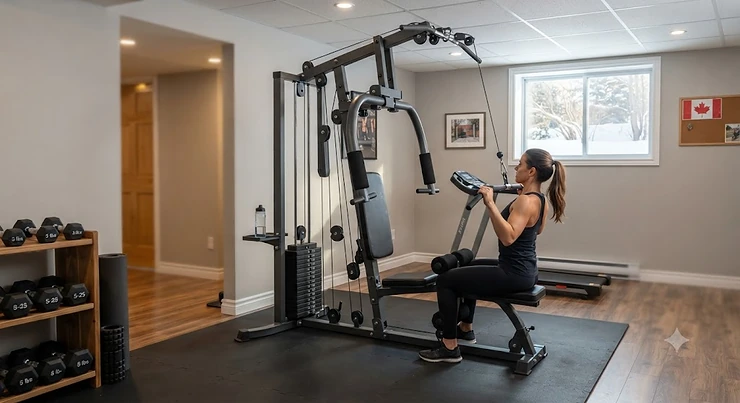
Somewhere between “I should really start lifting again” and actually doing it sits a folding treadmill gathering coats and a gym membership you haven’t used since March. That’s the gap single stack home gyms are built to close. One machine, one weight stack, a handful of pulleys, and suddenly your spare room or garage corner can carry you through chest presses, lat pulldowns, leg extensions, and cable rows without a single trip to a crowded commercial gym.
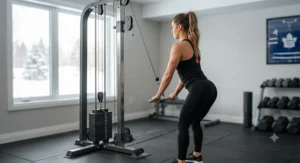
What is a single stack home gym? It’s a compact strength-training machine built around one selectorized weight stack that powers several cable stations — chest press, high pulley, low pulley, and usually a leg developer — through a single frame, letting you switch exercises by moving a pin instead of loading plates.
That “one stack, many stations” design is exactly what separates it from bulkier multi-stack setups, and it’s a big part of why single stack home gyms remain the default recommendation for Canadian condos, basements, and garages where floor space is precious and winter driveways make a 6 a.m. gym run feel like a dare. According to Health Canada’s physical activity guidance, muscle-strengthening activities like lifting weights help build stronger muscles and bones, and a single stack gym is one of the more space-efficient ways to fold that habit into a Canadian home. Below, we’ve dug into seven real machines sold in Canada — budget, mid-range, and premium — with honest specs, aggregated review sentiment, and the analysis Amazon listings never bother to give you.
Quick Comparison Table
| Model | Weight Stack | Footprint | Best For |
|---|---|---|---|
| Body-Solid EXM2500S | 210 lb | Compact | Best all-rounder |
| Body-Solid EXM1500S | 160 lb | Compact | Best value / budget |
| Body-Solid G1S | 160 lb | Smallest single stack | Tight spaces |
| Powerline BSG10X | 160 lb | Most compact overall | Apartments/condos |
| Marcy MWM-990 | 150 lb | Mid-size | Mid-range shoppers |
| Marcy Eclipse HG5000 | ~198 lb (90 kg) | Mid-size | Adjustable press angles |
| Body-Solid EXM3000LPS | 210 lb x2 (dual stack) | Large, dedicated room | Upgrading beyond single stack |
At a glance, the spread here tells its own story: five of these seven are genuinely single stack machines built for one lifter and one room, while the Body-Solid EXM3000LPS is a deliberate outlier — a dual-stack “what’s next” option for households that outgrow a single stack setup. Weight stack size matters less than most buyers assume; a 150 lb stack is plenty for most cable exercises, but leg presses and lat pulldowns eat through resistance faster than a chest press does, so heavier stacks like the 210 lb options give you more runway before you’re maxing out the pin. Footprint, meanwhile, is the real dealbreaker for apartment and condo dwellers, which is why the Powerline BSG10X and Body-Solid G1S show up so often in small-space recommendations.
💬 Just one click — help others make better buying decisions too!😊
Top 7 Single Stack Home Gyms: Expert Analysis
1. Body-Solid EXM2500S — best all-rounder single stack home gym
The Body-Solid EXM2500S earns its “best all-rounder” tag by doing the boring stuff extremely well: a 210 lb selectorized iron weight stack in 10 lb increments, five stations, and a heavy-duty steel frame that isn’t going anywhere. That 210 lb ceiling matters in practice — it’s roughly 30-50 lb more headroom than most single stack home gyms in this price bracket, so you’re less likely to plateau on chest press or leg extensions within your first year of consistent training. The pec station, press arm, and leg developer round out a genuinely comprehensive setup, and the DuraFirm padding on the seat and back holds up to daily use without flattening the way cheaper vinyl does. Based on the spec comparison, this is the machine for someone who wants one purchase to last five-plus years rather than something to “upgrade from” in eighteen months. Reviewers consistently note the smooth pulley action and solid welds, though a recurring theme in aggregated feedback is that the machine lacks a dedicated leg curl station, and some users report the Power Rod-style resistance curve feels different from free weights — worth knowing if you’re coming from a barbell background. It also carries Body-Solid’s lifetime warranty, which is a meaningful trust signal in a category where cheap machines rust or crack welds within a couple of winters.
Pros:
- ✅ 210 lb stack gives more long-term headroom than rivals
- ✅ Five stations cover a genuinely full-body program
- ✅ Lifetime warranty backs the steel frame
Cons:
- ❌ No dedicated leg curl station
- ❌ Resistance feel differs slightly from free weights
Expect this model to sit in the C$1,700-C$2,100 range at the time of research; check current price on amazon.ca, as fitness equipment pricing shifts with shipping and seasonal demand. For the money, it’s one of the strongest value propositions among single stack home gyms sold to Canadian buyers.
2. Body-Solid EXM1500S — budget pick with the widest station coverage
The Body-Solid EXM1500S was once named a “#1 Best Buy” by a leading consumer reporting magazine, and years later it’s still the machine most often recommended to first-time buyers. Its 160 lb selectorized stack in 10 lb increments powers five stations — lat pulldown/high pulley, ab crunch/mid pulley, leg extension/leg curl, chest press, and seated row/low pulley — which is unusually thorough for its price tier. What most buyers overlook about this model is that the low pulley station alone unlocks half a dozen exercises (seated rows, bicep curls, wrist curls, upright rows, shrugs) just by swapping the handle attachment, so the exercise variety punches well above the machine’s compact footprint. Reviewers consistently point to the lifetime warranty as a major reason for buying Body-Solid over cheaper unbranded alternatives, since home gym frames take a beating over years of pin-adjustments and seat sliding. On the downside, aggregated feedback flags that assembly is a genuine two-person job — the components are heavier than they look in photos — and a few buyers wished for a dedicated pec fly station, which this model skips in favour of keeping the frame compact.
Pros:
- ✅ Five stations at an entry-level price point
- ✅ Lifetime warranty on the frame
- ✅ Compact enough for spare bedrooms
Cons:
- ❌ Assembly genuinely needs two people
- ❌ No dedicated pec fly station
Price sits in the C$900-C$1,200 range at the time of research, making it one of the more accessible single stack home gyms for a household just starting a strength routine. It’s not the fanciest machine on this list, but it’s the one most likely to actually get used.
3. Body-Solid G1S — smallest footprint without cutting stations
Think of the Body-Solid G1S as the EXM1500S’s more refined sibling. It shares the same 160 lb weight stack and five-station layout, but Body-Solid tightened the frame to a 49″ L x 36″ W footprint — genuinely one of the smallest among comparable single stack home gyms — while upgrading to alloy weight plates with nylon bushings for quieter, smoother pin changes. Here’s what the spec sheet won’t tell you, but reviewers note: that alloy stack (versus painted iron) noticeably reduces the metallic clank you get on cheaper models, which matters more than it sounds when your “gym” is twelve feet from your living room couch. The 2,200 lb tension-rated aircraft cables and fibreglass-reinforced nylon pulleys are the same commercial-grade components Body-Solid uses across its lineup, so durability isn’t sacrificed for the smaller size. On the practical side, this model adds a rear accessory rack mount and bottle holder that the older EXM1500S lacks — small conveniences, but ones daily users tend to appreciate. The trade-off is price: expect to pay a modest premium over the EXM1500S for what is, functionally, a size-and-finish upgrade rather than a resistance upgrade.
Pros:
- ✅ Smallest footprint of the Body-Solid lineup
- ✅ Quieter alloy weight stack with nylon bushings
- ✅ Commercial-grade cables and pulleys
Cons:
- ❌ Weight stack rod isn’t upgradeable beyond 160 lb
- ❌ Costs more than the visually similar EXM1500S
Pricing generally lands in the C$1,000-C$1,400 range at the time of research. If square footage is your binding constraint, the Body-Solid G1S is arguably the most space-efficient of the true single stack home gyms on this list.
4. Powerline BSG10X — best for apartments and condos
If you’ve ever measured a doorway before buying furniture, the Powerline BSG10X by Body-Solid was built with you in mind. It ships 90% pre-assembled — most owners report having it ready to use in well under two hours, a rarity in a category notorious for four-hour assembly marathons — and its frame is deliberately compact, with the seat positioned close to the weight stack to shrink the overall footprint. The trade-off for that compactness is a 160 lb stack ceiling, which is on the lighter end for lat pulldowns and leg press-style movements once you’re past the beginner phase, though it’s genuinely sufficient for the vast majority of upper-body cable work. Based on the spec comparison, the eight-position adjustable press arm is the standout feature here: it lets you angle chest press work from flat to incline without buying a separate bench, which is exactly the kind of space-saving trick apartment dwellers need. Reviewers consistently describe it as one of the best single stack home gyms specifically for small-space living, citing the stable base and multiple seat adjustments as pleasant surprises given the compact frame. The main knock, echoed across aggregated feedback, is that serious lifters outgrow the 160 lb stack within a year or two of consistent training.
Pros:
- ✅ Arrives 90% pre-assembled — fastest setup on this list
- ✅ Genuinely compact frame for condos and apartments
- ✅ Eight-position press arm replaces a separate bench
Cons:
- ❌ 160 lb stack ceiling limits long-term progression
- ❌ Optional leg press attachment sold separately
Expect a price in the C$650-C$950 range at the time of research, which makes it one of the more budget-friendly single stack home gyms built specifically around space constraints rather than raw resistance.
5. Marcy MWM-990 — best mid-range value pick
The Marcy MWM-990 is the machine most likely to look familiar if you’ve ever pictured “a home gym” in your head — black steel frame, red accents, a 150 lb selectorized stack, and dual-action press arms that handle both chest press and vertical butterfly movements with a single pin swap. What stands out in the spec sheet is the overhead lat pulldown station, which many home gyms in this price range skip entirely in favour of a simplified high pulley. Reviewers consistently cite the removable curl pads and thick foam backrest as comfort wins, and the 300 lb max user weight capacity is generous for a mid-range machine. Here’s what most buyers overlook: assembly genuinely benefits from two to three people, not because any single part is unmanageable, but because several components are large and awkward to align solo. On the durability side, the two-year frame warranty is shorter than Body-Solid’s lifetime coverage, which is the clearest trade-off you’re making for the lower price point — you’re paying less upfront in exchange for less long-term protection.
Pros:
- ✅ Overhead lat pulldown included, unusual at this price
- ✅ Dual-action press arms cover two movements
- ✅ Comfortable padding and removable curl pads
Cons:
- ❌ Two-year frame warranty, shorter than Body-Solid options
- ❌ Best assembled with two to three people
Pricing sits in the C$550-C$800 range at the time of research, positioning it squarely as a mid-range value pick among single stack home gyms for buyers who want more stations than entry-level models without stretching to premium pricing.
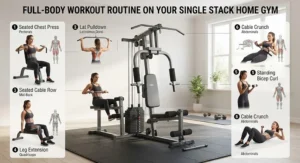
6. Marcy Eclipse HG5000 Deluxe — most adjustable press angles
Where most single stack home gyms give you one fixed chest press angle, the Marcy Eclipse HG5000 Deluxe lets you choose between six, using a spring-loaded release pin to shift between flat, incline, and shoulder press positions. Paired with an independent pec deck station that mimics a free-weight motion path rather than a fixed cable arc, this is the machine built for someone who wants training variety without buying a second piece of equipment. The roughly 198 lb (90 kg) vinyl-and-cable weight stack sits toward the heavier end for this category, and the centre pulley with a dedicated ab crunch strap adds a station some competitors treat as an afterthought. On the spec sheet, that’s a strong package; in aggregated review sentiment, the picture is more mixed. Multiple users report smooth, quiet operation and a roughly three-and-a-half-hour assembly window, while a separate cluster of reviews describes stiff cables and a weight-stack pin that occasionally sticks — variation that seems tied to manufacturing batch rather than a universal flaw. What most buyers overlook is that this model doesn’t ship with an exercise wall chart, which matters more for true beginners than for anyone who already knows their way around a cable station.
Pros:
- ✅ Six press-arm angles, most of any model here
- ✅ Independent pec deck simulates free-weight motion
- ✅ Dedicated centre pulley for ab work
Cons:
- ❌ Review sentiment on cable smoothness is inconsistent
- ❌ No exercise chart included
Price generally falls in the C$800-C$1,150 range at the time of research. If exercise variety through adjustable angles matters more to you than pulley-smoothness consistency, it’s a strong mid-to-upper-tier contender among single stack home gyms.
7. Body-Solid EXM3000LPS — premium pick for outgrowing a single stack
Every list like this needs an honest answer to “what’s next?” — and the Body-Solid EXM3000LPS is it. Worth flagging clearly: this is technically a dual-stack, multi-station gym rather than a true single stack home gym, built around two separate 210 lb weight stacks (420 lb combined) that let two people train side by side without sharing resistance. We’re including it because it’s the natural upgrade path for anyone who’s maxed out a single stack machine’s stack weight and wants club-style performance without a commute. Seven integrated stations — including a mid-height pulley uncommon even on commercial equipment, useful for face pulls and standing chest flys — sit inside a 14-gauge steel frame weighing close to 950 lbs once assembled. That mass is a feature, not a bug: it’s part of why the machine feels remarkably stable under heavy load, a common theme in aggregated reviews. On paper this means serious long-term investment protection; in practice, it also means a genuine 4-6 hour assembly with two people and a dedicated footprint of roughly 83″ x 76″ plus clearance — not a spare-bedroom purchase. Reviewers consistently describe the press arm and mid pulley as feeling closer to commercial-gym quality than anything else on this list, which tracks with the price jump.
Pros:
- ✅ Dual 210 lb stacks support two simultaneous users
- ✅ Seven stations including a rare mid-height pulley
- ✅ Commercial-grade stability from a 14-gauge steel frame
Cons:
- ❌ Requires a dedicated room, not a spare-bedroom fit
- ❌ Assembly runs 4-6 hours with two people
Expect a price in the C$4,500-C$5,500+ range at the time of research — firmly premium territory. It’s not for everyone reading this article, but for households who’ve genuinely outgrown a single stack setup, it’s a legitimate, honestly-earned step up.
Practical Usage Guide: Setting Up Your Single Stack Home Gym
Getting a single stack home gym into your house is only step one; getting real value out of it depends on set-up choices most buyers make in the first thirty days without thinking twice. Start with floor protection — a rubber gym mat under the frame prevents both floor scuffing and the slow creep of a machine shifting position under repeated pin-pulling, which is a common early complaint in aggregated reviews. Next, resist the urge to crank the weight stack to “prove something” on day one; most single stack home gyms ship with cables rated well above what a beginner needs, and starting light lets you dial in seat height and pulley angle before adding resistance. A common first-30-days mistake is skipping the manufacturer’s exercise poster or DVD that ships with most models — even experienced lifters benefit from seeing the intended cable path, since a slightly wrong angle on a low pulley row can shift strain toward the lower back rather than the target muscles. Maintenance is minimal but not optional: wipe down vinyl padding weekly, check cable tension monthly, and add a drop of silicone lubricant to visible pulley points every few months to keep single stack home gyms running quietly for years rather than developing the squeak that eventually drives owners to Marketplace listings.
Real-World Scenarios: Who Actually Buys a Single Stack Home Gym
Picture three very different Canadian households, all shopping the same category. First, a condo-dwelling downtown professional with roughly 40 square feet of spare space and a budget under C$1,000 — for them, the compact footprint and 90% pre-assembly of the Powerline BSG10X solves the two biggest barriers (space and setup hassle) in one purchase. Second, a suburban parent of two who wants a family-friendly machine that won’t intimidate a teenager just starting to lift, with a 300 lb user-weight ceiling and forgiving five-station layout — the Marcy MWM-990 fits that profile well, since its dual-action press arm keeps a learning curve manageable. Third, a former commercial-gym regular working from home who trained five days a week pre-pandemic and now wants near-commercial capability without the drive — for that buyer, the higher weight ceiling of the Body-Solid EXM2500S, or the genuine step-up of the EXM3000LPS, makes more sense than an entry-level frame they’d outgrow within a year. None of these profiles are wrong; they simply prioritize different variables — space, forgiveness, or resistance ceiling — and matching your own profile against those three variables narrows seven options down to one fairly quickly.
Problem → Solution: Common Single Stack Home Gym Frustrations
Even a well-reviewed single stack home gym runs into predictable snags, and most have straightforward fixes. If cables feel stiff or catch mid-pull, the likely culprit is dried factory lubricant rather than a defective unit — a light silicone spray on visible pulley contact points, reapplied every few months, usually resolves it. If the weight-stack pin sticks, check that the rod is inserted fully perpendicular rather than at a slight angle, a mistake that’s easy to make when reaching around a seat back. Buyers who find they’ve plateaued on a 150-160 lb stack within a year aren’t necessarily under-training — cable resistance and free-weight resistance aren’t a 1:1 comparison, so hitting the top pin on lat pulldowns doesn’t automatically mean you need a heavier machine; adding pause reps or slower eccentrics often restores progress. And for anyone whose seat pad has started to compress unevenly after a couple of years of daily use, most manufacturers, including Body-Solid and Marcy, sell replacement pads separately — a far cheaper fix than replacing the whole machine.
How to Choose a Single Stack Home Gym
Picking the right single stack home gym comes down to matching a handful of criteria to your actual space and goals, not to marketing copy:
- Measure your space first, including movement clearance. Add at least two to three feet around the frame for seat adjustments and full range of motion, not just the machine’s static footprint.
- Match weight stack size to your training stage. Beginners rarely need more than 150-160 lb; intermediate lifters benefit from 200 lb-plus stacks that offer more long-term headroom.
- Count the stations that matter to you. A model without a dedicated leg curl or pec fly station isn’t automatically worse, but confirm it covers the movements your program actually uses.
- Weigh assembly effort honestly. Pre-assembled models like the Powerline BSG10X save hours; heavier-duty frames like the EXM2500S trade assembly time for long-term durability.
- Check the warranty terms, not just the length. A lifetime frame warranty with limited parts coverage differs meaningfully from a shorter warranty covering everything.
- Read aggregated review sentiment for consistency complaints. Isolated one-star reviews happen to every product; recurring, specific complaints (like sticking pins) are the signal worth weighing.
- Decide your ceiling before you buy, not after. If you can already picture outgrowing a 160 lb stack within eighteen months, it may be worth stretching your budget toward a heavier single stack or dual-stack model upfront.
Single Stack Multi-Gym vs Cable Crossover Machine
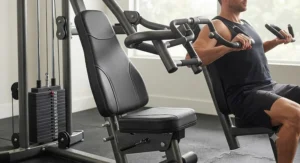
The comparison Canadian buyers ask about most often is single stack multi-gym vs cable crossover machine, and the honest answer is that they solve different problems. A single stack multi-gym, like the seven models covered above, bundles a fixed set of stations — chest press, pulldown, leg developer — into one guided frame, which means less setup flexibility but far more beginner-friendly guided movement paths. A cable crossover machine, closer in spirit to the Marcy MD-9010G’s dual-pulley Smith cage setup, uses adjustable pulley height and open cable arms instead of fixed stations, giving experienced lifters near-unlimited exercise angles at the cost of requiring more technique knowledge to use safely and effectively. For a first-time buyer, a single stack multi-gym’s guided paths reduce the injury risk that comes from improvising angles on an open cable system. For someone who’s already spent years in a commercial gym learning proper cable form, a crossover-style setup offers more long-term exercise variety, though usually at a higher price and larger footprint. If you’re unsure which camp you fall into, the guided single stack option is the safer default — you can always add a crossover-style setup later once you know exactly which angles your program is missing.
Single Stack vs Multi-Stack: What’s the Real Difference
Single stack vs multi-stack sounds like a resistance question, but it’s really a household-size question. A single stack home gym uses one weight stack to power every station, which means only one person can train at a time — perfectly reasonable for an individual or a household that trains on a rotating schedule. A multi-stack machine, like the dual-stack Body-Solid EXM3000LPS covered above, gives each station its own independent stack, letting two or three people train simultaneously without waiting or sharing resistance settings. Canada’s 24-Hour Movement Guidelines recommend adults perform muscle-strengthening activities using major muscle groups at least twice a week, and for most individual Canadians hitting that target, a single stack setup is genuinely sufficient — the extra cost of a multi-stack machine mainly pays for simultaneous-use convenience, not additional exercise capability. Where multi-stack machines earn their premium is in larger households or home gyms doubling as a small training space for friends; outside that specific use case, most buyers are better served putting the price difference toward a heavier single stack or better accessories.
Cable Machine Training: Getting the Most From Your Pulleys
Cable machine training on a single stack home gym rewards a slightly different mindset than free weights, and understanding why helps you avoid wasted sets. Unlike a barbell, cable resistance stays roughly consistent throughout the entire range of motion rather than peaking and dropping with leverage changes, which is why many physiotherapists favour cable work for joint-friendly rehab and hypertrophy training alike. What most buyers overlook when they first start cable machine training is pulley height’s outsized effect on which muscle fibres actually get emphasized — a high-to-low cable crossover recruits the lower chest differently than a mid-height press, even using the identical weight stack setting. Pace matters too: slowing the eccentric (lowering) portion of a cable movement increases time under tension without needing to add plates, a free progression trick most Amazon listings never mention. According to CBC’s coverage of the national exercise guidelines, adults should aim for at least 150 minutes of moderate to vigorous aerobic activity weekly alongside strength work, and cable machine training on a single stack setup is an efficient way to layer that strength component into an already busy week without a commute eating into either.
Multi-Gym for Beginners at Home: What to Expect
A multi-gym for beginners at home should feel forgiving, not intimidating, and single stack home gyms are generally built with exactly that learning curve in mind. Expect the first two weeks to be less about resistance and more about calibration — finding correct seat height, learning which handle attachment suits which movement, and building the habit of a consistent short routine rather than chasing heavier pin settings. A realistic beginner starting point is two to three short sessions per week, working through the machine’s five basic stations at a resistance that allows twelve to fifteen controlled repetitions, well within what a 150-160 lb stack comfortably supports. What most buyers overlook is that a multi-gym’s guided cable paths are actually a safety feature for beginners, not a limitation — they remove the guesswork of proper bar path that trips up so many new free-weight lifters. As confidence and strength build, most beginners naturally start noticing where a machine’s stack ceiling becomes limiting, which is the natural cue to consider a heavier single stack model or, eventually, a dual-stack upgrade like the EXM3000LPS.
Home Gym Upgrade: Long-Term Cost & Maintenance
Thinking about a home gym upgrade eventually is normal, and running the numbers honestly helps decide when it actually makes financial sense. A mid-range single stack home gym in the C$700-C$1,200 range, used consistently for even three years, works out to roughly C$20-C$35 per month — well under a typical Canadian gym membership, and that’s before accounting for gas, parking, or the workouts skipped on bad-weather days. Long-term maintenance costs stay modest: expect to budget roughly C$30-C$60 every couple of years for replacement seat pads or cables on heavily used machines, a fraction of what a gym membership costs annually. The upgrade calculus changes once you’ve genuinely maxed a stack’s resistance across most stations for several consecutive months — at that point, either a heavier single stack model or a dual-stack machine like the EXM3000LPS becomes the more cost-effective home gym upgrade than continuing to plateau. The mistake to avoid is upgrading prematurely based on boredom rather than actual resistance limits; varying rep tempo, rest periods, and exercise order on your current machine is a free “upgrade” most owners try too late.
Common Mistakes When Buying a Single Stack Home Gym
The most common mistake is buying based on station count alone without checking weight stack size, which leaves ambitious beginners plateaued within months. A close second is skipping the clearance measurement — a machine that technically fits against a wall but leaves no room for full seat travel or arm extension becomes frustrating fast, and returns on assembled fitness equipment are notoriously difficult in Canada. Buyers also frequently underweight warranty terms, assuming “lifetime warranty” always means full coverage when it often applies to the frame only, with cables and pads carrying shorter separate terms. Finally, a subtler mistake: choosing a machine based purely on the lowest listed price without reading aggregated review sentiment for recurring complaints, since a slightly pricier single stack home gym with consistently positive cable-smoothness feedback often outlasts a cheaper model that needs pulley replacements within two years.
Safety, Certification & Regulations for Home Gyms in Canada
Strength equipment sold in Canada isn’t subject to the same mandatory third-party certification regime as electrical appliances, but reputable manufacturers like Body-Solid and Marcy still publish maximum user-weight ratings and cable tension specifications that buyers should treat as hard limits, not suggestions. Placement matters for safety too — Canadian basements and garages often have concrete floors, and a rubber protective mat under a single stack home gym both protects flooring and reduces the frame’s tendency to creep during heavy pin-pulling sessions. The Canadian Society for Exercise Physiology’s guidance on resistance training covers health outcomes for adults as part of broader national physical activity guidance, and following a properly progressed program on a home gym machine reduces injury risk compared with improvising unfamiliar free-weight movements alone. Before your first heavy session, it’s worth having a quick form check — even with a friend or a short video call — since a guided cable path still can’t correct a rounded lower back on a seated row the way in-person coaching can.
✨ Don’t Miss These Exclusive Deals!
Ready to build real strength without the commute? Click on any highlighted pick above to check current pricing and availability on amazon.ca. These single stack home gyms will help you build the consistent, at-home routine your future self will thank you for!
Frequently Asked Questions
❓ How much space does a single stack home gym actually need?
❓ Can beginners use a single stack home gym safely without a trainer?
❓ How long does a single stack home gym typically last?
❓ Is a 150 lb weight stack enough for building muscle?
❓ What's the real difference between single stack and cable crossover machines?
Conclusion
Seven machines, three budget tiers, and one consistent theme: the “best” single stack home gym isn’t the one with the most stations or the flashiest listing photos — it’s the one that actually matches your space, your training stage, and how honestly you’ll use it three years from now. The Powerline BSG10X and Body-Solid G1S solve the space problem for condo and apartment living; the Body-Solid EXM1500S and Marcy MWM-990 balance station count against budget for most first-time buyers; the Body-Solid EXM2500S and Marcy Eclipse HG5000 offer the extra resistance and adjustability serious lifters will actually use; and the Body-Solid EXM3000LPS stands ready for whenever a single stack setup genuinely isn’t enough anymore. None of these are the “wrong” choice — they’re built for different rooms, different budgets, and different versions of your training life. What matters now is being honest about which version that is, checking current prices and availability, and picking the single stack home gym that gets used consistently rather than the one that just looks best in a listing photo.
Recommended for You
- Cable Row Handles 2026: 7 Picks That Won’t Wreck Your Wrists
- Home Multi-Gym vs Adjustable Dumbbells: 7 Smart 2026 Picks
- Best Home Multi-Gym for Small Apartments Picks (2026)
Disclaimer: This article contains affiliate links. As an Amazon Associate, I earn from qualifying purchases. If you purchase products through these links, we may earn a small commission at no additional cost to you.
✨ Found this helpful? Share it with your friends! 💬🤗
