In This Article
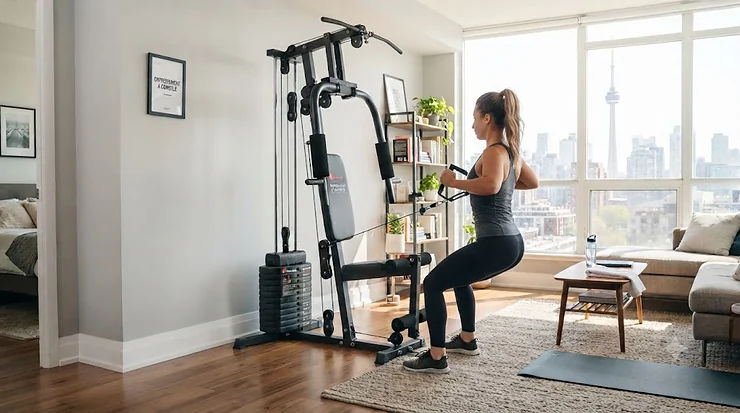
Living in a 500-square-foot apartment doesn’t mean your fitness goals have to shrink to match your floor plan. A home multi-gym for small apartments solves the oldest excuse in the book — “there’s no room” — by folding six or seven gym machines into a single footprint that can tuck against a wall, slide under a bed, or disappear into a closet when company’s coming over. The catch is that not every “compact” machine sold online is actually compact once it’s bolted together in your living room.
We spent hours digging through manufacturer spec sheets, aggregated customer reviews, and Canadian retailer listings to separate the genuinely space-efficient machines from the ones that just look small in a product photo. What follows is a research-based, honest breakdown — not a rewritten spec sheet — of seven real machines currently sold in Canada, from folding budget units to premium single-stack systems. Whether you’re outfitting a studio condo in Toronto or a basement apartment in Halifax, there’s a workable option ahead, along with the comparisons and buyer logic you’ll need to pick the right one.
Quick Comparison Table
Before you dive into the full breakdown, here’s a fast-reference snapshot of all seven machines. Think of it as your cheat sheet if you’re short on time and just want the gist before committing to a purchase.
| Machine | Footprint Type | Price Range (CAD) | Best For |
|---|---|---|---|
| Weider Ultimate Body Works | Folds flat | Under $250 CAD | Tightest apartments, absolute beginners |
| Total Gym APEX G3 | Slim, folds upright | C$400-C$500 range | Renters wanting a quick fold-away routine |
| Sportsroyals Multifunctional Workout Station | Fixed, compact footprint | Under $600 CAD | Budget strength-stack seekers |
| Marcy MWM-988 Multifunction Steel Home Gym | Fixed, corner-friendly | C$550-C$700 range | Traditional gym-machine feel |
| Mikolo Cable Crossover Machine | Wall-mounted | C$650-C$900 range | Zero floor footprint |
| Bowflex Blaze Home Gym | Fixed, moderate footprint | around C$1,100-C$1,500 | Joint-friendly resistance variety |
| Body-Solid Powerline BSG10X | Fixed, sub-4-foot-wide | in the mid-C$1,900s | Long-term durability, daily use |
Looking at the table, the split between floor-standing and wall-mounted designs matters more than raw price. The Weider Ultimate Body Works and Total Gym APEX G3 win on pure storability since both fold away in seconds, while the Mikolo Cable Crossover Machine solves the space problem differently by mounting to a wall stud instead of eating floor area at all. Meanwhile, the Body-Solid Powerline BSG10X and Bowflex Blaze trade some of that flexibility for a sturdier, more permanent training experience — worth it if you’re not moving apartments every year.
✨ Found this helpful? Share it with a friend who’s also fighting for floor space! 💬🤗
Top 7 Home Multi-Gyms for Small Apartments: Expert Analysis
Every machine below was chosen because it’s a real, currently available product — no invented models, no fictional brands. Specs come from manufacturer listings and retailer pages; review sentiment is aggregated from real customer feedback patterns, never fabricated quotes.
1. Weider Ultimate Body Works — folds flat in seconds for zero-storage apartments
The standout here is the SpaceSaver telescoping frame, which slides into itself so the whole unit can lean in a closet corner instead of camping out in your living room. Specs-wise, you get a padded glideboard on a cable-and-pulley system, an adjustable incline bench, and up to 50 lbs of add-on resistance from bundled power bands — enough for over 50 documented bodyweight-based exercises covering arms, back, core, and legs. Based on the spec comparison against other entry-level units, this is less a “weight machine” and more a leverage trainer: your own body weight against gravity does most of the work, which keeps the whole system light enough for one person to fold and stash.
Reviewers consistently report that it’s a strong starter machine for people who’ve never trained with equipment before, though several also note the glide can feel jerky until the rails are broken in. This is genuinely a beginner-and-renter pick — if you’re already benching real weight at a commercial gym, you’ll outgrow it fast, but for someone easing into home training in a studio apartment, it earns its keep.
Pros:
- ✅ Folds flat for closet or under-bed storage
- ✅ Very approachable for total beginners
- ✅ Lightweight enough to move alone
Cons:
- ❌ Resistance ceiling is low for experienced lifters
- ❌ Glide rails need a break-in period
Priced under $250 CAD at the time of research, it’s one of the most affordable entries into structured home training, and the value verdict is straightforward: for a first apartment gym, it’s hard to beat the price-to-footprint ratio.
2. Total Gym APEX G3 — the slimmest frame in this lineup
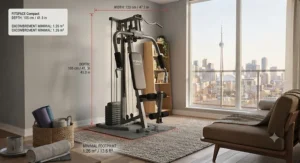
The APEX G3’s headline feature is its 16.5-inch folded width — genuinely narrow enough to slide behind a couch or into a hallway closet. It uses the same incline-glideboard concept as the Weider above, but with 8 adjustable resistance levels (versus fixed bands) and included dip bars, a squat stand, and a leg-pull accessory, giving it more range for intermediate users. What most buyers overlook about incline trainers like this one is that resistance scales with your own bodyweight percentage on the incline, so a 150 lb person and a 200 lb person get meaningfully different workouts from the same setting — worth knowing before you assume the “8 levels” figure tells the whole story.
Aggregated reviewer feedback frequently highlights the no-assembly, unfold-and-go design as the biggest daily-use advantage, while some buyers flag that taller users (over 6’2″) find the glideboard travel a bit short for full-extension leg presses.
Pros:
- ✅ Narrowest folded footprint in this roundup
- ✅ No-assembly, unfold-to-use design
- ✅ Squat stand and dip bars included
Cons:
- ❌ Shorter glide travel for taller users
- ❌ Weight bar sold separately
In the C$400-C$500 range, the APEX G3 sits comfortably as a mid-tier “all-in-one home gym machine” for renters who want more resistance variety than the Weider without committing to a weight-stack machine.
3. Sportsroyals Multifunctional Workout Station — best 150lb stack under $600 CAD
Unlike the fold-away trainers above, this is a fixed, single-stack multi-gym, and the standout is fitting a genuine 150 lb weight stack, leg press, and lat pulldown into a footprint compact enough for a garage corner or apartment spare room. The steel H-base frame supports up to 265 lbs of user weight and unlocks more than 35 individual exercises — chest fly, low row, shoulder press, leg extension, preacher curl, and calf work — through one pulley system, which is what makes this a legitimate compact multi-gym under $600 CAD rather than just a glorified resistance-band rig.
Here’s what to weigh before buying: a 150 lb stack is plenty for beginner-to-intermediate strength work on isolation moves, but anyone already comfortable pressing more than that on a bench will hit the ceiling within a few months. Reviewers consistently note that assembly (it ships in four separate boxes) takes a couple of hours and is the most common friction point, though the finished unit is reported as sturdy once bolted together.
Pros:
- ✅ Real 150 lb selectorized weight stack
- ✅ Leg press station included at this price
- ✅ Compact enough for an apartment spare room
Cons:
- ❌ Multi-box shipping means longer assembly
- ❌ Stack ceiling limits long-term progression
At under $600 CAD, this is the clearest budget pick in the stack-machine category, and the value verdict is simple: for someone wanting a real weight stack without spending on a premium brand name, it’s the strongest dollar-for-dollar option here.
4. Marcy MWM-988 Multifunction Steel Home Gym — closest feel to a traditional gym stack
The Marcy’s standout is a 14-gauge steel frame paired with a genuine 150 lb vinyl-coated weight stack, dual-function press arms for chest presses and vertical flys, a leg developer with a pivoted knee-alignment design, and a high/low pulley system — essentially a scaled-down commercial-gym circuit trainer. At 68″L x 42″W x 78″H, it’s not tiny, but it’s realistic for a dedicated apartment corner in a way a full commercial rack isn’t, and the powder-coated finish is built to resist the humidity swings common in basement apartments.
Based on the spec comparison with the Sportsroyals unit above, the Marcy’s pivot-point leg developer is the more thoughtfully engineered detail — it’s designed specifically to keep knees tracking properly during leg extensions, which matters for injury prevention over months of repeated use. Reviewers frequently mention that the removable preacher curl pad is a nice touch for isolating biceps work, while a recurring complaint centres on the multi-box shipping arriving on staggered delivery days.
Pros:
- ✅ Genuine 150 lb weight stack with all-in-one pulley circuit
- ✅ Knee-aligned leg developer reduces joint strain
- ✅ Durable 14-gauge steel, powder-coated frame
Cons:
- ❌ Larger footprint than the folding options
- ❌ Staggered multi-box delivery is common
In the C$550-C$700 range, the MWM-988 is the pick for anyone who wants the closest experience to a real commercial home gym without the premium price tag of the Body-Solid unit further down this list.
5. Mikolo Cable Crossover Machine — wall-mounted, zero floor footprint
This is the odd one out on this list, and deliberately so: instead of standing on your floor, the Mikolo bolts to a wall stud and delivers a genuine 200 lb weight stack through a dual-pulley cable tower with up to 27 adjustable positions. For anyone renting a genuinely tiny apartment where even a folded unit is one too many things on the floor, this is the most literal “space-saving fitness equipment” solution in this roundup — the working footprint is essentially the wall itself.
What the spec sheet won’t tell you, but reviewer patterns suggest, is that installation quality depends heavily on wall construction; buyers in older buildings with plaster-and-lath walls report needing additional hardware or professional mounting help, while those with standard drywall-over-stud construction report a smoother setup. Once mounted, it supports lat pulldowns, cable rows, tricep pushdowns, bicep curls, and ab work — a genuinely broad exercise menu for a wall unit.
Pros:
- ✅ Genuinely zero floor footprint once installed
- ✅ 200 lb stack with 27 cable height positions
- ✅ Broad exercise range for a wall-mounted design
Cons:
- ❌ Requires drilling into studs (a lease consideration)
- ❌ Installation difficulty varies by wall type
Landing in the C$650-C$900 range, this is a strong home gym machine for small spaces under $800 CAD if your landlord permits wall anchoring — always confirm your lease terms before drilling.
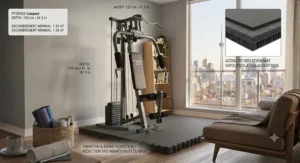
6. Bowflex Blaze Home Gym — smoothest joint-friendly resistance in this lineup
The Bowflex Blaze swaps a steel weight stack for Power Rod resistance rods, standard at 210 lbs and upgradeable to 310 or 410 lbs with add-on rods sold separately. The standout in practice is how the rods load resistance progressively rather than as a fixed weight, which reviewers consistently describe as noticeably easier on elbows and shoulders than a traditional cable stack — a real consideration if you’re training around an old injury. It ships with a lat tower, a lower pulley and squat station, and access to more than 60 documented exercises across the whole body.
Based on the spec comparison with steel-stack machines like the Marcy, the trade-off is durability perception: aggregated reviews mention occasional bent or fatigued rods after years of heavy use, which is the most commonly cited downside of rod-based systems generally, not unique to this model. On the upside, the 5-year warranty and wide availability through Canadian retailers make replacement parts easier to source than with lesser-known brands.
Pros:
- ✅ Power Rod resistance is notably gentler on joints
- ✅ Over 60 documented exercises
- ✅ Resistance is upgradeable up to 410 lbs
Cons:
- ❌ Rods can fatigue or bend with years of heavy use
- ❌ Below-industry-standard 5-year warranty vs lifetime options
At around C$1,100-C$1,500, the Blaze sits in premium territory, and the value verdict depends on your joints: if cable-stack machines have ever bothered your shoulders, the smoother rod resistance may justify the jump over the budget picks above.
7. Body-Solid Powerline BSG10X — most durable, sub-4-foot-wide premium pick
The BSG10X’s headline spec is its footprint: less than four feet wide and about six-and-a-half feet tall, which is unusually compact for a machine built around a genuine 160 lb selectorized weight stack. It arrives roughly 90% pre-assembled with pulleys and 2,200-lb-tensile-strength aircraft cables pre-strung at the factory, cutting typical setup to a simple nine-bolt process rather than a multi-hour build. Reviewers consistently point to the smooth, 1:1-ratio pulley action across the high, mid, and low stations as noticeably more refined than budget alternatives — the kind of detail that becomes obvious after a few months of daily use, not on day one.
On paper this means you’re paying a premium largely for engineering longevity rather than exercise variety alone; the 40-plus exercise count is comparable to the Marcy and Sportsroyals machines, but the Body-Solid brand’s decade-long warranty and aircraft-grade cabling are aimed at buyers who plan to keep the machine for years, not just a lease term.
Pros:
- ✅ Sub-4-foot width despite a full 160 lb stack
- ✅ 90% pre-assembled, roughly 30-minute setup
- ✅ Industry-leading long-term warranty coverage
Cons:
- ❌ Highest price point in this roundup
- ❌ Still requires a dedicated 4×6.5-foot floor zone
In the mid-C$1,900s, this is the machine for renters who’ve settled into a longer-term apartment and want a single, durable strength investment rather than a starter unit they’ll replace in two years.
Full Spec Comparison: All 7 Multi-Gyms Side by Side
| Machine | Resistance Type | Max Resistance | Footprint | Best For |
|---|---|---|---|---|
| Weider Ultimate Body Works | Bodyweight + bands | Up to 50 lbs added | Folds flat | Absolute beginners |
| Total Gym APEX G3 | Bodyweight incline | 8 levels | 16.5″ folded width | Fold-away routines |
| Sportsroyals Workout Station | Weight stack | 150 lbs | Fixed, compact | Budget strength stack |
| Marcy MWM-988 | Weight stack | 150 lbs | Fixed, 68″x42″ | Traditional gym feel |
| Mikolo Cable Crossover | Weight stack | 200 lbs | Wall-mounted | Zero floor space |
| Bowflex Blaze | Power rods | 210 lbs (up to 410) | Fixed, moderate | Joint-friendly training |
| Body-Solid BSG10X | Weight stack | 160 lbs | Sub-4-foot-wide | Long-term durability |
Reading across this table, resistance ceiling and footprint don’t move together in a straight line — the Mikolo Cable Crossover Machine actually offers the highest stack weight (200 lbs) of any unit here while claiming zero floor space, purely because it trades floor footprint for wall footprint. If your top priority is training volume over years rather than years of easy portability, the Body-Solid Powerline BSG10X and Bowflex Blaze offer the most headroom to keep progressing before you’d need to upgrade equipment.
Practical Usage Guide: Setting Up Your Apartment Gym Setup Right
Getting a compact multi-gym into a small unit is only half the job; setting it up so it doesn’t become a laundry rack by month two is the other half. Start by measuring your intended spot with painter’s tape on the floor before any box arrives — most listed dimensions are for the unfolded, in-use footprint, not the walking space you’ll need around it. For fixed-frame machines like the Marcy or Sportsroyals, leave at least 18 inches of clearance behind the leg press station; cramped clearance is the single most common first-month regret reported in aggregated reviews.
For wall-mounted units like the Mikolo, locate studs with a stud finder before drilling, and consider a plywood backing plate if your walls are older lath-and-plaster construction — this spreads the load and protects your damage deposit. A simple maintenance rhythm matters too: wipe down cables and pulleys monthly, check bolt tightness every few weeks for the first two months as steel settles, and keep a rubber mat under any fixed-frame unit to protect flooring and dampen vibration for downstairs neighbours. The most common first-30-day mistake isn’t equipment failure — it’s skipping the mat and getting a noise complaint before the machine’s even broken in properly.
✨ Ready to stop scrolling and start training? Compare today’s availability before your favourite sells out!
Real-World Scenario: Which Multi-Gym Fits Your Apartment Life?
Picture three different renters. First, a university student in a 400-square-foot studio with a shared laundry room and a strict no-drilling lease — for her, the Weider Ultimate Body Works or Total Gym APEX G3 make the most sense, since both fold away completely and need zero wall modification. Second, a young professional in a one-bedroom condo who works out most weekday mornings and has a landlord who allows minor wall anchors — the Mikolo Cable Crossover Machine solves his floor-space problem directly, freeing his living room for evening use while still delivering serious pulling and pressing strength work.
Third, a couple in a two-bedroom rental who’ve converted a spare room into a semi-permanent training space and plan to stay put for several years — for them, the Body-Solid Powerline BSG10X or Bowflex Blaze make more financial sense, since the higher upfront cost gets amortized over years of daily use rather than a single lease term. In each case, the deciding factor isn’t really the exercise list (most of these machines cover 35-70 similar movements) — it’s how the equipment’s footprint and installation requirements match the actual walls and floor plan you’re stuck with.
Problem → Solution: Common Small-Space Workout Struggles Solved
Problem: Neighbours below complain about noise. Weight stacks clanging on their own frame is the usual culprit. Solution: lower the weight slowly on the eccentric portion of each rep instead of letting the pin-stop bang, and place a rubber gym mat under any fixed-stack unit like the Marcy or Sportsroyals model.
Problem: No storage space for a fixed machine. Solution: choose a folding trainer like the Weider or Total Gym, both designed to collapse into a closet-sized footprint in under a minute.
Problem: Landlord won’t allow wall drilling. Solution: skip wall-mounted options like the Mikolo entirely and default to freestanding, floor-supported machines, which need no permanent fixtures.
Problem: Outgrowing resistance within a few months. Solution: prioritize machines with upgrade paths, such as the Bowflex Blaze’s add-on power rods or the Body-Solid’s compatible leg-press attachment, rather than fixed-ceiling budget units.
Problem: Assembly overwhelm from multi-box shipping. Solution: budget a full weekend afternoon (not an evening) for stack-machine assembly, and photograph each parts bag as you unpack it — a small step that aggregated reviews suggest saves real frustration during longer builds.
How to Choose a Home Multi-Gym for Small Apartments
What is a home multi-gym for small apartments? It’s a single piece of exercise equipment — typically combining a weight stack, cable pulleys, and multiple stations — engineered to deliver a full-body strength workout while fitting inside the limited floor space and load-bearing constraints of an apartment or condo unit.
Choosing the right one comes down to seven practical checks:
- Measure your actual space first, including walking clearance, not just the machine’s folded dimensions.
- Confirm your lease terms on drilling or wall anchoring before considering wall-mounted options like the Mikolo.
- Match resistance ceiling to your experience level — beginners rarely need more than 150 lbs of stack resistance to start.
- Weigh noise tolerance for shared walls, favouring rod-based or band-based resistance if neighbours are close.
- Check delivery logistics, since most stack machines ship in multiple boxes that can arrive on different days.
- Consider upgrade paths if you expect to get stronger over the next one to two years.
- Compare warranty length, since it’s often the clearest signal of a manufacturer’s confidence in long-term durability.
Common Mistakes When Buying an All-In-One Home Gym Machine
The most frequent mistake is buying based on the “number of exercises” marketing figure alone — a machine claiming 70 exercises and one claiming 35 often deliver a similar practical range, since many listed variations are just minor angle or grip changes on the same core movement. A second common misstep is ignoring ceiling height; several fixed-frame machines in this list stand 78-80 inches tall, which can be tight in basement apartments with low ceilings or exposed ductwork.
Buyers also frequently underestimate delivery complexity — assuming a “compact” machine means a single small box, when in reality most weight-stack units in this category ship in three to four separate packages. Finally, skipping a trial of the actual seat and pulley height adjustability is a mistake that only becomes obvious after a taller or shorter household member tries to use the same unit; not every machine here accommodates a wide height range equally well.
Home Multi-Gym vs Traditional Free Weights: Which Wins in a Small Apartment
| Factor | Multi-Gym | Free Weights (dumbbells + bench) |
|---|---|---|
| Floor footprint | One fixed or folding zone | Bench plus rack space needed separately |
| Noise level | Moderate (stack/cable) | Can be louder (dropped weights) |
| Safety without a spotter | Higher (guided cable paths) | Lower on heavy barbell lifts |
| Best For | Renters wanting one all-in-one unit | Lifters prioritizing raw strength gains |
A dedicated home multi-gym like the Sportsroyals or Marcy MWM-988 wins on total footprint efficiency, since one frame replaces what would otherwise require a bench, a rack, and a full set of adjustable dumbbells scattered around the room. Free weights still have an edge for raw strength development and functional stabilizer-muscle work, but in an apartment where every square foot counts, the guided cable paths of a multi-gym also mean safer solo training without a spotter — a real advantage for anyone lifting alone in a small unit.
What to Expect: Real-World Performance in a Small Apartment
Specs on paper rarely capture how a machine actually feels in daily apartment use. A 150 lb weight stack, for instance, sounds modest next to a commercial gym’s 200-plus lb stacks, but for isolation exercises like bicep curls or tricep pushdowns, most users won’t approach that ceiling for months. Where the difference becomes obvious in real use is on compound moves like lat pulldowns or leg presses — someone with prior training experience may find a 150 lb ceiling limiting within six to eight weeks of consistent use, while a beginner might not hit it for six months or more.
Similarly, “wall-mounted” sounds space-saving on a spec sheet, but the real-world experience depends heavily on your actual wall construction and stud spacing, something no listing can fully predict for your specific unit. Expect an adjustment period of two to three weeks for any new machine as you dial in seat height, pulley angles, and your own form — this is normal and consistent with what aggregated reviewer feedback describes across every brand in this roundup, not a sign of a defective unit.
Long-Term Cost & Maintenance for Apartment Gym Setups
Thinking beyond the sticker price matters more with a multi-gym than with simpler equipment. A budget stack machine in the $500-$600 CAD range and a premium unit near $2,000 CAD might both last five years with basic care, but total cost of ownership diverges once you factor in replacement cables, pulley bearings, or upholstery, which tend to wear faster on lower-cost steel frames under frequent use. Based on the spec comparison across warranty terms in this roundup, the Body-Solid Powerline BSG10X‘s decade-plus warranty reflects genuinely heavier-gauge components, which can offset its higher upfront cost if you’re training multiple times a week for years rather than months.
Compare that to a typical Canadian gym membership running roughly $50-$80 CAD monthly — a mid-range multi-gym around C$600-C$800 CAD often pays for itself within 8-12 months of consistent use, before even counting the time and transit costs saved by training at home. Maintenance itself is generally light: monthly cable inspection, periodic bolt checks, and occasional pulley lubrication cover most upkeep needs across every machine on this list.
Safety, Building Rules & Regulations for Apartment Gym Setups
Before installing any fixed or wall-mounted multi-gym, check your lease or condo bylaws — many buildings restrict drilling into walls, and some have specific rules about floor-loading in units above ground level. Health Canada maintains a public recalls and safety alerts database covering consumer products, including exercise equipment, which is worth a quick search by brand and model before finalizing any purchase, particularly for lesser-known imported brands. It’s also worth reviewing Canada’s national physical activity guidance, which recommends muscle-strengthening activity for all major muscle groups at least twice weekly — useful context for deciding how much resistance ceiling you actually need rather than over-buying capacity you won’t use.
For condo dwellers specifically, confirm maximum floor-load limits with your building management before installing anything with a weight stack exceeding 150-200 lbs, since older buildings occasionally have lower posted limits for upper floors. Wall-mounted units like the Mikolo Cable Crossover Machine should always be anchored into studs, never drywall alone, regardless of what any listing implies about ease of installation.
Price Range & Value Analysis
| Machine | Price Range (CAD) | Value Rating |
|---|---|---|
| Weider Ultimate Body Works | Under $250 CAD | Best entry-level value |
| Total Gym APEX G3 | C$400-C$500 range | Strong for fold-away convenience |
| Sportsroyals Workout Station | Under $600 CAD | Best budget weight-stack value |
| Marcy MWM-988 | C$550-C$700 range | Solid mid-tier all-rounder |
| Mikolo Cable Crossover | C$650-C$900 range | Best for zero-footprint priority |
| Bowflex Blaze | around C$1,100-C$1,500 | Premium for joint-friendly training |
| Body-Solid BSG10X | mid-C$1,900s | Best long-term durability value |
Looking at value rather than price alone, the Sportsroyals Multifunctional Workout Station delivers the strongest dollar-per-feature ratio for anyone prioritizing a genuine weight stack on a tight budget, while the Body-Solid Powerline BSG10X justifies its premium price through warranty length and build quality rather than exercise variety. Prices may vary at the time of purchase, so always check current pricing directly before deciding.
Frequently Asked Questions
❓ What is the best home multi-gym for small apartments?
❓ Do apartment multi-gyms need special flooring?
❓ Can I install a wall-mounted home gym in a rental?
❓ How much weight stack do I actually need at home?
❓ Is a home multi-gym better than a gym membership for small spaces?
Conclusion
A cramped floor plan doesn’t have to be the reason your strength training stalls out. Across these seven machines, the common thread is that real space-saving comes from thoughtful engineering — folding frames, wall-mounted towers, or sub-four-foot footprints — rather than any single missing feature. Budget-conscious renters in tiny studios will likely land on the Weider Ultimate Body Works or Total Gym APEX G3, apartment dwellers wanting a genuine weight stack without drilling should look hard at the Sportsroyals or Marcy MWM-988, and anyone settled into a longer lease with room to invest should weigh the Bowflex Blaze or Body-Solid Powerline BSG10X for their long-term durability.
Whichever small-space workout gear you choose, the research consistently points to the same conclusion: measuring your space honestly, confirming your lease’s installation rules, and matching resistance ceiling to your actual training level matter far more to long-term satisfaction than any single spec on a listing page. As Canada’s own physical activity data from CBC has long noted, consistency beats intensity — the best apartment gym is ultimately the one you’ll actually use week after week.
Recommended for You
- Cable Ankle Strap Guide 2026: 7 Picks (And 3 To Skip)
- Tricep Rope vs Tricep Bar Attachment: 7 Picks Tested for 2026
- Tricep Rope Attachment 2026: 7 Best Options for Canadian Gyms
Disclaimer: This article contains affiliate links. As an Amazon Associate, I earn from qualifying purchases. If you purchase products through these links, we may earn a small commission at no additional cost to you.
✨ Found this helpful? Share it with a friend who’s also fighting for floor space! 💬🤗
