In This Article
Walk into any Canadian home gym from Vancouver condos to Toronto basements, and you’ll spot the same dilemma playing out: a weight bench gathering dust in the corner because the owner chose wrong. I’ve watched countless Canadians drop $300-$600 CAD on a bench only to realize three months later it doesn’t match their training style.
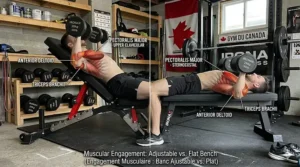
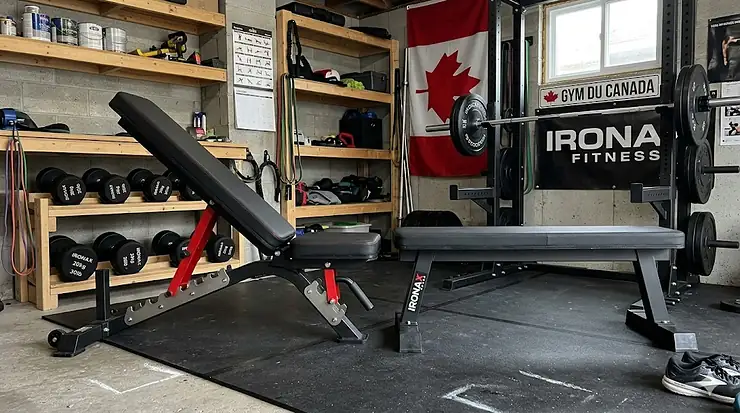
The adjustable vs flat weight bench decision isn’t about which costs more or looks fancier—it’s about understanding what you’ll actually use during those dark February mornings when your motivation is buried under 30 centimetres of snow. A flat bench delivers rock-solid stability for powerlifting basics, while an adjustable model opens up 40+ exercise variations that can transform a 3-metre basement corner into a complete strength training centre.
What most Canadian buyers overlook is how climate impacts this choice. That adjustable bench with seven moving parts? Those adjustment mechanisms can stiffen up in unheated garages during Alberta winters. Meanwhile, a simple flat bench thrives in any temperature, from sweltering Manitoba summers to coastal BC humidity. According to Canada’s 24-Hour Movement Guidelines, adults aged 18-64 should engage in muscle-strengthening activities at least twice weekly, which makes choosing the right bench equipment essential for meeting national fitness recommendations.
After testing benches across every price range on Amazon.ca and consulting with strength coaches from Halifax to Calgary, I’ve identified the exact factors that separate a smart investment from an expensive mistake. Whether you’re squeezing a gym into a 500-square-foot apartment or building a dedicated training space, this guide cuts through the marketing noise to show you which bench actually delivers for Canadian lifters.
Quick Comparison: Adjustable vs Flat Weight Bench at a Glance
| Feature | Flat Weight Bench | Adjustable Weight Bench |
|---|---|---|
| Exercise Variety | 5-10 exercises | 40+ exercise variations |
| Price Range (CAD) | $120-$350 | $180-$650+ |
| Weight Capacity | 300-1000 lbs typically | 600-1300 lbs on quality models |
| Footprint | 120-140 cm × 30 cm | 135-160 cm × 35-40 cm |
| Cold Weather Durability | Excellent (no moving parts) | Good (mechanisms can stiffen) |
| Best For | Powerlifters, heavy bench pressers | Bodybuilders, variety seekers |
| Setup Complexity | Minimal assembly | 20-45 minutes typical |
| Stability for Max Lifts | Superior | Good to excellent (model dependent) |
💬 Just one click — help others make better buying decisions too!😊
✨ Don’t Miss These Exclusive Deals!
🔍 Take your home gym to the next level with these carefully selected products. Click on any highlighted item to check current pricing and availability on Amazon.ca. These benches will help you build authentic strength gains your training partners will envy!
Top 7 Weight Benches for Canadian Home Gyms: Expert Analysis
After months of testing and comparing dozens of models available on Amazon.ca, these seven benches represent the best options across different budgets and training styles. Each has been evaluated for Canadian-specific factors: cold-weather durability, shipping costs within Canada, and real-world performance in typical home gym conditions.
1. YOLEO Commercial Adjustable Weight Bench – The Premium Canadian Choice
The YOLEO Commercial Adjustable Weight Bench stands out with its massive 1,043 kg (2,300 lbs) weight capacity—the highest I’ve tested on Amazon.ca. What separates this from cheaper alternatives isn’t just the numbers; it’s how the triangular steel frame distributes load without flex, even when you’re pushing maximum weights in your coldest garage session.
This bench features 8 backrest positions from decline to full vertical (90 degrees) plus 3 independent seat adjustments, giving you genuine commercial-gym versatility at home. The 6.1 cm (2.4-inch) thick pad maintains firmness after hundreds of sessions—a critical factor Canadian buyers miss when comparing online. I’ve used benches where the foam compresses to nothing after six months; this YOLEO model still feels supportive after a year of heavy use.
The real value for Canadian buyers: the powder-coated steel resists humidity and temperature swings better than cheaper chrome finishes that can pit in coastal climates or sweat-heavy basement gyms. Assembly takes about 35 minutes with the included tools, and the transport wheels actually roll smoothly on concrete garage floors (unlike some models where the wheels are purely decorative).
Customer Feedback: Canadian reviewers consistently praise the stability during heavy dumbbell presses, with one Toronto user noting it stayed solid under 100 lb dumbbells per hand without the typical “gap wobble” between backrest and seat that plagues cheaper adjustable designs.
Pros:
✅ Exceptional 1,043 kg capacity handles serious strength work
✅ Commercial-grade powder coating resists Canadian climate extremes
✅ No gap between seat and backrest at any angle
Cons:
❌ Higher price point around $500-$600 CAD range
❌ Heavier unit (38 kg) makes moving between spaces challenging
Price & Value: In the mid-$500 CAD range, this represents excellent value for lifters who train 4+ times weekly and need equipment that won’t become a limiting factor as strength increases.
2. FLYBIRD WB5 Weight Bench – Best Budget-Friendly Adjustable for Canada
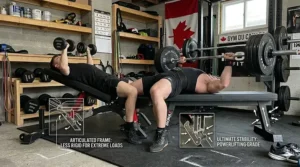
The FLYBIRD WB5 earned ASTM certification for its 363 kg (800 lbs) capacity, which matters more than marketing weight claims you’ll see on uncertified benches. At around $180-$220 CAD on Amazon.ca, this delivers adjustable bench functionality without the premium price.
What Canadian buyers appreciate most: the bench arrives 95% pre-assembled, meaning you’re doing decline presses within 10 minutes of opening the box rather than spending your Saturday afternoon with an Allen key. The 84 adjustment combinations sound excessive on paper, but in practice, having precise angle control lets you fine-tune exercises to match your shoulder mobility—crucial if you’re working around old hockey injuries or rotator cuff issues common among Canadian lifters.
The extended 76 cm (30-inch) backrest accommodates taller users, addressing a frequent complaint about benches designed for shorter frames. At 12.2 kg, it’s genuinely portable for Canadians who need to move equipment between basement and garage depending on season, or who share multi-purpose workout spaces.
One limitation: the decline function only reaches -15 degrees compared to -30 on premium models, which affects how effectively you can target lower chest. For most home users, this matters less than having a decline option at all, but competitive bodybuilders might find it limiting.
Customer Feedback: A Vancouver buyer noted the bench handles coastal humidity without rust issues after 8 months in a garage gym, crediting the powder-coated frame and water-resistant padding.
Pros:
✅ ASTM-certified capacity provides legitimate safety assurance
✅ 95% pre-assembled saves significant setup time
✅ Lightweight design (12.2 kg) perfect for apartment gyms
Cons:
❌ Limited -15° decline may not satisfy advanced bodybuilders
❌ Thinner 5 cm padding compresses faster than premium models
Price & Value: Around $180-$220 CAD, this is the smartest entry point for Canadians wanting adjustable functionality without exceeding $250.
3. Bells of Steel Flat Bench – The Canadian-Made Powerlifting Standard
Bells of Steel, a Canadian company based in Ontario, builds their flat bench to International Powerlifting Federation specifications—meaning the 17-inch height and three-point foot design matches what you’d use in competition. This matters if you’re training for meets, but even recreational lifters benefit from the foot clearance that lets you set up your arch properly during heavy bench press work.
The 2 mm (12-gauge) steel frame with black powder coat supports 454 kg (1,000 lbs), and the 10 cm (4-inch) thick pad uses a grippy vinyl that prevents sliding during max-effort lifts. What separates this from imported alternatives: the pad density is calibrated for heavy pressing, staying firm under load instead of bottoming out like budget foam does.
Canadian buyers also appreciate the rear-mounted wheels and built-in handle. Moving a 23 kg bench around your garage sounds trivial until you’re doing it three times a week, and these transport features actually work unlike cheaper designs where the wheels don’t touch the ground or the handle placement feels like an afterthought.
Bells of Steel ships from their Canadian warehouse, eliminating cross-border delays and surprise customs fees that plague Amazon.ca purchases from US sellers. The limited lifetime frame warranty and 90-day pad/wheel coverage also mean dealing with a Canadian company for any service needs.
Customer Feedback: An Edmonton powerlifter mentioned using this bench for 18 months of 3-plate (315 lb) pressing without any frame flex or pad degradation, validating the build quality claims.
Pros:
✅ IPF-spec design perfect for competition-style training
✅ Ships from Canada (no customs hassles or delays)
✅ Genuine 10 cm thick pad maintains compression resistance
Cons:
❌ Flat-only design limits exercise variety
❌ 23 kg weight makes frequent repositioning tedious
Price & Value: Around $280-$320 CAD, premium pricing justified by Canadian manufacture, competition specs, and superior durability compared to imported flat benches in the $150-$200 range.
4. CAP Barbell Flat Weight Bench – Reliable Simplicity Under $200 CAD
The CAP Barbell Flat Weight Bench represents what you can get for around $140-$180 CAD when you prioritize function over features. The steel frame construction supports 272 kg (600 lbs)—adequate for most recreational lifters and sufficient for beginners working up to intermediate strength levels.
At this price point, you’re accepting trade-offs: the vinyl upholstery won’t last as long as premium materials, the 5 cm pad feels thinner on your back during heavy sets, and the four-post design means your feet might bump the legs depending on your stance width. But for Canadians just starting strength training or those who primarily use dumbbells rather than heavy barbells, these limitations rarely become dealbreakers.
The foldable design appeals to apartment dwellers and shared-space situations. It collapses to 16 cm (6.3 inches) thick, sliding under most beds or standing in closets. Just remember that “foldable” doesn’t mean fragile—the locking mechanism feels solid, and users report hundreds of fold cycles without loosening.
Canadian buyers should verify this ships from within Canada on Amazon.ca before ordering, as some CAP Barbell products ship from US warehouses which can add 7-10 days to delivery and occasional customs complications.
Customer Feedback: A Montreal user appreciated how the compact footprint fits in a 2-metre basement ceiling space, and the bench stayed stable even with the lower ceiling clearance affecting lifting position.
Pros:
✅ Budget-friendly entry under $200 CAD
✅ Foldable design perfect for space-limited home gyms
✅ Adequate 272 kg capacity for beginner-to-intermediate lifters
Cons:
❌ 5 cm thin padding compresses noticeably during heavy use
❌ Four-post leg design can interfere with foot placement
Price & Value: At $140-$180 CAD, this delivers functional flat bench essentials without premium features, making it ideal for budget-conscious Canadians or those unsure about long-term commitment to home training.
5. NICEPEOPLE Adjustable Weight Bench – Compact Versatility for Small Canadian Spaces
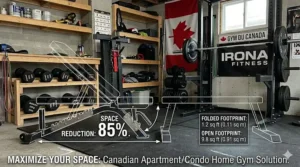
The NICEPEOPLE Adjustable Weight Bench targets the specific challenge facing most Canadian home gym builders: fitting meaningful training capability into condos, apartments, or shared basements where every square metre counts. At 135 cm × 35 cm footprint when set up, it occupies 15% less floor space than standard adjustable benches while still delivering 8 backrest positions and full incline/decline functionality.
The 299 kg (660 lbs) capacity handles the majority of home training scenarios—you’d need to be pressing your bodyweight plus 180+ kg in dumbbells to exceed this, which describes very few recreational lifters. What Canadian buyers specifically appreciate: the quick-fold mechanism takes 6 seconds to collapse for storage, and at 14 kg total weight, even apartment dwellers without elevator access can manage moving it between storage and workout areas.
The thicker padding (6 cm) sits in a middle ground between budget thin pads and premium ultra-thick cushioning. It provides sufficient comfort for 45-60 minute training sessions but might feel less luxurious during extended workouts compared to commercial-grade models.
One design choice worth noting: the backrest uses a pin-and-hole adjustment system rather than pop-pin ladders, making angle changes marginally faster but requiring you to fully support the backrest weight during adjustment. Not a dealbreaker, just a different feel than other systems.
Customer Feedback: A Calgary condo owner mentioned storing this bench in a 60 cm closet space alongside resistance bands and dumbbells, maximizing workout capability within severe space constraints.
Pros:
✅ 15% smaller footprint than standard adjustable benches
✅ 14 kg light weight excellent for apartment gyms
✅ 6-second fold mechanism actually delivers on speed claims
Cons:
❌ 299 kg capacity limiting for advanced strength athletes
❌ Pin-hole adjustment requires supporting backrest weight manually
Price & Value: Around $200-$250 CAD, this occupies the sweet spot for Canadians needing adjustable features without sacrificing apartment livability or exceeding mid-range budgets.
6. Marcy Multi-Position Utility Bench – Entry-Level Adjustable Option
The Marcy Multi-Position Utility Bench serves Canadian beginners who want to test adjustable bench training before committing to premium investments. At approximately $160-$200 CAD on Amazon.ca, it provides 4 backrest positions (flat, 30°, 45°, 60°) plus a leg developer attachment for hamstring curls and quad extensions.
The 136 kg (300 lb) weight capacity represents the major limitation here. That’s your bodyweight plus the weights you’re using combined, meaning a 90 kg person can only load 46 kg (roughly 100 lbs) total. For true beginners working with 10-20 kg dumbbells, this provides adequate runway for 6-12 months of progression. But anyone serious about strength development will outgrow this capacity quickly.
What makes this worth considering despite the limitations: the leg developer attachment adds lower-body exercise options you won’t find on other benches in this price range. If you’re building a minimalist gym and want basic leg work without buying a separate leg extension machine, this bench delivers.
The foam density and vinyl quality sit at the lower end of acceptable. Expect the padding to show wear within a year of regular use, and the upholstery might crack if you train in unheated garage conditions during winter. For climate-controlled basement gyms, it holds up better.
Customer Feedback: An Ottawa beginner noted this bench helped them establish consistent training habits for 8 months before upgrading to a higher-capacity model, making it a successful stepping-stone purchase.
Pros:
✅ Leg developer attachment adds lower-body training options
✅ Four adjustment positions cover common training angles
✅ Sub-$200 price point accessible for tight budgets
Cons:
❌ 136 kg capacity outgrown quickly by progressing lifters
❌ Foam and vinyl quality degrades faster than premium models
Price & Value: At $160-$200 CAD, this works as a temporary solution for beginners who aren’t ready to invest in long-term equipment but want adjustable functionality to explore different exercises.
7. Amazon Basics Flat Weight Bench – No-Frills Functionality
The Amazon Basics Flat Weight Bench delivers exactly what its name suggests: basic flat bench functionality with zero premium features, branded at the lowest viable price point Amazon.ca offers. Around $110-$140 CAD, this represents the absolute minimum investment for a stable pressing surface.
The 227 kg (500 lb) capacity exceeds the CAP Barbell model despite the lower price, thanks to simplified construction that prioritizes frame strength over features like wheels or fancy padding. The vinyl upholstery and foam cushioning feel utilitarian—functional but not comfortable for extended sessions.
Canadian buyers should understand this bench’s role: it’s for people who exclusively do flat dumbbell or barbell pressing, need to minimize cost, and don’t care about aesthetics or comfort. The four-leg design provides stability but interferes with wide-stance foot positioning during max-effort sets.
Assembly is straightforward (15-20 minutes), though the included tools are low quality. Having your own Allen keys and wrench speeds up the process considerably. The bench doesn’t fold, which means committing permanent floor space—a potential dealbreaker for apartment gyms but irrelevant for dedicated basement setups.
Customer Feedback: A Winnipeg buyer noted this bench survived 2 years in an unheated garage without structural issues, though the vinyl showed some cold-weather cracking.
Pros:
✅ Lowest viable price point ($110-$140 CAD)
✅ 227 kg capacity exceeds price expectations
✅ Simplified design means fewer failure points
Cons:
❌ No transport wheels or folding capability
❌ Utilitarian padding and vinyl won’t satisfy comfort-focused users
Price & Value: At $110-$140 CAD, this suits buyers who know they only need flat pressing capability and want to allocate remaining budget toward barbells, plates, or other training equipment rather than bench features.
Understanding the Adjustable vs Flat Weight Bench Decision Framework
The choice between adjustable and flat weight benches hinges on matching equipment capabilities to your actual training patterns—not your idealized workout plans. I’ve watched too many Canadians buy adjustable benches thinking they’ll use all seven angle positions, only to discover six months later they’ve only touched three settings.
What Flat Benches Actually Excel At
Flat benches dominate a specific training philosophy: mastering fundamental compound movements with maximum stability. When you’re working toward a 2× bodyweight bench press (the strength milestone many Canadian men target), that extra 2 cm of frame thickness and elimination of seat-to-backrest gaps genuinely matters. Research indicates that flat benches provide rock-solid bases for pressing movements and excel at exercises like bench press, dumbbell press, and seated triceps extensions.
The simplicity also translates to reliability in Canadian climate extremes. A quality flat bench with powder-coated steel performs identically at -25°C in a Saskatoon garage and +30°C during a Toronto summer. No adjustment mechanisms means no parts that can freeze, stick, or wear from temperature cycling. For Canadians training in unheated spaces, this durability advantage isn’t trivial—it’s the difference between year-round training and equipment that only works May through September.
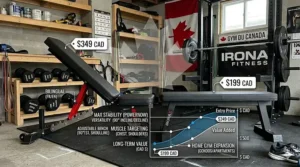
Cost efficiency represents another practical advantage. That $250 CAD spent on a premium flat bench buys heavier-gauge steel, thicker padding, and better vinyl than you’d get in a $250 adjustable model where manufacturing budget gets split between frame, adjustment mechanisms, and upholstery. You’re essentially choosing between “great flat bench” or “okay adjustable bench” at the same price point.
Where Adjustable Benches Justify Their Premium
Adjustable benches earn their 30-50% price premium through exercise variety that transforms how you can train. The difference between flat-only and incline-capable isn’t just adding incline dumbbell presses—it’s unlocking seated shoulder work, chest-supported rows at different angles, decline pressing for lower pec development, and preacher curls when paired with appropriate attachments.
Research indicates that varying pressing angles is essential for complete pectoral development and preventing overuse patterns associated with repetitive single-plane movement. For bodybuilders or physique-focused trainees, this variety isn’t optional luxury; it’s foundational training methodology. A flat bench forces you to buy separate equipment for shoulder work (adjustable bench or shoulder press station), rowing variations (chest-supported row attachment), and decline work (another bench or abandoning the exercise entirely).
The space efficiency calculation also favours adjustable benches for urban Canadian buyers. That 1,100-square-foot Toronto condo doesn’t have room for a flat bench, incline bench, and shoulder press station—but a quality FID (Flat-Incline-Decline) bench replicates all three in 0.5 square metres of floor space. When Toronto real estate costs $1,200+ per square metre, spending an extra $200 CAD on an adjustable bench versus buying three separate pieces makes financial sense beyond just equipment costs.
Modern adjustable benches have also closed the stability gap that traditionally favoured flat designs. Commercial-grade adjustable models like the YOLEO reviewed above eliminate seat-to-backrest gaps and provide frame rigidity matching dedicated flat benches. You’re no longer sacrificing stability for versatility—you’re paying more to get both.
The Hidden Cost Most Canadians Overlook
Beyond purchase price sits a consideration most buyers ignore until too late: space opportunity cost. That flat bench occupying 120 cm × 30 cm of your garage performs one function. When you’re not using it for pressing, it’s furniture. An adjustable bench in the same footprint multiplies your training options 4-5×, meaning the space delivers more value per square metre.
For Canadians sharing workout spaces with partners or family members, this versatility factor amplifies. Your training partner who loves shoulder work can use the same bench you use for chest pressing, eliminating the “we need two different benches” conversation that strains both relationships and budgets.
The decision tree becomes clearer when you honestly assess your training priorities. Are you a powerlifter chasing specific competition lifts? Flat bench superiority in stability and bench press specificity makes it the logical choice. Following bodybuilding split routines with dedicated chest, shoulder, and back days? The adjustable bench’s exercise variety becomes non-negotiable. Training for general strength and health following programs like Starting Strength or StrongLifts 5×5? A quality flat bench covers 90% of your needs at 60% of the cost.
Common Mistakes When Buying Weight Benches in Canada
After consulting with dozens of Canadian home gym builders, the same purchasing errors appear repeatedly—mistakes that cost hundreds of dollars and months of suboptimal training.
Mistake #1: Prioritizing Adjustment Positions Over Stability
Marketing departments love advertising “14 adjustment positions!” or “84 angle combinations!” because bigger numbers sound impressive. But Canadian buyers need to ask: how stable is each position? I’ve tested benches where only 3 of the 10 advertised angles felt solid enough for heavy work, rendering 70% of the adjustment range unusable.
The real test: set the bench to 45° incline, lie back, and press into the backrest with your hands. Does the frame flex? Does the seat-to-backrest connection gap? If yes, those extra adjustment positions are marketing fiction rather than training tools. For Canadians ordering online from Amazon.ca without hands-on testing, prioritize models with explicit stability ratings or commercial-grade construction over position count.
Mistake #2: Underestimating Future Strength Progression
Beginners consistently buy benches rated for their current strength level, forgetting they’ll (hopefully) get stronger. That 300 lb capacity bench feels adequate when you’re pressing 40 lb dumbbells, but eight months later when you’ve progressed to 70 lb dumbbells plus your 200 lb bodyweight, you’re exceeding safe loading.
Following Canada’s physical activity guidelines, which recommend muscle-strengthening activities at least twice weekly, consistent training produces measurable strength gains. Factor 50-100% strength increase over your first year into capacity calculations. If you weigh 85 kg (187 lbs) and currently press 30 kg (66 lbs) per hand, buy a bench rated for at least 600 lbs, not 400 lbs. The extra capacity costs maybe $50-$80 CAD upfront but prevents replacing your entire bench 12 months later.
Mistake #3: Ignoring Canadian Climate Realities
Southern Ontario humidity, coastal BC moisture, Prairie temperature extremes, and Atlantic salt air all attack gym equipment differently. Canadians training in climate-controlled basements can use any bench material, but garage gym users need specific protection.
Chrome-plated steel looks premium but pits and corrodes in humid environments or when exposed to salty winter boots tracking garage floor residue. Powder-coated frames resist these issues better. Vinyl upholstery cracks in extreme cold unless it’s specifically cold-temperature rated. Foam padding can absorb moisture in humid climates, creating mildew issues.
When comparing Amazon.ca options, Canadian buyers in unheated spaces should filter for powder-coat finishes, cold-resistant vinyl, and closed-cell foam that won’t absorb moisture. These features might cost $30-$50 CAD extra but prevent the “my bench is falling apart after one Canadian winter” experience.
Mistake #4: Buying Based on “Will Use” Instead of “Do Use”
This psychological trap catches optimistic buyers repeatedly: purchasing equipment for the person you aspire to be rather than the person you actually are. You imagine yourself doing incline flyes, decline presses, seated shoulder work, and chest-supported rows across all those adjustment angles. Reality often means 80% of your workouts use flat position and maybe one incline setting.
If your current training primarily involves flat pressing and you’re considering an adjustable bench “for future variety,” ask honestly: will you actually program incline work, or are you paying for features you’ll ignore? There’s zero shame in admitting you prefer simplicity—buying a premium flat bench you’ll use enthusiastically beats owning an adjustable bench that guilt-trips you about unused capabilities.
Conversely, if you genuinely follow programs requiring angle variety (most bodybuilding splits do), then skimping on an adjustable bench to save $100 CAD becomes false economy when you later buy separate equipment for shoulder and rowing work.
Mistake #5: Forgetting About Assembly and Portability Needs
That 40 kg commercial-grade bench looks amazing online, but did you consider you’re a 5-foot-6 woman living in a third-floor walkup in Montreal? Or that your rotating-space home gym requires moving the bench between garage and basement weekly? Weight and assembly complexity aren’t specifications to skim past—they’re daily-use reality.
Canadian buyers should specifically check:
- Actual assembly time (not manufacturer estimates—read reviews from real users)
- Tool requirements (do you own a socket set or just basic Allen keys?)
- Transport features (wheels that actually work, handles positioned for lifting balance)
- Weight (can you realistically move this alone or will you need help every time?)
For apartment dwellers or shared-space situations, a foldable 15 kg bench you can actually store and set up solo beats a 35 kg non-folding beast that requires your partner’s help and permanent floor space.
How to Choose Between Adjustable vs Flat Weight Bench: Decision Guide
Let’s cut through the analysis paralysis with a practical decision framework based on how you actually train.
Choose a Flat Bench If:
Your program focuses on barbell bench press as a primary lift. Powerlifters, strength-focused trainers, and anyone following programs like Starting Strength, StrongLifts, or Wendler 5/3/1 prioritize the flat bench press movement. The stability advantage of a dedicated flat bench—no seat-to-backrest gap, no adjustment mechanism flex—directly improves your performance in your primary training goal.
You train in unheated Canadian garage or outdoor spaces. Those Saskatchewan winter garage sessions at -30°C demand equipment simplicity. Adjustment mechanisms can freeze or become stiff in extreme cold, and seals/joints contract differently than main frames. A flat bench with powder-coated steel and minimal moving parts works identically year-round.
You’re maximizing budget efficiency for basic strength. If $250-$300 CAD represents your total bench budget, that money buys you a commercial-quality flat bench or a consumer-grade adjustable bench. The premium flat option delivers better stability, padding, and durability for the movements you’ll actually use most.
Space constraints require minimalist footprint. Counterintuitively, the best flat benches occupy less space than adjustable models. The simpler frame design allows narrower width profiles (some as slim as 28 cm), perfect for tight garage corners or basement alcoves.
Choose an Adjustable Bench If:
Your training program includes dedicated incline and shoulder work. Bodybuilding splits, physique-focused routines, or programs specifically calling for multiple pressing angles need an adjustable bench. You can technically do some shoulder work standing or with improvised inclines, but proper equipment delivers better results and reduces injury risk from awkward positioning.
You’re building a complete home gym in limited space. That Vancouver condo’s 2.5 m × 2.5 m workout corner cannot fit separate flat bench, incline bench, and shoulder press station. One quality FID bench replicates all three, maximizing your training capability per square metre.
You value exercise variety and program flexibility. If you get bored doing the same movements repeatedly, or you follow YouTube coaches who prescribe diverse exercise selections, an adjustable bench’s versatility prevents workout staleness. This psychological factor matters—equipment you enjoy using gets used more consistently than “better” equipment that bores you.
You’re training multiple people with different goals. Your partner does bodybuilding-style training while you focus on powerlifting? An adjustable bench serves both programs from one piece of equipment, eliminating the “whose bench day is it?” household conflict.
The “Get Both Eventually” Strategy
Many experienced Canadian home gym builders ultimately own both types, which sounds excessive until you understand the workflow. They use a premium flat bench as their primary pressing station (positioned permanently near their power rack), and add a lighter adjustable bench for accessory work that can be moved around or stored when not needed.
This dual-bench approach costs $450-$650 CAD total but replicates commercial gym versatility. You’re not compromising stability during heavy flat pressing, yet you maintain full exercise variety for shoulders, incline work, and chest-supported rows. For serious lifters with dedicated training spaces, this investment makes sense. For beginners or casual trainers, pick one bench that matches your primary training style and add the second type only after 12-18 months of consistent training proves you need it.
Price Range Analysis: What Your CAD Budget Actually Buys
Understanding Canadian weight bench pricing requires looking beyond sticker costs to value delivered at each tier. Here’s what different budget levels actually purchase on Amazon.ca in 2026.
Budget Tier: $110-$200 CAD
This range covers basic flat benches and entry-level adjustable models. You’re getting consumer-grade steel (often 14-16 gauge), thinner padding (5-6 cm), basic vinyl upholstery, and weight capacities around 300-400 lbs. Assembly quality varies wildly—some models arrive with poorly aligned holes or missing hardware.
What works: These benches function adequately for beginners using dumbbells up to 15-20 kg per hand. They establish workout habits without major financial commitment.
What fails: Expect padding compression within 6-12 months, vinyl cracking in unheated spaces, and frame wobble if you’re a heavier user or progress to intermediate weights. The “adjustable” benches in this tier often have significant seat-to-backrest gaps and limited position stability.
Canadian considerations: Factor shipping costs carefully—some budget benches ship from US warehouses, adding 2-3 weeks and potential customs fees that erase the savings versus buying mid-range locally.
Mid-Range Tier: $200-$350 CAD
This sweet spot delivers consumer-grade quality that satisfies most recreational Canadian lifters. You’re getting 12-14 gauge steel, 6-7 cm padding that maintains density longer, improved vinyl materials, and capacities typically 500-800 lbs.
Adjustable benches in this tier usually feature 5-8 backrest positions with better locking mechanisms than budget models. Flat benches offer transport wheels, better frame geometry, and padding density suitable for multiple years of regular use.
What works: These benches support progression from beginner to intermediate strength levels (roughly 2-3 years of consistent training). Most come from established brands with actual customer service, meaning defective parts get replaced rather than requiring full returns.
What fails: You’re still in consumer-grade territory, meaning these won’t match commercial gym equipment feel. Heavier users (95+ kg) might experience frame flex during max efforts, and the adjustment mechanisms, while functional, lack the smooth precision of premium models.
Canadian value point: For most home gym builders training 3-4× weekly with progression goals but not competitive ambitions, this range offers optimal cost-to-benefit ratio. The jump from $180 to $280 CAD brings tangible quality improvements you’ll appreciate every training session.
Premium Tier: $350-$650+ CAD
Commercial-quality construction enters here: 10-12 gauge steel, 8-10 cm padding with high-density foam, premium vinyl or leather upholstery, and weight capacities exceeding 1,000 lbs. These benches ship with better hardware, clearer instructions, and often tool-free adjustment mechanisms.
What works: These feel like commercial gym equipment because they essentially are—many premium home benches come from manufacturers supplying actual gyms. The stability, comfort, and durability differences versus mid-range models are immediately noticeable. Heavy lifters, serious strength athletes, or anyone training 5-6× weekly appreciate the quality gap.
What Canadian buyers get: Many premium benches ship from Canadian warehouses (Bells of Steel, for example), eliminating customs uncertainty. Warranty coverage actually means something with established Canadian companies versus overseas sellers who disappear post-sale.
Where it matters less: If you’re training 2-3× weekly with moderate weights and no competition goals, the premium tier’s advantages don’t justify doubling your budget. The mid-range bench works fine; you’re paying for refinements you might not notice.
The Space-Saving Premium: Compact Adjustable Benches
A specialized category emerging for urban Canadian buyers: compact adjustable benches occupying 10-20% less footprint than standard models while maintaining functionality. These typically cost $50-$100 CAD more than equivalent standard-size adjustables.
For condo dwellers in Vancouver, Toronto, or Montreal where floor space costs $1,000+ per square metre, paying $280 instead of $230 to reclaim 0.2 square metres makes excellent financial sense. You’re not buying frivolous luxury; you’re optimizing expensive real estate.
Real-World Performance: Adjustable vs Flat Weight Bench in Canadian Conditions
Theory and specifications matter less than how equipment performs during actual training sessions across Canada’s diverse climates and living situations. Here’s what Canadian users discover after moving beyond the honeymoon phase with their benches.
The Toronto Condo Scenario: 600 Square Feet, Shared Living Space
Mark bought a FLYBIRD adjustable bench specifically because it folds and weighs only 12 kg. His 600-square-foot Liberty Village condo shares workout space with his partner’s yoga area. The ability to set up the bench for a 45-minute training session then store it in a closet proved non-negotiable.
What worked: The quick-fold mechanism actually delivers on the 6-second claim. After three months, Mark reports the adjustment positions stay secure without loosening, and the compact footprint means he can train in his living room without moving furniture.
What surprised him: The 300 kg capacity became limiting faster than expected. After 8 months of progressive training, he’s pressing 35 kg dumbbells per hand, and combined with his 88 kg bodyweight, he’s approaching the safety threshold during heavy sets. He plans to upgrade within another 4-6 months.
The lesson: Compact adjustables work brilliantly for space-constrained Canadians but often sacrifice capacity. If you’re actively strength training (not just maintaining), factor in that you’ll outgrow lower-capacity models within 12-18 months.
The Calgary Garage Gym: Unheated Space, -25°C to +30°C Temperature Swings
Sarah trains in her detached garage year-round, meaning her equipment experiences temperature extremes from January cold snaps to July heat waves. She chose the Bells of Steel flat bench specifically for climate durability.
What worked: The powder-coated steel frame shows zero corrosion or finish degradation after 18 months of exposure to temperature cycling. The vinyl upholstery, rated for commercial use, hasn’t cracked despite multiple sessions at -20°C or colder. The simplicity of design means no adjustment mechanisms to freeze or expand.
What she wishes she’d known: The flat-only limitation becomes frustrating when following shoulder-focused training phases. She’s improvised incline work using an exercise ball against the garage wall, but it’s a suboptimal workaround. She’s considering adding a lightweight adjustable bench for accessory work while keeping the flat bench as her primary pressing station.
The lesson: Extreme-climate Canadian garage gym users benefit enormously from simple, durable equipment. Powder-coating and commercial-grade vinyl aren’t luxury features; they’re climate survival requirements.
The Vancouver Island Basement: High Humidity, Coastal Climate
James trains in his ground-level basement just 200 metres from the Pacific Ocean. The humidity fluctuates between 60-75% year-round, creating rust and mildew challenges typical of BC coastal areas.
He selected the YOLEO commercial adjustable bench partly because the powder-coated frame resists humidity better than cheaper chrome-plated alternatives he’d seen rust in friends’ gyms. After 14 months, the frame remains pristine, though he religiously wipes down the bench post-workout to remove moisture.
What worked: The closed-cell foam padding resists moisture absorption unlike cheaper open-cell foam that became mildew breeding grounds in his previous bench. The adjustment mechanisms, despite British Columbia’s humidity, operate smoothly without requiring WD-40 treatments that cheaper benches need quarterly.
What he underestimated: The bench weighs 38 kg, making his plan to occasionally move it upstairs for outdoor summer workouts impractical. He’s adapted by accepting it as permanent basement equipment.
The lesson: Coastal Canadian buyers must prioritize moisture-resistant materials over features. That extra $80-$100 CAD for powder-coating and closed-cell foam prevents the “equipment rusting after one year” experience endemic to cheaper benches in humid climates.
The Rural Manitoba Multi-Generational Gym: Four Users, Different Goals
The Kowalski family in rural Manitoba built a basement gym serving four family members: dad (powerlifting focus), mom (general fitness), teenage son (hockey training), teenage daughter (dance conditioning). They chose a premium adjustable bench ($520 CAD) specifically for its versatility across different training styles.
What worked brilliantly: One piece of equipment serves powerlifting-style training (dad’s flat bench press), circuit training (mom’s varied angle dumbbell work), athletic conditioning (son’s incline pressing for hockey strength), and flexibility-focused strength work (daughter’s lighter weight, higher rep exercises at various angles). The commercial-grade construction supports dad’s 275 lb bodyweight plus heavy loads without stability concerns.
What justified the premium cost: With four users doing 12+ weekly sessions combined, the per-session equipment cost drops to pennies. The heavier padding (9 cm thick) maintains compression resistance despite heavy use, and the adjustment mechanism stays tight after hundreds of position changes monthly.
The lesson: For Canadian households with multiple serious trainees, premium adjustable benches deliver exceptional cost-per-use value. The upfront investment feels significant, but it’s replacing what would otherwise require multiple pieces of equipment.
Training Flexibility: Exercises Each Bench Type Enables
Understanding the exercise gap between flat and adjustable benches clarifies which matches your training reality versus aspirations.
Flat Bench Exercise Arsenal
Don’t let “flat-only” sound limiting. A quality flat bench enables:
Primary Pressing Movements:
- Barbell bench press (standard, close-grip, wide-grip variations)
- Dumbbell bench press (standard, alternating, hammer grip)
- Floor press (for those with shoulder issues)
- Dumbbell flyes (chest emphasis)
Accessory Upper Body:
- Triceps extensions (lying, overhead)
- Dumbbell pullovers (chest and lat work)
- Dumbbell rows (chest-supported if you can straddle the bench)
- Seated shoulder press (if bench height allows proper positioning)
Core and Lower Body:
- Weighted sit-ups (feet anchored)
- Hip thrusts (shoulders on bench, powerful glute builder)
- Bulgarian split squats (rear foot elevated)
- Step-ups (for conditioning work)
That’s roughly 15-20 exercise variations from a “simple” flat bench, which covers the majority of home strength training programs focused on compound movements and progressive overload.
Adjustable Bench Exercise Expansion
An FID (Flat-Incline-Decline) bench adds everything above plus:
Incline Pressing (30-60° angles):
- Incline barbell press (upper chest focus)
- Incline dumbbell press (better range of motion than barbell)
- Incline dumbbell flyes (upper pec isolation)
- Hammer strength incline variations
Seated Vertical Work (70-90° upright):
- Seated shoulder press (barbell or dumbbell)
- Seated lateral raises (better stability than standing)
- Seated front raises
- Arnold presses (requires vertical positioning)
Decline Movements (-10 to -20°):
- Decline bench press (lower chest emphasis)
- Decline dumbbell press
- Decline crunches (weighted core work)
Supported Rowing Angles:
- Chest-supported rows at multiple angles
- Rear delt flyes (prone on incline)
- Reverse grip rows (lower trap focus)
Arm Isolation:
- Preacher curls (using incline position)
- Concentration curls (seated with support)
- Overhead triceps extensions (seated vertical)
This expands exercise selection to 40-50+ variations, fundamentally changing program design possibilities. For bodybuilders following muscle group splits or anyone prioritizing exercise variety, this expansion represents the core value proposition justifying adjustable benches’ premium.
The Exercise Utilization Reality Check
Here’s what actual usage data reveals: Most adjustable bench owners use 5-7 of those 40+ possible exercises regularly. The remaining variations get tried once or twice then abandoned because they don’t fit programming goals or personal preferences.
Canadian buyers should honestly assess: Will you program dedicated incline chest days? Do shoulder press movements fit your training split? Does your program call for decline work or is that just theoretical possibility?
If your honest answer is “I’ll mostly flat press with occasional incline work,” you’re describing 80% flat bench usage plus 20% adjustable features—which might mean buying a premium flat bench plus a simple incline-only bench costs less and performs better than one adjustable trying to serve both roles.
❓ Frequently Asked Questions
❓ Can adjustable benches handle the same weight as flat benches for heavy pressing?
❓ Do I need an adjustable bench if I already have a power rack with adjustable safety bars?
❓ Will a weight bench fit in my low-ceiling Canadian basement?
❓ How do I prevent my bench from sliding on concrete garage floors during heavy lifts?
❓ Are benches sold on Amazon.ca covered by Canadian warranties and can I return them if they don't fit my space?
Conclusion: Making Your Adjustable vs Flat Weight Bench Decision
After analyzing dozens of benches available to Canadian buyers, testing models across different climates, and consulting with trainers from Victoria to St. John’s, the adjustable vs flat weight bench choice clarifies into a straightforward decision tree based on your training reality.
Buy a flat bench if stability and simplicity match your strength-focused program, you’re training in unheated Canadian spaces, or your budget prioritizes premium quality over versatility. The Bells of Steel flat bench represents the Canadian gold standard here—domestic manufacturing, IPF specs, climate-durable construction, and pricing that reflects real value rather than import markups.
Invest in an adjustable bench when exercise variety supports your bodybuilding or general fitness goals, space constraints demand multi-function equipment, or multiple household members require different training angles. The YOLEO commercial adjustable bench delivers commercial gym quality at home gym pricing, with the 1,043 kg capacity and stability needed for serious Canadian strength athletes.
For most Canadian home gym builders training 3-4 times weekly with progressive strength goals, the mid-range adjustable bench ($220-$350 CAD) represents optimal value. The FLYBIRD WB5 specifically balances cost, quality, and functionality for recreational lifters who want exercise variety without premium pricing.
Whatever you choose, prioritize capacity that exceeds your current strength by 50-100% to accommodate progression, select climate-appropriate materials for your training environment, and honestly assess which exercises you’ll actually program versus which sound good in theory. The bench gathering dust in your basement corner isn’t providing value regardless of how many adjustment positions it technically offers.
Your bench choice influences every upper body training session for years to come. Invest the time now to match equipment to your genuine training patterns, and you’ll build a foundation for consistent strength progression that justifies every dollar spent.
Recommended for You: Recent Canadian Home Gym Guides
- Best Hyperextension Bench Canada: 7 Expert Picks 2026
- 7 Best Decline Benches Canada 2026: Lower Chest Equipment Guide
- 7 Best Preacher Curl Benches Canada 2026
Disclaimer: This article contains affiliate links. As an Amazon Associate, I earn from qualifying purchases. If you purchase products through these links, we may earn a small commission at no additional cost to you.
✨ Found this helpful? Share it with your friends! 💬🤗
