In This Article
Setting up a home gym in Canada comes with unique considerations, from basement ceiling heights in Ontario to garage spaces in Alberta. Whether you’re transforming a spare bedroom in Vancouver or building out a workout zone in your Montreal basement, understanding power rack dimensions isn’t just helpful — it’s absolutely essential for avoiding costly mistakes.
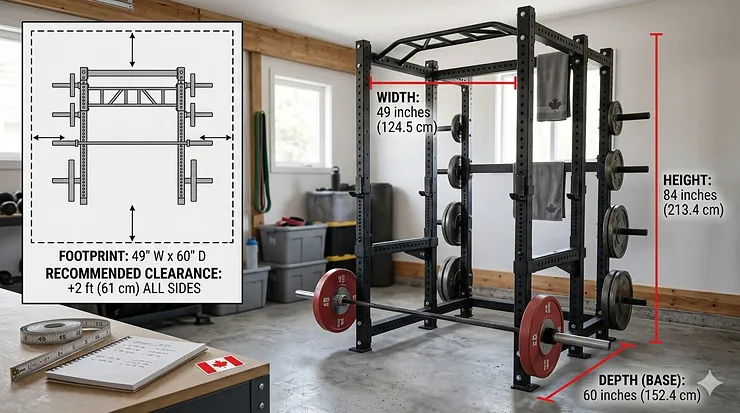
I’ve seen countless Canadians order their dream power rack only to discover it doesn’t fit through the basement door or scrapes against an 8-foot ceiling during pull-ups. That’s precisely why this guide exists. A power rack (also called a squat cage or power cage) serves as the centrepiece of any serious strength training setup, but getting the dimensions right requires more than just measuring the equipment itself.
The reality? You need to account for ceiling height clearance, workout area layout, barbell loading space, and safety zones around the rack. Standard Canadian homes typically feature 8-foot (2.4-metre) ceilings in basements and 9-foot (2.7-metre) ceilings on main floors, which dramatically impacts which rack models will work for your space. Add in the fact that most Olympic barbells stretch 7 feet (2.13 metres) across, and you quickly realize that gym space planning involves far more calculation than most people anticipate.
This comprehensive guide breaks down everything from footprint comparison power racks to the specific ceiling height requirements needed for overhead movements. You’ll discover exactly how much space power rack needs in Canadian homes, learn about workout area layout best practices, and get concrete recommendations for products available on Amazon.ca with pricing in Canadian dollars. Let’s transform your confusion into confidence and get you lifting safely in the perfect setup for your space.
Quick Comparison Table: Power Rack Dimensions at a Glance
| Rack Size Category | Height (inches/cm) | Width (inches/cm) | Depth (inches/cm) | Recommended Ceiling Height | Typical Price Range (CAD) |
|---|---|---|---|---|---|
| Compact/Short | 80-84″ / 203-213cm | 42-48″ / 107-122cm | 24-36″ / 61-91cm | 8.5-9 ft / 2.6-2.7m | $400-$700 |
| Standard | 82-85″ / 208-216cm | 48-50″ / 122-127cm | 36-48″ / 91-122cm | 9-9.5 ft / 2.7-2.9m | $600-$1,200 |
| Tall/Commercial | 90-95″ / 229-241cm | 48-60″ / 122-152cm | 48-60″ / 122-152cm | 9.5-10 ft / 2.9-3.0m | $1,000-$2,500 |
| Half Rack | 80-90″ / 203-229cm | 48-54″ / 122-137cm | 24-42″ / 61-107cm | 8.5-9.5 ft / 2.6-2.9m | $500-$1,000 |
| Wall-Mounted | 72-90″ / 183-229cm | 48-54″ / 122-137cm | 24-48″ / 61-122cm | 8-9.5 ft / 2.4-2.9m | $550-$1,100 |
💬 Just one click – help others make better buying decisions too! 😊
Top 7 Power Racks Available in Canada: Expert Analysis
Finding the right power rack dimensions starts with knowing what’s actually available to Canadian buyers. I’ve researched dozens of options on Amazon.ca and narrowed down the top choices across different size categories, all with verified Canadian availability and CAD pricing.
1. Fitness Reality 810XLT Super Max Power Cage – Best Compact Dimensions
The Fitness Reality 810XLT stands out as the budget champion for Canadians dealing with tight spaces. This rack measures 81″ tall × 46.5″ wide × 46.5″ deep (206cm × 118cm × 118cm), making it one of the few quality cages that actually fits in standard 8-foot basement ceilings with room to spare.
Key specifications include 2″ × 2″ heavy-duty tubular steel construction, 800-pound weight capacity, and 19 adjustable height levels for safety bars and J-hooks. The pull-up bar offers two height options at 78″ or 81″, accommodating different ceiling configurations.
Canadian buyers on Amazon.ca consistently praise its value, with one Toronto reviewer noting: “Perfect for my low-ceiling basement. Assembly took about 3 hours but instructions were clear.” The rack typically sells between $350-$500 CAD depending on sales and includes compatibility with the Fitness Reality 1000 bench.
✅ Pros: Fits 8-foot ceilings, excellent price-to-quality ratio, solid 800lb capacity
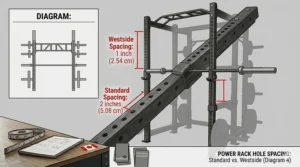
✅ Pros: Westside hole spacing for precise adjustments
✅ Pros: Compatible with various attachments
❌ Cons: 2×2″ tubing less robust than 3×3″ premium racks
❌ Cons: Some assembly challenges reported
2. Titan Fitness T-3 Series Power Rack – Best Customizable Dimensions
The Titan T-3 offers incredible flexibility with dimensions available in 82″ or 91″ heights paired with 24″ or 36″ depths (208-231cm height, 61-91cm depth). The 2″ × 3″ 11-gauge steel uprights provide that sweet spot between compact 2×2″ and bulky 3×3″ tubing.
This rack features Westside hole spacing through the bench zone, 1,100-pound rackable capacity, and includes both 1.25″ standard and 2″ fat pull-up bars. The modular design means you can start with the 82″ × 24″ configuration for tight spaces and upgrade later if you move to a larger area.
Canadian pricing through various retailers runs approximately $700-$900 CAD for the base rack. One Calgary lifter shared: “The 24-inch depth was perfect for my one-car garage. I can still park and lift.” The powder-coat finish holds up well in unheated Canadian garages through winter temperature fluctuations.
✅ Pros: Multiple size configurations for different spaces
✅ Pros: 1,100lb capacity handles serious lifting
✅ Pros: Extensive compatibility with T-3 accessories
❌ Cons: Can experience stock shortages
❌ Cons: Requires bolting down for maximum stability
3. Mikolo K3 Power Cage with Cable System – Best All-in-One Dimensions
The Mikolo K3 measures 83.5″ tall × 66.8″ wide × 61.9″ deep (212cm × 170cm × 157cm), creating a larger footprint that delivers comprehensive gym functionality. The 2″ × 3″ steel construction supports 1,400 pounds while incorporating a built-in cable crossover system.
This all-in-one solution eliminates the need for separate cable machines, saving both money and space despite its larger dimensions. The integrated lat pulldown and low row system features 16 height positions with a 2:1 ratio pulley setup for smooth resistance.
Available on Amazon.ca typically between $1,100-$1,500 CAD with frequent promotions. A Vancouver buyer reported: “Shipping to BC took about 10 days. The cable system works surprisingly smoothly for the price point.” The wider stance provides excellent stability without requiring floor anchoring.
✅ Pros: Combines rack and cable machine in one footprint
✅ Pros: 1,400lb capacity with stable wide base
✅ Pros: Includes multiple attachments and accessories
❌ Cons: Larger footprint requires more space
❌ Cons: Assembly complexity increases with cable system
4. Sportsroyals Power Cage with Adjustable Cables – Best Mid-Range Dimensions
The Sportsroyals Power Cage delivers commercial-grade construction in dimensions of approximately 82″ tall × 60″ wide × 58″ deep (208cm × 152cm × 147cm). Built from 13-gauge rolled steel tubing (40mm × 80mm), this cage weighs a substantial 273 pounds, ensuring rock-solid stability.
The dual pulley cable system offers 20 adjustable height positions with a near 1:2 ratio. Maximum capacity reaches 1,600 pounds on the rack itself with specific component ratings: 1,000lbs on J-hooks, 700lbs on safety bars, and 440lbs on the cable system. This differentiation matters for serious Canadian lifters planning progressive overload.
Pricing on Amazon.ca ranges from $900-$1,300 CAD depending on accessories included. One Saskatchewan user noted: “Handles our brutal temperature swings without issue. The powder coating hasn’t chipped after two winters in an uninsulated garage.” The package includes lat pulldown bar, cable handles, dip bars, landmine attachment, and battle rope ring.
✅ Pros: Heavy 273lb weight for natural stability
✅ Pros: Complete accessory package included
✅ Pros: 1,600lb rack capacity
❌ Cons: Requires significant assembly time (4-5 hours)
❌ Cons: Wide footprint not ideal for small spaces
5. Goimu C1-V4 Power Cage – Best Premium Dimensions
The Goimu C1-V4 measures approximately 84″ tall × 64″ wide × 60″ deep (213cm × 163cm × 152cm) with premium 3″ × 3″ uprights. The 2,000-pound rated capacity puts this in commercial territory, with flip-down safety arms and sandwich J-hooks providing maximum protection.
Multi-function capabilities include integrated lat pulldown station, dual-track pulley system for smooth cable exercises, and compatibility with Olympic weights. The attention to detail shows in laser-cut hole spacing and reinforced connection points throughout the frame.
Canadian buyers on Amazon.ca can expect to pay $1,300-$1,800 CAD. A Halifax trainer commented: “I run a small private training studio and this competes with equipment three times the price. The pulleys glide better than my old commercial Cybex machine.” Shipping to Atlantic Canada typically adds 7-10 business days but arrives without damage thanks to robust packaging.
✅ Pros: Commercial 2,000lb rating
✅ Pros: Premium 3×3″ construction
✅ Pros: Buttery-smooth dual-track pulley system
❌ Cons: Higher price point
❌ Cons: Heavier weight requires extra help during assembly
6. Mikolo F4 2.0 Power Cage – Best Innovative Dimensions
The Mikolo F4 2.0 introduces unique features in a footprint measuring roughly 81″ tall × 62″ wide × 56″ deep (206cm × 157cm × 142cm). The standout innovation? An integrated adjustable leg roller (leg hold-down) that stabilizes your body during heavy lat pulldowns — a game-changer for preventing that annoying lift-off during cable work.
The dual-track pulley system utilizes two steel guide rods instead of the typical single pole, dramatically reducing friction and noise. Constructed from 14-gauge steel (50mm × 50mm), the rack handles 1,200 pounds with confidence. The multi-position cable system offers versatility for everything from face pulls to tricep pushdowns.
Expect pricing between $1,000-$1,400 CAD on Amazon.ca with various package options available. An Edmonton CrossFit enthusiast shared: “The leg hold-down actually lets me pull my bodyweight plus 100lbs without flying off the bench. That alone justified the purchase.” The included accessories bundle features lat pulldown bar, tricep rope, cable handles, landmine attachment, and more.
✅ Pros: Unique leg hold-down for heavy cable work
✅ Pros: Dual-track system for ultra-smooth motion
✅ Pros: Comprehensive attachment package
❌ Cons: Specific dimensions may not suit all ceiling heights
❌ Cons: Premium features increase complexity
7. Major Fitness PLM03 Multi-Functional Power Rack – Best Versatile Dimensions
The Major Fitness PLM03 offers customizable dimensions with modular attachment options. Standard configuration measures approximately 83″ tall × 58″ wide × 54″ deep (211cm × 147cm × 137cm), expandable with lat pulldown attachments and additional uprights.
This rack earned a 4.8 out of 5-star rating on the Major Fitness website and 4.6 stars on Amazon with hundreds of verified reviews. The modular approach lets Canadian buyers start with core dimensions and expand as budget allows. Quality 11-gauge steel construction supports serious training despite the budget-friendly positioning.
Canadian availability through Amazon.ca typically ranges $800-$1,200 CAD. One Winnipeg reviewer noted: “Shipped in three boxes over two days. Assembly instructions could be better but YouTube videos filled the gaps. Solid value for money.” The rack accepts standard Olympic barbells and is compatible with Major Fitness attachments for future expansion.
✅ Pros: Modular design grows with your needs
✅ Pros: Strong value proposition
✅ Pros: Solid customer ratings
❌ Cons: Assembly instructions need improvement
❌ Cons: Customer service response times vary
Understanding Standard Power Rack Height Requirements
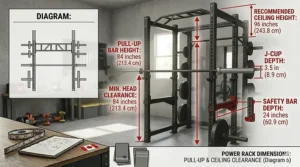
Ceiling height requirements represent the most critical dimension to measure before purchasing any power rack. Most Canadian homes feature 8-foot (96-inch or 244cm) ceilings in basements and 9-foot (108-inch or 274cm) ceilings on main floors, but this raw measurement tells only half the story.
According to strength training research, proper overhead movement patterns require clearance beyond the rack’s physical height. If your power rack stands 84 inches tall with a pull-up bar at 80 inches, you’ll need at minimum 10-15 inches (25-38cm) of clearance above the pull-up bar to execute full-range pull-ups and overhead presses comfortably.
This calculation becomes even more critical for taller Canadians. Someone standing 6’3″ (190cm) performing pull-ups will occupy roughly 85-90 inches of vertical space at the top of the movement. Add this to an 80-inch rack, and you’re looking at 165-170 inches minimum — nearly 14 feet (4.3 metres) of total ceiling height if you want generous clearance. Most recreational lifters can work with less, but cramped overhead space forces compromised form and reduces exercise variety.
Basement gyms present additional challenges beyond advertised ceiling height. Ductwork, floor joists, recessed lighting, and support beams often steal valuable vertical space. One Vancouver homeowner discovered his “8-foot basement” actually offered only 90 inches of usable height after accounting for a bulkhead running across the workout zone. Always measure at the exact spot where your rack will sit, not just the highest point in the room.
Short racks (80-82 inches tall) work brilliantly in standard 8-foot basements, providing adequate clearance for pull-ups and most exercises. Standard racks (84-86 inches) require 9-foot ceilings for comfortable use. Tall racks (90+ inches) belong in spaces with 10-foot ceilings or higher. Wall-mounted and folding racks offer flexibility for extremely tight spaces, collapsing against the wall when not in use to maximize ceiling clearance.
Temperature considerations matter too in Canadian climates. If you’re setting up in an unheated garage in Saskatoon or Calgary, winter contractions and summer expansions affect metal dimensions slightly. Quality powder coating helps protect against moisture and temperature swings, but verify your measurements during the coldest months to account for any settling or expansion that might reduce effective clearance.
Calculating Footprint Comparison Power Racks
The base footprint of your power rack determines how much floor real estate it consumes, but the actual workout zone extends far beyond these numbers. A rack with a 48″ × 48″ (122cm × 122cm) footprint might seem modest on paper, yet you’ll need a minimum 10′ × 10′ (3m × 3m) area — that’s 100 square feet — for safe, functional use.
Why such a dramatic difference? Olympic barbells measure approximately 7 feet (213cm) long, and you need clearance on both ends for loading plates, adjusting collars, and walking around the equipment. Calculate 12 inches (30cm) minimum on each side of the barbell for plate loading, though 18-24 inches (45-61cm) feels far more comfortable and prevents the constant shimmy-shuffle when adding or removing weight plates.
Depth requirements expand based on exercise selection. Squatting requires walking back from the J-hooks 2-3 feet (60-90cm) to clear the uprights before descending. Bench pressing needs similar space in front of the rack for proper setup. If you’re incorporating Olympic lifts or dynamic movements, add another 4-6 feet (120-180cm) in front for the barbell path and emergency bail-outs.
Here’s a practical breakdown by rack type:
Compact racks (24-inch depth) work best for strictly vertical movements — squats, bench press, overhead press — where the depth dimension stays minimal. They excel in one-car garages and narrow basement areas but limit exercise variety. These racks typically need an 8′ × 10′ (2.4m × 3m) minimum training zone.
Standard racks (36-48 inch depth) accommodate most home gym needs with a balanced footprint. They allow comfortable movement around the rack while still fitting in typical Canadian basement or garage spaces. Plan for a 10′ × 12′ (3m × 3.7m) minimum area.
Extended racks (48+ inch depth) provide maximum versatility and often include integrated cable systems or storage that extends the footprint. These work beautifully in dedicated gym rooms or two-car garages but require 12′ × 14′ (3.7m × 4.3m) or larger spaces to shine.
Door width matters tremendously for Canadian homeowners planning basement gyms. Standard residential doorways measure 30-36 inches (76-91cm) wide. If your rack arrives fully assembled or features non-removable crossmembers wider than your doorway, you’ll face the heartbreaking reality of disassembling door frames or choosing a different rack. Most quality racks ship as bolt-together designs precisely for this reason.
The shape of your space influences rack selection too. Long, narrow rooms favour half racks or squat stands positioned lengthwise. Square spaces accommodate full cages efficiently. Irregularly shaped areas might benefit from corner-mount or wall-mounted designs that optimize awkward dimensions.
Determining Power Rack Space Requirements for Canadian Homes
Canadian home architecture varies dramatically by region and construction era, creating unique space planning challenges. Victorian homes in Montreal feature high ceilings but narrow rooms. Post-war bungalows across the Prairies offer sprawling basements with 8-foot ceilings. Modern condos in Toronto and Vancouver provide minimal square footage but sometimes surprising ceiling heights.
The Canadian Fitness Safety Standards recommend maintaining clear zones around all strength training equipment. While not legally binding for home gyms, these guidelines offer sensible parameters. A minimum 24-inch (61cm) clearance on all sides prevents accidents during barbell loading and provides escape routes if equipment fails or exercises go wrong.
Basement humidity presents a uniquely Canadian concern, especially in coastal regions like Nova Scotia or BC’s Lower Mainland. Power racks themselves handle moisture reasonably well with powder coating, but the surrounding space needs dehumidification to protect flooring, walls, and other gym equipment. Ensure adequate space for air circulation around the rack — cramming equipment into corners creates moisture traps that accelerate rust and corrosion.
Electrical considerations affect space planning too. If you’re adding lighting for safety, fans for ventilation, or power for future equipment, maintain access to outlets without running extension cords across workout zones. A rack positioned 18 inches from a wall might work dimensionally but block the only accessible outlet in the room.
Window placement influences natural light and ventilation but can restrict rack positioning. You want daylight for mood and energy, yet windows create cold zones in winter. One Edmonton lifter solved this by positioning his rack perpendicular to basement windows, maximizing natural light while avoiding the direct cold air infiltration during -30°C snaps.
Noise transmission matters in multi-family dwellings or homes with shared walls. The impact of deadlifts and barbell drops travels through floors and walls more than most people anticipate. Position your rack away from bedrooms, nurseries, or shared walls with neighbours when possible. Quality rubber flooring helps, but physical distance works better for maintaining domestic tranquility.
Storage space planning prevents workout areas from becoming cluttered disaster zones. If you only account for the rack footprint without considering plate storage, accessory organization, and equipment staging areas, you’ll quickly find the space unusable. Allocate at minimum an additional 2′ × 4′ (60cm × 120cm) zone for storage near — but not in — your primary workout area.
Measuring Ceiling Height Clearance Accurately
Measuring ceiling height sounds straightforward until you actually attempt it in a real Canadian home. Grab a tape measure and head to your intended gym space. Measure from the floor to the absolute lowest point overhead in the area where you’ll position your rack. This might be a ceiling beam, HVAC duct, recessed light fixture, or pipe — not the drywall ceiling itself.
Older Canadian homes often feature inconsistent ceiling heights across a single room. One corner might offer 94 inches while another provides only 89 inches due to settling, original construction variations, or repairs. Measure multiple points and use the lowest number for planning purposes. You can’t perform pull-ups in the high section if the rack sits where the ceiling dips lower.
Floor covering thickness affects effective ceiling height more than most people realize. If you’re installing 20mm rubber flooring for impact protection — highly recommended for any serious home gym — that’s nearly an inch of height immediately consumed. Premium shock-absorbing platforms might eat 2-3 inches. Subtract these dimensions from your ceiling measurement before comparing against rack heights.
Removable obstacles versus permanent restrictions require different approaches. Can you relocate that recessed light fixture for $200 and gain 4 inches of clearance? Maybe worth it. Structural beam supporting your house? Not moving, so design around it. One creative Saskatchewan homeowner notched his drop ceiling tiles around the pull-up bar, gaining precious inches without compromising the basement’s finished appearance.
Test your measurements under loaded conditions if possible. Stand on a bench or box to simulate the height you’ll occupy during pull-ups or overhead presses. Extend your arms overhead and verify comfortable clearance exists. If your knuckles brush the ceiling, you’ll need a shorter rack or higher ceiling — no middle ground exists for overhead movements.
Seasonal changes affect some Canadian homes, particularly those with crawl spaces or pier foundations in regions with significant frost heave. Your winter ceiling height might differ from summer measurements by an inch or more as the foundation settles and shifts. Measure during the coldest part of the year for the most conservative (and safest) calculation.
Document your measurements with photos showing the tape measure in place. These images prove invaluable when shopping for racks online, allowing you to reference exact dimensions months later without remeasuring. Share them with customer service representatives if you need guidance choosing between rack models for your specific situation.
Comparing Workout Area Layout Options
Three primary layout philosophies dominate home gym design, each with distinct dimensional requirements and space efficiency characteristics. The choice between them depends on available square footage, ceiling height, and training priorities.
The centred island layout positions your power rack in the middle of the room with clearance on all four sides. This arrangement requires the most space but provides maximum flexibility. You can access the rack from any angle, making it ideal for training partners or group workouts. Minimum room dimensions: 14′ × 14′ (4.3m × 4.3m) for standard racks, larger for commercial-sized equipment. This works brilliantly in finished basements or dedicated gym rooms but wastes space in smaller areas.
The wall-adjacent layout places one or two sides of the rack against walls, reducing required floor space significantly. Position the loading side (where you add/remove weight plates) with clearance while backing other sides against walls. This cuts space requirements to roughly 10′ × 12′ (3m × 3.7m) while maintaining functional workout zones. Most Canadian home gyms use this approach as the sweet spot between space efficiency and versatility.
The corner layout tucks the rack into a corner, minimizing footprint to around 8′ × 10′ (2.4m × 3m) but limiting access and exercise options. You’ll likely need to exit the rack the same way you entered, and adding/removing plates becomes more awkward. This strategy works well for extremely tight spaces or multipurpose rooms where the gym equipment needs to stay unobtrusive. Half racks and squat stands work better than full cages for corner installations.
Traffic flow patterns matter more than many realize. Your gym might share space with laundry facilities, storage areas, or household thoroughfares. A rack positioned to block the path to the furnace room becomes a daily obstacle rather than a training asset. Sketch your intended layout on paper, marking not just equipment footprints but also common paths through the space.
Multi-station planning requires thinking beyond the rack itself. If you’re adding a bench, cardio equipment, or accessory stations, map their positions relative to the rack before purchasing anything. A treadmill positioned too close to the squat zone creates safety hazards. A bench stored directly beside the rack blocks barbell loading. Think through the complete gym workflow, not individual pieces in isolation.
Lighting placement coordinates with rack position for both safety and aesthetics. You want bright, shadow-free lighting over your workout zone without fixtures positioned directly overhead where they interfere with pull-ups or cable movements. LED shop lights mounted parallel to the rack provide excellent illumination without occupying vertical clearance in the working zone.
Flooring seams and transitions affect rack stability. Position your rack so all four feet rest on the same flooring type — ideally a level platform or mat. Straddling the transition from concrete to carpet or rubber to tile creates wobble and instability under load. If you must span different floor surfaces, use shims to level the rack precisely.
How Much Space Does a Power Rack Actually Need?
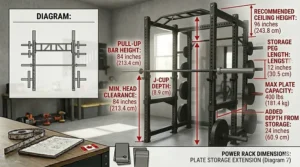
The honest answer? More than the product dimensions suggest, but less than worst-case scenarios predict. A rack measuring 48″ × 48″ × 84″ (122cm × 122cm × 213cm) doesn’t operate in a vacuum. It requires breathing room for safe, effective training.
Minimum viable space for a basic power rack setup runs approximately 10′ × 10′ (3m × 3m) with 8.5-9 foot (2.6-2.7m) ceiling height. This accommodates the rack, a 7-foot barbell with modest plate loading clearance, and minimal movement space for squats and presses. You’ll feel constrained but functional. Think efficiency apartment — it works but won’t win design awards.
Comfortable training space expands to 12′ × 12′ (3.7m × 3.7m) or ideally 12′ × 14′ (3.7m × 4.3m). Now you’ve got generous clearance for barbell loading, a portable bench you can position as needed, space for accessory equipment like a landmine attachment or resistance bands, and room to move naturally during dynamic exercises. This represents the home gym sweet spot — enough space to train seriously without requiring a commercial-sized facility.
Optimal space for a dedicated strength training room reaches 14′ × 16′ (4.3m × 4.9m) or larger. At this scale, you can add multiple training stations, integrate cardio equipment, create dedicated stretching zones, and maintain commercial gym spacing between equipment pieces. Most Canadian homeowners can’t dedicate this much space to fitness, but if you have it, the investment pays dividends in training versatility and enjoyment.
Barbell clearance specifically needs careful attention. A standard 7-foot Olympic barbell extends 86 inches (218cm) from end to end. Position this in J-hooks on a rack with 42-inch interior width, and you’ve got 22 inches (56cm) protruding from each side. Add weight plates and you’re easily at 30-36 inches (76-91cm) per side. Now factor in space to comfortably grab those plates for loading/unloading — another 12-18 inches (30-45cm) minimum per side.
The math: 42″ (rack interior) + 44″ (barbell overhang) + 36″ (plate loading clearance on both sides) = 122 inches or just over 10 feet (3m) of width requirement. And that’s for basic plate loading access. Add a training partner spotting you, and you’ll want 14-15 feet (4.3-4.6m) of total width for civilized operation.
Depth calculations follow similar logic. The rack itself occupies 36-48 inches (91-122cm) front to back. Add 36 inches (91cm) behind for walking back from the J-hooks during squats. Add another 24 inches (61cm) in front for bench positioning and safety zones. Suddenly you’re looking at 96-108 inches (244-274cm) of depth — that’s 8-9 feet (2.4-2.7m).
Real-world examples help ground these calculations. A single-car garage in Canada typically measures 12-14 feet wide by 20-22 feet deep (3.7-4.3m × 6.1-6.7m). Position your rack along one wall and you’ve got adequate space while preserving vehicle parking ability. A standard basement room might run 12′ × 16′ (3.7m × 4.9m), offering comfortable gym space with room for storage and accessories.
Planning Workout Area Layout for Optimal Flow
Effective gym layout considers movement patterns, not just static equipment positions. Think about the actual exercises you’ll perform and how your body moves through space during each one.
Squats require the most planning. You’ll unrack the bar, walk backward 2-3 feet (60-90cm), set your stance, descend, and potentially need to bail forward or backward if the lift fails. This demands clear zones extending 4-5 feet (1.2-1.5m) behind the rack and ideally 3-4 feet (0.9-1.2m) in front for emergency exits. Don’t position your rack so close to a wall that failed squats leave you trapped.
Bench pressing creates different space needs. The bench slides into the rack at a perpendicular angle, extending the effective depth significantly. A standard flat bench runs 48-52 inches (122-132cm) long. Add this to your rack’s front-to-back dimension and account for headroom behind the bench for getting into position. You’re looking at 8-9 feet (2.4-2.7m) of clear depth for comfortable benching.
Pull-ups demand overhead clearance we’ve discussed extensively, but also consider your body’s arc during the movement. You don’t hang straight down — most people pike slightly at the bottom and shift forward at the top. This means clearance extends outward from the rack’s footprint during pull-up execution. One BC lifter discovered this when his feet repeatedly kicked a wall positioned just 18 inches behind his rack.
Deadlifts and floor-based exercises benefit from being performed in front of or beside the rack rather than inside it. The rack’s four posts potentially interfere with natural deadlift positioning. Many lifters set up a dedicated deadlift zone 4-6 feet (1.2-1.8m) from the rack, using crash pads or heavy-duty flooring to protect against barbell drops. This adds to total space requirements but dramatically improves deadlift comfort and safety.
Accessory exercise stations integrate into corners or walls away from the main lifting zone. A landmine attachment bolted to the floor, a set of resistance bands anchored to the wall, or a set of dumbbells on a rack all function better when they’re accessible but not positioned where they interfere with primary movements.
Strategic mirrors multiply functionality while checking form, but positioning matters enormously. Mirrors directly in front of your squat station help monitor bar path and depth. Mirrors beside the rack prove useless and potentially dangerous if you’re looking sideways during heavy lifts. Most Canadian home gyms benefit from a single large mirror on the wall facing the rack’s working side, providing clear sight lines without creating distraction or safety concerns.
Climate control equipment positioning influences comfort and consistency. If you’re training in a garage, portable heaters in winter or fans in summer need placement that provides comfort without interfering with movement. One Manitoba lifter runs two space heaters positioned 8 feet from his rack, warming the space before workouts without creating trip hazards or hot zones in the lifting area.
Adapting to Canadian Home Architecture Constraints
Canadian homes present delightfully diverse architectural challenges depending on region, construction era, and building type. Navigating these constraints successfully often determines whether your home gym dreams thrive or flounder.
Basement gyms dominate Canadian home fitness due to dedicated space and privacy, but ceiling height remains the eternal challenge. The 8-foot standard basement ceiling provides just enough space for shorter racks (80-82 inches) with careful planning. Solutions include prioritizing pull-up bar height adjustments, choosing racks with removable crossmembers that drop vertical clearance slightly, or accepting reduced pull-up range of motion in exchange for basement location benefits.
Unfinished basements offer advantages for serious lifters. Exposed ceiling joists might provide 8’6″ to 9′ (2.6-2.7m) of clearance before you hit the subfloor above — precious extra inches that open up rack options. Concrete floors handle weight without complaint and don’t care about dropped dumbbells. The downside? Cold, damp conditions in winter and potential moisture issues that rust equipment over time. Quality dehumidifiers and powder-coated equipment prove essential investments.
Garage gyms work brilliantly in suburban and rural Canada where single or double garages provide 150-400 square feet of space. Insulation status dramatically affects usability. Heated, insulated garages function year-round. Uninsulated garages in Winnipeg or Edmonton become challenging from November through March when temperatures plunge below -20°C or -30°C. Cold metal barbells and frozen fingers aren’t conducive to productive training, though some hardy souls persevere with space heaters and thick gloves.
Vehicle sharing strategies make or break garage gym functionality. Folding racks that collapse against walls allow vehicle parking when not in use. Strategic positioning places the rack where it doesn’t interfere with car doors opening or garage door operation. Some Canadians sacrifice their vehicle to winter outdoor parking to maintain year-round gym access — a trade-off that works better in Victoria than Yellowknife.
Spare bedroom conversions offer climate-controlled comfort but severely limited ceiling heights — usually 8 feet (2.4m) in older homes, sometimes 9 feet (2.7m) in newer construction. You’re looking at short racks only, with pull-ups potentially requiring creative solutions like doorway pull-up bars used separately from the rack. Floor load capacity becomes relevant if you’re stacking hundreds of pounds of weights on upper floors. Most modern Canadian homes handle this fine, but older structures or condos might benefit from load calculations.
Condo gyms present unique constraints. Noise transmission rules out certain exercises. Floor load limits might restrict total weight. Limited square footage demands compact equipment selections. Many urban Canadians solve this with half racks or squat stands rather than full power cages, accepting reduced exercise variety in exchange for functioning within apartment constraints.
Dedicated gym rooms represent the dream scenario — purpose-built spaces optimized for training without compromise. New construction or renovation allows you to specify ceiling heights, flooring types, electrical outlets, and climate control exactly where needed. If you’re building or renovating, target 9-10 foot (2.7-3m) ceilings minimum, run dedicated electrical circuits for equipment and fans, specify slip-resistant waterproof flooring, and design the space at least 12′ × 14′ (3.7m × 4.3m) for comfortable rack operation.
Essential Accessories That Affect Space Planning
Power racks rarely exist in isolation. Accessories and complementary equipment significantly impact your total space footprint and dimensional requirements. Planning for these additions from the start prevents the common trap of buying a rack that fits, then discovering your bench, weights, and accessories create an overcrowded disaster.
Weight storage consumes surprising amounts of space. A basic set of Olympic plates might include pairs of 45lb, 35lb, 25lb, 10lb, 5lb, and 2.5lb plates — roughly 250-300 pounds of iron. Stack these on the floor and you’re looking at multiple square feet of footprint that creates trip hazards and looks chaotic. Integrated plate storage on the rack itself helps but adds 8-12 inches (20-30cm) to the rack’s width per side. Dedicated plate trees positioned nearby work well but require 2′ × 2′ (60cm × 60cm) of additional floor space each.
Adjustable benches anchor many training programs but take up 4-5 feet (1.2-1.5m) of length when set up. You’ll slide it into the rack for pressing movements, then move it aside for squats and deadlifts. Where does it go when not in use? One Alberta lifter discovered his “perfect” rack layout blocked his bench storage spot, forcing him to carry the 60-pound bench up and down basement stairs daily. Plan your bench parking location before finalizing rack positioning.
Barbells don’t take up much floor space individually, but most serious lifters accumulate multiple bars — a standard Olympic barbell, perhaps a women’s bar for specific lifts, maybe a specialty bar like a trap bar or safety squat bar. Vertical barbell storage integrated into the rack or wall-mounted nearby works brilliantly. Horizontal storage requires 7+ feet (2.1m) of continuous wall space that doesn’t interfere with other equipment.
Cable attachments for racks with integrated pulleys multiply quickly — lat pulldown bars, tricep ropes, cable handles, ankle straps. These accessories need organized storage accessible from the rack. Many Canadians use simple pegboards mounted on nearby walls, consuming 2′ × 3′ (60cm × 90cm) of wall space but keeping accessories visible and organized.
Resistance bands anchor to the rack for accommodating resistance during squats or assistance during pull-ups. The bands themselves take minimal space, but you’ll want them immediately accessible. Band pegs built into the rack posts solve this elegantly without adding dimensional requirements.
Flooring and platforms protect your floors and equipment while reducing noise. Minimum recommendation: 8mm rubber flooring under and extending 2-3 feet (60-90cm) beyond the rack on all sides. Better solution: 20mm rubber flooring across the entire workout zone. Optimal approach: a proper lifting platform under the rack with rubber flooring connecting to broader gym space. Factor flooring into your budget and space calculations — quality flooring runs $2-4 CAD per square foot.
Mirrors help with form checking but need strategic positioning. A 4′ × 6′ (1.2m × 1.8m) mirror provides adequate viewing angles for most exercises. Position it on the wall you face during lifts, typically 4-6 feet (1.2-1.8m) from the rack. Avoid positioning mirrors where barbell drops or wild plate loading could shatter them — safety glass or acrylic alternatives cost more but survive gym environments better.
Frequently Asked Questions About Power Rack Dimensions
❓ What's the minimum ceiling height needed for a power rack in Canada?
❓ How much floor space do I need around a power rack for safe workouts?
❓ What's the ideal power rack width for standard Canadian garage gyms?
❓ Do I need to bolt down my power rack or can it sit on the floor?
❓ What power rack dimensions work best for 8-foot basement ceilings?
Conclusion: Getting Your Power Rack Dimensions Right
Choosing the right power rack dimensions for your Canadian home gym comes down to three critical measurements: ceiling height, floor space, and workout zone requirements. Measure twice, buy once — this old carpenter’s wisdom applies perfectly to home gym equipment that won’t fit through basement doors or scrapes against garage ceilings.
Start with your ceiling height at the exact installation location, accounting for flooring thickness and overhead obstacles. Subtract your intended rack height and ensure 10-15 inches (25-38cm) minimum clearance remains for overhead movements. Next, map your floor space including the rack footprint plus essential clearance for barbell loading and exercise execution. Finally, sketch your complete workout zone showing traffic flow patterns, accessory storage, and bench positioning.
The products I’ve detailed range from the budget-friendly Fitness Reality 810XLT perfect for tight basement spaces to the premium Goimu C1-V4 competing with commercial equipment. Canadian buyers benefit from Amazon.ca availability and CAD pricing that removes currency conversion headaches. Each rack serves specific dimensional constraints — compact for 8-foot basements, standard for comfortable training, extended for dedicated gym rooms.
Remember that your home gym evolves over time. Today’s basic rack might expand with cable attachments, specialty bars, and integrated storage systems. Planning slightly larger than minimum requirements future-proofs your investment and prevents the frustration of outgrowing your space within months. The power rack represents the foundation of serious strength training — get the dimensions right, and everything else falls into place beautifully.
✨ Don’t Miss These Exclusive Deals!
🔍 Take your home gym setup to the next level with these carefully selected products available in Canada. Click on any highlighted item to check current pricing and availability on Amazon.ca. These tools will help you create authentic strength training results your whole family will benefit from!
Recommended for You
- 7 Best Power Rack for Powerlifting Canada 2026
- 7 Best Power Racks for Beginners Canada 2026
- 7 Best Pull Up Bar Attachment Power Rack in Canada 2026
Disclaimer: This article contains affiliate links to Amazon.ca. If you purchase products through these links, we may earn a small commission at no additional cost to you.
✨ Found this helpful? Share it with your friends! 💬🤗
