In This Article
Building serious powerlifting strength requires more than just motivation—it demands equipment that won’t fail when you’re pushing your absolute limits. Whether you’re attempting a new squat PR at 2:00 AM in your garage gym or training for your first sanctioned meet, a quality power rack for powerlifting serves as your most essential training partner. Unlike casual fitness equipment, powerlifting racks must withstand the brutal forces of maximal lifts, provide precise adjustability for different body types, and offer the safety features that let you train to failure without fear.
The Canadian powerlifting market presents unique challenges that make equipment selection particularly critical. From managing shipping costs and customs fees to dealing with frigid garage gym temperatures that affect powder coating durability, Canadian lifters face considerations their American counterparts don’t. Research published in the National Institutes of Health confirms that serious strength training with proper equipment significantly improves bone density, metabolic health, and functional strength—benefits that compound over decades of consistent training. This makes choosing the right rack not just a purchase decision, but an investment in your long-term athletic development.
I’ve spent countless hours researching the current market, comparing specifications, analyzing Canadian customer feedback, and consulting competitive powerlifting standards to identify racks that actually deliver for serious lifters. This guide cuts through the marketing noise to help you find a competition power rack canada that matches your training style, space constraints, and budget—all while navigating the unique landscape of purchasing heavy equipment in the Great White North.
Quick Comparison Table
| Power Rack | Weight Capacity | Steel Gauge | Spacing Type | Approx. Price (CAD) | Best For |
|---|---|---|---|---|---|
| Rogue R-3 Power Rack | 850 lbs | 11-gauge 2×3″ | Westside Pattern | $900-$1,100 | Competition training, lifetime investment |
| Bells of Steel Residential Rack | 700 lbs | 14-gauge 2×2″ | 1″ bench zone | $449-$549 | Budget-conscious Canadian lifters |
| REP Fitness PR-4000 | 1,000 lbs | 11-gauge 3×3″ | 1″ bench zone | $1,100-$1,400 | Versatile serious lifters |
| Titan T-2 Series | 850 lbs | 14-gauge 2×2″ | 2″ standard | $500-$650 | Compact spaces, value seekers |
| Bells of Steel Light Commercial | 1,000 lbs+ | 12-gauge 2.3×2.3″ | 1″ bench zone | $699-$849 | Home gym powerlifters |
| Mikolo Power Cage K3 | 1,500 lbs | 14-gauge | 1″ spacing | $750-$950 | All-in-one functionality |
| CANPA Multifunction Rack | 800 lbs | Standard gauge | 1″ holes | $229-$299 | Entry-level budget option |
💬 Just one click – help others make better buying decisions too! 😊
Top 7 Power Rack for Powerlifting: Expert Analysis
1. Rogue R-3 Power Rack – Premium Westside Design
The Rogue R-3 Power Rack represents the gold standard for serious powerlifters training in Canadian home gyms. Built with 2×3″ 11-gauge steel uprights standing 90.375″ tall (with a shorter 84.375″ option), this rack directly adapts the legendary Westside Barbell design that’s produced countless world champions.
Key Specifications:
- Rackable capacity: 850 lbs (suitable for 99% of home lifters)
- Westside hole spacing: 1″ through bench and clean pull zone, 2″ above/below
- Inside depth: 24″ with compact 53″ x 34″ footprint
- Includes Fat/Skinny pull-up bar, Infinity J-cups, pin/pipe safeties
Priced between $900-$1,100 CAD through Rogue Canada, this rack ships directly from the USA with Rogue covering customs fees—a significant advantage for Canadian buyers. The precision laser-cut 5/8″ holes and industrial powder coating withstand the temperature swings common in garage gyms from Vancouver to Halifax.
Canadian customers consistently praise the R-3’s stability during heavy squats. One Ontario lifter reported: “Rock-solid for squats up to 180 kg. Installed myself in about 2 hours.” The Westside spacing pattern allows micro-adjustments crucial for dialling in perfect rack heights for competition-style lifts.
✅ Pros: Lifetime warranty, Canadian shipping support, Westside spacing, massive attachment ecosystem
❌ Cons: Premium pricing, requires ceiling clearance, minimal included attachments
Best for: Lifters committed to long-term powerlifting progression who value buy-once-cry-once quality.
2. Bells of Steel Residential Power Rack – Canadian Value Champion
As an authentic Canadian company shipping from Calgary and Toronto warehouses, Bells of Steel Residential Power Rack delivers exceptional value without the cross-border headaches. At $449-$549 CAD, this 14-gauge steel rack punches well above its price point.
Key Specifications:
- Weight capacity: 700 lbs static
- 2×2″ powder-coated steel frame
- Available in 84.5″ standard or 72″ short heights
- Includes triple-padded J-cups, pin/pipe safeties, bare steel pull-up bar
Canadian lifters appreciate the flat-rate shipping (maximum $199 CAD nationwide) and 30-day return policy. The rack features 1″ hole spacing through the bench zone and 2″ above/below—not quite Westside spacing, but adequate for most training applications.
Customer reviews from across Canada highlight the surprising build quality. The UHMW plastic lining on J-cups protects bar knurling, while the secondary steel pipe covering on safety arms prevents bar damage during failed lifts. Most buyers report assembly in under 90 minutes.
✅ Pros: Exceptional CAD value, Canadian warehouses, fast shipping, solid construction
❌ Cons: Lower weight capacity, limited premium attachments, narrower uprights
Best for: Budget-conscious Canadian lifters building their first serious home gym without compromising safety.
3. REP Fitness PR-4000 – Heavy-Duty Powerlifting Workhorse
The REP Fitness PR-4000 targets serious powerlifters who demand 1,000-pound capacity and extensive customization options. Built with commercial-grade 3×3″ 11-gauge steel, this heavy duty powerlifting rack handles anything short of equipped world record attempts.
Key Specifications:
- Rackable capacity: 1,000 lbs
- 3×3″ 11-gauge steel uprights
- 1″ hole spacing through bench zone, 5/8″ pin holes
- Available depths: 24″, 30″, 41″
REP ships to Canada with free shipping on qualifying orders, though delivery times can extend 2-3 weeks. The PR-4000 uses 5/8″ hardware compatible with both 4000-series and some 5000-series attachments, creating an extensive upgrade path as training needs evolve.
The laser-cut numbering every fifth hole simplifies setup—a feature even the pricier Rogue R-3 lacks. Canadian buyers note the rack’s exceptional stability during dynamic movements like clean pulls and drop-in squats. The wider 3×3″ uprights provide noticeably less wobble during strict pull-ups compared to 2×2″ alternatives.
✅ Pros: 1,000 lb capacity, extensive attachment options, laser-cut numbering, depth choices
❌ Cons: Higher price point ($1,100-$1,400 CAD), shipping wait times, heavier (harder to move)
Best for: Intermediate to advanced powerlifters planning long-term rack expansion with cables, lever arms, and specialty attachments.
4. Titan T-2 Series Power Rack – Compact Powerlifting Solution
The Titan T-2 Series carved out a reputation as the budget rack that refuses to act like one. Constructed from 2×2″ 14-gauge steel with an 850-pound capacity, this rack safely handles loads that would destroy cheaper alternatives.
Key Specifications:
- Rackable capacity: 850 lbs
- Available heights: 71″ (short) or 83″ (standard)
- Inside depth: 24″ standard
- 2″ hole spacing throughout
While Titan doesn’t ship directly to Canada, the racks appear on Amazon.ca through third-party sellers, typically priced $500-$650 CAD. Canadian buyers should verify shipping costs and return policies before purchasing, as these vary by seller.
The T-2’s extended base feet provide excellent stability without bolting down—crucial for lifters in rental properties or those who reconfigure their gym layout. Multiple Canadian reviewers mention the surprising lack of wobble during heavy squats, attributing this to the extended stabilizer design.
One basement gym owner in British Columbia noted the 71″ height perfectly accommodates 81″ ceilings while leaving room for pull-ups. The rack’s 2×2″ construction keeps the overall weight manageable for one-person assembly and repositioning.
✅ Pros: Strong capacity-to-price ratio, compact footprint, manageable weight, short option available
❌ Cons: Limited Canadian availability, no Westside spacing, fewer premium features
Best for: Space-constrained lifters in basements or garages who need legitimate powerlifting capacity without premium pricing.
5. Bells of Steel Light Commercial Rack – Bridge to Competition Equipment
Bells of Steel’s upgrade from their residential model, the Light Commercial Power Rack uses 12-gauge 2.3×2.3″ steel tubing to achieve 1,000+ pound capacity. Priced at $699-$849 CAD, it occupies the sweet spot between entry-level and elite racks.
Key Specifications:
- Weight capacity: 1,000 lbs+
- 12-gauge steel construction
- Dimensions: 62.5″ x 49″ x 84.5″
- Includes premium spotter straps (4,400 lb capacity), multi-grip pull-up bar
The premium safety spotter straps represent a significant upgrade over traditional pin/pipe safeties—they’re quieter during use, won’t damage bar knurling, and provide a broader safety range for exercises like pin presses and rack pulls. Canadian commercial gyms frequently use this rack model, testament to its durability under daily heavy use.
Same-province buyers (Alberta and Ontario) can pick up directly from Bells of Steel warehouses, eliminating shipping costs entirely. The wider 2.3×2.3″ tubing accommodates more third-party attachments than standard 2×2″ racks while maintaining compatibility with many market accessories.
✅ Pros: Commercial-grade capacity, premium safety straps, Canadian warranty support, pick-up options
❌ Cons: Heavier than residential model, larger footprint, mid-tier pricing
Best for: Serious home powerlifters who’ve outgrown entry equipment but aren’t ready for $1,500+ racks.
6. Mikolo Power Cage RSI-K3 – Modern Multi-Function Design
The Mikolo K3 takes a different approach to powerlifting equipment by integrating cable systems directly into the rack structure. With 1,500-pound capacity from 14-gauge commercial steel, this all-in-one system appeals to lifters wanting both barbell work and accessory training.
Key Specifications:
- Maximum capacity: 1,500 lbs
- Dimensions: 85.7″ x 68.1″ x 74.3″
- Includes LAT pulldown, cable crossover, power tower functionality
- Extensive free accessories (20+ items)
Available on Amazon.ca for $750-$950 CAD with Prime shipping, the Mikolo rack arrives with everything needed for comprehensive training: LAT bars, tricep ropes, J-hooks rated for 500 lbs, safety catches rated for 800 lbs, dip bars, landmine attachment, and weight storage.
The integrated cable system uses upgraded sliding sleeves with four white rollers, ensuring smooth operation while protecting uprights from wear. This matters for Canadian garage gyms where temperature fluctuations can affect cheaper pulley systems.
Canadian customers report 3-5 hour assembly time with two people, noting the comprehensive instructions. The rack’s 1″ hole spacing provides 30 height options—excessive for some, perfect for lifters who obsess over rack height precision.
✅ Pros: All-in-one design, extensive included accessories, high capacity, modern features
❌ Cons: Large footprint, complex assembly, integrated cables limit some barbell movements
Best for: Lifters wanting powerlifting capability plus comprehensive accessory work without buying separate cable machines.
7. CANPA Multifunction Power Rack – Entry-Level Powerlifting Access
The CANPA Multifunction Rack makes powerlifting-style training accessible at Amazon.ca’s most aggressive price point: $229-$299 CAD with Prime membership. While not suitable for elite-level loading, it handles intermediate strength levels admirably.
Key Specifications:
- Weight capacity: 800 lbs
- Front and rear double support design
- 17-hole adjustable barbell arms
- 6-speed height adjustment
At this price, expectations must be realistic. The gauge rating sits below commercial standards, pull-up bar options are limited compared to premium racks, and the attachment ecosystem is minimal. However, for lifters currently squatting under 315 lbs who need legitimate safety features, this rack provides essential functionality.
Over 790 Canadian customers have reviewed this rack on Amazon.ca, with most praising the stability relative to price. The adjustable height system accommodates lifters from 5’2″ to 6’4″, while the 1″ standard holes accept most common attachments.
Prime shipping reaches most Canadian cities within 5-7 business days. Returns follow Amazon’s standard policy, reducing purchase risk for first-time equipment buyers uncertain about long-term commitment.
✅ Pros: Lowest price point, Prime shipping, adequate for beginner/intermediate, adjustable height
❌ Cons: Lower capacity, fewer features, limited upgrade path, entry-level construction
Best for: Budget-constrained beginners establishing training habits before investing in premium equipment.
Understanding Power Rack for Powerlifting Specifications
Selecting a competition power rack canada requires understanding specifications that directly impact training quality and safety. While marketing emphasizes flashy features, core structural elements determine whether a rack supports serious powerlifting progression or becomes a frustrating limitation.
Steel Gauge and Construction Quality
Steel gauge measurement works inversely—lower numbers indicate thicker, stronger steel. An 11-gauge rack uses approximately 1/8″ thick steel walls, while 14-gauge measures roughly 0.075″. This seemingly minor difference dramatically affects load capacity and long-term durability.
Research published in the Journal of Strength and Conditioning Research demonstrates that powerlifters generate forces exceeding their lifted weight during the eccentric portion of squats and during aggressive bar racking. An 11-gauge rack rated for 850 pounds actually handles these dynamic forces more safely than a 14-gauge rack rated similarly. The thicker steel better dampens vibration, reducing the unsettling rack wobble that undermines confidence during maximal attempts.
| Steel Gauge | Thickness | Typical Capacity | Best Application | Canadian Price Range |
|---|---|---|---|---|
| 11-gauge | ~0.120″ | 850-1,000+ lbs | Advanced powerlifters, competition training | $900-$2,500 CAD |
| 12-gauge | ~0.105″ | 700-1,000 lbs | Serious home gyms, light commercial | $650-$1,200 CAD |
| 14-gauge | ~0.075″ | 600-850 lbs | Intermediate lifters, budget builds | $400-$800 CAD |
| 16-gauge | ~0.060″ | 400-600 lbs | Beginners, light training only | $200-$500 CAD |
Canadian garage gyms face additional considerations. Temperature swings from -30°C winter storage to +35°C summer training stress rack materials differently than climate-controlled commercial facilities. Thicker steel maintains structural integrity across wider temperature ranges, while premium powder coating prevents the rust issues common in humid environments like Maritime provinces.
Westside Spacing vs Standard Hole Patterns
Westside spacing refers to the legendary hole pattern developed at Westside Barbell in Columbus, Ohio. This pattern features 1″ hole spacing through the bench press and clean pull zones (roughly 40-60″ from the floor), with 2″ spacing above and below. Standard racks typically use uniform 2″ spacing throughout.
| Spacing Type | Bench Zone | Above/Below | Adjustment Precision | Ideal For | Price Premium |
|---|---|---|---|---|---|
| Westside Pattern | 1″ spacing | 2″ spacing | Excellent (1″ increments) | Competition prep, tall lifters | +$200-$400 CAD |
| Numbered Westside | 1″ spacing | 2″ spacing | Exceptional (laser-cut numbers) | Advanced powerlifters | +$300-$500 CAD |
| Standard 2″ | 2″ spacing | 2″ spacing | Good (2″ increments) | General training | Base price |
| 1″ Throughout | 1″ spacing | 1″ spacing | Maximum (every inch) | Specialty applications | +$100-$300 CAD |
The 1″ spacing advantage becomes apparent during competition preparation. IPF and most federation rules specify strict depth requirements for squats and precise bar heights for bench press. Being able to adjust J-cups in 1″ increments rather than 2″ allows lifters to match their competition setup exactly—critical for muscle memory and technique consistency.
For taller lifters (over 6’2″) or those with longer femurs, standard 2″ spacing often forces uncomfortable compromises. You’re either too high and walking the bar out on your toes, or too low and performing an awkward good-morning to clear the J-cups. Westside spacing eliminates this frustration.
Weight Capacity Reality Check
Manufacturers rate capacity conservatively, but understanding the difference between static and rackable capacity prevents dangerous misconceptions. A rack’s 1,000-pound static capacity means it can support that weight sitting stationary. Rackable capacity—the weight you can actually lift and re-rack—runs 15-25% lower due to the dynamic forces of movement.
A serious male powerlifter might handle a 500-pound squat, 350-pound bench press, and 550-pound deadlift, totalling 1,400 pounds. Despite this being well above any single lift’s requirement, the squat alone generates enough dynamic force to warrant a rack rated at least 850 pounds rackable capacity. Add in years of accumulated training volume, and the structural integrity of higher-capacity racks justifies their premium pricing.
Canadian buyers should also consider long-term progression. A rack that handles your current maxes perfectly might become limiting within 2-3 years of consistent training. Starting with adequate capacity prevents the expensive mistake of upgrading prematurely.
IPF Approved Power Rack Alternative Options
The International Powerlifting Federation maintains strict equipment standards for sanctioned competitions, including specific requirements for racks and combo racks. While few home gym racks carry official IPF approval (which requires expensive certification), several options meet or exceed IPF specifications for training purposes.
Understanding IPF Rack Standards
IPF-approved racks like the ATX Combo Rack and Rogue Combo Rack feature specific characteristics: wide-angle stable bases, precise height adjustability, quick-change systems for transitioning between squat and bench setups, and robust spotter arm systems. These racks typically cost $3,000-$5,000+ CAD, pricing them beyond most home gym budgets.
The IPF technical committee specifies that approved racks must allow athletes of varying heights to achieve proper positioning, provide adequate spotter arm coverage, and maintain stability under maximum loads. While you can’t use a home rack in IPF competition, training on equipment meeting these standards better prepares you for meet day.
Meet Standard Training Gear for Home Use
Several racks provide IPF-quality training without the certification premium. The Rogue R-6 Power Rack (6-post design with extensive storage) and REP PR-5000 series both feature construction meeting IPF specifications, minus the official approval paperwork.
For Canadian powerlifters training for provincial or national competitions, matching your home setup to the rack you’ll encounter at meets proves invaluable. Provincial championships across Canada typically use combo racks from manufacturers like Rogue, Eleiko, or ATX. Training on racks with similar dimensions, hole spacing, and J-cup styles reduces the mental adjustment required on competition day.
The Westside spacing pattern, regardless of rack brand, mimics competition equipment more closely than standard 2″ spacing. This consistency helps grove movement patterns and bar path memory that translates directly to platform performance.
Choosing Between Full Cage vs Half Rack vs Wall-Mount
Canadian garage and basement gyms often face space constraints that influence rack selection beyond just training preferences. Each rack style offers distinct advantages that suit different situations.
Full Cage Power Racks
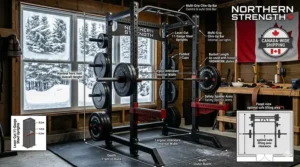
Full four-post cages provide maximum versatility and safety. The enclosed design allows safe training to failure on any lift, accommodates the widest range of attachments, and provides superior stability during dynamic movements. However, they occupy the most floor space (typically 53-60″ x 50-60″) and cost more than alternatives.
| Rack Type | Footprint | Stability | Attachment Options | Typical Cost (CAD) | Best Canadian Use Case |
|---|---|---|---|---|---|
| Full Cage (4-post) | 50-60 sq ft | Excellent | Maximum | $900-$2,500 | Dedicated garage gyms, basement gyms |
| Half Rack (2-post front) | 30-40 sq ft | Good (bolted) | High | $600-$1,200 | Limited space, multi-use areas |
| Wall-Mounted Folding | 15-25 sq ft (folded: 2-4 sq ft) | Excellent (wall-mounted) | Moderate | $650-$1,200 | Winter vehicle storage, apartments |
| Squat Stands (Independent) | 20-30 sq ft | Fair | Low | $300-$700 | Minimal space, Olympic lifting focus |
For Canadian lifters with dedicated garage space or basement gyms exceeding 150 square feet, full cages represent the optimal choice. They handle heavy squats without bolting down (important for rental properties), support pull-ups without wall reinforcement, and create a psychologically secure training environment that encourages pushing limits.
Half Racks and Squat Stands
Half racks eliminate the rear posts, reducing footprint by 30-40% while maintaining most functionality. The Rogue S-Series and REP Apollo exemplify this category, offering legitimate powerlifting capacity in more compact packages.
The tradeoff involves reduced stability (requiring floor bolting for heavy lifts or weighted plate loading for stability) and fewer attachment mounting points. However, lifters who squat and bench inside the rack rather than walking weights out prefer the openness half racks provide.
Wall-Mounted Folding Racks
Wall-mounted options like the Rogue RML-3W ($950-$1,200 CAD) and Bells of Steel Folding Rack offer the ultimate space efficiency. When folded, they project just 4-6″ from the wall, allowing garages to serve dual purposes as parking and training spaces—essential for Canadian winter vehicle storage.
Installation requires solid wall framing (minimum 2×6 studs on 16″ centres) or concrete walls, limiting applications. Canadian builders should account for stud spacing differences in older homes and consult structural engineers for proper mounting in areas with seismic activity (British Columbia).
Essential Accessories for Serious Lifter Home Equipment
A power rack forms your gym’s foundation, but accessories determine training versatility and injury prevention. Research from Harvard’s School of Public Health indicates that 30-60 minutes of weekly strength training reduces all-cause mortality by 10-20%—but only when performed safely and consistently.
H3: ✨ Don’t Miss These Exclusive Deals!
🔍 Take your strength training to the next level with these carefully selected power racks and accessories available in Canada. Click on any highlighted product name to check current pricing and availability on Amazon.ca. These racks will help you create authentic powerlifting gains your training partners will respect!
Safety Equipment Beyond Basic Safeties
Standard pin/pipe safeties provide basic protection, but serious powerlifters benefit from upgrades. Strap safeties (like those included with the Bells of Steel Light Commercial) offer quieter operation, wider coverage area, and no bar damage. They’re particularly valuable for exercises like pin presses and board presses where you’re intentionally failing reps.
Spotter arms add adjustable safety outside the rack’s main uprights, essential for exercises performed outside the cage like floor presses or with specialty bars. Budget $150-$300 CAD for quality spotter arms compatible with your rack’s hole diameter.
J-Cups and Barbell Support
Upgrading from standard J-cups to UHMW-lined versions protects bar knurling during thousands of repetitions over years of training. The initial $80-$150 CAD investment prevents replacing damaged barbells costing $400-$800 CAD.
Roller J-cups facilitate easier bar unracking during heavy squats, though they add $200-$350 CAD. Powerlifters over 200 pounds attempting 3+ times bodyweight squats report noticeable benefit, while lighter lifters or those handling lower multiples find standard J-cups adequate.
Storage and Organization
Canadian garage gyms become cluttered disasters without proper storage. Plate storage pegs ($40-$80 per pair) keep weights organized and add rack stability through ballast effect. Band pegs ($30-$60 for four) enable resistance band training during deload weeks or warmups.
Barbell holders mounted to rack uprights ($50-$120) prevent specialty bars from rolling around the garage floor, risking damage and safety hazards. This matters particularly with Canadian winter conditions where floor moisture can rust unprotected bars overnight.
Competitive Lifting Equipment Setup Guide
Transitioning from general strength training to competitive powerlifting requires systematic equipment configuration that mirrors meet conditions. Understanding federation standards helps Canadian lifters prepare appropriately.
Federation-Specific Requirements
CPU (Canadian Powerlifting Union), the Canadian IPF affiliate, follows IPF equipment specifications strictly. Provincial federations under CPU sanction use similar racks and setup protocols. Understanding these standards helps home gym configuration:
Squat setup typically positions bar height allowing lifters to unrack without excessive toe-raise. J-cups should place the bar at sternum-to-clavicle height. Safety bars sit 2-4 holes below J-cups, providing protection without interfering with full depth squats. Competition racks allow precise adjustment here—home racks with 1″ spacing approximate this better than 2″ spacing.
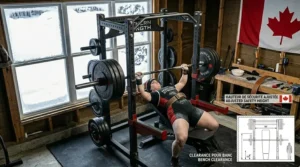
Bench press competition uses specific bench pad heights (17-18″ from floor to pad top) and spotter arm positioning. The Rogue Combo Rack and REP PR-5000 with bench attachment most closely replicate meet conditions, though their $2,000-$3,000 CAD costs exceed most home budgets. Training with a separate adjustable bench inside your power rack while matching pad height approximates competition setup adequately.
Programming Around Home Equipment
Elite powerlifting coach and IPF World Champion Ray Williams emphasizes that home training requires different strategic approaches than commercial gym training. Your power rack becomes the centre of a minimalist but complete program.
Primary movements (competition squat, bench, deadlift) receive rack support and full safety systems. Accessory work gets creative—floor presses replace decline bench, rack pulls substitute block pulls, and tempo variations replace some equipment-dependent exercises. Canadian winter challenges make this flexibility valuable when ice storms prevent gym access.
The rack’s pull-up bar handles back training adequately for many lifters, though adding rings or a dedicated pull-up station provides exercise variety. Dip attachments available for most racks ($100-$200 CAD) enable weighted dips that build pressing strength transferable to bench press.
Budget Planning for Canadian Powerlifters
Assembling competitive-quality meet standard training gear in Canada requires strategic budget allocation. Understanding total cost of ownership prevents the frustration of incomplete gyms or redundant purchases.
Initial Investment Tiers
Entry Level ($800-$1,200 CAD): Basic power rack ($400-$600), Olympic barbell ($250-$350), starter plate set ($150-$300). This handles first 1-2 years of training for most lifters.
Intermediate Level ($2,000-$3,500 CAD): Quality rack with Westside spacing ($900-$1,400), certified powerlifting barbell ($400-$600), calibrated plates 2.5-20kg ($800-$1,200), competition-spec bench ($400-$700).
Advanced Level ($4,000-$7,000+ CAD): Heavy-duty powerlifting rack ($1,500-$2,500), IPF-approved barbell ($600-$900), full calibrated plate run ($1,500-$2,500), specialty bars ($400-$800), comprehensive accessories ($800-$1,200).
Canadian-Specific Cost Considerations
Cross-border purchases add 13-20% depending on province (GST/HST plus potential provincial taxes). Brokerage fees range $30-$100 CAD per shipment. Canadian brands like Bells of Steel eliminate these costs while supporting domestic manufacturing.
Shipping heavy equipment across Canada’s vast geography creates significant expense. Manitoba to British Columbia ground shipping can exceed $300 CAD for a full cage. Choosing brands with Canadian warehouses (Bells of Steel in Calgary and Toronto, Rogue’s Canadian subsidiary) reduces this burden.
Provincial infrastructure affects installation costs. Quebec’s stricter building codes might require professional installation for wall-mounted racks. British Columbia’s seismic requirements could necessitate engineer-stamped mounting plans. Factor $200-$500 CAD for professional installation if DIY isn’t feasible.
✨ Ready to Build Your Canadian Powerlifting Setup?
🏋️ The power racks featured in this guide represent the best options for Canadian powerlifters across all budget levels. From the premium Rogue R-3 to the budget-friendly CANPA Multifunction Rack, each option delivers the safety and stability you need. Click any rack name throughout this article to check today’s pricing on Amazon.ca and start building the home gym that will support decades of strength gains!
Space Planning and Installation Tips
Canadian home gym spaces present unique challenges beyond basic square footage calculations. Temperature control, humidity management, and structural considerations vary dramatically from Yukon to Nova Scotia.
Minimum Space Requirements
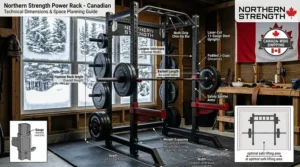
A functional powerlifting setup requires minimum 8′ x 8′ floor space for rack placement, though 10′ x 10′ allows better movement. Ceiling height minimizes complications with 8′ minimum—crucial for pull-ups and overhead pressing. Canadian basements averaging 84-90″ clearance work better with short-height racks (71-84″).
Measure carefully before ordering. That 90″ rack listing refers to overall height, but don’t forget the pull-up bar adds 2-4″ at top. Leave 3-6″ clearance above pull-up bar for safety and comfort. Also account for ceiling joists, lighting fixtures, and HVAC vents that reduce effective ceiling height.
Floor loading matters, especially in upper-level apartments or older homes. A loaded power rack (300 lbs) plus lifter (200 lbs) plus barbell and weights (500+ lbs) creates 1,000+ pound point loads. Basement concrete slabs handle this easily; residential flooring requires load distribution via 4′ x 8′ platform or rubber floor tiles rated for heavy loading.
Climate Control for Canadian Gyms
Saskatchewan garage gyms face -40°C winters; British Columbia coastal garages battle 90%+ humidity. Temperature extremes affect both equipment and lifters.
Powder coating prevents rust but can crack under rapid temperature cycling. Storing racks in unheated garages year-round causes less stress than moving between heated and unheated spaces. Oil barbells monthly during humid seasons to prevent surface rust.
Human performance drops significantly below 10°C. Installing basic radiant heaters ($150-$400 CAD) makes winter training tolerable. Even 12-15°C garage temperatures support productive training with proper warm-up protocols.
Dehumidifiers ($200-$400 CAD) combat coastal moisture and prevent the surface rust issues common on cheaper equipment. Run during humid months to maintain 40-50% relative humidity—low enough to prevent corrosion, high enough to avoid dried-out joints and respiratory issues.
Frequently Asked Questions
❓ What weight capacity do I need for serious powerlifting in Canada?
❓ Do I need Westside spacing for competitive powerlifting?
❓ How much should I budget for a complete home powerlifting setup in Canada?
❓ Can I use a power rack in an unheated Canadian garage year-round?
❓ What's the difference between power racks sold on Amazon.ca versus specialty fitness retailers?
Conclusion
Selecting the ideal power rack for powerlifting in Canada requires balancing structural integrity, training specificity, space constraints, and budget realities. Whether you’re investing in the premium Rogue R-3 with its legendary Westside spacing and lifetime warranty, or starting your journey with the budget-friendly CANPA Multifunction Rack, prioritize safety features and adequate capacity over flashy add-ons.
The Canadian powerlifting landscape demands equipment that withstands both your training intensity and our extreme climate. Racks from established manufacturers like Bells of Steel, Rogue Canada, and REP Fitness deliver the durability needed for decades of consistent training, while emerging brands provide accessible entry points for budget-conscious lifters.
Remember that your power rack investment extends beyond the initial purchase price. Factor in the value of training safely to failure without spotters, the confidence to attempt PRs in your garage at unconventional hours, and the long-term health benefits that proper strength training provides. Research from the National Institutes of Health confirms that consistent heavy resistance training yields benefits that compound across decades—making your rack purchase not an expense, but an investment in lifelong athletic capacity.
For Canadian lifters serious about competitive powerlifting or simply committed to building exceptional strength, choose equipment that matches your five-year training vision rather than just your current capacity. Your rack will likely outlast your first car and possibly your first house. Choose wisely, train consistently, and let the gains begin.
Recommended for You
- 7 Best Power Racks for Beginners Canada 2026
- 7 Best Pull Up Bar Attachment Power Rack in Canada 2026
- 7 Best Landmine Attachment for Power Rack Canada 2026
Disclaimer: This article contains affiliate links to Amazon.ca. If you purchase products through these links, we may earn a small commission at no additional cost to you.
✨ Found this helpful? Share it with your friends! 💬🤗
