In This Article
If you’ve ever stood in front of a Smith machine at your local gym and thought, “Wait — is this thing leaning?” — you’re not imagining things. The debate over angled vs straight smith machine which is better has been going on in weight rooms from Vancouver to Halifax for years. And honestly? The answer isn’t as simple as a Reddit poll would have you believe.
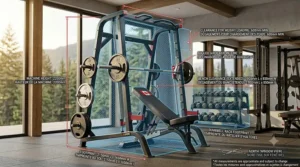
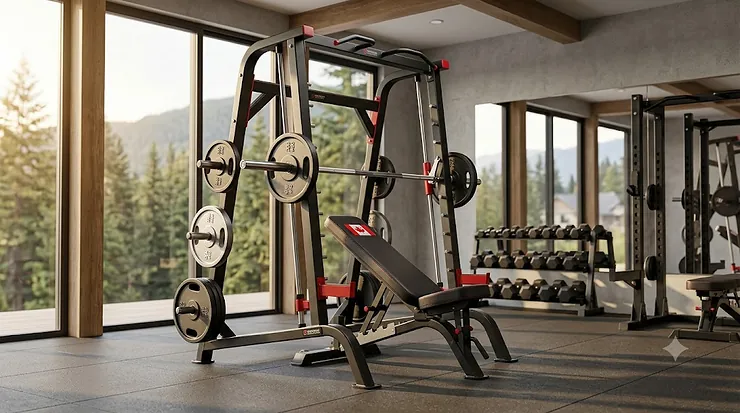
Here’s the short version for anyone in a hurry: an angled Smith machine (typically tilted 7–12 degrees) follows the natural arc your body creates during pressing and squatting movements. A straight (vertical) Smith machine keeps the bar on a perfectly 90-degree path, which suits a narrower range of movements but does so with maximum stability. Picking the wrong one for your training goals — or worse, using an angled machine while facing the wrong direction — can lead to joint stress, unnatural movement patterns, and stalled progress.
For Canadians building home gyms in 2026, this decision has real consequences. Space is often tight (especially if you’re in a Toronto condo or a Winnipeg basement), budget matters in CAD, and you want equipment that earns its square footage every single session. Whether you’re comparing a 7 degree vs 0 degree smith machine, trying to understand bar angle training effect, or just want to make sure your lower body mechanics aren’t suffering on your Sunday squat sessions — this guide breaks it all down.
I’ve researched the top options available on Amazon.ca and Canadian fitness retailers, dug into the biomechanics, and pulled together everything you actually need to know. Let’s get into it.
Quick Comparison: Angled vs Straight Smith Machine at a Glance
| Feature | Angled Smith Machine (7–12°) | Straight Smith Machine (0°) |
|---|---|---|
| Bar Path | Slightly tilted, mimics natural arc | Perfectly vertical |
| Best For | Squats, bench press, overhead press | Shrugs, calf raises, deadlifts, split squats |
| Muscle Activation | Higher engagement in compound movements | Higher stability, less stabilizer demand |
| Joint Friendliness | Better for squats and pressing when used correctly | Can create unnatural shear forces on knees during squats |
| Learning Curve | Higher — orientation matters critically | Lower — straightforward up-and-down |
| Typical Price Range (CAD) | $800–$2,500+ | $500–$1,800 |
| Space Footprint | Often slightly larger | More compact |
| Best Canadian Use Case | All-round home gym, compound lifting focus | Upper-body focus, beginners, smaller spaces |
The table above tells a clear story: if your goal is squatting heavy and pressing safely, the angled Smith machine is the stronger performer — but only if you face the right direction. If you primarily train your upper body or are new to barbell training, a straight machine’s simplicity and compact footprint may serve your Canadian home gym better. We’ll break down what each choice means in practice throughout this guide.
💬 Just one click — help others make better buying decisions too! 😊
Top 7 Smith Machines Available in Canada: Expert Analysis
🔍 Take your home gym to the next level with these carefully selected Smith machines. Click on any highlighted item to check current pricing and availability on Amazon.ca. These options will help you train smarter, safer, and stronger all year round!
1. Eonfit E3 Smith Machine All-in-One Power Cage
The Eonfit E3 is the compact overachiever of the Canadian Amazon.ca market — and it’s become a genuine crowd favourite for small-space home gyms across the country.
Key specs with real-world meaning: The E3 uses a vertical bar path with a 400 lb (181 kg) weight rating on the smith bar, built on a 2″×2″ 14-gauge steel frame within a footprint of roughly 159 cm L × 180 cm W × 216 cm H (62.5″ × 71″ × 85″). For Canadians with a standard 8-foot basement ceiling, that height clears comfortably — no need to knock out a wall. The vertical guide rails run on premium solid steel bearings for ultra-smooth movement. What most buyers miss: the 3D rotating functional arms allow cable fly, lateral raises, and face pulls outside the rack frame, which dramatically opens up training variety in a tight space.
Who is this for? The E3 suits the Canadian urban lifter — think a Calgary apartment dweller or a Montreal condo owner — who wants a full gym in one machine without sacrificing an entire room. It handles shoulder presses, calf raises, shrugs, and cable work beautifully on its vertical path. For lower body work, you’ll want to place your feet slightly forward of centre to compensate for the straight bar path.
Canadian customer feedback: Canadian buyers consistently praise the build quality for the price range and note that assembly, while taking 5–6 hours, is straightforward with clear instructions. A few users mention the cable pulleys are noticeably smoother with the optional aluminium pulley upgrade.
✅ Compact footprint for small Canadian home gyms
✅ Premium solid steel bearings for smooth operation
✅ 3D rotating arms unlock 200+ exercise variations
❌ Vertical bar path requires foot positioning adjustment for squats
❌ 400 lb smith bar rating may limit advanced powerlifters
Price range in CAD: Mid-range — check current pricing on Amazon.ca. Solid value for the feature set offered.
2. EonfitOmni E5 Smith Machine with Vertical Leg Press
If the E3 is the compact champion, the EonfitOmni E5 is its muscular older sibling. This 11-in-1 station integrates a vertical leg press directly into the frame — a feature that sets it apart from virtually everything else on Amazon.ca.
Key specs with real-world meaning: The E5 shares the same 2″×2″ frame DNA as the E3 but adds a dedicated vertical leg press attachment with a quick-locking footplate. This matters enormously for Canadian lifters who can’t or don’t want to barbell squat — whether because of a knee injury, a low garage ceiling, or simply training alone. The machine also includes LAT pulldown stations, dip handles, J-hooks, safety spotter arms, band pegs, a T-bar, and a rowing footplate. That’s the equivalent of 4–5 separate pieces of equipment.
Who is this for? The E5 is the pick for the serious Canadian home gym builder who wants “buy it once” versatility. Picture a Brampton family of two sharing a home gym, or a Kelowna remote-worker who cancelled their gym membership. The vertical leg press also makes this an exceptional choice for anyone recovering from a hip flexor injury where traditional squatting is off the table.
Canadian customer feedback: Users love the “gym experience at home” factor and note the free-motion arms are a game-changer for chest fly variations. Assembly time runs 5–7 hours but the instructions are solid.
✅ Vertical leg press is a rare differentiator at this price tier
✅ 11-in-1 functionality replaces multiple machines
✅ Premium bearings and safety spotter arms for solo lifting
❌ Larger footprint — measure your space carefully before ordering
❌ Higher price bracket; investment requires planning in CAD budget
Price range in CAD: Upper mid-range — check current pricing on Amazon.ca. Prime-eligible for most Canadian addresses.
3. GarveeLife Smith Machine Home Gym All in One (2200 LBS)
The GarveeLife Smith Machine 2200 LBS variant is one of the most capable heavy-duty all-in-one systems on Amazon.ca right now — and it doesn’t sugarcoat what it is: a serious, high-capacity training station for lifters who move real weight.
Key specs with real-world meaning: A 2,200 lb (998 kg) total weight capacity is a number that earns its own paragraph. For context, most home gym Smith machines cap out at 800–1,000 lbs. This GarveeLife model’s structural integrity is built for people who aren’t messing around. The frame includes 15 adjustable safety catch positions, LAT pulldown, cable systems, and a leg hold-down attachment. The 70.9″ × 48″ footprint (180 cm × 122 cm) sits on the larger end but remains manageable in a two-car garage.
Who is this for? The GarveeLife 2200 LBS is best suited for intermediate-to-advanced Canadian lifters who train heavy and need a machine that won’t wobble under a loaded bar. If you’re consistently squatting 150 kg+ or doing heavy Romanian deadlifts, you don’t want to second-guess your equipment. Available in black and red/black colourways on Amazon.ca.
Canadian customer feedback: Reviewers appreciate the structural sturdiness and the comprehensive accessory kit. A minority note that the assembly manual could be clearer, and some Canadian buyers in remote areas (northern BC, rural Manitoba) mention extended delivery windows — worth accounting for.
✅ Industry-leading 2,200 lb weight capacity for serious lifters
✅ 15 adjustable safety catch positions for versatile setup
✅ Available in multiple colourways on Amazon.ca
❌ Heavier and more complex assembly — plan for 2 people
❌ No counterbalance system on the smith bar
Price range in CAD: Mid-to-upper range — check current pricing on Amazon.ca.
4. Soozier 3-in-1 Smith Machine Multi-Functional Power Cage
Sometimes the best piece of equipment isn’t the one with the most features — it’s the one that does exactly what you need without complication. The Soozier 3-in-1 Smith Machine earns its place on this list precisely because of that philosophy.
Key specs with real-world meaning: The Soozier 3-in-1 combines a Smith machine, cable crossover system, and pull-up station into one unit. With 16-level squat rack height adjustment and a barbell included, it’s one of the more turnkey options on Amazon.ca — meaning you don’t need to source a separate bar. For Canadians who want to get training immediately after delivery without hunting for compatible accessories, this is a meaningful advantage.
Who is this for? The Soozier 3-in-1 is the pick for Canadian beginners and intermediate lifters who want a structured, straightforward machine. Think of a first-time home gym builder in suburban Ottawa who doesn’t want to research compatible add-ons. The included barbell and pull-up station create immediate value. Sold by Aosom Canada on Amazon.ca, so you’re dealing with a Canadian-facing seller — which helps with returns and service.
Canadian customer feedback: Reviewers praise ease of assembly and the included accessories. Noted limitation: the weight stack or plate capacity is lower than heavier-duty competitors, so advanced lifters may outgrow it within 12–18 months.
✅ Barbell included — no separate sourcing required
✅ Sold by Aosom Canada — reliable Canadian fulfilment
✅ Beginner-friendly with 16-level height adjustment
❌ Lower weight capacity limits long-term progression for advanced lifters
❌ Cable crossover system less refined than premium alternatives
Price range in CAD: Budget-to-mid range — check current pricing on Amazon.ca.
5. Altas Strength AL-3058G Smith Machine (Canadian Brand, 9-in-1)
Here’s the Canadian brand that deserves more attention than it gets. Altas Strength is headquartered in Canada with retail locations in Toronto, Barrie, London, and Longueuil (Québec) — which means you can actually walk in, see the machine in person, and speak with a knowledgeable team member before committing. The AL-3058G is their flagship 9-in-1 multi-function unit.
Key specs with real-world meaning: The AL-3058G is built to light-commercial standards with a heavy-duty steel frame and a powder-coated finish rated to 2,000 lb tensile strength. It combines a Smith machine, leg developer, LAT pulldown, functional arm station, chin-up bar, and more. The spring-loaded safety catches and commercial-grade components put this machine in a different quality bracket than many Amazon-only offerings. For bilingual Canadian households, Altas’s documentation and support is available in both English and French.
Who is this for? The AL-3058G suits the serious Canadian home gym owner who wants commercial-grade quality, the confidence of a Canadian brand with physical retail support, and a machine that will last 10+ years. If you’re in the GTA or Greater Montréal area, being able to visit a showroom and assess the machine in person is a distinct advantage that online-only brands simply can’t offer.
Canadian customer feedback: Consistently strong. Users highlight build quality, smooth bar movement, and responsive Canadian customer service. Available on Amazon.ca and direct from fitnessavenue.ca.
✅ Canadian brand with physical retail locations for in-person assessment
✅ Light-commercial build quality; 2,000 lb tensile-rated frame
✅ French and English support — relevant for Québec buyers
❌ Premium price reflects commercial build — highest CAD investment on this list
❌ Large footprint; requires spacious dedicated gym room
Price range in CAD: Premium range — check current pricing on Amazon.ca and fitnessavenue.ca.
6. Altas Strength AL-3000Y Smith Machine with Pulley System
A step down from the 3058G in complexity but not in quality, the Altas Strength AL-3000Y is one of the most popular Smith machines on Amazon.ca among Canadian home gym builders who want a focused, well-built machine without the 9-in-1 footprint.
Key specs with real-world meaning: The AL-3000Y integrates a Smith machine with an upper and lower pulley system, pull-up bar, and leg developer — a focused combination that covers 80% of the training most people actually do. The commercial-grade chin-up bar and adjustable safety catches make this excellent for solo training, which matters in a Canadian home gym where training partners aren’t always available, especially during long winter months when outdoor activities wind down and Canadians turn to home training.
Who is this for? The AL-3000Y is ideal for the experienced Canadian lifter who has moved past beginner gear but doesn’t need — or have room for — a 9-in-1 behemoth. It’s an honest, well-built machine that does its job without pretense. Available from Amazon.ca and Fitness Avenue’s physical locations.
Canadian customer feedback: Users rate the pulley system smoothness highly and appreciate the leg developer quality. A recurring note: delivery to remote Canadian addresses (northern Ontario, rural Alberta) can take longer — factor this into your planning.
✅ Trusted Canadian brand with established service network
✅ Focused, practical feature set covers core training needs
✅ Excellent solo training safety with adjustable catches
❌ Less versatile than flagship 3058G model
❌ Extended delivery timelines to remote Canadian communities
Price range in CAD: Upper mid-range — check current pricing on Amazon.ca.
7. U-MAX Smith Machine Power Squat Rack Cage (2000 LBS)
Rounding out the list is the U-MAX Smith Machine Power Squat Rack Cage, a 2,000 lb dual cable crossover machine that delivers genuine bang-for-your-buck performance on Amazon.ca.
Key specs with real-world meaning: The U-MAX unit features a dual cable crossover with LAT pulldown integrated into a Smith machine power cage. The 2,000 lb (907 kg) total capacity covers the vast majority of Canadian home gym users. Linear bearing guides keep the bar movement smooth during heavy squats and presses. The dual cable system runs from high-to-low positions, enabling a wide range of cable exercises — chest fly, face pulls, tricep pushdowns, rows — without any additional equipment.
Who is this for? The U-MAX is a smart mid-range pick for Canadian lifters who want the combined power of a Smith machine and cable crossover without paying premium brand prices. Think of a first-time home gym builder in Edmonton or a Hamilton lifter upgrading from a basic squat rack. The dual cable system in particular adds tremendous training variety that simpler Smith machines can’t match.
Canadian customer feedback: Buyers highlight assembly clarity and the smooth cable system. The machine tends to arrive in excellent condition thanks to solid packaging — important for Canadians receiving large freight deliveries to suburban or semi-rural addresses.
✅ Dual cable crossover adds exceptional training variety
✅ 2,000 lb capacity handles advanced training loads
✅ Competitive CAD pricing for the feature set
❌ Assembly is time-intensive — plan for a full afternoon
❌ Straight bar path (vertical) — less ideal for squat biomechanics
Price range in CAD: Mid-range — check current pricing on Amazon.ca.
How to Use an Angled Smith Machine Correctly: A Practical Guide for Canadian Lifters
Here’s the thing the spec sheet won’t tell you: having an angled Smith machine is only an advantage if you understand how to orient your body. Get this wrong, and the angle actively works against you. I’ve seen experienced lifters make this mistake in gyms across Canada.
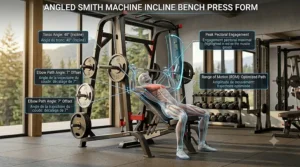
Step 1: Identify the angle direction. Before you load a single plate, unrack the empty bar and do one rep. Watch which direction the bar travels. On an angled machine, the bar should move slightly backward as you press up, not forward.
Step 2: Face the correct direction for each exercise. For squats: face away from the machine’s lean (toward the room). As you descend, the bar travels slightly backward, naturally accommodating your hip hinge — mimicking the rearward travel of the barbell in a free-weight squat. This is the key angled smith machine benefit that straight machines cannot replicate for lower body mechanics. For bench press: the bar should travel toward your face on the way up, not toward your feet. Lie so your head is toward the machine’s lean. For overhead press: stand facing away from the lean; the bar should press slightly back over your head.
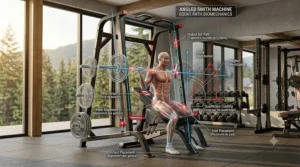
Step 3: Adjust your foot placement. On an angled Smith machine squat, you can position your feet slightly further forward than on a vertical machine. This redistributes load more toward the hips and glutes — a meaningful bar angle training effect that can reduce knee shear forces. Research published in MDPI Sensors examining the biomechanics of Smith machine squats found that guide bar angle measurably influences joint moments at the hip and knee, with a 5-degree angle affecting pelvis, hip, and knee flexion patterns.
Step 4: Cold-weather tip for Canadian home gyms. If your garage gym drops below 10°C in a Canadian winter, your bearing grease can thicken and the bar movement will feel sluggier than expected. Run 5–10 slow unloaded reps to warm the bearings before adding weight. This is especially relevant for those in Manitoba, Saskatchewan, or northern Ontario where garages can approach freezing temperatures in January.
Step 5: Maintenance check. Every 2–3 months, wipe down the guide rails with a dry cloth and apply a light machine oil to keep bearings smooth. Salt residue from Canadian winter boots tracked into the gym can accelerate corrosion if left unchecked.
Canadian Buyer Profiles: Which Smith Machine Suits You?
Let me paint three Canadian scenarios. One of these is almost certainly you.
Profile 1 — The Toronto Condo Lifter (Space-Constrained, Budget-Conscious). You have a den that doubles as a gym, roughly 2.5 m × 3 m, a CAD budget in the mid-range, and you train 4x per week. You want a machine that handles upper body pressing, some cable work, and basic squats. Best pick: Eonfit E3 or Soozier 3-in-1. Their compact footprints fit your space, and the vertical bar path is fine for the upper-body-dominant training you’re doing. You’re not competing in powerlifting; you want to stay fit and strong year-round without a gym membership.
Profile 2 — The Suburban Calgary Home Gym Builder (Dedicated Space, Intermediate Lifter). You’ve got a two-car garage that you’ve committed to fitness. You squat, bench press, and deadlift regularly, you train alone most of the time, and you want equipment that’ll last a decade. You have a CAD budget in the upper mid-range. Best pick: GarveeLife 2200 LBS or U-MAX 2000 LBS. The high weight capacities match your training, the safety systems let you max out solo, and the dual cable options on the U-MAX add the conditioning work you’re after.
Profile 3 — The Serious Québec Home Gym Investor (Commercial-Grade Goals, Bilingual Needs). You’ve invested in fitness for 10+ years, you want a machine that mirrors the quality of a commercial gym, and you appreciate being able to speak to a Canadian company with French-language support. Budget is secondary to quality. Best pick: Altas Strength AL-3058G. The Canadian brand, physical retail presence (Longueuil location serves Greater Montréal), light-commercial build quality, and bilingual support all align perfectly with your profile.
Angled Smith Machine Benefits vs. Straight Bar: The Honest Biomechanics Breakdown
Let’s get into the real reason the straight bar vs angled smith machine debate matters — joint mechanics.
The human body doesn’t press weight in a straight vertical line. When you bench press with free weights, the bar naturally arcs slightly backward over your face as you lockout. When you squat, your hips travel backward while the bar stays centred over your mid-foot. These are curved paths, not vertical ones.
A straight (vertical) Smith machine forces you to accommodate its fixed path. For upper body pressing, this can cause internal shoulder rotation and anterior shoulder stress — particularly during flat bench press. Research on muscle activation published in the National Center for Biotechnology Information database found differences in lower limb muscle engagement when the barbell’s movement path is fixed versus free, with fixed vertical paths affecting gastrocnemius, biceps femoris, and vastus medialis activation during squats (NCBI, PMC9745169).
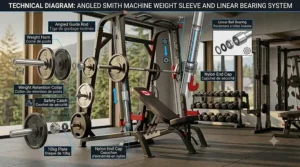
An angled machine — typically 7–12 degrees — solves this. The 7 degree vs 0 degree smith machine difference sounds minor, but in practice it’s the difference between a bar path that fights your anatomy and one that works with it. The angle allows your hip hinge movement to flow naturally during squats: as you descend, the bar travels slightly backward, letting your hips sit back without the bar forcing your knees forward. That’s a meaningful hip hinge movement improvement over the vertical alternative.
Here’s the catch that 90% of lifters miss: the angled machine only helps if you face the correct direction. Facing the wrong way on an angled Smith machine inverts the benefit entirely — the bar now travels toward your knees during a squat descent, creating precisely the unnatural shear force you were trying to avoid. Always unrack the empty bar and do a test rep before loading.
For exercises like shrugs, calf raises, and upright rows — where pure vertical movement is actually biomechanically correct — the straight Smith machine is the more appropriate tool. The bar angle training effect cuts both ways.
| Movement | Angled (7–12°) Performance | Straight (0°) Performance |
|---|---|---|
| Back Squat | ✅ Excellent — supports hip hinge | ⚠️ Acceptable with foot repositioning |
| Flat Bench Press | ✅ Better for shoulder path | ⚠️ Risk of shoulder impingement |
| Overhead Press | ✅ Natural arc over head | ⚠️ Forces strictly vertical path |
| Shrugs | ⚠️ Angle less natural | ✅ Perfect vertical path |
| Calf Raises | ⚠️ Slight lean affects balance | ✅ Ideal for isolated calf load |
| Romanian Deadlift | ✅ Bar follows hip hinge arc | ✅ Also workable with foot placement |
The bottom line: if you do any pressing or squatting, the angled Smith machine is the stronger performer. If you primarily train upper traps, calves, and upright rows, a straight machine is the cleaner tool.
How to Choose a Smith Machine for Your Canadian Home Gym: 6 Criteria That Actually Matter
Forget the marketing language. Here are the six things that determine whether a Smith machine earns its place in your Canadian home gym — ranked by importance.
1. Bar path type (angled vs. straight). This is the foundational decision. As we’ve established, angled machines suit compound pressing and squatting; straight machines suit purely vertical movements. Match this to your actual training goals, not what sounds impressive.
2. Weight capacity in real-world terms. A 2,000 lb machine sounds enormous — but that’s total system capacity, not the smith bar rating. Check the smith bar specific weight rating, which is often 400–800 lb. For most Canadian home gym users, 400 lb on the smith bar covers 95% of use cases. Only competitive powerlifters need to worry about exceeding this.
3. Bearing quality. Linear bearings make the difference between a bar that glides and one that grinds. Ask specifically about bearing type before purchasing. Cheap ball bearings degrade faster, especially in cold Canadian garage environments where temperature cycling accelerates wear.
4. Space footprint vs. your available space. Measure your space in metres, not feet, and add 60–90 cm of clearance on all sides for safe movement. A Smith machine that fits your room layout but leaves you banging elbows on the wall isn’t actually a good fit. Online product dimensions are often listed in imperial inches — convert to centimetres before buying.
5. Canadian-specific availability and warranty support. Some Smith machines listed on Amazon.ca are fulfilled from US warehouses. This can mean longer delivery times, potential customs delays, and warranty claims that route through American support channels. Prioritize machines sold by Canadian sellers (Aosom Canada, Fitness Avenue, Altas Strength) for smoother post-purchase experience.
6. Assembly realism. A two-person, 6-hour assembly is the realistic expectation for most full-size Smith machines. Budget for this time and recruit a helper — especially for the overhead rail sections, which are genuinely difficult to position solo.
Common Mistakes When Buying a Smith Machine in Canada
These are the errors I see repeatedly, and they’re all avoidable with a few minutes of research.
Mistake 1: Buying an angled machine but never learning the correct orientation. The angled Smith machine only delivers its biomechanical advantage if you face the right direction for each exercise. Many Canadian buyers discover this months after purchase — after wondering why their shoulders are sore from bench pressing.
Mistake 2: Ignoring the smith bar weight vs. total capacity distinction. A machine rated at 2,200 lb total doesn’t mean you can load 2,200 lb on the barbell. Total capacity includes the frame’s structural load. Always confirm the specific smith bar weight rating before purchasing.
Mistake 3: Not confirming Amazon.ca availability vs. Amazon.com. Some machines appear in Google search results but link to Amazon.com, which may not ship to Canada or prices products significantly higher due to exchange rates and duties. Always verify you’re on Amazon.ca and that the seller ships to your province. Remote communities in northern Canada, Nunavut, and parts of the Northwest Territories may have limited delivery options regardless of retailer.
Mistake 4: Underestimating ceiling height requirements. Most full-size Smith machines require a ceiling clearance of 250–260 cm (approximately 98–102 inches). Older Canadian homes — particularly those in Toronto’s inner suburbs or Montréal’s established neighbourhoods — often have basement ceilings of 220–240 cm. Measure twice before purchasing.
Mistake 5: Ignoring winter storage and maintenance needs. Unheated Canadian garages expose steel equipment to freeze-thaw cycles that accelerate rust and bearing degradation. If your garage drops below freezing, either invest in a garage heater, apply a rust-inhibiting spray to the guide rails seasonally, or store the machine inside over winter.
FAQ: Angled vs Straight Smith Machine in Canada
❓ Is the angled vs straight smith machine which is better question really important for squats specifically?
❓ Can I use a straight Smith machine for bench press safely in Canada?
❓ Do Smith machines available on Amazon.ca ship to all provinces?
❓ What is the bar angle training effect and does it actually matter?
❓ Do I need a CSA-certified Smith machine for my Canadian home gym?
Conclusion: Which Is Actually Better for Canadian Lifters?
After all this, here’s the honest answer to angled vs straight smith machine which is better: the angled machine is the superior choice for most Canadian home gym users, provided you learn to use it correctly. It supports better hip hinge movement, delivers a more natural bar angle training effect during squats and pressing, and reduces the joint shear forces that accumulate over months of training.
The straight Smith machine is not bad — it’s simply the right tool for a narrower set of movements. If your training centres on shrugs, calf raises, upright rows, and basic vertical pressing, a straight machine delivers those with excellent stability and often in a more compact footprint.
For the majority of Canadians building a home gym — where you want to squat, press, row, and cable train all from one machine — an angled model like the Eonfit E3, GarveeLife 2200, or Altas Strength AL-3058G gives you the biomechanical alignment, safety, and versatility to train hard and stay injury-free across every Canadian season.
✨ Don’t Miss These Exclusive Deals!
🔍 Ready to build your best home gym? Click on any highlighted product above to check current pricing and availability on Amazon.ca. These Smith machines are trusted by Canadian lifters from Victoria to St. John’s — find the one that fits your space, your budget in CAD, and your training goals!
Recommended for You
- Best Angled Smith Machine Canada 2026: 7 Top Picks Reviewed
- Best Counter Balanced Smith Machine in Canada 2026: Top 7 Picks
- Guided Smith Machine vs Free Weight Barbell: 7 Best Picks in Canada 2026
Disclaimer: This article contains affiliate links. As an Amazon Associate, I earn from qualifying purchases. If you purchase products through these links, we may earn a small commission at no additional cost to you.
✨ Found this helpful? Share it with your friends! 💬🤗
